
What is the Best BPC-157 in Australia? A Researcher’s Guide (2026)
- peptideresearchau
- May 31
- 12 min read
Updated: Jun 7
Why do the majority of international peptide imports fail to meet the analytical standards required for precision laboratory study? For scientific professionals, identifying what is the best bpc-157 in australia involves more than comparing digital storefronts; it requires a deep dive into chemical nomenclature and verifiable purity data. You likely recognize the logistical hurdles presented by inconsistent international batches and the persistent risk of Customs seizures that stall critical research timelines. These variables compromise the integrity of your data and the efficiency of your laboratory operations.
This requirement for purity is equally vital when researching newer sequences such as Retatrutide, where even minor synthesis errors can significantly alter the compound's metabolic interactions in a laboratory setting.
This guide establishes the technical benchmarks for high-grade BPC-157, focusing on domestic sourcing and rigorous testing protocols. You'll learn how to interpret High-Performance Liquid Chromatography (HPLC) results and Mass Spectrometry (MS) data to ensure your research compounds meet a 99% purity threshold. We'll examine the specific advantages of Australian-based distribution, including cold-chain stability and immediate domestic dispatch, to provide a reliable framework for your laboratory requirements. This analysis prioritizes empirical data over marketing jargon to ensure your procurement process remains scientifically sound.
Key Takeaways
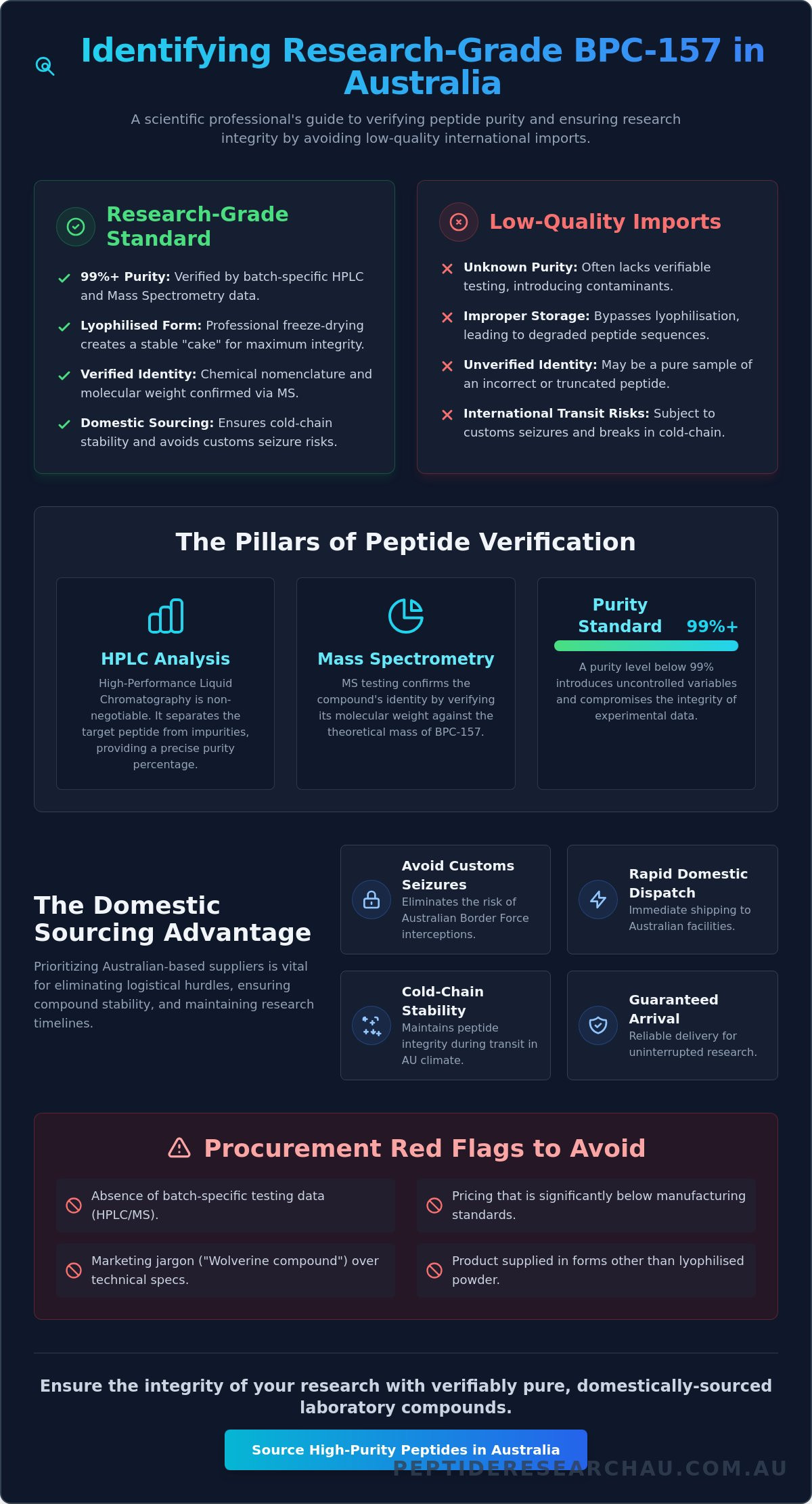
Establish quality benchmarks by requiring High-Performance Liquid Chromatography (HPLC) and Mass Spectrometry (MS) data to verify 99%+ purity.
Determine what is the best bpc-157 in australia by prioritizing domestic laboratory sourcing to avoid Australian Border Force seizures and international transit risks.
Distinguish between high-grade synthetic pentadecapeptides and low-quality imports by analyzing technical specifications and chemical nomenclature.
Identify procurement red flags such as the absence of batch-specific testing or pricing that contradicts established manufacturing standards.
Ensure research integrity by utilizing domestic shipping protocols that maintain peptide stability and guarantee arrival at Australian facilities.
Table of Contents
Defining 'Best' in the Australian Research Peptide Market
In the context of laboratory investigation, the "best" compound isn't determined by anecdotal testimonials or marketing superlatives. It's defined by chemical precision and structural stability. Determining what is the best bpc-157 in australia requires a shift away from consumer-facing "grey market" narratives toward established analytical standards. As of 2026, the Australian peptide therapeutics market continues its expansion, projected to reach USD $3,711.1 million by 2033. However, data from Grand View Research indicates Australia accounted for only 1.4% of the global market in 2025. This limited domestic footprint makes the identification of high-quality, research-grade sources even more critical for local investigators.
Research Grade vs. Consumer Grade
Legitimate laboratory study requires a stable, synthetic pentadecapeptide with a specific amino acid sequence. While social media influencers often refer to this as the "Wolverine compound," such colloquialisms frequently mask low-quality synthesis and inadequate purification processes. Research-grade BPC-157 must undergo professional lyophilisation. This freeze-drying process removes solvents and moisture, creating a stable "cake" that preserves the peptide's structural integrity during storage and transit. Consumer-grade products often bypass these refined steps, resulting in degraded sequences that yield inconsistent experimental results.
Why Purity Matters in Australia
Purity levels below 99% introduce uncontrolled variables into an environment where precision is paramount. Residual solvents, trifluoroacetic acid (TFA), and truncated peptide sequences can interfere with cellular assays and biochemical pathways. In the Australian climate, high ambient temperatures and humidity levels accelerate the degradation of poorly synthesized compounds. When researchers ask what is the best bpc-157 in australia, they are essentially seeking a product that maintains molecular stability under local environmental stressors.
For a deeper technical analysis of the pentadecapeptide sequence and its historical context, consult our comprehensive guide to BPC-157. High-purity compounds ensure that observed biological interactions are the result of the peptide itself, not an artifact of manufacturing contaminants. Quality is a binary state in research. A compound is either chemically pure or it's a liability to the study's integrity. Establishing these standards is the first step in successful procurement.
99%+ purity as verified by third-party HPLC.
Lyophilised powder form for maximum shelf-life.
Absence of bacterial endotoxins or heavy metals.
Verified chemical nomenclature and molecular weight.
Technical Benchmarks: HPLC and Mass Spectrometry Testing
High-Performance Liquid Chromatography (HPLC) serves as the primary analytical tool for determining chemical purity. This process separates the target pentadecapeptide from synthesis byproducts, providing a clear chromatogram of the compound's composition. When evaluating what is the best bpc-157 in australia, researchers must demand primary data over secondary claims. Purity alone is insufficient without identity verification. Mass Spectrometry (MS) confirms the molecular weight of the compound, ensuring the synthesized sequence matches the theoretical mass of BPC-157. Without MS data, a high HPLC purity score might simply reflect a pure sample of an incorrect peptide sequence.
Trifluoroacetic acid (TFA) management is another critical benchmark for laboratory excellence. TFA is a common reagent used during the cleavage and purification stages of synthesis. Excessive residual TFA can lower the pH of research solutions, potentially interfering with biological assays or causing rapid degradation of the peptide once reconstituted. Rigorous standards for Peptide Sourcing and Quality dictate that identity confirmation is only valid through mass spectrometry and that TFA levels should be minimized through specialized exchange processes. Independent third-party verification remains the only way to ensure these technical benchmarks are met without manufacturer bias.
Reading a Certificate of Analysis (COA)
A legitimate 2026 COA must display a clear chromatogram with a sharp, singular peak representing the target compound. Red flags in testing documentation include blurred laboratory logos, mismatched batch numbers, or report dates that are more than 12 months old. You should also verify that the testing facility is an independent entity rather than an internal department of the supplier. HPLC analysis ensures batch-to-batch consistency by providing a quantitative profile of the peptide's purity and identifying any residual baseline noise.
The Synthesis Process
Solid-phase peptide synthesis (SPPS) is the preferred method for producing BPC-157 due to its ability to manage the 15-amino acid sequence with high precision. Unlike liquid-phase methods, SPPS allows for more efficient washing of intermediate products, which results in a more stable final compound. The synthesis must also include steps to ensure the product is free from bacterial endotoxins, which can compromise laboratory results. Determining what is the best bpc-157 in australia requires looking beyond the label to the underlying chemical methodology. Reviewing the technical specifications of high-purity research peptides allows for better experimental design and more reliable data collection.
The Domestic Advantage: Why Sourcing Within Australia is Vital
Sourcing laboratory compounds in Australia requires a comprehensive understanding of local logistics. While chemical purity is the fundamental baseline, the delivery mechanism often dictates the ultimate viability of the research. When determining what is the best bpc-157 in australia, the domestic advantage becomes clear through reduced transit times and regulatory certainty. Relying on international supply chains introduces variables that can compromise both the legality and the structural integrity of your research materials.
Customs and Regulatory Compliance
As of May 2026, BPC-157 remains classified as a Schedule 4 Prescription-Only Medicine in Australia. While the compound is available for laboratory study, the Australian Border Force (ABF) has significantly increased its scrutiny of international peptide shipments following the TGA safety alert in April 2026. Many overseas suppliers attempt to circumvent these protocols by mislabeling packages. This practice frequently leads to immediate seizure and destruction of the material, resulting in total loss of the research investment. Utilizing a domestic provider ensures the supply chain remains entirely within Australian borders. This eliminates the risk of international regulatory interference and ensures a more reliable procurement process. For detailed insights into these requirements, refer to the Peptides Australia guide on sourcing standards and current regulations.
Environmental Stability and Transit
Environmental factors present a significant challenge to peptide longevity. Lyophilised powder is designed for stability, but prolonged exposure to extreme temperatures during international transit can cause subtle molecular degradation. Shipments originating from the Northern Hemisphere must cross the equator, where they often reside in uncooled cargo holds or shipping containers for extended periods. This thermal stress can impact the peptide's efficacy before it even reaches the laboratory.
In contrast, domestic sourcing allows for climate-controlled storage until the exact moment of dispatch. Using 1-2 day domestic Express Post significantly limits thermal exposure and ensures the what is the best bpc-157 in australia remains structurally intact upon arrival. Maintaining this gold standard of stability is vital for researchers who require consistent, reproducible data. Reliability in the supply chain is not just a convenience; it's a prerequisite for professional scientific study. By choosing Australian-based distribution, investigators protect their experimental timelines from the unpredictable variables of global logistics.
Elimination of ABF customs seizure risks.
Reduced thermal degradation through shorter transit paths.
Consistent access to domestic Express Post tracking.
Accountability through Australian-based quality control.
Avoiding Red Flags: Identifying Low-Quality BPC-157
Price remains one of the most reliable indicators of product integrity in the research peptide sector. High-purity synthesis via Solid-Phase Peptide Synthesis (SPPS) and subsequent purification are resource-intensive processes. If a supplier offers pricing significantly below the market average, it typically indicates a compromise in batch testing or the use of lower-grade reagents. Determining what is the best bpc-157 in australia involves recognizing that "cheap" compounds often carry hidden costs, such as research failure or equipment contamination. Quality synthesis requires a financial commitment to analytical rigor that "budget" suppliers simply don't maintain.
Scientific transparency is another hallmark of a legitimate supplier. Professional entities provide specific chemical nomenclature and technical specifications rather than vague marketing summaries. If a website lacks clear Australian business registration or verifiable contact information, it should be treated with skepticism. Authoritative sources prioritize technical data over "miracle cure" narratives. Marketing that focuses on anecdotal healing claims rather than molecular weight and purity percentages suggests a consumer-focused "grey market" operation rather than a laboratory-grade provider. In the scientific community, data is the only currency that matters.
The Danger of 'Black Market' Peptides
Underground labs (UGLs) often operate without the sterile environments required for peptide synthesis. This lack of oversight leads to significant risks, including heavy metal contamination from industrial-grade solvents or impure raw materials. Researchers using unverified batches may inadvertently introduce lead, arsenic, or mercury into their experimental models, which invalidates any resulting data and poses severe safety risks. Professional intent is often signaled by clear, minimalist branding that emphasizes the chemical identity of the compound rather than its perceived lifestyle benefits. Minimalist packaging reflects a focus on the substance itself rather than the marketing of a finished consumer product.
Format Comparison: Capsules vs. Lyophilised Powder
The Australian market has seen a trend toward oral capsule formats for BPC-157. While these may appeal to the general public, they are rarely suitable for high-precision laboratory research. Oral formats often suffer from poor bioavailability and lack the stability of lyophilised powder. Most professional investigators prefer lyophilised vials because they allow for precise reconstitution and quantitative analysis. The freeze-drying process ensures the peptide remains stable during storage, whereas capsules are more susceptible to environmental degradation and inconsistent dosing. Determining what is the best bpc-157 in australia for research purposes inevitably leads back to the lyophilised vial format.
Identifying these red flags is essential for maintaining the standards of your scientific work. You can secure high-quality research compounds and laboratory diluents through providers who prioritize analytical verification and domestic accountability. Avoid the risks associated with unverified sources to ensure the integrity of your experimental data.
Peptide Research AU: Australia’s Standard for Laboratory Compounds
Peptide Research AU provides the technical infrastructure required for high-fidelity laboratory study. By focusing on chemical precision and logistical reliability, the platform addresses the primary concerns of the Australian scientific community. Identifying what is the best bpc-157 in australia requires a provider that treats research compounds with the same rigor as pharmaceutical-grade substances. Our inventory is strictly categorized for laboratory use, ensuring that every vial adheres to the technical standards established in previous sections of this guide. As the Australian peptide therapeutics market is projected to reach USD $3,711.1 million by 2033 with a 7.8% CAGR starting in 2026, the demand for verified, high-purity compounds has never been more critical.
Our Testing Protocol
We maintain a 99%+ purity threshold for all BPC-157 batches. Every lot undergoes rigorous analysis via High-Performance Liquid Chromatography (HPLC) and Mass Spectrometry (MS) to verify both chemical purity and molecular identity. By collaborating with independent, third-party laboratories, we ensure that our data is objective and verifiable. This level of transparency allows researchers to proceed with confidence, knowing their experimental variables remain controlled. We provide direct support for Australian-based research projects, offering technical documentation that matches the demands of modern scientific inquiry. You don't have to guess the quality of your materials when batch-specific COAs are readily accessible.
Streamlined Sourcing for 2026
Logistical efficiency is essential for maintaining the stability of synthetic pentadecapeptides. Our domestic distribution network bypasses the risks associated with international transit and the high rates of customs interference observed in early 2026. We utilize discreet, rapid shipping methods across Australia to guarantee that every order arrives within 1-2 business days. This ensures that lyophilised powders aren't exposed to the thermal stressors characteristic of long-haul international freight, preserving the peptide's structural integrity for your assays.
Our commitment extends beyond the peptides themselves. We supply the high-grade laboratory diluents necessary for accurate reconstitution and study. When researchers evaluate what is the best bpc-157 in australia, they prioritize providers who offer a complete, laboratory-grade solution. This integrated approach to sourcing ensures that your research environment remains professional and your results stay reproducible. By maintaining a domestic inventory, we eliminate the uncertainty of global supply chains and provide a dependable foundation for Australian scientific advancement.
Secure high-purity BPC-157 for your 2026 research here.
Advancing Laboratory Standards in 2026
The selection of research compounds requires a commitment to analytical rigor and logistical reliability. By prioritizing HPLC and mass spectrometry data, you ensure that experimental variables remain controlled and results remain reproducible. Sourcing domestically eliminates the risks of international transit degradation and the persistent threat of customs seizures. These protocols establish a professional framework for your laboratory operations and data integrity. Precision in procurement is as vital as precision in the laboratory itself.
Determining what is the best bpc-157 in australia depends on the verification of 99%+ purity and the consistent use of independent, third-party laboratory testing. Peptide Research AU maintains these benchmarks by providing batch-specific documentation and rapid domestic express shipping across Australia. This approach protects your research timelines and ensures the structural integrity of every vial. By choosing a provider that prioritizes technical specifications over marketing jargon, you align your procurement with the highest standards of the scientific community.
Order Laboratory-Grade BPC-157 from Peptide Research AU to secure high-purity research compounds for your 2026 studies. We look forward to supporting the advancement of your scientific findings.
Frequently Asked Questions
Is BPC-157 legal to buy in Australia for research?
BPC-157 is classified as a Schedule 4 Prescription-Only Medicine in Australia. This means possession or sale without a valid medical prescription is illegal under state and territory laws. While many online platforms market these as research chemicals, they haven't been evaluated by the TGA for safety or quality. Researchers should be aware that penalties for unauthorized supply can be severe; for example, the ACT imposes a maximum penalty of 5 years imprisonment for unauthorized supply.
How can I verify the purity of the BPC-157 I purchased?
Purity verification requires reviewing a batch-specific Certificate of Analysis (COA) containing High-Performance Liquid Chromatography (HPLC) and Mass Spectrometry (MS) data. HPLC confirms the percentage of the target peptide, while MS verifies the molecular weight and identity of the sequence. Researchers should ensure the COA is from an independent third-party laboratory and features a recent date and sharp chromatogram peaks. Reliable data is the only way to confirm chemical integrity.
What is the difference between BPC-157 and TB-500 for research?
BPC-157 is a synthetic pentadecapeptide composed of 15 amino acids, whereas TB-500 is a synthetic version of a naturally occurring 43-amino acid protein fragment called Thymosin Beta-4. In laboratory studies, these compounds are often investigated for different cellular pathways and biological interactions. Determining what is the best bpc-157 in australia for a specific study depends on whether the research objective focuses on gastrointestinal or musculoskeletal models. Both require high purity for consistent results.
Does BPC-157 require refrigeration during shipping in Australia?
Lyophilised BPC-157 powder is structurally stable at room temperature for short periods, but refrigeration is recommended for long-term storage. During domestic Australian shipping, the compound remains stable due to the 1-2 day transit time provided by Express Post. Once reconstituted with laboratory diluents, the peptide becomes significantly more fragile and must be stored at 2-8 degrees Celsius to prevent rapid degradation. Maintaining the cold chain after reconstitution is vital for experimental accuracy.
Why do some BPC-157 vials look different in size?
Variations in the appearance of the lyophilised "cake" or vial size usually reflect the use of different bulking agents, such as mannitol, or different vial capacities. The visual volume of the powder does not indicate the actual milligram content of the peptide. Researchers must rely on the precise technical specifications provided by the supplier to ensure accurate dosing during reconstitution. The physical size of the lyophilised mass is irrelevant to the chemical concentration of the compound.
What is the best way to reconstitute BPC-157 for lab use?
Reconstitution should be performed using sterile laboratory diluents, such as bacteriostatic water or sterile saline, depending on the requirements of the assay. The diluent should be introduced slowly down the side of the vial to avoid agitating the peptide directly. Gentle swirling is sufficient to dissolve the lyophilised powder; vigorous shaking should be avoided as it can cause mechanical denaturation of the delicate peptide chains. Proper handling preserves the structural integrity of the pentadecapeptide.
Can I buy BPC-157 from an international supplier safely?
Importing BPC-157 from international suppliers carries significant risks, including seizure by the Australian Border Force and potential product degradation during transit. Packages are often mislabeled to bypass customs, which can lead to legal complications for the importer. Sourcing domestically within Australia ensures the product remains within a controlled supply chain and significantly reduces the time the peptide is exposed to environmental stressors. Domestic sourcing provides a more reliable foundation for professional laboratory study.
What are the common impurities found in low-grade peptides?
Low-grade peptides often contain residual solvents, heavy metals, or truncated sequences that failed to reach the full 15-amino acid length during synthesis. High levels of Trifluoroacetic acid (TFA) are also common and can negatively impact the pH of research solutions, leading to inconsistent data. Identifying what is the best bpc-157 in australia requires selecting batches that have been cleared of these contaminants through rigorous purification and secondary testing phases. Purity below 99% introduces uncontrolled variables.


Comments