
Research Grade vs. Pharmaceutical Grade Peptides Australia: A 2026 Scientific Comparison
- peptideresearchau
- 3 hours ago
- 11 min read
Does a "99% purity" certificate truly guarantee the integrity of your laboratory results? While high-purity percentages are essential, the technical distinction between research grade vs pharmaceutical grade peptides australia is defined by the manufacturing environment and the regulatory pathway rather than a single metric. It's understandable why researchers feel frustrated by "Research Use Only" labels that often mask a lack of transparency regarding manufacturing standards. You likely worry about under-dosed vials or hidden contaminants that could compromise your study's reproducibility.
This comparison will clarify the rigorous HPLC and mass spectrometry testing required to verify compound identity and purity. You'll also learn to navigate the 2026 TGA compliance priorities that have reshaped the Australian peptide market. We examine the specific criteria for identifying high-purity suppliers and provide the regulatory clarity necessary to maintain laboratory standards in the current scientific climate.
Table of Contents
Defining Peptide Grades: Research vs. Pharmaceutical Standards
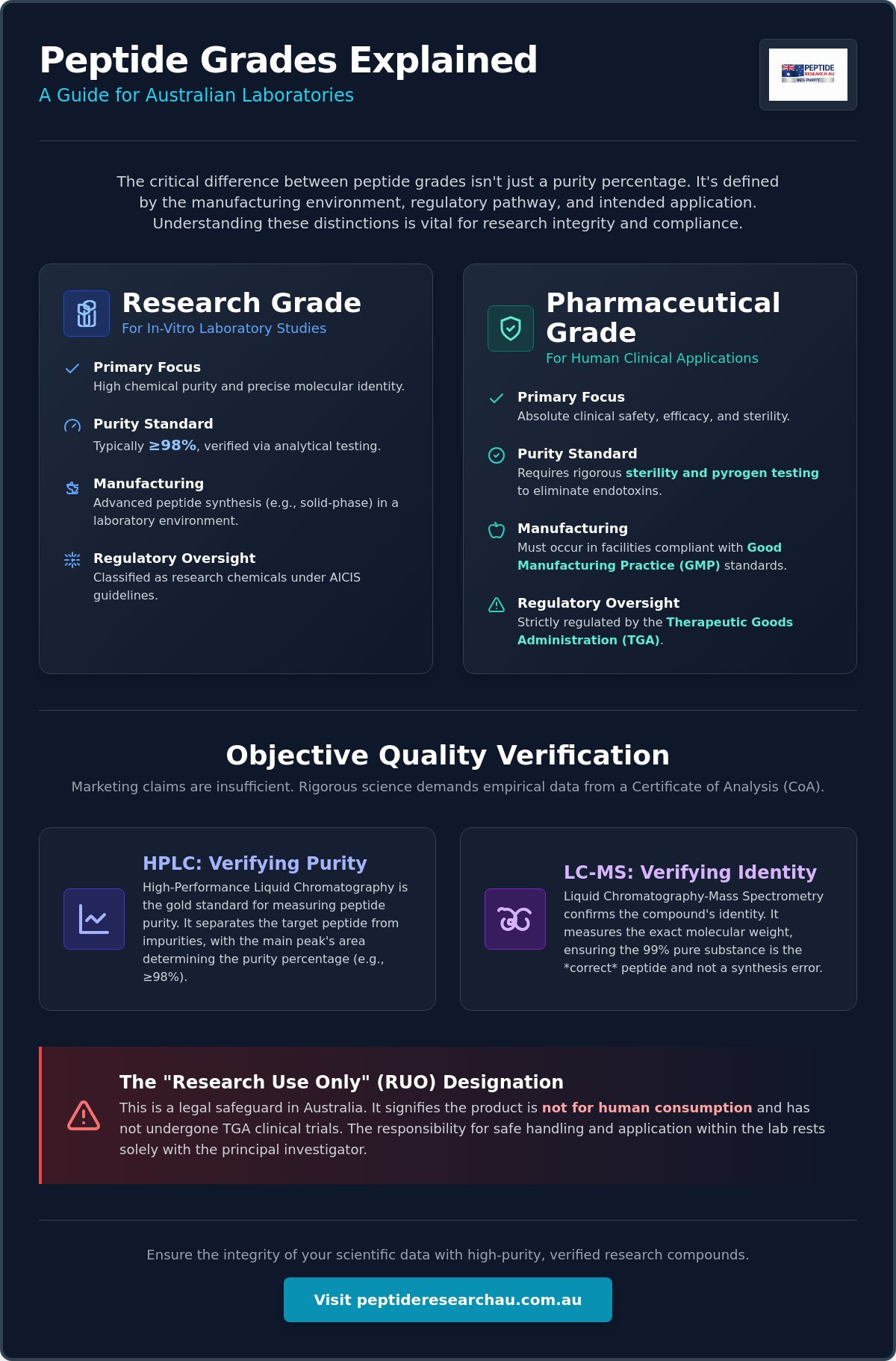
The distinction between research grade vs pharmaceutical grade peptides australia is rooted in the intended application and the regulatory framework governing production. Grade selection is not merely a label; it represents a fundamental difference in manufacturing environment and quality control protocols. While both grades require high levels of chemical purity, the oversight and validation processes vary significantly to meet either laboratory or clinical requirements. Choosing the incorrect grade can compromise research integrity or lead to severe regulatory non-compliance.
What Constitutes Research Grade?
Research grade peptides focus on high chemical purity and precise molecular identity. These compounds are synthesized using advanced Peptide Synthesis Methods, often through solid-phase synthesis, to achieve specific amino acid sequences. In an Australian laboratory context, purity levels typically reach 98% or higher, verified through analytical techniques like HPLC. Stability is maintained through lyophilisation, a process that removes moisture to create a shelf-stable powder suitable for long-term storage in university or private research facilities. These materials carry the "Research Use Only" (RUO) designation, signifying they are not for human consumption or clinical diagnostic procedures.
Pharmaceutical Grade and GMP Compliance
Pharmaceutical grade peptides meet the most stringent criteria for clinical safety and efficacy. These products are manufactured in facilities that adhere to Good Manufacturing Practice (GMP) standards as regulated by the Therapeutic Goods Administration (TGA). Unlike research grade, which focuses primarily on chemical purity, pharmaceutical grade requires rigorous sterility and pyrogen testing. This ensures the absence of endotoxins and other biological contaminants. Every excipient and delivery system must meet TGA-approved standards, and the entire supply chain is subject to oversight to ensure patient safety. This grade is mandatory for any compound intended for human administration.
The RUO label is a legal safeguard in Australia. It indicates that the material has hasn't undergone the clinical trials required for TGA registration. For researchers in Sydney, Melbourne, or Brisbane, this means the compound is legally classified as a research chemical rather than a therapeutic good. This classification shifts the responsibility of safety and handling to the principal investigator of the laboratory. It also dictates how the substance is imported and stored according to the Australian Industrial Chemicals Introduction Scheme (AICIS) guidelines. Understanding this boundary is vital for compliance with institutional biosafety committees and ensuring that research grade vs pharmaceutical grade peptides australia are applied correctly within their respective domains.
Purity Standards and Analytical Testing Protocols
Empirical data provides the only objective measure of quality when comparing research grade vs pharmaceutical grade peptides australia. Marketing claims of "high purity" are insufficient for rigorous laboratory work. Researchers must rely on a Certificate of Analysis (CoA) that details specific analytical testing results. These documents confirm that the compound matches its intended chemical structure and remains free from significant manufacturing byproducts.
How to Read an HPLC Report
High-Performance Liquid Chromatography (HPLC) is the gold standard for peptide purity verification. When reviewing an HPLC chromatogram, the primary peak represents the target peptide. The area under this peak, relative to the total area of all peaks, determines the purity percentage. Impurities appear as smaller "ghost peaks" or shoulders on the main signal. If these secondary peaks are prominent, they indicate the presence of truncated sequences or residual solvents that could skew experimental results. For laboratory integrity, a purity level of ≥98% is the standard expectation for high-quality research compounds.
Verifying Molecular Identity with LC-MS
Purity alone doesn't guarantee the correct compound is present. Liquid Chromatography-Mass Spectrometry (LC-MS) verifies the molecular identity by measuring the exact mass-to-charge ratio of the molecules. Scientific protocols require comparing the observed molecular weight against the theoretical weight of the amino acid sequence. Discrepancies often suggest a synthesis error or a completely different compound. This verification is critical because a vial can be 99% pure but contain the wrong peptide entirely, rendering your research data invalid.
A common point of confusion in laboratory settings is the difference between net peptide content and gross peptide weight. Vials are often sold by gross weight, which includes the peptide, counterions (like acetate or TFA), and residual water. However, the net peptide content—the actual weight of the peptide molecules—is usually 60% to 80% of the total mass. Accurate reconstitution requires calculating dosages based on the net content to ensure consistency across experimental trials. Without this adjustment, your results may be under-dosed and lack reproducibility.
The rise in unverified products has led to increased scrutiny within the Australian Regulatory Framework for Peptides. This regulatory environment makes third-party verification essential for any Australian research supplier. Independent testing ensures that the manufacturer's internal data is accurate and that the product is free from harmful contaminants. Researchers who prioritise data integrity often source their Research Peptides from providers who offer transparent, batch-specific analytical reports. This level of transparency is the only way to bridge the gap between manufacturer claims and laboratory reality.
The Australian Regulatory Framework for Peptides in 2026
The Therapeutic Goods Administration (TGA) designated unapproved peptide products as a compliance priority in June 2026. This regulatory focus targets the rise in illegal importation and online advertising of non-registered substances. While pharmaceutical grade peptides are Schedule 4 prescription-only medicines, research grade compounds are classified as industrial chemicals under the Australian Industrial Chemicals Introduction Scheme (AICIS). This legal separation is the primary factor when comparing research grade vs pharmaceutical grade peptides australia. It's a distinction that dictates how these substances are introduced into the country and used within professional settings.
Australian Border Force and the TGA work in tandem to monitor imports. On June 20, 2026, the TGA and Australia's Chief Medical Officer issued a joint statement warning against the use of unapproved peptide products. For researchers, this means that importing compounds requires clear documentation proving the material is intended for in-vitro or laboratory study. Possession for personal use without a prescription carries heavy penalties; in NSW, this includes a $2,200 fine, while the ACT imposes fines up to $66,000. Legitimate possession is restricted to research applications where the compound doesn't enter the human supply chain.
TGA Schedule 4 vs. Research Exemptions
Pharmaceutical peptides are listed under Schedule 4 of the Poisons Standard, requiring a valid prescription for human application. In contrast, compounds used strictly for laboratory study are exempt from TGA registration provided they aren't administered to humans or animals. This exemption allows for the study of peptides like BPC-157 or CJC-1295 in a controlled, non-clinical environment. To understand the nuances of these legal categories, consult Peptides Australia: The Researcher’s Guide.
Compliance for Australian Lab Environments
Maintaining regulatory compliance in a laboratory requires meticulous record-keeping. Australian researchers must maintain an inventory of all research compounds, including batch numbers and supplier details. Every compound must be accompanied by a Safety Data Sheet (SDS) that outlines handling risks and chemical properties. Proper disposal protocols are also mandatory. Since many peptides are biologically active, they must be treated as hazardous waste to prevent environmental contamination. Adhering to these 2026 standards ensures that the use of research grade vs pharmaceutical grade peptides australia remains within the bounds of scientific legality.
Sourcing Criteria for Australian Laboratory Research
Selecting a provider requires balancing analytical transparency with logistical reliability. When evaluating research grade vs pharmaceutical grade peptides australia, domestic sourcing often provides the most predictable outcomes for scientific studies. International shipments face prolonged customs inspections and extreme temperature variations. These factors can degrade sensitive amino acid chains before they reach the laboratory. A domestic supply chain ensures that the material hasn't been subjected to the environmental stresses common in transcontinental freight.
Technical support is another critical factor. Sourcing from within the Australian time zone allows for immediate communication regarding batch specifications or handling protocols. This accessibility is vital when coordinating complex experiments that require precise timing. Providers who understand the local regulatory climate can offer better guidance on compliance with Australian standards, ensuring that your laboratory remains aligned with 2026 TGA and AICIS priorities.
Evaluating Supplier Credibility
Credible suppliers provide batch-specific testing rather than generic, outdated certificates. A significant red flag is the absence of verifiable HPLC or LC-MS reports for the current inventory. Pricing that falls significantly below market averages often indicates compromised purity or incorrect salt concentrations. Researchers should prioritise suppliers who demonstrate a commitment to technical accuracy and long-term batch consistency. It's better to have a supplier with a proven track record of 98% purity across multiple years than one who claims 99% but lacks the data to support it.
Logistics and Handling in Australia
Temperature control is vital for maintaining the structural integrity of lyophilised powders. For example, sensitive compounds like TB-500 require stable environments to prevent premature degradation. Domestic Australian shipping reduces the risk of peptide denaturation by minimizing the duration of transit and exposure to uncontrolled climate conditions. Fast, discreet delivery ensures that the compounds remain in a stable state until they can be transferred to appropriate laboratory refrigeration.
Effective laboratory study also depends on the availability of high-quality laboratory diluents. Using validated bacteriostatic water is essential for preventing microbial growth in multi-use vials. Sourcing these supplies from the same provider ensures compatibility and reduces the risk of chemical interference during the research phase. To maintain the highest standards of data integrity, researchers can source verified research compounds from established Australian providers who prioritise scientific excellence.
Peptide Research AU: Commitment to Laboratory Excellence
Understanding the technical requirements of research grade vs pharmaceutical grade peptides australia is essential for maintaining a high-standard laboratory. Our mission is to provide the Australian scientific community with access to compounds that meet rigorous analytical benchmarks. We recognize that the integrity of your data depends on the precision of your materials. By focusing on meticulous quality control, we bridge the gap between complex chemical synthesis and practical researcher accessibility. This commitment ensures that your study remains compliant with the evolving 2026 regulatory landscape while achieving reproducible results.
Quality Assurance and Testing Standards
Our selection process involves a multi-stage verification protocol to confirm the purity and identity of every batch. We utilize High-Performance Liquid Chromatography (HPLC) and Mass Spectrometry (MS) to provide the empirical evidence required for professional study. This rigorous testing is applied to our entire catalog, including widely studied compounds such as BPC-157 and GHK-Cu. Furthermore, we ensure that our laboratory diluents are manufactured to the same high standards to prevent contamination during the reconstitution process. We provide the analytical data required to distinguish research grade vs pharmaceutical grade peptides australia in a professional setting.
Your Partner in Australian Scientific Inquiry
Logistical reliability is a cornerstone of our service. We offer fast domestic shipping across Australia to minimize the time compounds spend in transit, which is vital for maintaining product integrity. Our team provides dedicated support for technical queries, allowing researchers to focus on their data rather than sourcing hurdles. We understand the specific needs of Australian universities and private laboratories, offering a reliable supply chain that mitigates the risks associated with international procurement. This focused approach allows us to serve as a dependable partner in your scientific advancements.
Maintaining a high-purity laboratory environment requires both the correct compounds and the proper handling tools. We provide the essential materials needed for precise reconstitution, ensuring that your research compounds remain stable and effective throughout the duration of your study. Our commitment to excellence is reflected in every vial we supply, supported by batch-specific documentation and local expertise. Browse our range of high-purity research peptides today to secure the materials necessary for your next laboratory project.
Advancing Australian Research Standards
Distinguishing between research grade vs pharmaceutical grade peptides australia is a fundamental requirement for maintaining laboratory integrity and ensuring 2026 regulatory compliance. The scientific validity of your data depends on high-purity compounds that have undergone batch-specific HPLC and MS verification. These protocols confirm molecular identity and concentration, providing the precision your study demands. It's also vital to consider logistics, as domestic shipping remains the most reliable method for avoiding peptide denaturation during transit.
Our commitment to excellence involves a rigorous selection process for high-purity research compounds. We provide the essential tools for handling and reconstitution while supporting the Australian scientific community with tested, reliable materials. By bridging the gap between technical complexity and researcher accessibility, we ensure your laboratory has the foundation needed for success. This focus on meticulous quality control allows you to proceed with your experiments knowing the materials meet international standards.
Explore Our Range of Laboratory-Grade Research Peptides today to secure the compounds required for your next scientific inquiry. We're dedicated to helping you achieve precise, reproducible results in every trial.
Frequently Asked Questions
Is it legal to buy research-grade peptides in Australia without a prescription?
It's legal to purchase research grade vs pharmaceutical grade peptides australia for in-vitro or laboratory study without a prescription. These compounds are regulated by the Australian Industrial Chemicals Introduction Scheme (AICIS) as industrial chemicals rather than therapeutic goods. However, possession for personal use or administration to humans without a valid medical prescription is illegal and subject to significant penalties under the Poisons Standard. Legitimate acquisition is strictly limited to professional research applications.
What is the difference between 98% and 99% purity in peptide research?
The 1% difference represents the concentration of synthesis byproducts, such as truncated sequences or residual reagents. In sensitive laboratory experiments, these impurities can interfere with molecular interactions and skew results. While 98% purity is often acceptable for general screening, 99% or higher is preferred for high-precision assays where even minute contaminants might trigger unintended biochemical responses or compromise the reproducibility of the data.
Can I use research-grade peptides for personal health purposes in Australia?
Research-grade peptides are strictly prohibited for personal health purposes or human administration in Australia. These materials lack the TGA-mandated sterility, pyrogen testing, and safety evaluations required for clinical use. Using "Research Use Only" compounds for health purposes bypasses medical oversight and exposes individuals to unknown manufacturing contaminants, which the TGA and Chief Medical Officer explicitly warned against in June 2026.
How do I verify the authenticity of a peptide supplier's HPLC report?
Authenticity is verified by cross-referencing the batch number on the vial with the data on the HPLC report. A legitimate report should include a clear primary peak with a corresponding area percentage and a specific timestamp from the analytical laboratory. You should also check for a matching molecular weight on the MS report. If a supplier provides the same report for multiple batches or withholds the testing date, it's a significant red flag.
Why are pharmaceutical-grade peptides so much more expensive than research-grade?
The elevated cost of pharmaceutical-grade peptides reflects the rigorous Good Manufacturing Practice (GMP) environment required by the TGA. This includes extensive clinical trials, facility validation, sterility testing, and ongoing stability studies to ensure patient safety. Research-grade manufacturing focuses primarily on chemical purity for laboratory use, which avoids the multi-million dollar overhead associated with clinical registration and the pharmaceutical supply chain.
What happens if my research peptide shipment is seized by Australian Customs?
Australian Border Force may seize shipments if they lack clear documentation proving the materials are intended for laboratory research. If a shipment is intercepted, the importer usually receives a seizure notice. You must provide evidence of legitimate research intent or an AICIS registration to secure the release. Failure to provide this documentation can result in the destruction of the materials and potential investigation for importing unapproved therapeutic goods.
Do research-grade peptides require refrigeration during shipping in Australia?
Most lyophilised research peptides remain stable at room temperature for short durations during domestic transit. The freeze-drying process removes moisture, which significantly slows degradation. However, once they reach the laboratory, they should be stored at -20°C for long-term stability. For highly sensitive sequences, using fast domestic shipping reduces the risk of thermal stress that could occur during extended transcontinental transport.
What are the risks of using peptides that haven't undergone MS testing?
The primary risk is that the compound's molecular identity remains unconfirmed despite a high purity reading on an HPLC report. HPLC measures purity but doesn't verify that the amino acid sequence is correct. Without Mass Spectrometry (MS) to confirm the molecular weight, a researcher might unknowingly use the wrong peptide entirely. This error invalidates all subsequent data and wastes laboratory resources on flawed experimental foundations.


Comments