
Lyophilised vs. Reconstituted Peptide Stability: A Researcher’s Guide (2026)
- peptideresearchau
- 11 minutes ago
- 12 min read
What if the primary variable compromising your research isn't the experimental design, but a silent molecular countdown that began the moment you added a diluent? Maintaining the integrity of sensitive compounds is the cornerstone of reproducible data, yet many researchers face uncertainty regarding lyophilized vs reconstituted peptide stability. With the Australian Therapeutic Goods Administration (TGA) increasing regulatory scrutiny as of June 2026, the necessity for precise laboratory methodology and documented compound accountability is paramount.
You likely recognize that improper storage leads to wasted materials and inconsistent results that can stall critical projects. This guide provides a technical analysis of peptide degradation rates, comparing the long-term stability of freeze-dried powders against aqueous solutions in laboratory settings. We'll establish a clear timeline for maintaining potency, provide validated storage protocols for both states, and identify which specific amino acids are most susceptible to rapid chemical alteration.
Table of Contents
What is Lyophilisation? Understanding the Peptide 'Stasis' State
Synthetic peptides are inherently unstable in aqueous environments. To counteract this, researchers rely on Freeze-drying (lyophilization) to achieve a state of molecular stasis. This process involves sublimation, where water transitions from a solid to a gas phase without passing through a liquid state. By eliminating water, the primary catalyst for hydrolytic degradation is removed. This distinction is a critical factor when evaluating lyophilized vs reconstituted peptide stability, as the dry state significantly extends the window for viable experimentation.
The stability of a freeze-dried compound depends heavily on its glass transition temperature (Tg). Below this specific temperature, the peptide matrix exists in a rigid, amorphous solid state. Molecular mobility is almost entirely restricted; this prevents the physical aggregation that often plagues liquid formulations. While the powder appears inert, it remains highly moisture-sensitive. Any ingress of humidity can lower the Tg, potentially transitioning the peptide into a "rubbery" state where degradation kinetics accelerate. Sequences rich in aliphatic chains, such as those containing Glycine, Valine, or Leucine, show exceptional resilience in this freeze-dried form due to their non-reactive side chains.
The Chemical Advantages of Freeze-Drying
Freeze-drying minimizes the risk of molecular collisions that lead to denaturation. This restriction of movement prevents the formation of inactive aggregates that could skew experimental results. During the sealing process, atmospheric oxygen is typically replaced with an inert gas like nitrogen to protect sensitive residues from oxidation. Lyophilisation is the removal of solvent via sublimation under vacuum to preserve molecular integrity. This meticulous vacuum-sealing ensures the compound remains in a state of high purity until the moment of use.
Shelf-Life Expectations for Lyophilised Powders
Storage at -20°C is the standard protocol for most research applications, providing stability for several months. For long-term archiving over several years, -80°C is the preferred tier to ensure zero loss of potency. Short-term transit stability remains high; most lyophilised sequences tolerate 1-2 weeks at room temperature without measurable degradation. The primary threat during this phase isn't heat alone, but hygroscopy. Tightly sealed vials serve as the first line of defense against atmospheric moisture. Understanding lyophilized vs reconstituted peptide stability helps researchers plan their procurement and storage logistics around these specific temperature tiers, ensuring that the "biological countdown" only begins once the researcher decides to reconstitute the vial.
Reconstitution and the Onset of Peptide Degradation
The introduction of a solvent terminates the state of molecular stasis achieved during freeze-drying. This transition initiates what researchers call the biological countdown. Water acts as a direct catalyst for several chemical pathways that compromise structural integrity. When analyzing lyophilized vs reconstituted peptide stability, the liquid phase represents the period of highest risk for the researcher. Hydrolysis and deamidation are the primary chemical mechanisms responsible for this decline. Hydrolysis involves the nucleophilic attack of water on the peptide backbone, which leads to chain cleavage. Deamidation involves the conversion of side-chain amides into carboxylic acids, which can fundamentally alter the peptide's binding affinity and biological activity.
Solution pH dictates the rate of these degradative reactions. A common misconception in laboratory settings is that a neutral pH of 7.0 is universally optimal. In reality, the pH of maximum stability varies significantly between sequences. Many compounds are most stable at a slightly acidic pH (4.0 to 6.0), where deamidation rates are minimized. Temperature acts as a multiplier for these effects. While a lyophilised powder may tolerate temporary ambient exposure, a reconstituted solution kept at room temperature can experience significant potency loss within 24 to 48 hours. Maintaining a strict cold chain at 2-8°C is the baseline requirement for liquid storage. It's a protocol that shouldn't be overlooked if data reproducibility is the goal.
The Role of Bacteriostatic Water in Stability
Bacteriostatic water is a standard diluent containing 0.9% benzyl alcohol. This additive serves as a preservative by inhibiting the growth of most bacteria. Microorganisms can rapidly consume peptide sequences as a nutrient source, leading to total sample failure. There is a technical trade-off to consider. Some evidence suggests that benzyl alcohol can slightly increase the rate of chemical oxidation or aggregation compared to sterile, preservative-free water. For protocols spanning more than 24 hours, the protection against biological contamination usually outweighs the marginal increase in chemical degradation. Sterile saline is often used for immediate applications but doesn't provide the long-term protection required for multi-day studies.
Signs of Peptide Degradation in Solution
Physical changes provide the most immediate evidence of compound failure. Visual cues such as cloudiness, the formation of white precipitates, or subtle color shifts indicate advanced aggregation or oxidation. These changes occur when the peptide's solubility limit is exceeded or when sensitive residues react with dissolved oxygen. Potency loss is frequently invisible to the naked eye. Deamidation of asparagine or glutamine residues is the most common cause of potency loss in aqueous solutions. This internal rearrangement can only be detected through high-performance liquid chromatography (HPLC). To maintain experimental precision, researchers should utilize high-grade laboratory diluents and monitor their samples for any deviation from the initial clear state.
Stability Comparison: Lyophilised vs. Reconstituted Peptides
The discrepancy in shelf-life between these two states is stark. Lyophilised peptides exist in a state of molecular stasis, while reconstituted solutions are in a state of active chemical decay. This comparison is vital for researchers managing tight experimental timelines. In its freeze-dried form, a compound like BPC-157 remains stable at -20°C for years. Once you add a diluent, that same compound's viability drops to a window of weeks, even under strict refrigeration. This dramatic shift highlights the inherent volatility of the aqueous state.
Light exposure is another critical variable that differentiates these two forms. UV radiation triggers the photolysis of certain residues, particularly those with aromatic rings. Storing reconstituted vials in clear glass on a laboratory bench exposes them to ambient light, which accelerates degradation far faster than in the powder form. Amber vials or opaque storage boxes are necessary to maintain liquid integrity. Repeated freeze-thaw cycles present an even greater threat to solutions. Each cycle causes localized concentration changes and physical stress from ice crystal formation, which can lead to irreversible aggregation and a total loss of biological activity.
Amino Acid Sensitivity Rankings
High Risk: Cysteine residues are prone to rapid oxidation, forming unwanted disulfide bridges. Asparagine and Glutamine are highly susceptible to deamidation, which alters the peptide's net charge.
Moderate Risk: Methionine can undergo oxidation to sulfoxide. Tryptophan is sensitive to both oxidation and UV-induced photolysis when in solution.
Low Risk: Aliphatic amino acids like Glycine, Alanine, and Leucine are chemically inert and remain highly stable in both states.
Quantifying the Potency Loss
In a refrigerated state (2-8°C), most reconstituted peptides lose approximately 2% to 5% of their potency per week. This rate isn't linear and depends heavily on the sequence complexity. For instance, TB-500 is a larger, more complex sequence that requires stricter handling than smaller, more robust chains. Researchers often use the concept of a storage "half-life" to determine when a sample is no longer suitable for high-precision assays. If a study requires 98% purity, a reconstituted vial may only be viable for 7 to 10 days. Managing lyophilized vs reconstituted peptide stability effectively requires a proactive approach to aliquotting. By dividing a reconstituted solution into single-use portions before freezing, you avoid the damage of repeated cycles and preserve the maximum possible potency for longitudinal studies.
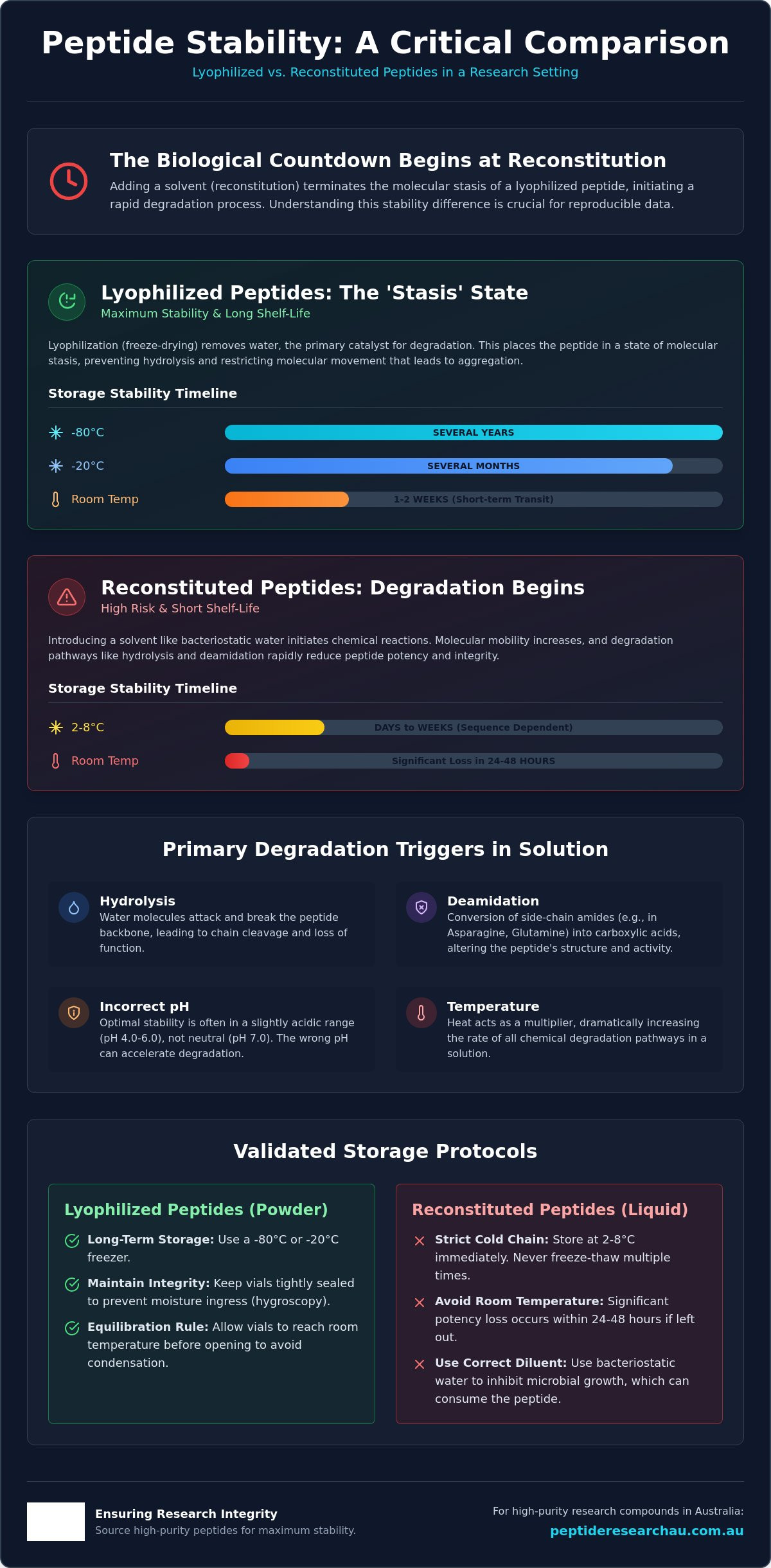
Maximising Shelf Life: Storage Protocols for Australian Environments
Australia’s environmental conditions present significant challenges for maintaining compound integrity. Ambient temperatures during the summer months frequently exceed 40°C, creating a high-risk environment for sensitive laboratory materials. While lyophilised powders are robust, they aren't indestructible. Researchers must implement strict cold chain management from the moment of delivery. Effective storage requires more than just a functional freezer; it demands an understanding of how local climate variables like humidity and thermal spikes impact lyophilized vs reconstituted peptide stability over time.
A common pitfall in laboratory storage is the use of "frost-free" freezers. These units utilize internal heating cycles to prevent ice accumulation, which causes the internal temperature to fluctuate significantly. For peptides, these micro-thaw cycles are damaging. A dedicated manual-defrost freezer is essential for maintaining a constant -20°C or -80°C environment. Additionally, secondary containment is necessary in high-humidity coastal regions. Placing vials inside a sealed container with silica gel desiccants provides a critical barrier against moisture ingress, which can lower the glass transition temperature of the powder and lead to premature degradation.
The Equilibration Protocol
Opening a chilled vial prematurely is a frequent cause of sample failure. When a cold vial is exposed to warm, humid air, moisture condenses instantly on the interior surfaces and the peptide powder itself. This moisture introduces the exact catalyst for hydrolysis that lyophilisation was designed to remove. To prevent this, follow a strict three-step equilibration protocol:
Step 1: Remove the vial from the freezer and place it in a dry area.
Step 2: Allow the vial to reach ambient room temperature, typically requiring 30 to 60 minutes.
Step 3: Once the exterior is dry and at room temperature, open the vial for weighing or reconstitution.
Following this procedure ensures that the "biological countdown" only begins when you intentionally add a solvent, rather than through accidental environmental exposure.
Navigating Australian Shipping Challenges
International transit often exposes packages to unmonitored warehouse temperatures and long delays in customs. These factors increase the cumulative thermal load on the product. Domestic sourcing through Peptides Australia reduces this risk by minimizing transit time and ensuring the product remains within a controlled domestic network. Researchers should also utilize thermal indicators or data loggers to verify that shipping conditions remained within acceptable parameters. To protect the validity of your longitudinal studies, always source your Research Peptides from providers who prioritize documented cold chain integrity and climate-specific packaging solutions.
Ensuring Integrity: Sourcing and Quality Assurance
The foundation of reproducible data is the chemical purity of the starting material. If a peptide contains significant residual trifluoroacetic acid (TFA) or moisture from the synthesis process, its shelf life is compromised regardless of storage temperature. These contaminants accelerate the degradative pathways discussed in earlier sections. High-performance liquid chromatography (HPLC) and Mass Spectrometry (MS) are the essential tools for verifying that the compound matches its intended sequence and meets the required purity threshold. Peptide Research AU adheres to these laboratory-grade standards to ensure that Australian researchers receive compounds that maintain their structural integrity throughout the duration of a study.
Analytical verification is the only way to guarantee that a "Research Grade" label translates to actual performance. Without a specific Certificate of Analysis (CoA), a researcher cannot account for the baseline impurities that might skew longitudinal results. Meticulous sourcing is the first step in managing the biological countdown once a vial is opened. It's a critical component of any risk-mitigation strategy in the lab.
Interpreting Lab Results for Stability
A Certificate of Analysis provides the empirical evidence needed to assess lyophilized vs reconstituted peptide stability. A purity rating of 98%+ indicates that the primary sequence is the dominant molecular species, with minimal truncated sequences or deletion peptides. These minor impurities are not just inert fillers; they can often participate in cross-linking reactions or promote aggregation. Higher initial purity levels significantly correlate with slower degradation rates in both lyophilised and reconstituted states. By starting with a highly purified compound, researchers extend the window of opportunity before potency drops below the critical threshold required for accurate data.
The Protocol for Successful Research
Successful research outcomes require a standardized protocol for handling sensitive compounds like PT-141. This specific peptide is highly susceptible to environmental stressors and requires meticulous care during reconstitution. To maintain consistency, researchers should adopt a "just-in-time" preparation strategy. Use this final checklist to preserve sample integrity:
Procure only the quantity required for the immediate phase of research to avoid long-term liquid storage.
Store lyophilised vials at -20°C or -80°C until the exact day of use.
Reconstitute using chilled diluents to minimize thermal shock to the molecular structure.
Divide the solution into single-use aliquots immediately after reconstitution to avoid the freeze-thaw damage mentioned previously.
Aliquoting is the most effective method to prevent the catastrophic effects of repeated temperature fluctuations. By following these rigorous quality assurance and handling protocols, researchers can mitigate the inherent risks of lyophilized vs reconstituted peptide stability and ensure that their experimental results are a true reflection of the peptide’s biological activity rather than a byproduct of its degradation.
Optimising Molecular Integrity for Future Research
Maintaining experimental precision requires a comprehensive understanding of the transition from molecular stasis to active decay. Lyophilisation offers a robust defense against hydrolytic degradation; however, the introduction of a diluent initiates a biological countdown that cannot be reversed. Researchers who master the nuances of lyophilized vs reconstituted peptide stability ensure that their data remains valid and reproducible. By implementing strict equilibration protocols and avoiding the thermal fluctuations of frost-free freezers, you protect the structural integrity of your compounds against the unique challenges of the Australian climate.
Reliable data begins with verified starting materials. Sourcing from providers who offer laboratory-grade purity (98%+) and independent HPLC and MS testing is essential for mitigating the risks of premature degradation. Secure the foundation of your laboratory work and Source Laboratory-Grade Research Peptides in Australia to benefit from express domestic shipping and documented quality assurance. Precise handling and rigorous sourcing standards are the final steps in securing the long-term success of your research initiatives.
Frequently Asked Questions
How long can lyophilised peptides stay at room temperature?
Lyophilised peptides can generally remain at room temperature for 1 to 2 weeks without significant loss of potency. This stability allows for standard domestic and international shipping of freeze-dried powders. Prolonged exposure to ambient heat can initiate the slow degradation of sensitive residues. Researchers should transfer vials to cold storage immediately upon arrival to preserve the baseline integrity established during the manufacturing process.
Can I refreeze a peptide once it has been reconstituted with bacteriostatic water?
Refreezing a reconstituted peptide is generally discouraged because it subjects the molecular structure to physical stress. Each freeze-thaw cycle creates ice crystals that can shear peptide chains and promote irreversible aggregation. If you must store a solution long-term, divide it into single-use aliquots before the initial freeze. This practice is a critical component of managing lyophilized vs reconstituted peptide stability to ensure consistent experimental results.
Does light exposure affect the stability of peptides in solution?
Light exposure significantly accelerates the degradation of peptides in an aqueous state. Ultraviolet radiation triggers the photolysis of aromatic amino acids like Tryptophan and Tyrosine, leading to chemical rearrangement. While lyophilised powders are somewhat protected by their solid matrix, solutions are highly vulnerable. Researchers should use amber glass vials or store reconstituted samples in light-shielded containers to prevent this invisible loss of biological activity.
What is the best temperature for long-term storage of freeze-dried peptides?
The optimal temperature for long-term storage of freeze-dried peptides is -20°C for standard use or -80°C for archival purposes. At these temperatures, molecular mobility is restricted and the rate of chemical reactions is negligible. Storing vials in a manual-defrost freezer is essential to avoid the micro-thaw cycles found in frost-free units. These cycles can introduce moisture and heat that compromise the stability of the powder over time.
Why do some peptides turn cloudy after reconstitution?
Cloudiness or precipitation after reconstitution typically indicates that the peptide has reached its solubility limit or has begun to aggregate. This physical change can occur if the diluent pH is too close to the peptide's isoelectric point or if the solution was agitated too vigorously. Cloudiness is a clear sign of compromised integrity. Researchers should ensure they're using appropriate laboratory diluents and gentle swirling techniques to achieve a clear, homogenous solution.
How do I know if my peptide has degraded and is no longer effective for research?
Peptide degradation is often invisible, but physical indicators include cloudiness, precipitation, or a change in solution color. If a previously clear solution becomes turbid, the compound has likely aggregated and lost its biological efficacy. Because chemical changes like deamidation don't always cause visual shifts, the only definitive way to confirm potency is through HPLC analysis. Monitoring these factors is vital for maintaining lyophilized vs reconstituted peptide stability in longitudinal studies.
Is there a difference in stability between BPC-157 and other peptides?
Yes, sequence complexity directly influences stability profiles. BPC-157 is a relatively robust pentadecapeptide that shows higher resilience compared to larger, more complex sequences like TB-500. Peptides with multiple cysteine or methionine residues are more prone to oxidation and require stricter handling. Understanding the specific amino acid composition of your compound allows for more precise storage and reconstitution protocols tailored to its unique chemical vulnerabilities.
How does the Australian climate specifically affect peptide shipping?
The Australian climate presents extreme thermal challenges, with summer temperatures often exceeding 40°C during transit. These conditions increase the cumulative thermal load on compounds, potentially shortening the viable window for lyophilised powders. Domestic sourcing reduces this risk by minimizing time spent in unmonitored sorting facilities. Researchers must account for these environmental factors by utilizing express shipping and verifying that cold chain protocols were maintained throughout the delivery process.


Comments