
Peptide Reconstitution Calculation: A Professional Laboratory Guide
- peptideresearchau
- 23 hours ago
- 12 min read
Precision in peptide research is not found in a digital calculator; it's established through a rigorous understanding of the relationship between lyophilized mass, diluent volume, and syringe displacement. Many researchers struggle with the transition from dry powder to precise liquid concentrations, often fearing that a single mathematical oversight will degrade the compound or invalidate an entire study. It's a valid concern, as the confusion between international units on a syringe and the actual micrograms of a research peptide remains a leading cause of laboratory error. As regulatory scrutiny of research compounds increases in 2026, the requirement for meticulous documentation and exact dosing protocols becomes a baseline for professional study.
Mastering the peptide reconstitution calculation is essential for maintaining high manufacturing standards and rigorous methodology. This professional guide provides a repeatable mathematical formula for any vial size, alongside a clear protocol for sterile reconstitution. We will examine the specific mathematics of diluent volume, provide a step-by-step workflow for mixing, and clarify the technical nomenclature used in professional laboratory settings. By following these established protocols, you'll ensure experimental accuracy and gain absolute confidence in your laboratory outcomes.
Table of Contents
Fundamentals of Peptide Reconstitution in Research
Reconstitution is the essential process of restoring a lyophilized research compound to its aqueous state for laboratory analysis. This procedure requires more than simple dilution; it demands an exact understanding of the Fundamentals of Peptides to ensure the biochemical integrity of the molecule is maintained. Accurate peptide reconstitution calculation serves as the foundation for experimental reproducibility. Without precise mathematics, researchers risk inconsistent concentrations that lead to skewed data and failed studies. Precision in the early stages of preparation ensures that every subsequent step of the research project is based on reliable, verifiable metrics.
The Science of Lyophilisation
Lyophilisation is a dehydration process used to preserve a perishable material or make the material more convenient for transport. In the context of research compounds, this involves freezing the peptide and then reducing the surrounding pressure to allow the frozen water to sublime directly from the solid phase to the gas phase. This method preserves the delicate secondary structure of the peptide chains, which would otherwise degrade in a liquid state. The resulting product is often referred to as a "cake" or lyophilized powder. This format is highly stable and allows for long-term storage at controlled temperatures, protecting the compound from hydrolytic degradation during transit and storage.
Choosing the Correct Diluent
The choice of solvent is a critical variable in the reconstitution protocol. Most laboratory studies utilize bacteriostatic water, which contains 0.9% benzyl alcohol. This additive acts as a preservative, inhibiting the growth of potentially contaminating bacteria and extending the shelf life of the reconstituted solution. In contrast, sterile water lacks this preservative and is generally reserved for single-use applications where benzyl alcohol might interfere with specific assays.
Solubility factors often dictate the use of alternative diluents. While most peptides dissolve readily in bacteriostatic water, certain sequences require specific conditions to reach a fully homogeneous state:
Sterile Saline (0.9% NaCl): Used when osmotic balance is required for specific experimental models.
Acetic Acid (0.1% to 1%): Necessary for basic peptides that exhibit low solubility in neutral water.
Sodium Bicarbonate: Occasionally used for acidic peptides to help achieve a stable solution.
The pH level of the chosen diluent significantly impacts peptide longevity. Most research compounds remain stable in a slightly acidic environment, typically between pH 4.0 and 6.0. Deviations from the optimal pH range can lead to aggregation or rapid degradation of the compound. Proper peptide reconstitution calculation must account for the final volume to ensure the concentration remains within the desired parameters for the duration of the study.
The Mathematical Formula for Peptide Reconstitution
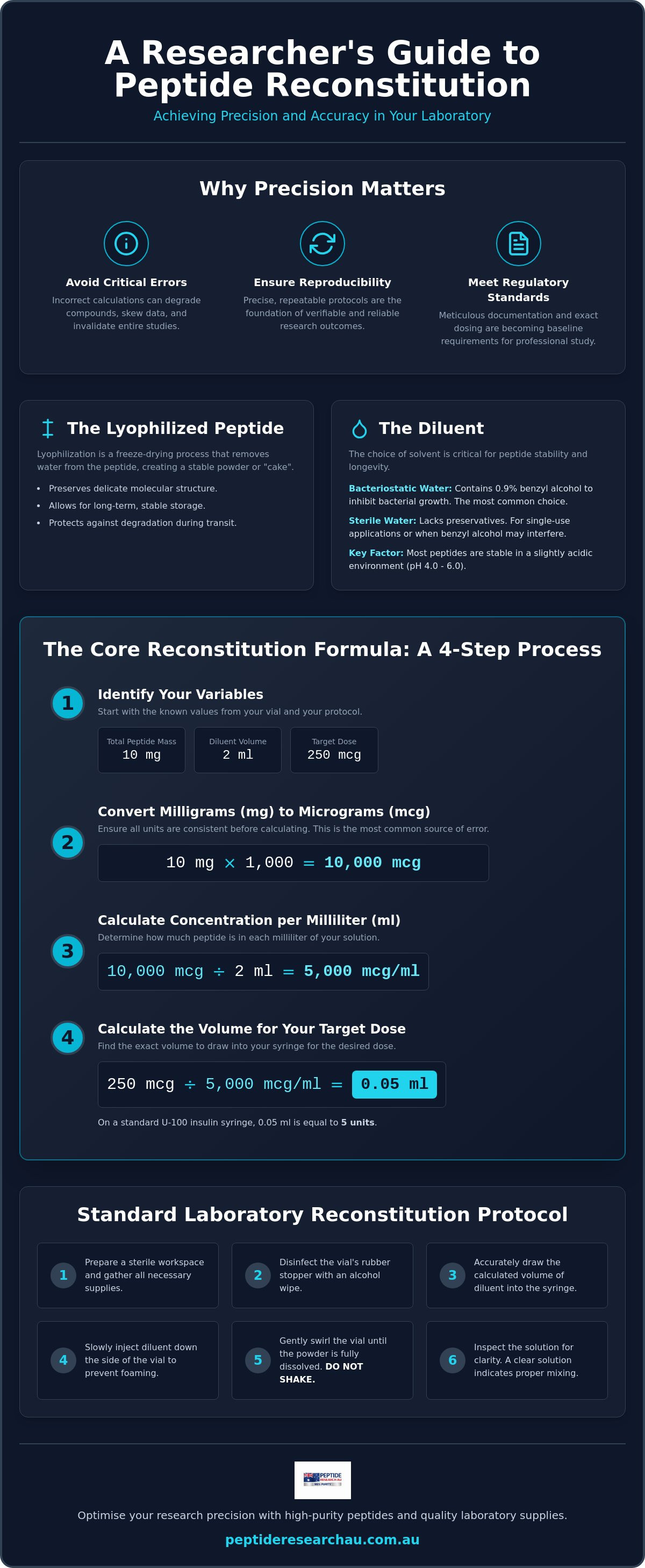
Relying on automated digital tools can lead to a lack of oversight in a professional laboratory setting. A manual peptide reconstitution calculation ensures the researcher understands the concentration dynamics within the vial and provides a necessary audit trail for experimental data. The process begins by identifying three primary variables: the total mass of the peptide in milligrams (mg), the volume of diluent added in milliliters (ml), and the desired target dose in micrograms (mcg). Accuracy in these initial measurements is the only way to guarantee the integrity of the resulting solution.
To maintain unit consistency, the first step is always conversion. 1 milligram (mg) is equivalent to 1,000 micrograms (mcg) in all peptide research contexts. This conversion is vital because most research doses are measured in mcg, while vial contents are typically labeled in mg. Attempting to calculate volumes without this conversion often leads to decimal point errors that can result in a tenfold difference in the final concentration.
The core formula for establishing concentration is straightforward: (Total mg / Total ml) = Concentration per ml. Once the concentration per ml is established, calculating the volume required for a specific aliquot involves dividing the target dose by that concentration. This manual verification provides a necessary check against software errors and ensures the researcher maintains full control over the methodology.
Step-by-Step Calculation Example
Consider a scenario involving the reconstitution of BPC-157. If a vial contains 5mg of the peptide and the researcher adds 2ml of bacteriostatic water, the calculation follows these structured steps:
Step 1: Convert the mass to micrograms (5mg = 5,000mcg).
Step 2: Determine the concentration (5,000mcg / 2ml = 2,500mcg per ml).
Step 3: Calculate the draw volume for a 250mcg dose (250 / 2,500 = 0.1ml).
In this example, 0.1ml corresponds to 10 units on a standard U-100 syringe. Precision at this level is non-negotiable for high-standard laboratory study and ensures that the target dose is delivered exactly as planned.
Common Variables in Peptide Mass
Higher mass vials, such as 10mg or 20mg configurations, require careful consideration of diluent volume. While it's tempting to add more liquid to these vials, over-dilution can complicate precise measurement. If the volume becomes too large, the required dose might exceed the capacity of small-gauge syringes, leading to multiple draws and increased risk of contamination. Conversely, using too little diluent with a high-mass vial creates a solution that is too concentrated. In such cases, a tiny measurement error results in a significant dosage deviation that can compromise the study.
Researchers must balance vial capacity with the need for measurable volumes. For those conducting rigorous studies, sourcing high-purity research peptides is the first step toward ensuring these mathematical models translate into accurate experimental results.
Syringe Calibration and Unit Conversions
Precision in the laboratory requires a seamless transition from the peptide reconstitution calculation to the physical measurement within a syringe barrel. Once the liquid concentration is determined, the researcher must select the appropriate hardware to draw the required volume. Laboratory study typically utilizes insulin syringes, which are available in 0.3ml, 0.5ml, and 1.0ml capacities. While these syringes are marked in "Units" (IU), it's vital to remember that these markings represent volume, not the mass of the research compound. Selecting a syringe with a capacity that closely matches the target volume increases the resolution of the measurement and reduces the margin of error.
The most prevalent error in peptide research is the conflation of Insulin Units with the mass of the peptide itself. On a standard U-100 syringe, the scale is calibrated so that 100 units equal exactly 1.0ml of liquid. This means one unit is equivalent to 0.01ml. A common mistake involves assuming that 10 units of liquid always contains a specific weight of peptide, such as 100mcg. In reality, the amount of peptide in those 10 units is entirely dependent on your initial peptide reconstitution calculation and the amount of diluent added to the vial. If the concentration is not correctly mapped to the syringe scale, the resulting data will be fundamentally flawed.
The 1ml Syringe Breakdown
The 1.0ml syringe is the standard for many reconstitution protocols. It's typically marked with bold lines at every 10-unit increment, which correspond to 0.1ml intervals. Smaller tick marks usually represent 2-unit increments (0.02ml). For high-precision research requiring micro-dosing, measuring partial units becomes necessary. This requires a steady hand and a clear view of the plunger's leading edge. Researchers must also account for "dead space," which is the small amount of liquid that remains in the needle and hub after the plunger is fully depressed. In high-precision studies, low-dead-space syringes are preferred to ensure the entire calculated dose is delivered without waste or retention.
Conversion Reference: ml to IU
To ensure accuracy during the draw process, use the following volume-to-unit mappings for standard U-100 syringes:
0.1ml = 10 Units
0.2ml = 20 Units
0.25ml = 25 Units
0.5ml = 50 Units
1.0ml = 100 Units
Visualizing the meniscus is critical for laboratory measurement. The researcher should align the top ring of the plunger stopper, not the conical tip, with the desired unit marking on the barrel. Always view the syringe at eye level to avoid parallax error. By maintaining this level of meticulous detail, you ensure that the mathematical precision of your calculations is preserved during the physical handling of the research material.
Standard Laboratory Reconstitution Protocol
The physical execution of a peptide reconstitution calculation is as critical as the mathematical preparation. Even the most precise formula fails if the physical handling of the compound introduces contaminants or structural damage. High-standard research requires a controlled environment. Begin by swabbing the rubber stoppers of both the diluent and the peptide vial with 70% Isopropyl Alcohol (IPA). This step is non-negotiable for preventing microbial introduction during the needle entry. Allow the alcohol to air dry completely before proceeding to ensure no residual solvent enters the vial.
A common oversight in laboratory practice is the failure to manage the vacuum seal within the peptide vial. Most professional-grade vials are sealed under negative pressure. If the needle is inserted without resistance, the vacuum will pull the diluent from the syringe with significant force. This rapid intake can cause mechanical stress on the lyophilized cake, potentially shearing delicate peptide bonds. Researchers must maintain a firm grip on the syringe plunger; this allows the diluent to enter the vial slowly and under manual control. By controlling the flow, you preserve the structural integrity of the research compound.
Step-by-Step Mixing Procedure
Adhering to a standardized workflow reduces variables that could compromise your data. Follow this sequence for optimal results:
1. Clean the workspace and both vials (peptide and diluent) with 70% IPA.
2. Draw the calculated volume of bacteriostatic water into the syringe.
3. Angle the needle toward the vial wall to allow the diluent to drip slowly onto the powder.
4. Allow the vial to sit for 2-5 minutes if the cake does not dissolve instantly.
Once the diluent is added, the "gentle swirl" technique is the only approved method for ensuring a homogeneous solution. Vigorous shaking is strictly prohibited in scientific protocols. Peptides are fragile molecules. The kinetic energy from shaking can lead to denaturation or aggregation. If the solution appears cloudy or contains visible particulates after several minutes, it may indicate a solubility issue or a compromised compound. A successful reconstitution results in a clear, particle-free solution ready for refrigerated storage.
Post-Reconstitution Handling
The transition from room temperature to a controlled refrigerated environment (2°C to 8°C) must happen immediately following mixing. Environmental factors like heat and UV exposure accelerate the degradation of the peptide chains. Certain compounds, such as GHK-Cu, are particularly sensitive to light and require storage in amber vials or dark containers. Once reconstituted, most peptides have a shelf life of 21–30 days if stored correctly in a refrigerated environment. For researchers requiring the highest quality materials for their protocols, sourcing from a reliable provider of research compounds is essential for maintaining experimental integrity.
Optimising Precision with Quality Research Supplies
The mathematical integrity of a peptide reconstitution calculation is fundamentally tied to the quality of the raw material. If the lyophilized mass in the vial deviates from the labeled amount, every subsequent dilution will be inaccurate. Professional laboratory study requires high-purity compounds to ensure that the restored liquid remains clear and stable. Cloudy solutions or persistent particulates often indicate the presence of synthesis by-products or degraded sequences. These impurities compromise the concentration and the validity of the research data. Precision requires reliable data, and that data begins with the physical compound.
Domestic Australian sourcing offers a significant advantage in maintaining the structural integrity of these compounds. International shipping often exposes vials to extreme temperature fluctuations during transit. These fluctuations can create "hot" or "cold" spots within the lyophilized cake where the peptide has partially degraded. By sourcing through Peptide Research AU, researchers ensure that the chain of custody is shorter and the environmental exposure is minimized. This supports Australian scientific standards by providing a more stable foundation for any laboratory protocol.
Quality Control in Australia
Reliability starts with verification. Researchers should prioritize compounds that have undergone rigorous third-party testing, specifically High-Performance Liquid Chromatography (HPLC) and Mass Spectrometry (MS). These analytical methods confirm purity levels and verify the exact mass of the peptide before the peptide reconstitution calculation is performed. Knowing the verified milligram content allows for absolute certainty when establishing the denominator in your formula. Without this verification, a researcher is merely guessing at the starting mass, which invalidates the precision of the final concentration.
Essential Laboratory Add-ons
Consistency in research results depends on the use of laboratory-grade diluents. Bacteriostatic water is the standard for studies extending over several weeks. The inclusion of 0.9% benzyl alcohol prevents microbial growth; this ensures the solution remains sterile throughout the duration of the project. Using substandard or non-preserved water increases the risk of contamination, which can alter the peptide's biochemical properties and lead to experimental failure. The choice of diluent is just as important as the peptide itself.
Beyond the diluent, the procurement of sterile, single-use syringes and Isopropyl Alcohol (IPA) swabs is essential for maintaining a clean workflow. A complete research setup minimizes external variables and allows the focus to remain on the data. For those committed to maintaining high laboratory standards, the selection of high-grade supplies is the final step in achieving excellence. You can view our range of laboratory-grade peptides and supplies to ensure your next study is backed by verified quality and professional-grade materials.
Advancing Laboratory Precision
Precision in biochemical research is built upon the synthesis of mathematical accuracy and procedural discipline. By mastering the manual peptide reconstitution calculation, researchers eliminate the risks associated with automated errors and ensure that every microgram of the compound is accounted for. This technical foundation, combined with an exact understanding of syringe calibration and sterile handling, preserves the molecular integrity of the peptide throughout the duration of the study. Consistency isn't just about the math; it's about the rigorous application of professional standards at every stage of the workflow.
Maintaining these high standards requires access to reliable, high-purity materials. Peptide Research AU provides a secure foundation for your methodology through laboratory-grade purity standards and third-party HPLC testing on all research compounds. With Australian-based domestic shipping, you reduce the environmental risks associated with international transit and ensure your supplies arrive in optimal condition. Browse Laboratory-Grade Peptides and Supplies at Peptide Research AU to secure the precision your research demands. Achieving absolute experimental accuracy is within reach when you combine technical expertise with verified, high-quality supplies.
Frequently Asked Questions
How much bacteriostatic water should I add to a 5mg peptide vial?
The amount of bacteriostatic water added depends on your desired concentration, but 2ml is a common standard for a 5mg vial. This volume results in a concentration of 2,500mcg per ml. Choosing a volume between 1ml and 3ml ensures the solution is neither too concentrated nor too diluted for precise measurement in a standard syringe. Always verify the total mass before starting your preparation.
Is 100 units on a syringe the same as 1mg of peptide?
No, 100 units on a U-100 syringe represents a volume of 1ml, not a specific mass of peptide. The amount of peptide contained within those 100 units is determined entirely by your initial peptide reconstitution calculation. Confusing volume in units with mass in milligrams is a primary cause of dosing errors in laboratory settings. You must calculate the concentration for every new vial.
What happens if I accidentally shake the peptide vial after adding water?
Shaking a peptide vial can cause mechanical stress that denatures the delicate protein chains. Peptides are held together by fragile bonds that may break under vigorous agitation. If accidental shaking occurs, allow the vial to settle and inspect the solution for cloudiness or foam. The structural integrity and potency of the compound may be compromised, leading to inconsistent experimental results.
Can I use sterile saline instead of bacteriostatic water for reconstitution?
Sterile saline can be used for immediate applications, but it lacks the 0.9% benzyl alcohol found in bacteriostatic water. Without this preservative, the solution is at risk for microbial growth and is generally only stable for 24 hours. Bacteriostatic water remains the preferred diluent for multi-week laboratory studies to ensure long-term sterility and compound stability in a refrigerated environment.
How do I calculate a 250mcg dose from a 10mg vial reconstituted with 3ml of water?
To extract a 250mcg dose from a 10mg vial reconstituted with 3ml of water, you first convert 10mg to 10,000mcg. Dividing 10,000mcg by 3ml yields a concentration of 3,333mcg per ml. Your required draw volume is 0.075ml, which corresponds to 7.5 units on a standard U-100 insulin syringe. This peptide reconstitution calculation ensures your dose is mathematically accurate before you draw the solution.
How long is a peptide stable after it has been mixed with a diluent?
Most research peptides remain stable for 21 to 30 days once reconstituted, provided they are stored in a refrigerated environment between 2°C and 8°C. Exposure to room temperature or direct light for extended periods will accelerate the degradation process. Always check for solution clarity before use. The presence of particulates or a change in color indicates the compound is no longer viable for study.
Why is there a vacuum in my peptide vial when I insert the needle?
The vacuum is a result of the lyophilization process, where the vial is sealed under negative pressure to maintain a sterile, moisture-free environment. This seal protects the lyophilized cake from oxidation and degradation during storage. When performing your peptide reconstitution calculation, you must manage this vacuum by holding the plunger and allowing the diluent to enter the vial slowly to prevent mechanical damage.
Does the volume of water added change the potency of the peptide dose?
The volume of water added does not change the total potency or mass of the peptide in the vial, but it does change the concentration. Adding more diluent means you must draw a larger volume of liquid to reach the same target dose. Precision is often easier to achieve with moderate volumes, as very high concentrations make even a tiny measurement error on the syringe barrel more significant.


Comments