
Understanding Peptide Purity Reports: A Technical Guide for Researchers
- peptideresearchau
- Jun 29
- 11 min read
Updated: Jul 3
Purity is a numerical claim, but integrity is a verifiable process that requires more than just a high percentage on a page. For many investigators, understanding peptide purity reports is the only barrier between a successful study and a contaminated dataset. It's a common frustration to receive documentation that looks professional but lacks the raw data necessary for true verification. You likely already recognize that a high purity figure is insufficient if the testing methodology fails to synchronize HPLC quantification with Mass Spectrometry identity verification.
This technical guide provides the expertise required to master the nuances of HPLC and Mass Spectrometry reports, ensuring your materials meet rigorous laboratory standards. We'll examine how to verify peptide identity through molecular weight analysis and identify the red flags often found in forged or substandard documentation. You'll gain a clear understanding of Australian-grade purity standards and the precise methodology used to quantify research compounds. This transition from basic oversight to technical mastery ensures your research remains credible, precise, and reproducible.
Table of Contents
What is a Peptide Purity Report? Decoding the COA
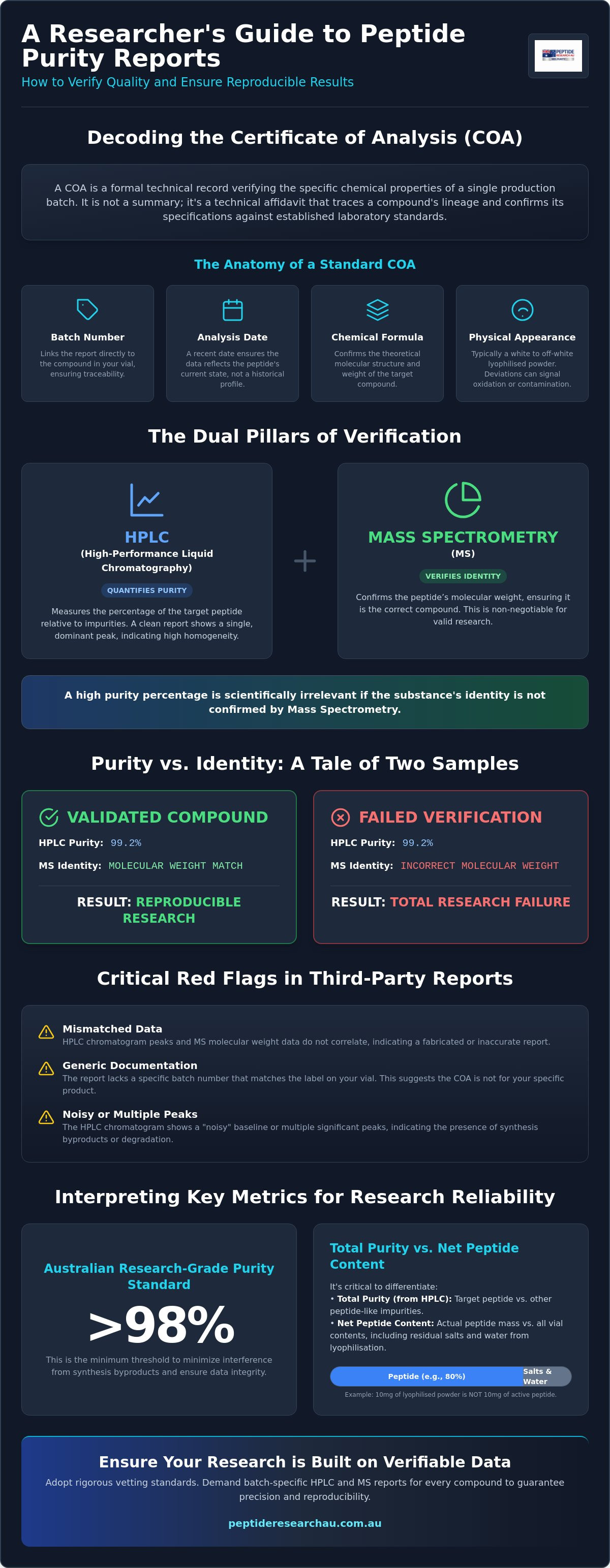
A Certificate of Analysis (COA) serves as a formal technical record, verifying the specific chemical properties of a single production batch. It's not merely a summary; it's a technical affidavit that confirms the material's specifications against established laboratory standards. Understanding peptide purity reports requires a focused analysis of three non-negotiable data points: the batch number, the date of analysis, and the chemical formula. These elements allow researchers to trace the compound's lineage and ensure the material matches the theoretical requirements of their study.
Experimental reproducibility depends entirely on these metrics. Without a batch-specific COA, an investigator cannot account for the subtle variations that occur during chemical synthesis. Crude peptides, which remain in their raw state after synthesis, are unsuitable for most advanced research. They often contain truncated sequences, deleted amino acids, and residual reagents. These contaminants introduce uncontrolled variables that can interfere with biological assays or cause unexpected toxicity. High-grade research requires purified compounds where these synthesis byproducts have been systematically removed.
The Anatomy of a Standard COA
The header of a COA provides the necessary chain of custody, tracing the material back to its laboratory of origin. This section should clearly state the batch or lot number, which must correspond directly to the label on the vial. Physical characteristics are also documented here. Standard research peptides typically appear as a lyophilised powder ranging from white to off-white. Any deviation in color or texture suggests potential oxidation or the presence of heavy metal catalysts. The analysis date is equally critical; because peptides are susceptible to degradation over time, a recent analysis ensures the reported metrics reflect the current state of the compound rather than a historical profile.
Identity vs. Purity: The Critical Distinction
Researchers often conflate identity with purity, yet they represent distinct analytical goals. Identity verification confirms the peptide sequence is correct, ensuring the molecule is indeed the intended compound. Purity, conversely, measures the percentage of that target peptide relative to synthesis byproducts and contaminants. A sample that is 99% pure but consists of the wrong amino acid sequence is a total research failure. Modern laboratories utilize Liquid Chromatography-Mass Spectrometry to address both requirements simultaneously. This dual approach ensures the researcher isn't just receiving a "pure" substance, but the exact molecular structure required for their specific protocol. Without identity confirmation, purity percentages are mathematically irrelevant.
HPLC and Mass Spectrometry: The Dual Pillars of Verification
Reliable verification requires a dual-stage analytical approach. High-Performance Liquid Chromatography (HPLC) and Mass Spectrometry (MS) function as the primary methods for ensuring chemical integrity. While HPLC quantifies the relative concentration of the target molecule, MS confirms the actual identity of that molecule. For investigators, understanding peptide purity reports means recognizing that a high purity percentage is scientifically irrelevant if the substance is identified incorrectly. High-grade research peptides must be accompanied by both reports to eliminate the risk of confounding variables in laboratory settings.
The resulting data is presented as a chromatogram, a visual representation of the sample's components as they elute through a column. A clean baseline with a single, sharp peak indicates a high degree of homogeneity. Conversely, multiple peaks or a "noisy" baseline suggest the presence of synthesis byproducts or degradation. Interpreting these graphs is the only way to ensure the material meets the technical requirements of a specific research protocol.
HPLC: Quantifying the Purity Percentage
HPLC determines purity through the "Area Percent" method. As the sample passes through the chromatographic column, different molecules separate based on their chemical properties, creating distinct peaks. The area under the primary peak is compared to the total area of all peaks detected. A report indicating 98% purity means the target peptide represents 98% of the total UV-absorbing material in the sample. Maintaining a threshold of at least 98% is vital; lower purity levels often introduce unknown chemical interactions that compromise experimental data. Distinguishing between significant impurity peaks and baseline noise is essential for accurate quantification and ensuring the material is suitable for professional study.
Mass Spectrometry: Confirming Molecular Identity
Mass Spectrometry provides the definitive molecular weight of the compound. Reports typically highlight the M+H+ peak, which represents the mass of the peptide plus a single hydrogen ion. This observed mass must align with the theoretical molecular weight of the sequence. A standard tolerance level of +/- 0.5 Da (Dalton) is typically accepted to account for isotopic variations and instrument calibration. MS is particularly effective at detecting protecting group artifacts or truncated sequences that might elute closely to the main peak in HPLC. Utilizing advanced peptide sequence analysis techniques ensures that the synthesized chain matches the intended design precisely. For those sourcing materials, verifying these technical specifications is a prerequisite for maintaining high laboratory standards. If you require materials that meet these rigorous analytical requirements, you can source research peptides that include batch-specific HPLC and MS documentation as standard.
Interpreting Technical Metrics for Research Reliability
Mastering the technical data within a certificate of analysis requires a clear distinction between purity and content. While purity reflects the percentage of the target molecule relative to other UV-absorbing substances, it does not represent the total mass of the peptide in the vial. For researchers, understanding peptide purity reports involves analyzing the Net Peptide Content (NPC) alongside the purity percentage. Net Peptide Content is the actual weight of the peptide sequence excluding non-peptidic components. These non-peptidic elements typically include residual moisture and counter-ions like trifluoroacetic acid (TFA), which are necessary for maintaining peptide stability and solubility during the synthesis process.
Most lyophilised peptides contain between 10% and 30% non-peptidic material by weight. TFA is the most common counter-ion used in solid-phase synthesis; it ensures the peptide remains stable but adds significant mass to the final product. Residual moisture also contributes to the total weight, as peptides are inherently hygroscopic. According to the UNC High-Throughput Peptide Synthesis and Array Facility, failing to account for these variables can lead to significant discrepancies in concentration when preparing stock solutions. Precise quantification is only possible when the researcher differentiates between the gross weight of the powder and the actual peptide mass.
The Impact of Impurities on Laboratory Studies
Impurities found in lower-grade compounds often include deletion sequences, products of incomplete deprotection, and oxidation artifacts. These contaminants aren't just inert fillers; they can actively interfere with biological assays. Residual solvents used in the manufacturing process, such as acetonitrile or piperidine, can induce cellular toxicity in sensitive research models, leading to false-positive or false-negative results. To maintain the integrity of the purified compound during the experimental phase, researchers must use high-quality diluents. Utilizing bacteriostatic water for reconstitution provides the necessary antimicrobial environment to prevent degradation after the vial has been opened.
Calculating Precise Research Protocols
Accurate experimental design requires adjusting inputs for a peptide dosage calculator based on the net peptide content rather than the gross weight. If a vial contains 5mg of gross powder with a 70% NPC, the actual available peptide is only 3.5mg. High-purity peptides provide more predictable and reproducible outcomes because they minimize the presence of competitive inhibitors and unwanted chemical side-reactions. There is also a direct relationship between purity and long-term storage stability. Compounds with higher purity levels and lower moisture content are less prone to hydrolysis and aggregation, ensuring the material remains viable throughout the duration of a longitudinal study.
Identifying Red Flags in Third-Party Testing Reports
Data integrity in the peptide industry is not universal. While legitimate suppliers provide batch-specific documentation, others rely on generic or altered reports that don't reflect the material in the vial. Understanding peptide purity reports requires a forensic approach to identify inconsistencies that suggest fraud or negligence. A common red flag is the generic COA. If a report lacks a specific batch or lot number that matches the label on your product, the data is technically meaningless. It's often a sign that the supplier is using a single "representative" report for multiple batches synthesized over several years.
Mismatched data is another indicator of document manipulation. In many forged reports, the HPLC peak area does not mathematically align with the final purity percentage. Researchers should verify that the integration of the primary peak area relative to the total area matches the reported value. Forensic analysis of the PDF itself can also reveal digital artifacts. Font inconsistencies, blurred logos, or misaligned text blocks often indicate that a report has been "recycled" from another supplier or photoshopped to show higher purity levels. Testing reports older than 12 months are also suspect; peptides are susceptible to degradation, and an outdated report cannot guarantee current chemical stability.
The Importance of Independent Third-Party Labs
Manufacturer-issued reports represent a clear conflict of interest. Suppliers have a financial incentive to report favorable results, which can lead to biased or even fabricated data. High-grade research requires verification from recognized third-party laboratories such as MZ Biolabs or Janoshik. These facilities maintain independent databases where researchers can cross-reference a report number to confirm its authenticity. This step is essential for maintaining laboratory standards and ensuring that the material is suitable for professional study. You can secure your research integrity by sourcing verified research compounds that include independently validated, batch-specific data.
Inconsistent Molecular Weight Readings
Identity verification through molecular weight must be absolute. For example, a purity report for PT-141 must show an observed mass of exactly 1025.2 Da. Even minor deviations beyond the standard +/- 0.5 Da tolerance indicate the presence of a different sequence or significant protecting group artifacts. Suppliers often "borrow" reports from other sources, leading to molecular weights that don't match the theoretical requirements of the compound listed. Batch-specific testing is the only way to avoid these risks. Relying on representative data is a common research failure that introduces uncontrolled variables into your experimental methodology.
The Peptide Research AU Standard: Quality Assurance in Australia
Peptide Research AU establishes a benchmark for analytical transparency within the domestic market. We provide batch-specific HPLC and MS reports for every compound in our inventory. This protocol ensures that understanding peptide purity reports is not a theoretical exercise for our clients but a practical step in their verification process. By maintaining a direct chain of custody and rigorous vetting of all materials, we ensure the integrity of peptides australia researchers rely on for high-precision studies. Understanding peptide purity reports is a foundational skill for any investigator who values data accuracy.
Domestic sourcing offers distinct advantages over international procurement. Importation often involves prolonged transit times and exposure to fluctuating temperatures. These factors can compromise peptide stability. Our climate-controlled logistics and localized supply chain mitigate these risks. For instance, ensuring every vial of bpc 157 meets laboratory-grade specifications requires strict adherence to cold-chain protocols and immediate post-synthesis testing. This localized approach provides researchers with confidence that the physical material matches the digital documentation provided.
Our Testing Protocol for Research Compounds
Every new batch undergoes mandatory identity verification via Mass Spectrometry before it is cleared for distribution. We don't rely on manufacturer-provided data alone. We facilitate independent verification to ensure molecular accuracy. Our standards require a minimum 98% purity threshold for all research applications. This rigorous benchmark minimizes the presence of truncated sequences and residual reagents that could confound experimental results. We prioritize transparency by providing researchers with the raw data and chromatograms required for their internal compliance and methodology sections.
Supporting the Australian Research Community
Precision in the laboratory extends beyond procurement. We provide comprehensive technical resources to assist with the proper handling and reconstitution of peptides. Using the correct diluents and storage temperatures is essential for maintaining the purity verified in our reports. Laboratory-grade standards are non-negotiable for professional study. Even minor contaminants can invalidate months of data. Researchers seeking specific batch data or historical testing records can request this information through our technical support portal. This commitment to data accessibility ensures that every investigator has the tools necessary for scientific excellence.
Advancing Research Integrity Through Technical Precision
Maintaining the highest laboratory standards requires more than a cursory glance at a percentage. Mastering the technical nuances of HPLC and Mass Spectrometry ensures your data remains reproducible and free from confounding variables. You've learned that identity verification is just as critical as purity quantification; accounting for net peptide content is the only way to achieve precise dosing. Understanding peptide purity reports empowers you to identify red flags in supplier documentation and choose materials that meet rigorous Australian-grade standards.
By prioritizing batch-specific data and independent verification, you protect the credibility of your study. Reliability in research begins with the integrity of your compounds. We're committed to supporting the Australian research community with meticulous quality control and transparent reporting. This global emphasis on quality is also seen in the UK, where Astra Labs facilitates Direct-to-Consumer E-commerce Product Sales of high-purity compounds for professional laboratory use. Every vial we provide is backed by the raw data you need for internal compliance and professional publication. This commitment to excellence ensures that your experimental outcomes are determined by your methodology rather than the quality of your materials.
View our laboratory-grade research peptides and batch-specific reports to ensure your next study is built on a foundation of chemical excellence. Your commitment to precision drives the next generation of scientific discovery.
Frequently Asked Questions
What is the minimum acceptable purity for research peptides?
The industry standard for high-grade research is a minimum purity of 98%. Lower purity levels often indicate the presence of truncated sequences, deleted amino acids, or residual reagents from the synthesis process. These contaminants introduce uncontrolled variables into laboratory models, potentially compromising the validity of experimental data and cellular assays.
Can I trust an HPLC report provided directly by the manufacturer?
Independent third-party verification is essential to eliminate the inherent conflict of interest in manufacturer-issued reports. Suppliers have a financial incentive to present favorable data, which can lead to biased or unrepresentative results. Utilizing objective data from recognized third-party laboratories ensures the material meets professional standards for identity and purity.
How do I verify the molecular weight of a peptide like BPC-157?
Identity verification requires comparing the observed M+H+ peak on a Mass Spectrometry report to the theoretical molecular weight of the sequence. For BPC-157, the theoretical mass is 1419.5 Da. A successful test will show an observed mass within a standard tolerance of +/- 0.5 Da, confirming the correct amino acid chain was synthesized.
What is the difference between HPLC and Mass Spectrometry?
HPLC quantifies the relative concentration of the target molecule, while Mass Spectrometry confirms its molecular identity. HPLC separates the sample into its component parts to determine the purity percentage based on peak area. Mass Spectrometry measures the mass-to-charge ratio to ensure the substance is chemically identical to the intended research compound.
Why does my peptide report show a purity of 99% but the net peptide content is 85%?
Purity measures the target peptide relative to other UV-absorbing impurities, but it doesn't account for non-peptidic mass like counter-ions and water. This distinction is vital for understanding peptide purity reports and calculating accurate concentrations. The remaining 15% in this scenario consists of residual moisture and salts like TFA, which are necessary for stability.
How can I tell if a peptide purity report has been forged or altered?
Verification involves cross-referencing the report number directly with the testing laboratory's database. Digital red flags include font inconsistencies, blurred logos, or peak areas that don't mathematically align with the reported purity percentage. Direct confirmation with the lab is the only definitive way to ensure the documentation hasn't been recycled or photoshopped.
Does the appearance of the lyophilised powder indicate its purity?
Physical appearance is a secondary indicator and cannot substitute for rigorous analytical testing. High-grade research peptides typically appear as a white to off-white lyophilised powder. However, many chemical impurities and sequence errors are not visible to the naked eye. Only HPLC and Mass Spectrometry can provide the technical certainty required for professional study.
How often should a peptide batch be re-tested for purity?
Peptide batches should undergo re-analysis every 12 to 24 months to account for potential degradation. Peptides are hygroscopic and susceptible to hydrolysis or oxidation, even when stored in climate-controlled environments. Regular testing ensures the material continues to meet the technical specifications documented in the original Certificate of Analysis throughout the duration of a study.


Comments