
Peptide Reconstitution Guide: Laboratory Protocols and Standards (2026)
- peptideresearchau
- 1 day ago
- 11 min read
A single mechanical error during solvation can render a high-purity lyophilised compound biologically inert before the first assay is even conducted. Researchers in Australia operate in a landscape where precision is paramount, particularly as the TGA intensifies its focus on the quality and compliance of peptide products through 2026. You understand that maintaining the molecular stability of these sensitive materials is the foundation of any successful study; however, the transition from powder to liquid remains the most common point of degradation.
This peptide reconstitution guide provides a precise scientific manual for solvating research peptides while ensuring absolute experimental accuracy. It resolves common technical hurdles, such as the selection between bacteriostatic and sterile diluents, and provides a repeatable protocol to prevent molecular shear. We'll examine the specific requirements for diluent volume, gentle mixing techniques, and the thermal standards necessary to maximise shelf-life and ensure reliable data. By implementing these laboratory standards, you'll protect your research materials and ensure the integrity of your results.
Table of Contents
The Science of Peptide Reconstitution: Principles of Solvation
Reconstitution is the precise restoration of a lyophilised compound using a specific diluent. This laboratory procedure is more than a simple mixing task; it's a controlled chemical event where a dehydrated solid returns to its biologically active liquid state. For researchers following a peptide reconstitution guide, success depends on understanding the thermodynamics of solvation. This involves the breaking of solute-solute interactions within the powder and the formation of new solute-solvent bonds. If this process is rushed or handled with incorrect reagents, the integrity of the research material is compromised immediately.
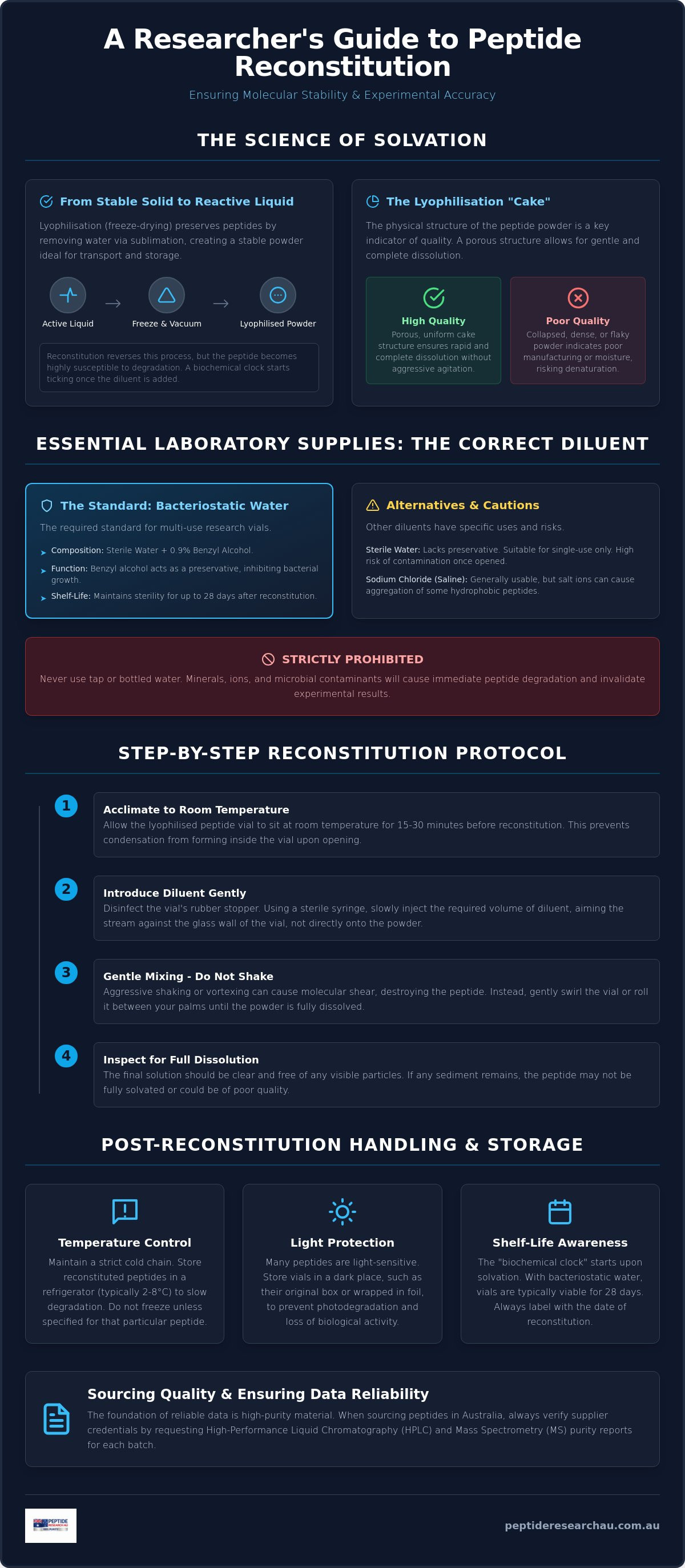
The physical structure of the peptide, often referred to as the "lyophilisation cake," plays a vital role in how effectively it dissolves. High-quality research compounds possess a porous, uniform cake structure. This porosity allows the diluent to penetrate the mass through capillary action, ensuring rapid and complete dissolution without the need for aggressive mechanical agitation. When a cake is collapsed or dense, it indicates poor manufacturing standards or moisture ingress, both of which increase the risk of denaturation. Protecting the Principles of the Peptide Bond is essential during this phase; these covalent links are sensitive to pH extremes and rapid temperature shifts that occur during careless solvation.
The Lyophilisation Process
Lyophilisation, or freeze-drying, preserves the molecular structure of peptides by removing water through sublimation. During this process, ice turns directly into vapour under a vacuum, bypassing the liquid phase. This is why research peptides are shipped in powdered form; it's the most stable state for long-term storage and international or domestic Australian transport. Laboratory-grade compounds frequently include cryoprotectants. These substances prevent the formation of sharp ice crystals that could otherwise shear the delicate peptide chains during the initial freezing stage of production.
Molecular Stability Post-Solvation
The transition from a stable solid state to a reactive liquid state marks the point where the peptide's shelf-life begins to diminish rapidly. While the solid form is relatively inert, the solvated form is susceptible to hydrolysis, oxidation, and microbial proliferation. Several factors influence the rate of degradation after mixing, including the final concentration of the solution and the presence of stabilising agents in the diluent. In the Australian research environment, where ambient temperatures can fluctuate significantly, maintaining a strict cold chain post-reconstitution is mandatory to prevent the loss of molecular potency. Once the vacuum seal is broken and the diluent is introduced, the compound's biochemical clock starts, requiring immediate adherence to storage protocols.
Essential Laboratory Supplies: Selecting the Correct Diluent
The chemical integrity of a peptide solution is directly influenced by the solvent used during the restoration process. A comprehensive peptide reconstitution guide must distinguish between various diluents, as each possesses unique properties that affect molecular stability. Using non-laboratory grade liquids, such as tap or bottled water, is strictly prohibited; these contain minerals, ions, and microbial life that cause immediate peptide degradation or precipitation.
Bacteriostatic water is the established standard for multi-use research vials in Australia. It consists of sterile water containing 0.9% benzyl alcohol, which serves as a preservative to inhibit the growth of most potentially contaminating bacteria. In contrast, sterile water for injection lacks this preservative. While suitable for single-use applications, sterile water becomes a liability once the vial's seal is breached. Sodium chloride (saline) is another option, though the presence of salt ions can occasionally trigger the aggregation of specific hydrophobic peptides. Sourcing high-purity laboratory diluents from domestic providers ensures that the chemical baseline of your study remains consistent.
The Chemistry of Bacteriostatic Water
Benzyl alcohol functions by disrupting the cell membranes of bacteria, effectively halting their reproduction. This bacteriostatic property is vital for maintaining a sterile environment over the typical 28-day lifespan of a reconstituted vial. The presence of this agent also slightly alters the pH of the solution, which can influence the solubility of certain compounds. Researchers should store unopened bacteriostatic water in a cool, dark environment to prevent the degradation of the preservative agent itself.
Syringe and Needle Selection
Precision is the primary requirement when handling micro-litre volumes. U-100 insulin syringes are the preferred tool for micro-dosing due to their clear graduations and thin needle gauges, which minimise damage to the vial's rubber stopper. Maintaining a sterile field is mandatory; this includes using 70% isopropyl alcohol swabs on all contact surfaces before the needle enters the vial. Scientists must also account for "dead space," the small volume of liquid that remains in the syringe hub after the plunger is fully depressed. In high-sensitivity assays, failing to account for this residual volume can result in significant dosage inaccuracies across a series of samples.
Step-by-Step Reconstitution Protocol: Standardised Methodology
Adhering to a standardised peptide reconstitution guide is the only way to ensure experimental repeatability across multiple assays. The protocol begins with environmental control. Researchers must work within a clean, draught-free space, ideally under a laminar flow hood. Sterilise the benchtop and the rubber stoppers of both the diluent and the peptide vials using 70% isopropyl alcohol. It's vital to allow the lyophilised vial to reach room temperature, approximately 20 to 25 degrees Celsius, before introducing any liquid. This prevents internal condensation and reduces the risk of thermal shock, which can compromise the integrity of sensitive amino acid sequences.
Most laboratory-grade research vials are packed under a vacuum to enhance stability during transit. This vacuum presents a significant risk during the initial solvation phase. If the diluent is allowed to be "sucked" into the vial rapidly by the negative pressure, the resulting mechanical force can shear the delicate peptide chains. You must maintain manual control of the syringe plunger, allowing the diluent to enter the vial in a slow, controlled stream to mitigate this effect.
The Injection and Mixing Phase
The physical method of introducing the diluent dictates the success of the solvation. Aim the needle toward the inner glass wall of the vial rather than striking the lyophilised cake directly. The liquid should trickle down the glass to meet the powder gradually. Once the diluent is added, the "swirl vs. shake" rule is absolute. Never shake the vial. Shaking introduces air bubbles and causes foaming, which leads to the denaturation of the compound. Instead, use a gentle swirling motion. Rotate the vial slowly until the solution is completely clear and no visible particles remain.
Pressure Equalisation and Aliquoting
Internal vial pressure must be managed to ensure accurate volume draws in future steps. After the diluent is introduced, insert an empty, sterile syringe into the vial to allow the internal and external pressures to equalise. For studies spanning several weeks, aliquoting the solution into smaller, single-use sterile vials is a standard laboratory practice. This prevents the molecular degradation caused by frequent temperature fluctuations and repeated needle penetrations of the primary stopper. Every aliquot requires precise labelling, including the date of reconstitution, the final concentration in mg/mL, and the specific diluent type used.
Stability, Storage, and Post-Reconstitution Handling
The post-reconstitution phase is a critical window where molecular integrity is most vulnerable to environmental stressors. Once a compound is solvated, its biochemical clock accelerates, making strict adherence to this peptide reconstitution guide essential for data validity. Most research peptides remain viable in liquid form for approximately 28 to 30 days when stored under optimal conditions. Beyond this period, the risk of hydrolysis increases, leading to a measurable loss of potency. Researchers must monitor vials for visual signs of degradation, such as persistent cloudiness, the formation of precipitates, or unexpected colour shifts. Any change in the solution's clarity suggests that the peptide bonds have been compromised or that microbial contamination has occurred.
Light sensitivity is another factor that often goes overlooked in the laboratory. UV exposure can trigger the photolysis of specific amino acid residues, particularly those containing aromatic rings. Storing vials in amber glass or within opaque secondary containers is a standard requirement. To ensure your study utilizes materials that haven't already begun this degradation process, it's vital to buy research peptides from suppliers who maintain strict climate-controlled domestic shipping within Australia.
Cold Storage Protocols
Maintaining a temperature between 2°C and 8°C is the baseline requirement for active research compounds. This refrigeration range slows down the kinetic energy of the molecules, reducing the rate of spontaneous chemical reactions. You should never refreeze a peptide once it has been reconstituted. The formation of ice crystals during a second freeze cycle creates significant mechanical shear stress, which can physically tear the peptide chains apart. It's also important to store vials away from the refrigerator door to avoid the frequent temperature fluctuations caused by opening and closing the unit.
Managing Peptide Aggregation
Aggregation occurs when peptide molecules clump together, forming insoluble particles or "floaters." This is frequently a pH-dependent issue. For example, GHK-Cu is notably sensitive to acidic environments and may precipitate if the diluent's pH is too low. Conversely, BPC-157 is generally more robust across a wider pH range but remains susceptible to oxidation if the vial's headspace is not properly managed. If a solution remains turbid after gentle swirling, it may indicate that the peptide has reached its isoelectric point, where its net charge is zero, causing it to drop out of the solution. Troubleshooting these issues requires a precise understanding of the specific peptide's chemical properties and the ionic strength of the chosen diluent.
Sourcing Quality Laboratory Supplies and Peptides in Australia
Domestic sourcing within Australia has become a strategic necessity for research continuity. As the TGA designates unapproved peptides as a compliance priority for 2026, laboratories must ensure their procurement channels are transparent and legally sound. International imports are frequently intercepted by the Australian Border Force; a significant crackdown in May 2026 resulted in the seizure of over 900,000 units of illicit therapeutic goods. Sourcing from Peptide Research AU avoids these customs hurdles while providing a verifiable chain of custody for all research compounds. Using this peptide reconstitution guide in conjunction with high-purity domestic materials ensures that your data remains untainted by the contaminants often found in unregulated international shipments.
The "Research Use Only" (RUO) designation is a critical regulatory standard. It signifies that the compounds are intended for laboratory study by qualified professionals and haven't been evaluated for human consumption. This distinction is vital for maintaining compliance with Australian regulations. Reliable suppliers provide comprehensive documentation to support this status, ensuring that institutional research meets the necessary ethical and legal benchmarks. Choosing a domestic partner like Peptide Research AU allows for direct communication and technical accountability that international wholesalers can't match.
Quality Assurance Standards
Evaluating supplier purity requires a technical understanding of High-Performance Liquid Chromatography (HPLC) and Mass Spectrometry (MS). Every batch should be accompanied by a Certificate of Analysis (CoA) that confirms both the sequence identity and the purity percentage. For longitudinal studies, batch-to-batch consistency is mandatory to prevent variables that could skew results. The purity of laboratory diluents is equally important; even a 99% pure peptide will degrade if the bacteriostatic water contains trace metallic ions or organic impurities. We provide diluents that meet rigorous laboratory-grade standards to protect your molecular assets.
Logistics and Domestic Reliability
Sensitive research materials require specific environmental controls during transit. Cold-chain shipping is essential for many compounds to prevent thermal degradation before they reach your laboratory. When you order peptides Australia wide, domestic logistics providers offer faster turnaround times, often reducing the window of environmental exposure to less than 24 to 48 hours. This efficiency is a safeguard for the molecular stability of your compounds. Additionally, Australian-based technical support provides researchers with immediate access to expertise regarding specific reconstitution challenges or solubility issues, ensuring that your project remains on schedule and your data remains reliable.
Advancing Experimental Precision in Peptide Research
Maintaining the biological activity of research compounds requires a meticulous approach to every stage of the solvation process. By adhering to this peptide reconstitution guide, researchers ensure that their data remains reliable and their molecular structures remain intact. Success depends on the trifecta of environmental control, the selection of high-purity laboratory diluents, and the elimination of mechanical stress during mixing. These standards aren't just recommendations; they're the foundation of repeatable, high-precision science in the Australian research community.
Consistency in your results begins with the quality of your starting materials. Every batch we provide undergoes rigorous HPLC and MS testing to verify purity before it enters our domestic distribution network. We also offer specialised laboratory-grade diluents designed to maximise the shelf-life of your solvated compounds. All orders are supported by fast domestic shipping across Australia to maintain the integrity of the cold chain throughout transit. Protecting your research investment starts with sourcing from a partner that values precision as much as you do.
Shop Laboratory-Grade Research Peptides and Supplies and secure the reliability of your next study.
Frequently Asked Questions
How much bacteriostatic water should I add to a 5mg peptide vial?
The volume depends on the desired concentration, but 2mL is a standard laboratory baseline for a 5mg vial. This creates a concentration of 2.5mg/mL, which is sufficient for most research applications as it ensures complete solvation without over-diluting the compound. Always consult your specific research protocol to determine if a different concentration is required. Precise volume measurement is essential for maintaining consistent micro-dosing across all study subjects in your assay.
Can I use sterile water instead of bacteriostatic water for reconstitution?
Sterile water is appropriate only if the entire vial is used immediately after reconstitution. Because it lacks a preservative like benzyl alcohol, it cannot prevent microbial growth once the seal is breached. For multi-use vials intended for storage, bacteriostatic water is the mandatory standard. Using sterile water in a multi-use context risks contaminating the research material and compromising the integrity of your longitudinal data over the course of the study.
How long do peptides stay stable after they have been reconstituted?
Most reconstituted peptides remain stable for approximately 28 to 30 days when refrigerated at 2-8°C. Biological potency begins to decline after this window due to hydrolysis and other degradation pathways. This peptide reconstitution guide recommends discarding any solutions that exceed this timeframe to ensure experimental accuracy. Some sensitive sequences may degrade even faster. Always monitor the solution for changes in clarity, which serve as visual indicators that the peptide bonds have begun to break down.
Why is it important to inject the diluent down the side of the vial?
Injecting down the side prevents the diluent from striking the lyophilised cake directly, which avoids foaming and molecular shear. Peptides are delicate chains of amino acids that can be physically damaged by high-velocity impacts. By allowing the liquid to trickle down the glass wall, you ensure a gentle interaction between the solvent and the solute. This technique prevents the formation of air bubbles and foam, which can render the compound biologically inactive.
What should I do if my peptide powder does not fully dissolve?
If particles remain after the initial mix, allow the vial to sit in the refrigerator for several hours or gently swirl it again. Never shake the vial to force dissolution. Some hydrophobic peptides require more time to reach a fully solvated state. If the solution remains turbid, you might need to adjust the pH slightly or use a different diluent. Persistent cloudiness often indicates that the peptide has precipitated or was not manufactured to the required purity standards.
Can I pre-mix different peptides like BPC-157 and TB-500 in the same vial?
No, it's not recommended to mix different peptides in the same vial due to the risk of cross-reactions and aggregation. Combining compounds like BPC-157 and TB-500 in a single solution can lead to unpredictable molecular interactions. These interactions may alter the solubility or biological activity of both substances. To maintain the integrity of your research, reconstitute and store each compound in its own sterile vial and only combine them during the final assay if required.
Is it normal for the vial to have a vacuum when I first insert the needle?
The presence of a vacuum is normal and confirms that the vial's seal remained intact during transit and storage. Most laboratory-grade research vials are vacuum-sealed to prevent oxidation. You must manage this pressure carefully during reconstitution to prevent the diluent from being pulled in too quickly. Control the syringe plunger manually to ensure a slow, steady release of the liquid. Once the diluent is added, equalise the internal pressure by inserting an empty, sterile syringe.
How do I calculate the concentration of my peptide solution?
Divide the total mass of the peptide in milligrams by the volume of diluent added in millilitres. Calculating the concentration is a fundamental step in any peptide reconstitution guide. For instance, adding 2mL of bacteriostatic water to a 5mg vial results in a concentration of 2.5mg/mL. This means every 0.1mL contains 0.25mg of the compound. Maintaining a clear log of these calculations is essential for ensuring that every dose in your study is accurate and repeatable.


Comments