
Peptide Research for Athletic Performance AU: A 2026 Scientific Overview
- peptideresearchau
- 3 days ago
- 11 min read
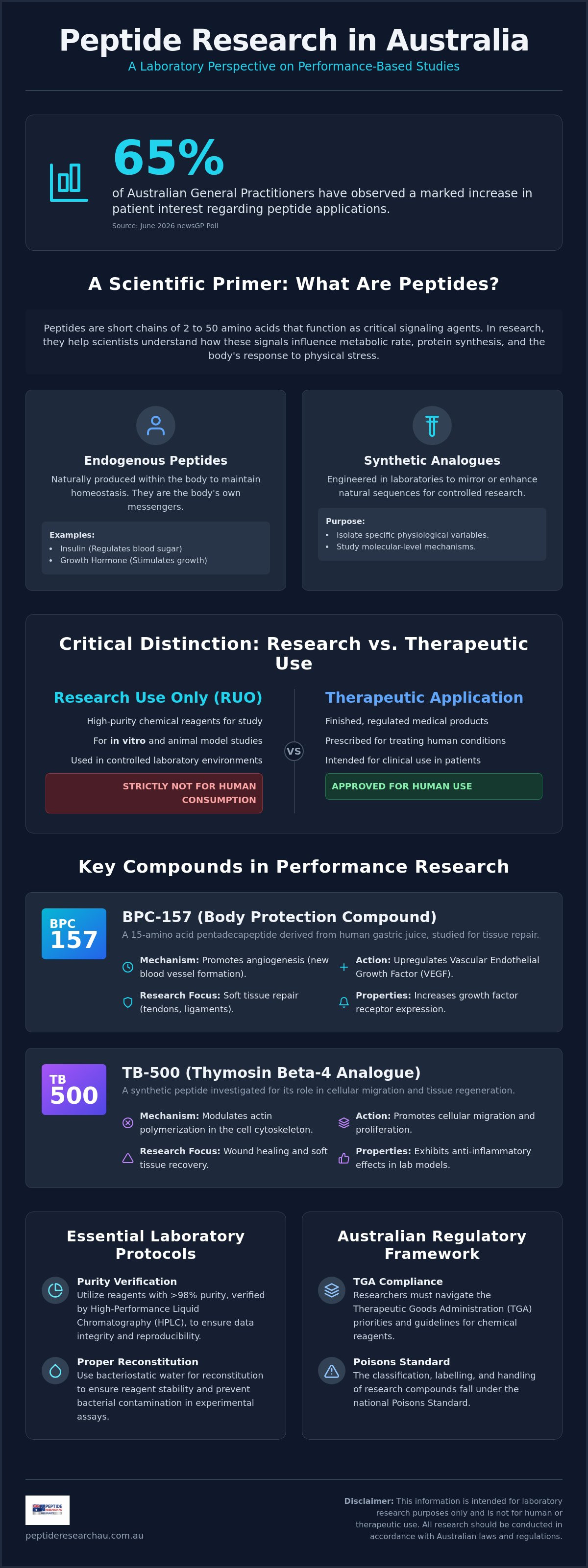
A June 2026 newsGP poll indicates that 65 percent of Australian General Practitioners have observed a marked increase in patient interest regarding peptide applications. This surge highlights a critical need for clarity within the scientific community, as the distinction between clinical use and Peptide research for athletic performance AU remains a point of significant regulatory focus. For laboratory researchers, the challenge lies in navigating the 2026 TGA compliance priorities while maintaining the integrity of molecular signaling studies.
You likely recognize that the landscape of peptide procurement is increasingly complex, especially with heightened scrutiny on high-purity reagents. This analysis provides a technical deep dive into the biochemical mechanisms of BPC-157 and TB-500, focusing strictly on their utility in controlled laboratory environments. We will clarify the essential differences between research-grade compounds and prohibited substances, outline current Australian regulatory frameworks, and establish rigorous protocols for handling these specialized chemical reagents.
Table of Contents
Defining Peptide Research for Athletic Performance in Australia
Peptides are short chains of amino acids, typically consisting of 2 to 50 units, linked by covalent peptide bonds. In the context of physiological research, these molecules function as critical signaling agents that coordinate complex biological processes. They act as messengers, binding to specific cell surface receptors to trigger intracellular cascades. Peptide research for athletic performance AU focuses on how these signaling pathways influence metabolic rate, protein synthesis, and the body's systemic response to physical stress.
A fundamental distinction exists between endogenous peptides and synthetic research analogues. Endogenous peptides are produced naturally within the human body, such as insulin or growth hormone, to maintain homeostasis. Synthetic analogues are engineered in laboratory settings to mirror these natural sequences or to enhance specific properties, such as half-life or receptor affinity. Researchers utilize these synthetic versions to isolate specific physiological variables without the confounding factors present in full-length proteins. This precision allows for a granular understanding of how skeletal muscle hypertrophy and connective tissue repair occur at a molecular level.
The Evolution of Peptide Science
The history of peptide discovery in exercise physiology has shifted from broad hormonal studies to highly targeted molecular research. Early investigations focused primarily on insulin and its role in nutrient partitioning. However, the trajectory has moved toward understanding site-specific repair mechanisms. By 2026, Australian laboratory studies have increasingly focused on the molecular triggers for rapid tissue recovery. This evolution reflects a broader trend in science where researchers seek to map the exact signaling cascades that govern how the body adapts to high-intensity resistance or endurance training.
Research vs. Therapeutic Application
It's vital to maintain a clear boundary between Research Use Only (RUO) standards and therapeutic applications. Research peptides are high-purity chemical reagents intended for in vitro studies or animal models within controlled environments. They are not finished consumer products, nor are they intended for human consumption or clinical use. In Australian laboratories, these compounds facilitate the study of cellular behavior under specific conditions. For example, scientists use BPC-157 to observe its interaction with tendon fibroblasts and its potential role in modulating angiogenic factors. This distinction ensures that the scope of Peptide research for athletic performance AU remains focused on data acquisition and biochemical analysis rather than medical intervention.
The integrity of experimental data depends entirely on the use of laboratory-grade compounds. Valid research requires reagents that meet strict purity benchmarks, often exceeding 98 percent as verified by High-Performance Liquid Chromatography (HPLC). Lower-grade or industrial chemicals often contain residual solvents or truncated peptide sequences that can compromise cellular assays. Using professional-grade research compounds and high-quality laboratory diluents ensures that findings are reproducible and scientifically sound. This commitment to quality is the cornerstone of modern Australian peptide research.
Key Compounds in Performance-Based Peptide Research
Peptide research for athletic performance AU centers on identifying specific amino acid sequences that exert localized and systemic effects on biological systems. Unlike broad-spectrum hormones, these research compounds often target precise cellular pathways involved in structural integrity and energy metabolism. By isolating these mechanisms, scientists can better understand the physiological limitations of recovery and performance within controlled laboratory settings. Current studies focus heavily on peptides that modulate the extracellular matrix and mitochondrial function.
BPC-157 and Tissue Repair Mechanisms
BPC-157, a 15-amino acid pentadecapeptide derived from human gastric juice, is a primary focus in soft tissue research. It's recognized for its stable molecular structure and its role in promoting angiogenesis, which is the formation of new blood vessels. This process is often observed through the upregulation of Vascular Endothelial Growth Factor (VEGF) in research models. By stimulating angiogenic pathways, BPC-157 facilitates the delivery of oxygen and nutrients to poorly vascularized tissues, such as tendons and ligaments. Experimental data suggests it also increases the expression of growth factor receptors, which may enhance the body's natural response to structural micro-trauma. Researchers can find detailed technical specifications in this BPC-157 guide for scientific studies.
Thymosin Beta-4 (TB-500) and Cellular Recovery
Thymosin Beta-4, frequently studied via its synthetic analogue TB-500, is a major actin-sequestering protein found in almost all mammalian cells. Its primary mechanism involves binding to G-actin, which regulates the polymerization of the cellular cytoskeleton. This action is essential for cell migration, allowing progenitor cells to move efficiently to sites of physiological stress or damage. Research into TB-500 also investigates its influence on inflammatory cytokines and its potential to modulate the healing environment of the extracellular matrix. Understanding these actin-binding properties is crucial for researchers investigating cellular motility and repair. For further analysis of its biochemical properties, scientists often consult a TB-500 guide.
Metabolic signaling research has expanded to include MOTS-c, a mitochondrial-derived peptide. It's currently investigated for its role in the mitochondrial-to-nucleus signaling pathway, which influences insulin sensitivity and metabolic flexibility during physical exertion. Simultaneously, GHK-Cu is analyzed for its role as a copper-tripeptide complex. It's essential for collagen synthesis and maintaining the integrity of connective tissues. Researchers requiring high-purity reagents for these studies can explore our specialized research compound inventory to ensure experimental consistency and data accuracy.
Navigating the Australian Regulatory Framework for Research
The Australian regulatory environment for Peptide research for athletic performance AU is governed by the Therapeutic Goods Administration (TGA) and the Standard for the Uniform Scheduling of Medicines and Poisons (SUSMP). As of 2026, the TGA has designated unapproved peptide products as a primary compliance priority. Most synthetic peptides are categorized under Schedule 4 (Prescription Only Medicines), meaning their possession and supply are strictly regulated. For researchers, this means that while compounds are acquired for laboratory study, they must remain within the legal framework of "Research Use Only" (RUO) to ensure compliance with state and federal laws.
Sport Integrity Australia and Prohibited Lists
The 2026 World Anti-Doping Agency (WADA) Prohibited List, enforced domestically by Sport Integrity Australia, classifies many research peptides under sections S0 (Non-approved substances) or S2 (Peptide hormones, growth factors, and related substances). These substances are typically prohibited at all times, both in and out of competition. For scientists conducting Peptide research for athletic performance AU, it's essential to understand that any participation of competitive athletes in studies involving these compounds can lead to anti-doping rule violations. This distinction is critical; while a compound might be legally held for in vitro laboratory analysis, its administration to a human subject in a performance context is subject to severe penalties and professional sanctions.
Compliance in Peptide Procurement
Securing high-purity reagents requires a meticulous approach to sourcing. Importing research compounds from international vendors often results in seizure by Australian Border Force if the documentation doesn't meet TGA requirements for unapproved substances. Domestic procurement from established Australian providers mitigates these risks, ensuring that the supply chain remains transparent and compliant with local standards. This domestic focus also allows for better verification of purity through independent laboratory testing. Researchers can refer to the Peptides Australia guide for comprehensive details on quality standards and sourcing protocols for the 2026 calendar year.
The legal landscape in 2026 reflects a period of heightened vigilance. State-specific penalties for the illegal possession of restricted substances vary significantly, with fines in the Australian Capital Territory reaching up to $66,000. Researchers must maintain rigorous documentation that clearly defines the intended laboratory application of all acquired compounds. By adhering to these standards, the scientific community can continue to explore the molecular signaling of peptides without infringing upon the regulatory boundaries established to protect public health and sport integrity.
Laboratory Protocols: Handling and Reconstituting Peptides
Maintaining the structural integrity of amino acid chains is paramount for the validity of Peptide research for athletic performance AU. Peptides are inherently fragile molecules. Their secondary and tertiary structures can easily denature if subjected to thermal stress, UV exposure, or mechanical agitation. Researchers must adhere to standardized laboratory protocols to ensure that the biochemical signaling observed in experimental models is a result of the peptide itself rather than degraded fragments or contaminants.
The selection of a proper diluent is the first step in ensuring research accuracy. Bacteriostatic water, which contains 0.9 percent benzyl alcohol, is the industry standard for reconstituting research peptides. This additive inhibits the growth of potentially transformative bacteria within the vial, preserving the compound for multiple withdrawals over the course of a study. Using simple sterile water without a bacteriostatic agent significantly increases the risk of contamination and rapid molecular breakdown. For high-precision studies, researchers should source laboratory diluents that meet strict purity requirements to maintain reagent stability.
Reconstitution Best Practices
Precision in concentration is achieved through careful calculation of diluent ratios. If a researcher requires a concentration of 2mg/mL for a 5mg vial, 2.5mL of bacteriostatic water must be introduced. Most high-quality research vials are sealed under a vacuum. When introducing the diluent, the researcher should allow the vacuum to draw the liquid in slowly. The stream should be directed against the glass wall of the vial rather than directly onto the lyophilized powder to prevent "flash" denaturation. A successful reconstitution results in a completely clear solution. Any cloudiness or persistent particulates typically indicate that the peptide has denatured or that the purity of the reagent is compromised.
Storage and Stability Standards
Lyophilized peptides are significantly more stable than their reconstituted counterparts. In their freeze-dried state, these compounds can often be stored at room temperature for short periods, though long-term storage requires temperatures of -20 degrees Celsius or lower. Once reconstituted, the stability window narrows considerably. Most peptides must be kept in a refrigerated environment between 2 and 8 degrees Celsius. Exposure to heat or light will accelerate the cleavage of peptide bonds, rendering the compound useless for Peptide research for athletic performance AU. Additionally, vials should never be shaken. Gentle swirling is the only acceptable method for mixing, as vigorous agitation can break the delicate covalent bonds of the peptide sequence.
Adhering to these meticulous handling standards ensures that experimental results remain reproducible. By controlling variables such as temperature, diluent quality, and mechanical stress, researchers can isolate the specific physiological signaling pathways they intend to study. This technical discipline is the foundation of high-quality Australian laboratory research.
Sourcing High-Purity Research Peptides in Australia
The final phase of any rigorous Peptide research for athletic performance AU involves the procurement of chemical reagents that meet exacting purity standards. Identifying the difference between laboratory-grade and industrial-grade compounds is critical for experimental validity. Industrial-grade peptides often contain residual solvents, heavy metals, or truncated sequences that can interfere with cellular signaling assays. In contrast, laboratory-grade reagents are manufactured under strict quality control protocols to ensure that the amino acid sequence is precisely as intended and free from contaminants that could skew data or cause unexpected cellular reactions.
Domestic vs. International Sourcing
For Australian researchers, domestic sourcing offers significant advantages regarding molecular stability. Peptides are thermally sensitive; extended transit times associated with international shipping expose lyophilized powders to unpredictable temperature fluctuations. These fluctuations can lead to premature degradation before the research even begins. Domestic supply chains provide reduced transit times, ensuring that the compounds remain within stable parameters. Additionally, sourcing within Australia ensures that the procurement process aligns with domestic laboratory standards and avoids the frequent seizures by Border Force that occur with international research shipments. Reliability in the supply chain is essential for long-term longitudinal studies where consistent reagent batches are required.
Research Compound Quality Control
Verification of supplier credentials must go beyond surface-level claims. Reliable providers utilize High-Performance Liquid Chromatography (HPLC) and Mass Spectrometry (MS) to verify both the purity and the identity of the peptide. HPLC determines the percentage of the target peptide in the sample, while MS confirms that the molecular weight matches the intended amino acid sequence. Peptide Research AU prioritizes these laboratory-grade standards to provide researchers with the precision required for high-stakes studies. Understanding these technical benchmarks is vital for anyone entering this field. For a deeper analysis of the biochemical properties of these molecules, researchers often refer to a What are Peptides guide to establish a baseline for their scientific inquiries.
Final research design must account for the consistency of the chemical reagents used across all experimental groups. Variations in purity levels can introduce significant variables that compromise the reproducibility of the study. Researchers should maintain a comprehensive log of batch numbers and corresponding purity certificates. By combining high-purity domestic sourcing with the rigorous laboratory protocols and regulatory awareness discussed in previous sections, scientists can conduct Peptide research for athletic performance AU that contributes meaningful, accurate data to the global body of physiological knowledge. This meticulous approach to sourcing is the final safeguard in the scientific method.
Advancing Physiological Discovery through Precise Methodology
Modern scientific inquiry requires a strict adherence to regulatory standards and laboratory precision. This overview has established that successful Peptide research for athletic performance AU depends on distinguishing between research-grade reagents and prohibited substances while maintaining rigorous reconstitution protocols. Utilizing specialized diluents like bacteriostatic water and ensuring climate-controlled storage are essential steps in preserving the molecular integrity of your samples. These technical disciplines ensure that the data collected is both accurate and reproducible within a professional environment.
Securing high-purity compounds is the final safeguard for any experimental design. By choosing domestic Australian shipping, researchers minimize the risks of thermal degradation and customs interference, ensuring that every study begins with stable, reliable material. Our commitment to excellence provides the scientific community with the tools necessary to map complex cellular signaling pathways with absolute confidence. Explore our range of laboratory-grade research peptides to enhance the accuracy of your next project. We're dedicated to supporting your contribution to the future of exercise physiology and biochemical science.
Frequently Asked Questions
Are peptides legal for athletic performance research in Australia?
Peptides are legal for laboratory study when utilized within a strictly defined Research Use Only framework. Most synthetic analogues are classified as Schedule 4 substances under the Poisons Standard, requiring appropriate authority for possession. As of 2026, the TGA has intensified compliance monitoring to ensure these chemical reagents remain in controlled environments and are not diverted for unapproved clinical or athletic use.
What is the difference between research peptides and supplements?
Research peptides are high-purity chemical reagents intended for laboratory analysis; supplements are finished consumer products designed for human ingestion. Unlike oral supplements, research compounds are typically provided as lyophilized powders and require precise reconstitution with laboratory diluents. They lack the fillers and binders found in consumer goods, focusing instead on molecular purity to ensure the accuracy of signaling studies.
How should BPC-157 be stored in a laboratory environment?
BPC-157 must be stored in a climate-controlled setting to prevent molecular denaturation. Lyophilized vials should be kept at -20 degrees Celsius for long-term stability, while reconstituted solutions require refrigeration between 2 and 8 degrees Celsius. Exposure to UV light or temperatures exceeding 25 degrees Celsius will accelerate the cleavage of peptide bonds, which compromises the integrity of the experimental data.
Can athletes use peptides for recovery under WADA rules?
Athletes are prohibited from using peptides for recovery under the 2026 WADA Prohibited List. Substances such as BPC-157 and TB-500 fall under categories S0 and S2, making them prohibited at all times, both in and out of competition. Any administration to a competitive athlete subject to Sport Integrity Australia oversight results in severe professional sanctions and anti-doping rule violations.
What is the role of bacteriostatic water in peptide research?
Bacteriostatic water serves as a specialized diluent containing 0.9 percent benzyl alcohol to inhibit bacterial growth. This preservation is critical for Peptide research for athletic performance AU because it allows for multiple withdrawals from a single vial over an extended study period. Without this agent, the peptide solution would quickly succumb to contamination, leading to rapid degradation and invalid research outcomes.
Why is purity testing essential for performance-based research?
Purity testing ensures that observed physiological effects are caused solely by the target amino acid sequence. Impurities or residual solvents can trigger secondary biological responses that confound experimental results and decrease reproducibility. Utilizing High-Performance Liquid Chromatography (HPLC) allows researchers to verify that a compound meets the 98 percent or higher purity benchmark required for rigorous scientific analysis.
How do I calculate the correct concentration for research peptides?
Concentration is determined by dividing the total peptide mass by the volume of diluent introduced to the vial. For example, adding 2mL of bacteriostatic water to a 5mg vial creates a concentration of 2.5mg/mL. Accurate calculations are fundamental to the scientific method, ensuring that delivery in laboratory models remains consistent across all experimental groups for valid data acquisition.
What are the risks of using unapproved peptides in an athletic context?
The risks involve significant legal consequences and unknown health hazards from unregulated chemical compounds. In 2026, state-specific fines for illegal possession can reach $66,000, and unapproved substances often contain harmful contaminants or incorrect sequences. Conducting Peptide research for athletic performance AU outside of a compliant laboratory setting bypasses TGA safety evaluations and exposes individuals to high-risk, unverified reagents.


Comments