
Tirzepatide for Laboratory Research AU: A Comprehensive 2026 Guide
- peptideresearchau
- Jul 6
- 12 min read
The Therapeutic Goods Administration has officially designated unapproved peptide products as a primary compliance priority for 2026. This shift underscores the necessity for absolute precision when sourcing tirzepatide for laboratory research au. Most researchers recognize that the gap between theoretical potential and empirical success is often widened by inconsistent chemical purity or documentation gaps. When you're managing a study, there's no room for uncertainty regarding Certificate of Analysis (COA) verification or the stability of dual-agonist compounds during transit.
This guide provides a comprehensive technical framework for the application of Tirzepatide within professional Australian laboratory environments. We'll examine the specific GIP and GLP-1 receptor pathways to clarify how this synergistic mechanism influences metabolic data. You'll find a detailed analysis of reconstitution protocols and handling standards designed to preserve peptide integrity. By focusing on domestic sourcing and rigorous quality control, we'll outline a path to establishing a reliable research protocol that minimizes lead times and maximizes data reliability for your upcoming projects.
Table of Contents
Understanding Tirzepatide: A First-in-Class Dual Agonist for Metabolic Research
The Synergistic Mechanism: GIP and GLP-1 Receptor Engagement
Laboratory Handling Protocols: Reconstitution and Storage of Tirzepatide
Sourcing Tirzepatide in Australia: Purity Standards and Domestic Logistics
Current Directions in Tirzepatide Research: Beyond Glucose Regulation
Understanding Tirzepatide: A First-in-Class Dual Agonist for Metabolic Research
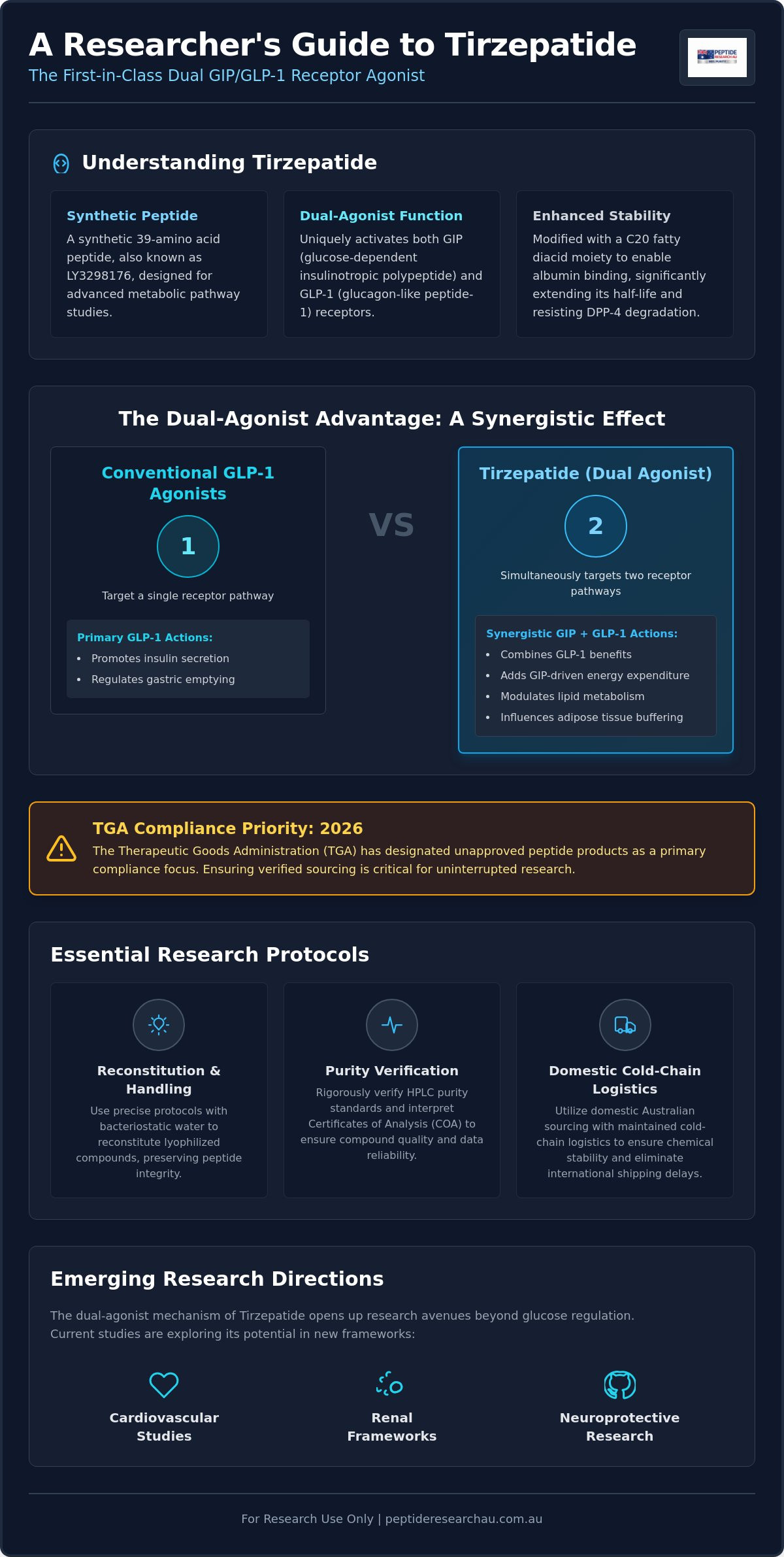
Tirzepatide, identified in scientific literature as LY3298176, represents a significant advancement in the study of metabolic pathways. It's a synthetic 39-amino acid peptide that functions as a dual agonist. Unlike traditional research compounds that target a single pathway, tirzepatide for laboratory research au allows investigators to examine the simultaneous activation of two distinct incretin receptors. This biochemical profile is essential for modern endocrine studies focusing on glycemic control and lipid metabolism.
Molecular Structure and Synthesis
The molecular architecture of Tirzepatide is based on the native GIP sequence. It incorporates specific modifications to enhance stability and receptor affinity. Tirzepatide is a dual GIP and GLP-1 receptor agonist with a C20 fatty diacid moiety. This acylation is critical because it facilitates albumin binding, which significantly extends the compound's half-life in laboratory models. Researchers rely on this structural integrity to ensure the peptide resists rapid enzymatic degradation by dipeptidyl peptidase-4 (DPP-4). Detailed structural data available on Tirzepatide on Wikipedia confirms that the sequence includes two non-proteinogenic amino acids at positions 2 and 13 to further prevent proteolysis.
Tirzepatide vs. Conventional GLP-1 Agonists
Standard GLP-1 receptor agonists have long been the baseline for metabolic research. Tirzepatide deviates from this single-agonist model by integrating GIP receptor engagement. While GLP-1 agonists primarily focus on insulin secretion and gastric emptying, GIP activity adds a layer of regulation regarding adipose tissue metabolism and glucagon secretion. This dual-pathway engagement is the current focus of endocrine research because it creates a synergistic effect that single agonists cannot replicate. When evaluating these compounds, researchers should consult established guidelines for peptides in Australia to ensure that the chemical analogues used in the lab meet international purity standards.
In Australian research environments, the application of tirzepatide for laboratory research au has expanded beyond simple glucose monitoring. Current studies utilize this peptide to explore complex interactions between incretin hormones and systemic energy balance. The peptide's 39-amino acid chain is synthesized to maintain high potency at both receptors, though it exhibits a balanced affinity that favors the GIP receptor. This specific ratio is a key variable in longitudinal metabolic studies. Researchers must account for these receptor affinity profiles when designing experimental protocols to ensure the data accurately reflects the dual-agonist mechanism.
The Synergistic Mechanism: GIP and GLP-1 Receptor Engagement
Tirzepatide functions as a unimolecular dual agonist. It targets both the glucose-dependent insulinotropic polypeptide (GIP) receptor and the glucagon-like peptide-1 (GLP-1) receptor. This dual engagement creates what researchers term the "twincretin" effect. By activating both pathways simultaneously, the compound achieves metabolic outcomes that exceed the capabilities of single-receptor agonists. This synergy is the primary driver behind its effectiveness in complex metabolic models.
When these receptors are engaged, they initiate a cascade of downstream intracellular events. The primary mechanism involves the activation of adenylate cyclase, which increases intracellular cyclic adenosine monophosphate (cAMP) levels. This rise in cAMP subsequently activates protein kinase A (PKA) and exchange protein directly activated by cAMP (Epac2). These pathways are essential for researchers to monitor when assessing the efficacy of tirzepatide for laboratory research au in metabolic environments. The integration of these two signals allows for a more nuanced regulation of cellular metabolism than traditional peptides provide.
GIP Receptor Activity in Metabolic Models
GIP receptors are highly expressed in pancreatic beta-cells and adipose tissue. In research models, GIP activity promotes energy expenditure and modulates lipid metabolism. Unlike GLP-1, GIP has a significant role in adipose tissue buffering, which influences how fat is stored and utilized. Researchers studying energy balance find that GIP-mediated insulin secretion is highly glucose-dependent. This provides a controlled environment for metabolic observation, allowing for a clearer understanding of how nutrient intake influences hormonal response.
GLP-1 Signaling and Glucose Regulation
GLP-1 signaling is characterized by its impact on the gastrointestinal tract and the pancreas. It slows gastric emptying and enhances satiety signaling within the central nervous system. GLP-1 receptor engagement modulates glucose-dependent insulin secretion by sensitizing pancreatic beta-cells to ambient glucose levels. This prevents the over-secretion of insulin when glucose levels are low. For a broader perspective on how these mechanisms translate to clinical data, the FDA Drug Trials Snapshots for Mounjaro offer detailed insights into the efficacy observed during large-scale trials. These trials highlight the consistent performance of the dual-agonist approach compared to traditional methods.
Understanding these dual pathways is fundamental for designing rigorous experiments. Researchers often require high-purity multi-peptide complexes to explore these complex interactions in a controlled laboratory setting. Utilizing tirzepatide for laboratory research au ensures that investigators can observe the full spectrum of dual-incretin activity without the interference of chemical impurities.
Laboratory Handling Protocols: Reconstitution and Storage of Tirzepatide
Precise laboratory handling is as critical as the chemical purity of the compound itself. For investigators utilizing tirzepatide for laboratory research au, the transition from lyophilized powder to a stable solution requires adherence to strict sterile techniques. Failure to follow established protocols can lead to peptide denaturation, significantly compromising experimental outcomes. Researchers must prioritize the use of high-purity laboratory diluents, specifically bacteriostatic water, to ensure the solution remains stable and free from microbial growth during the study period.
Tirzepatide is a delicate peptide sequence. Its structural integrity is vulnerable to environmental stressors like heat, light, and mechanical agitation. According to data found on the Tirzepatide on NCBI Bookshelf, the compound's pharmacological profile is dependent on its specific 39-amino acid arrangement and acylation. Any disruption to this structure, even at the molecular level during preparation, can alter its affinity for GIP and GLP-1 receptors. Maintaining this stability is essential for generating reproducible data in metabolic studies.
Reconstitution Protocol for Lyophilized Peptides
Reconstitution requires a calculated approach to achieve the desired concentration. Investigators typically target a concentration that allows for precise measurement without requiring excessive volumes. For instance, adding 2mL of bacteriostatic water to a 10mg vial results in a concentration of 5mg/mL. It's essential to perform these calculations prior to introducing the diluent to avoid over-dilution or concentration errors. The technique used for mixing is equally important to preserve the peptide's primary structure.
Sanitize: Clean the rubber stopper of the peptide vial and the diluent container with 70% isopropyl alcohol.
Add Diluent Slowly: Aim the needle at the side of the glass vial. Allow the liquid to trickle down the wall rather than dropping directly onto the powder to minimize foaming.
Allow to Dissolve Naturally: Don't shake the vial. Gently swirl the container or allow it to sit undisturbed until the solution is completely clear.
Optimal Storage and Stability Standards
Stability is the cornerstone of reproducible research. Lyophilized Tirzepatide should be stored at -20°C for long-term preservation. Once reconstituted, the solution is best maintained at 4°C. Researchers must strictly avoid multiple freeze-thaw cycles. The expansion and contraction of the solvent during these cycles can cause mechanical shearing of the peptide bonds. This leads to a loss of potency that may not be visible to the naked eye but will skew metabolic results.
In Australian research environments, cold-chain management is a primary concern. During summer months, ambient temperatures in many regions can exceed 40°C. Maintaining a consistent temperature during transit and within the facility is non-negotiable. Use insulated shipping containers and monitoring devices to ensure the compound doesn't experience thermal degradation before it reaches the lab bench. Protecting the vials from direct light exposure is also necessary to prevent photo-oxidation of the amino acid side chains. Adhering to these standards ensures that tirzepatide for laboratory research au remains a viable and reliable tool for advanced metabolic investigation.
Sourcing Tirzepatide in Australia: Purity Standards and Domestic Logistics
The procurement of tirzepatide for laboratory research au requires a meticulous evaluation of analytical data. In the current 2026 regulatory environment, the Therapeutic Goods Administration (TGA) has intensified its focus on unapproved peptide compounds. This shift makes the verification of chemical purity a non-negotiable standard for any legitimate research facility. Researchers must ensure that every batch is accompanied by a comprehensive Certificate of Analysis (COA) to guarantee the validity of their metabolic data. Without this documentation, the risk of experimental interference from synthesis byproducts becomes unacceptably high.
Verifying Peptide Purity and Quality
High-Performance Liquid Chromatography (HPLC) is the primary methodology for determining peptide purity. For tirzepatide, a purity level exceeding 99% is the required benchmark. This percentage represents the concentration of the target peptide relative to total impurities. Mass Spectrometry (MS) serves as a secondary verification tool. It confirms the precise molecular weight of the compound to ensure identity matches the synthetic sequence. The "Research Use Only" designation is a standard industry marker; it distinguishes these high-purity laboratory compounds from finished consumer products or prescription medications. This labeling is essential for maintaining compliance within a professional laboratory framework.
Domestic vs. International Sourcing in Australia
Choosing a domestic supplier offers significant advantages regarding logistics and compliance. International shipments of peptides often face prolonged customs delays or seizure. As of June 2026, the TGA has scaled up enforcement against the unlawful importation of unapproved peptides. Sourcing within Australia bypasses these risks and ensures that the compound remains within a controlled cold chain. Reduced transit times are vital for maintaining the stability of acylated peptides. Researchers should align their procurement strategies with established Peptide Research AU standards to ensure the highest levels of quality control.
Relying on local dispatch also facilitates easier verification of COA data. When you source tirzepatide for laboratory research au from a domestic provider, you gain access to more transparent documentation and responsive support for technical queries. This reliability is essential for maintaining the integrity of long-term metabolic studies. You can view our current range of high-purity research peptides to secure verified compounds for your laboratory. Domestic sourcing remains the most effective method for ensuring that your research materials arrive in peak condition, free from the thermal degradation often associated with international transit.
Current Directions in Tirzepatide Research: Beyond Glucose Regulation
The research scope for Tirzepatide has expanded significantly beyond its initial metabolic focus. While glycemic control was the foundational metric, current studies in 2026 investigate systemic impacts across multiple organ systems. Investigators are now utilizing tirzepatide for laboratory research au to explore cardiovascular outcomes, specifically focusing on its role in reducing systemic inflammation and improving endothelial function in preclinical models. Renal research is another emerging field where dual-agonist peptides are evaluated for their potential to mitigate oxidative stress and fibrosis within the kidneys.
Neuroprotective properties have also become a primary interest for the scientific community. The presence of GIP and GLP-1 receptors in the central nervous system suggests that these compounds may influence neuro-inflammatory pathways. Early-stage laboratory models are currently assessing the impact of dual incretin agonism on neurodegenerative processes, providing a broader understanding of how metabolic hormones interact with brain health. These studies are essential for determining if the metabolic benefits of the peptide translate into long-term cognitive stability in research subjects.
Comparative Research: Tirzepatide vs. Retatrutide
The evolution of incretin science has led to the development of triple-agonist compounds. While Tirzepatide targets two pathways, Retatrutide incorporates a third activation point via the glucagon (GCG) receptor. This transition to triple-agonism represents an incremental increase in research complexity. However, Tirzepatide remains a vital control in these studies. It provides a necessary benchmark for isolating the specific effects of GIP and GLP-1 activation without the confounding variables introduced by glucagon receptor signaling. Analyzing these differences is essential for researchers aiming to map the hierarchy of metabolic regulation and energy expenditure.
Future Horizons in Australian Peptide Science
Australian researchers are increasingly looking toward non-metabolic pathologies as the next frontier for peptide application. The versatility of the 39-amino acid sequence allows for diverse experimental designs, ranging from hepatology to immunology. As these studies progress, the requirement for high-purity, domestically sourced materials becomes even more pronounced. Peptide Research AU continues to support these efforts by providing the laboratory-grade compounds necessary for rigorous scientific inquiry. This ensures that Australian labs remain at the forefront of global peptide innovation.
Tirzepatide has established itself as a cornerstone of modern peptide research. Its dual-agonist mechanism has paved the way for more sophisticated multi-pathway therapies. As we look toward the future, the use of tirzepatide for laboratory research au will likely remain central to understanding the complex interplay of human physiology and synthetic peptide science. The data generated from these studies today will define the standards for metabolic and systemic research for years to come, solidifying the role of dual-agonists in advanced laboratory protocols.
Advancing Metabolic Research Standards
The dual-agonist mechanism of Tirzepatide represents a fundamental shift in endocrine study. Success in the laboratory depends on both chemical precision and rigorous handling protocols. By prioritizing domestic sourcing and verified purity, researchers can eliminate the variables that often compromise longitudinal data. Maintaining a strict cold chain and utilizing high-purity diluents ensures that the peptide's 39-amino acid sequence remains intact for the duration of your study.
Securing high-purity tirzepatide for laboratory research au is the primary requirement for generating reproducible results in 2026. Consistent data starts with verified materials that meet international benchmarks for excellence. Every batch we provide features >99% HPLC purity verification and includes a comprehensive COA for your records. Our domestic Australian cold-chain shipping ensures that your compounds arrive in peak condition without the risks of international transit delays.
Establishing a reliable research framework allows you to focus on the data that matters most. Browse Laboratory-Grade Tirzepatide at Peptide Research AU to secure the high-standard compounds your project requires. We're committed to supporting the next generation of scientific breakthroughs in Australia through meticulous quality control and dependable logistics.
Frequently Asked Questions
Is Tirzepatide legal for laboratory research in Australia?
Tirzepatide is legal for use in Australia strictly within a regulated laboratory research framework. Legitimate investigators must adhere to federal and state laws regarding Schedule 4 substances. This typically requires institutional authority or a valid research license. The Therapeutic Goods Administration (TGA) oversees the supply of unapproved therapeutic goods for human clinical trials via the CTN and CTA schemes. Possession of these compounds without specific legal authority for research purposes remains a serious compliance risk.
What is the recommended storage temperature for lyophilized Tirzepatide?
Lyophilized Tirzepatide should be stored at -20°C for long-term stability. This temperature preserves the 39-amino acid sequence and prevents the degradation of the fatty acid side chain. For short-term use, the powder can be kept at 4°C for up to four weeks. It's essential to keep the vials in a dark environment and protect them from moisture. Maintaining these standards ensures the peptide remains viable for metabolic studies without losing potency over time.
How much bacteriostatic water should be used for 10mg of Tirzepatide?
The volume of bacteriostatic water depends on your required laboratory concentration for tirzepatide for laboratory research au. A common protocol involves adding 2mL of diluent to a 10mg vial to achieve a concentration of 5mg/mL. This ratio allows for precise measurement during experimental procedures. You should always calculate the desired molarity before reconstitution to ensure the resulting solution aligns with your specific study requirements. Always use high-purity laboratory diluents to maintain compound stability.
What is the difference between Tirzepatide and Semaglutide in a research context?
Tirzepatide is a dual GIP and GLP-1 receptor agonist, while Semaglutide targets only the GLP-1 receptor. This dual-pathway engagement is often called the "twincretin" effect in metabolic models. Researchers utilize Tirzepatide to study the synergistic impact of GIP on adipose tissue and energy expenditure, which isn't present in single-agonist GLP-1 studies. This makes Tirzepatide a more complex tool for investigating multi-pathway metabolic regulation compared to traditional single-agonist compounds like Semaglutide.
Can Tirzepatide be used for human consumption in Australia?
No, research-grade peptides are strictly for in vitro and non-human laboratory use. They aren't finished consumer products and aren't manufactured for human administration. Legitimate medical use of Tirzepatide requires a valid prescription from a medical practitioner and must be dispensed by a pharmacist as a TGA-approved medication. Using laboratory compounds for human consumption is illegal and poses significant safety risks because these materials aren't produced under clinical-grade manufacturing standards or safety protocols.
How long does reconstituted Tirzepatide remain stable?
Reconstituted Tirzepatide typically remains stable for up to 28 days when stored at 4°C. After this period, the peptide may begin to undergo proteolysis or chemical degradation, which can compromise the accuracy of your research data. You should never freeze the peptide once it's in liquid form, as ice crystal formation can shear the molecular bonds. Always inspect the solution for clarity before use. If the solution appears cloudy or contains particulates, the compound should be discarded.
What does >99% HPLC purity actually mean for my research results?
A purity level of >99% HPLC means that less than 1% of the vial's content consists of synthesis byproducts or truncated sequences. This high standard is critical for tirzepatide for laboratory research au because impurities can cause off-target effects or unintended cellular responses. Using verified high-purity compounds ensures that the observed biological activity is solely attributable to the dual-agonist peptide. This increases the reliability and reproducibility of your findings, which is essential for peer-reviewed research outcomes.
Where can I find the COA for Tirzepatide purchased in Australia?
You should receive a batch-specific Certificate of Analysis (COA) directly from your domestic peptide supplier. This document provides the HPLC and Mass Spectrometry data required to verify the compound's identity and purity levels. Professional laboratories should always review the COA before beginning an experiment. If a supplier can't provide this documentation, the chemical integrity of the peptide can't be guaranteed. Reliable Australian providers ensure that every batch is fully documented to support rigorous scientific standards.


Comments