
The Cost of Peptide Research in Australia: A Comprehensive 2026 Budgetary Guide
- peptideresearchau
- 5 hours ago
- 12 min read
Why does a 99% purity certificate often result in a 0% success rate for Australian research projects? Many investigators find it difficult to distinguish legitimate laboratory-grade compounds from consumer-facing skincare or volatile international listings. You're likely aware that identifying competitive peptide prices australia requires looking far beyond the initial invoice to account for the rigorous TGA compliance standards and Schedule 4 classifications governing the 2026 landscape.
It's frustrating when hidden variables like cold-chain logistics, laboratory diluents, and the risk of Australian Border Force seizures inflate a project budget unexpectedly. This guide provides a clinical breakdown of the total cost of ownership for high-purity research compounds. We'll examine the price-to-purity ratio, the essential ancillary costs for preparation, and the strategic framework required to ensure research continuity through reliable domestic sourcing. Understanding these budgetary drivers is essential for maintaining precision and compliance in a tightening regulatory environment.
Table of Contents
Understanding the Economics of Peptide Research in Australia
The 2026 Australian research environment is defined by unprecedented regulatory oversight. The Therapeutic Goods Administration (TGA) has designated unapproved peptide substances as a primary compliance priority, reflecting a significant increase in scrutiny compared to previous years. This shift directly impacts how institutions and independent researchers calculate their operational budgets. While evaluating peptide prices australia, it's a mistake to focus solely on the per-vial invoice. Instead, professional investigators must adopt the Total Cost of Research (TCR) model. This metric accounts for procurement, laboratory verification, and the financial risk of supply chain disruptions.
Before analyzing the fiscal variables, it's useful to establish a baseline for what are peptides? in a biochemical context. These short chains of amino acids are essential for diverse biological studies, yet their efficacy is entirely dependent on purity and stability. In Australia, peptides are classified as Schedule 4 substances under the Poisons Standard. This classification influences every stage of the supply chain, from manufacturing standards to the strict legal requirements for possession and use in a laboratory setting.
Domestic vs. International Sourcing: A Risk-Adjusted Cost Analysis
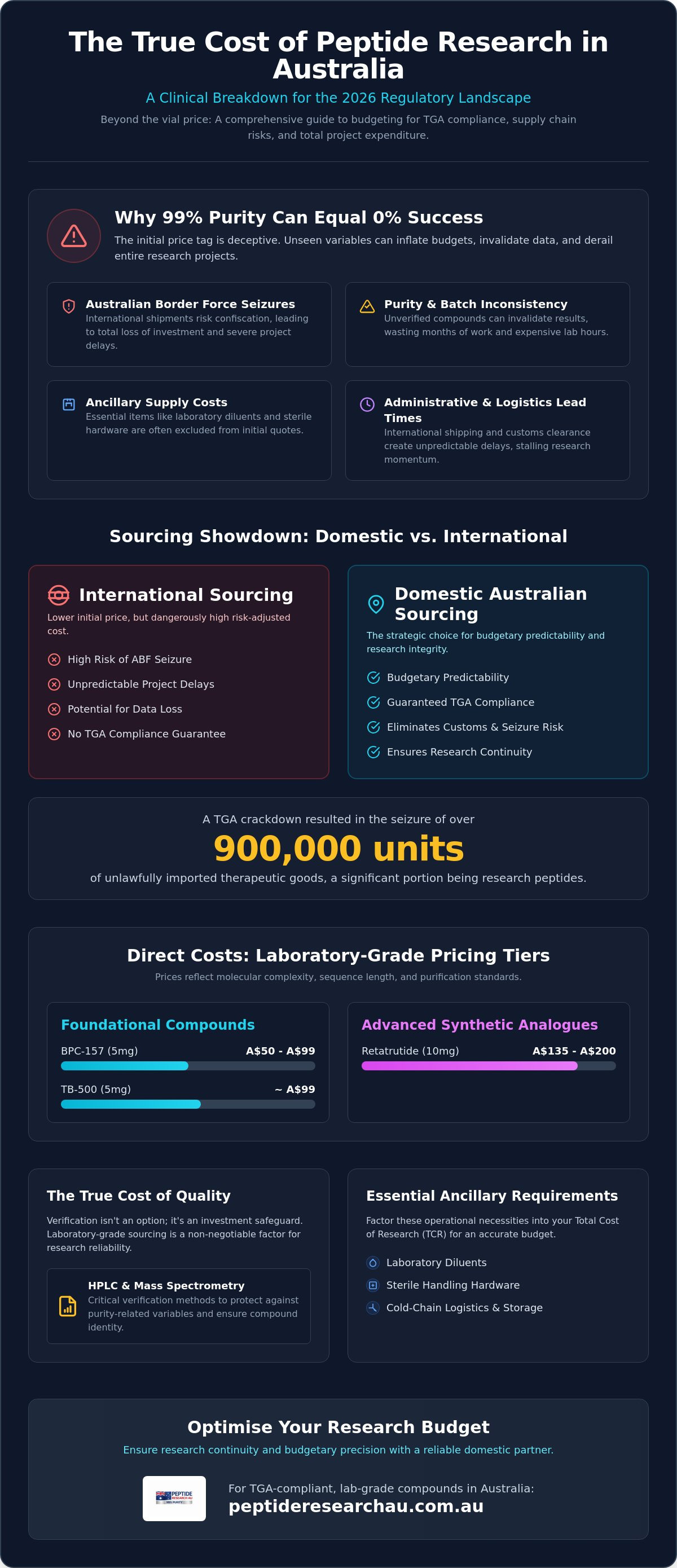
Sourcing from international vendors often presents a lower initial procurement price, but the risk-adjusted cost is frequently higher. Australian Border Force (ABF) interventions are a major budgetary variable. In mid-2026, a TGA crackdown resulted in the seizure of over 900,000 units of unlawfully imported therapeutic goods, with a high proportion being performance-related peptides. A single seizure doesn't just result in the loss of the procurement fee; it causes laboratory downtime and forces a total restart of longitudinal data collection. Domestic sourcing eliminates these variables. Local suppliers provide budgetary predictability by removing international freight duties and the threat of product destruction at the border.
The Role of Regulatory Compliance in Research Budgeting
Budgeting for 2026 requires a commitment to high-purity laboratory-grade compounds. These substances are synthesized specifically for professional study rather than general use. Attempting to reduce costs by utilizing inferior grades often leads to batch inconsistency, which invalidates experimental results and wastes expensive laboratory hours. Compliance with Australian standards isn't just a legal requirement; it's a financial safeguard for the research project's longevity. Laboratory grade is a non-negotiable cost factor for 2026 research reliability because it ensures the chemical nomenclature matches the delivered product without exception.
Direct Costs: Pricing Tiers of Laboratory-Grade Compounds
Direct procurement represents the primary expenditure in any biochemical study. The price of a compound is a direct reflection of its amino acid sequence length, molecular weight, and the purification steps required to reach a 99% threshold. In the current market for peptide prices australia, researchers should anticipate a tiered structure based on molecular complexity. Adhering to Australian peptide regulations ensures that these price points reflect verified laboratory standards rather than compromised grey-market alternatives that lack rigorous testing.
The price of foundational research compounds reflects their established synthesis protocols and high production yields. Market data for 2026 indicates that BPC-157 (5mg) typically ranges between A$50 and A$99, while TB-500 (5mg) maintains a standard price point near A$99. These foundational sequences are often the starting point for longitudinal studies, and maintaining a consistent supply at these price levels is essential for budgetary stability. Researchers can find further baseline cost context in this BPC-157 guide, which outlines the technical specifications that justify these professional-grade costs.
Advanced synthetic analogues command a higher premium due to the complexity of triple-agonist synthesis and the proprietary nature of newer sequences. Compounds like Retatrutide (10mg) represent a higher tier, with peptide prices australia for these analogues falling between A$135 and A$200. Other sophisticated compounds such as Cagrilintide and SS-31 follow a similar upward trajectory. These prices are driven by the intensive solid-phase peptide synthesis (SPPS) techniques required to ensure correct peptide folding and biological activity.
Volume-based procurement remains the most effective strategy for reducing the cost-per-milligram within a laboratory setting. Most domestic suppliers offer significant discounts on multi-vial kits, often reducing the per-unit cost by 15% to 25% when purchasing in batches of five or ten. This approach not only lowers the immediate financial burden but also ensures batch consistency across an entire study phase. Procuring high-purity research compounds in bulk allows laboratories to lock in prices and protect against fluctuating raw material costs.
Standard Research Peptides vs. Advanced Synthetic Analogues
Cost drivers for standard peptides are primarily linked to amino acid scarcity and synthesis yield. Newer triple-agonist peptides are significantly more expensive because they require more frequent purification cycles to remove truncated sequences. Predicting the cost of future analogues involves monitoring the synthesis complexity; as more amino acids are added to a sequence, the probability of errors increases, which necessitates higher pricing to cover the intensive quality control measures.
Multi-Peptide Blends and Stacks: Efficiency vs. Expense
Pre-formulated blends, such as the CJC-1295 and Ipamorelin complex (10mg), typically cost between A$125 and A$158. These integrated research complexes offer economic benefits by combining synergistic compounds into a single vial, reducing the need for multiple procurement lines. Pre-formulated stacks can reduce overall laboratory handling time and labor costs. Comparing individual component costs against these blends often reveals that the integrated option provides superior value when accounting for the reduced volume of laboratory diluents required.
Ancillary Expenses: Reconstitution, Storage, and Handling
Effective budgeting for peptide research in Australia requires a granular view of ancillary overheads. While procurement of the compounds themselves is the primary focus, the supporting hardware and diluents significantly influence peptide prices australia. Researchers must account for the infrastructure required to transition a lyophilised (freeze-dried) powder into a stable, usable solution. High-purity peptides are exceptionally sensitive to environmental variables; therefore, the cost of maintaining their biochemical integrity is an essential component of the Total Cost of Research (TCR).
The procurement of laboratory diluents is the first secondary expense. Bacteriostatic water (0.9% benzyl alcohol) is the industry standard for preventing bacterial growth in multi-use vials, typically costing A$25 per 10mL. Sterile saline is an alternative for single-use applications, though it lacks the preservative qualities required for longitudinal studies. Additionally, precision handling requires specific hardware. A standard peptide starter kit, which includes 31-gauge syringes, sterile vials, and alcohol prep pads, is approximately A$50. Disposal protocols, including sharps containers and biohazardous waste management, add small but mandatory recurring costs to the laboratory budget.
Reconstitution Protocols and Supply Costs
Budgeting for high-quality bacteriostatic water is mandatory to ensure compound stability. The chemical bonds in peptides are fragile; using sub-standard diluents or improper mixing techniques can lead to immediate structural degradation. These hidden costs of improper reconstitution are significant, as they result in wasted research material and invalid data points. Proper reconstitution is as critical to the budget as the peptide itself. If a researcher spends A$100 on a high-purity vial but compromises it during preparation, the effective cost of the remaining viable material doubles instantly.
Long-term Storage and Stability Infrastructure
Cold-chain storage is a non-negotiable requirement for maintaining peptide efficacy. Lyophilised vials are relatively stable at room temperature for short durations, but long-term storage requires a consistent environment between 2°C and 8°C. For studies extending beyond several months, ultra-low temperature freezers (-20°C or -80°C) may be necessary to prevent peptide deamidation or oxidation. These requirements introduce energy and equipment maintenance costs into the research budget. In poorly managed laboratory environments where temperature fluctuates, the cost of waste is high. Losing a batch of advanced synthetic analogues due to refrigeration failure represents a total loss of the procurement fee and the labor hours invested in the study to that point.
The True Cost of Quality: Verification, Purity, and COAs
High-purity validation is the most significant hidden variable in peptide prices australia. A Certificate of Analysis (COA) is not merely a document; it is a clinical verification of synthesis accuracy and purification efficiency. Professional laboratories utilize High-Performance Liquid Chromatography (HPLC) and Mass Spectrometry to confirm that the molecular weight and sequence match the intended design. While these testing protocols increase the initial procurement price, they eliminate the financial risk of conducting studies with sub-standard material. Relying on unverified compounds introduces variables that can invalidate months of data collection.
Quantifying the cost of failure is essential for budgetary planning. If a researcher utilizes an impure batch, the results are often non-reproducible. This requires a total restart of the study phase. The loss includes not only the procurement fee but also the expensive laboratory hours and ancillary supplies consumed during the failed trial. Third-party testing remains the most credible method for verifying purity claims, as it provides an objective assessment of the manufacturer's quality control standards. You can access laboratory-grade compounds that include these critical verification reports to safeguard your research investment.
HPLC Analysis as a Budgetary Insurance Policy
Maintaining a 99%+ purity threshold is essential for research reproducibility. Impurities in a sample can lead to off-target effects or inconsistent biological responses. These deviations necessitate repeating entire experiment phases, which doubles the operational overhead. HPLC is the gold standard for verifying molecular integrity and protecting project budgets. By ensuring the chemical nomenclature is accurate from the outset, investigators avoid the compounding costs of labor spent troubleshooting anomalous data caused by contaminated samples.
Identifying and Avoiding False Economy in Sourcing
Low-cost procurement often hides the presence of residual solvents, salts, or truncated sequences. These contaminants are not inert. They interfere with cellular assays and biochemical pathways, leading to false positives or negatives. A slightly higher upfront investment for verified material results in lower total study costs by preventing data corruption. For instance, GHK-Cu research requires specific copper-peptide complexation that is highly sensitive to purity levels. Compromising on quality at the procurement stage is a false economy that jeopardizes the integrity of the entire scientific inquiry.
Optimising Your Research Budget with Peptide Research AU
Achieving fiscal efficiency in 2026 requires a shift from transactional purchasing to strategic procurement. While the initial peptide prices australia are a significant factor, the true value lies in domestic logistics that bypass the volatility of international supply chains. Sourcing from within Australia eliminates the risk of customs interventions and the associated financial losses from seized materials. This domestic framework ensures that research timelines remain intact; it provides a level of budgetary predictability that international vendors can't match. By aligning with a local provider, laboratories can focus their resources on data acquisition rather than navigating the complexities of border compliance.
Peptide Research AU supports the Australian scientific community by providing transparent access to high-purity compounds. Reliability is the cornerstone of any longitudinal study, and consistent access to laboratory-grade materials prevents the expensive necessity of re-baselining data. When every vial is backed by rigorous quality assurance, the risk of experimental failure due to substance degradation is virtually eliminated. This commitment to excellence ensures that the financial resources of Australian institutions are directed toward meaningful scientific advancement rather than troubleshooting inconsistent results.
Strategic Procurement and Loyalty Benefits
Maximising research budgets involves leveraging structured incentive programs designed for recurring studies. Through the My Rewards and referral initiatives, laboratories can significantly offset the costs of recurring research supplies. These programs allow for the accumulation of credits that apply directly to future procurement, effectively lowering the long-term price-per-milligram. Logistical efficiency is also enhanced by utilizing secure Australian payment gateways like PayID. This system facilitates immediate transaction verification and simplifies project auditing for grant-funded research. Nationwide shipping is handled with discretion and precision, reducing the administrative overhead often associated with complex international freight tracking and duty calculations.
Final Budgetary Checklist for 2026 Research Projects
Before initiating a new study phase, researchers should evaluate their expenditure against the five primary cost pillars. This systematic approach ensures no hidden variables compromise the project's financial viability. It's essential to account for the cumulative impact of these factors rather than viewing them in isolation. A comprehensive budget must account for:
Peptides: Procurement of high-purity, laboratory-grade compounds with verified COAs.
Supplies: Laboratory diluents, precision hardware, and biohazardous disposal protocols.
Storage: Cold-chain infrastructure, energy requirements, and stability monitoring.
Testing: HPLC and Mass Spectrometry verification to ensure research reproducibility.
Logistics: Secure domestic shipping fees and proactive lead-time management.
Selecting a reliable provider is the final step in ensuring research continuity. We recommend sourcing high-integrity peptides in Australia to maintain compliance with evolving standards. View our HPLC-tested product range and secure your research supplies today.
Strategic Budgeting for Scientific Continuity
Navigating the 2026 landscape requires a transition from viewing procurement as a simple expense to managing it as a strategic investment. Successful investigators recognize that competitive peptide prices australia are only valuable when paired with verifiable molecular integrity and domestic logistical security. By accounting for the Total Cost of Research, including ancillary supplies and cold-chain stability, you protect your data from variables that lead to experimental failure. High-purity compounds backed by HPLC verification remain the most effective safeguard against budget inflation caused by non-reproducible results.
Peptide Research AU provides the infrastructure necessary for consistent, high-standard study outcomes. Our commitment to HPLC lab verified quality and discreet nationwide shipping ensures your laboratory operates without the friction of customs delays or batch inconsistency. You can also leverage our loyalty rewards program for researchers to further optimize recurring expenditures. Maintaining a focus on precision and reliability will ensure your project remains both compliant and fiscally sound. Browse our laboratory-grade research peptides with domestic Australian shipping and establish a foundation for excellence in your next research phase.
Frequently Asked Questions
How much does a typical 5mg vial of BPC-157 cost in Australia?
A typical 5mg vial of BPC-157 in the 2026 market ranges between A$50 and A$99. These peptide prices australia reflect the synthesis complexity and purification standards required for laboratory-grade material. Costs fluctuate based on batch size and the inclusion of high-performance liquid chromatography verification. Maintaining a consistent supply chain within this price bracket is essential for researchers managing longitudinal study budgets and ensuring data integrity.
Are there additional customs fees when buying peptides from Australian suppliers?
No additional customs fees or import duties apply when procuring from domestic Australian suppliers. Purchasing locally eliminates the fiscal risk of Australian Border Force seizures and the administrative burden of international freight clearances. This sourcing strategy ensures budgetary predictability by removing variable costs associated with cross-border logistics. It also prevents the research delays often caused by regulatory interventions at the point of entry into the country.
Why is bacteriostatic water more expensive than standard sterile water?
Bacteriostatic water contains 0.9% benzyl alcohol as a preservative to inhibit bacterial growth in multi-use vials. Standard sterile water lacks this antimicrobial agent and is intended only for single-use applications. In 2026, a 10mL vial of bacteriostatic water typically costs A$25. This price difference reflects the specialized manufacturing and stability testing required to ensure the diluent remains sterile over a 28-day period after the initial vial puncture.
Does the purity percentage (e.g., 98% vs 99%) significantly impact the price?
Purity percentages significantly influence peptide prices australia because reaching the 99% threshold requires additional purification cycles. Each cycle increases the loss of raw material and requires more laboratory labor, which is reflected in the final invoice. While 98% purity may appear cost-effective, the 1% difference often contains truncated sequences or residual solvents. These impurities can compromise research reproducibility, leading to higher total project costs if experiments must be repeated.
What are the expected shipping costs for laboratory-grade peptides within Australia?
Domestic shipping for laboratory-grade compounds typically ranges from A$15 to A$25 for standard express services. These costs cover discreet, temperature-monitored packaging necessary for maintaining the integrity of sensitive sequences during transit. Many professional suppliers offer complimentary shipping on orders exceeding a specific threshold, such as A$200. This provides a clear budgetary advantage over international freight, which often incurs substantial surcharges and unpredictable lead times for delivery.
Can I save money by purchasing peptide stacks instead of individual vials?
Purchasing pre-formulated multi-peptide complexes generally offers a lower cost-per-milligram than procuring individual components. For example, a CJC-1295 and Ipamorelin blend (10mg) ranges from A$125 to A$158. This integrated approach reduces the total volume of laboratory diluents and hardware required for reconstitution. It also minimizes the administrative overhead of managing multiple inventory lines, making it a fiscally efficient choice for synergistic research applications in professional settings.
Is third-party lab testing included in the retail price of research peptides?
Professional-grade suppliers include third-party HPLC and Mass Spectrometry verification within the stated retail price. This transparency ensures that the researcher receives a Certificate of Analysis (COA) without paying additional laboratory fees. While unverified compounds may have a lower initial price, they lack the quality assurance necessary for credible scientific study. Investing in verified material serves as a budgetary insurance policy against the high cost of data corruption or total experimental failure.
How should I budget for long-term storage of lyophilised peptides?
Budgeting for long-term storage must include the acquisition and maintenance of cold-chain infrastructure. Lyophilised vials require consistent temperatures between 2°C and 8°C for short-term stability, while deep-freeze environments of -20°C or -80°C are necessary for multi-year preservation. Researchers should account for energy costs and the potential loss of material in the event of equipment failure. Implementing temperature-monitoring systems is a mandatory overhead that prevents the expensive waste of sensitive research compounds.


Comments