
Sermorelin Australia: A 2026 Research Guide to the GHRH(1-29) Analogue
- peptideresearchau
- 4 days ago
- 11 min read
The most precise tool for studying natural growth hormone pulsatility isn't a complex modified analogue, but the truncated native sequence found in Sermorelin. Many scientists face significant hurdles when sourcing Sermorelin Australia, especially with the April 2026 TGA safety alerts highlighting the risks of impure or mislabelled laboratory compounds. You likely understand the difficulty of maintaining research integrity while addressing the complexities of shifting regulatory standards and technical nomenclature.
This guide delivers a definitive scientific overview of the GHRH(1-29) analogue and its specific biochemical mechanism. We'll examine how this peptide functions as a growth hormone secretagogue and provide a clear comparison with modified sequences like CJC-1295. You'll gain the technical insights necessary to identify reliable research sources and ensure your laboratory protocols meet the highest standards of precision. We also detail the critical differences between research-grade materials and clinical products to support informed, data-driven methodology in your professional study.
Table of Contents
The Biochemistry of Sermorelin: Defining the GHRH(1-29) Sequence
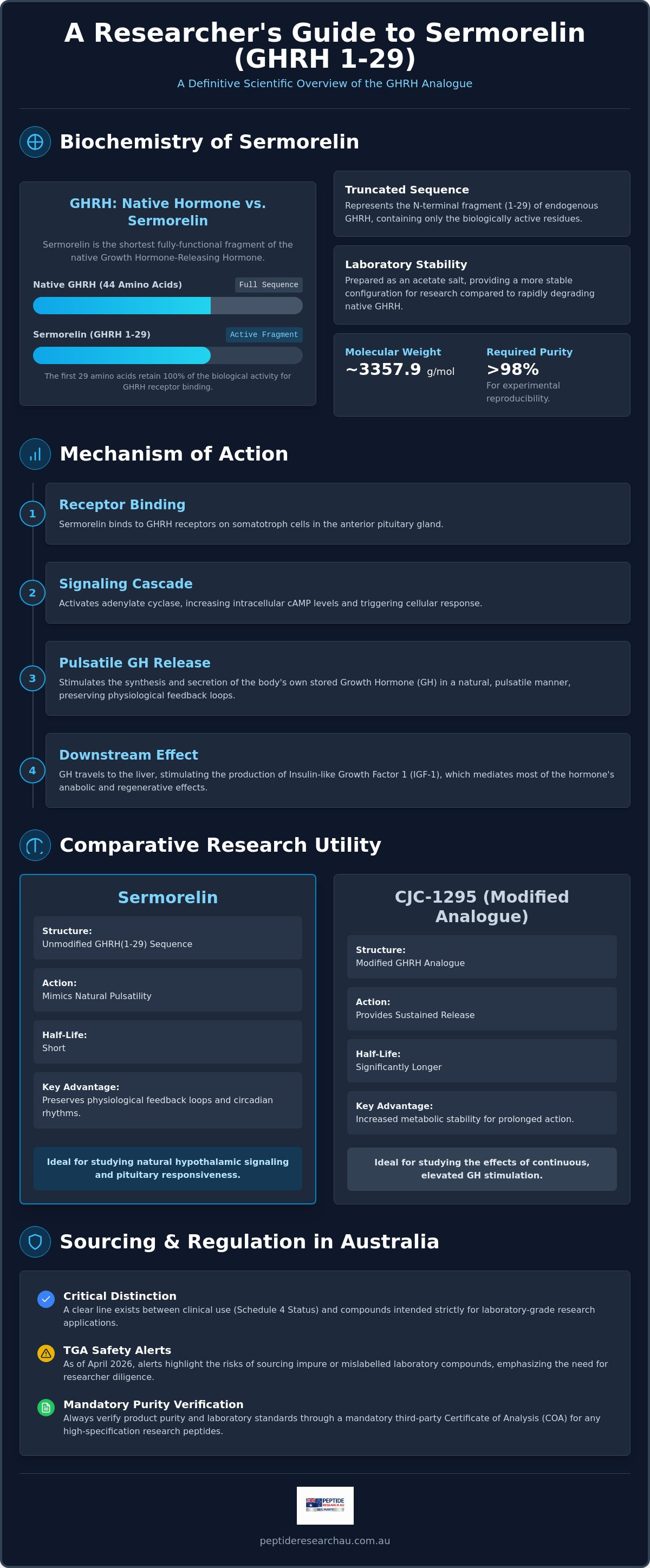
Sermorelin represents the functional N-terminal fragment of the endogenous hormone responsible for stimulating growth hormone release. Researchers investigating Sermorelin Australia primarily focus on this 29-amino acid peptide, which mimics the active fragment of GHRH. While the naturally occurring hormone consists of 44 amino acids, Sermorelin (GHRH 1-29) contains only the first 29 residues. This specific truncation isn't arbitrary; it's the shortest sequence that maintains full biological activity and receptor binding affinity. Historically, this compound served as a clinical diagnostic tool to assess pituitary reserve, but its utility has expanded into broader laboratory study. This foundational biochemistry makes it an essential tool for endocrinology research.
The distinction between native GHRH and synthetic Sermorelin acetate lies in the latter's preparation for laboratory stability. Endogenous GHRH is highly susceptible to rapid enzymatic degradation. The synthetic acetate salt form provides a more stable configuration for in vitro and in vivo studies. This structural integrity ensures that researchers can observe the somatotropic axis's response without the confounding variables associated with larger, less stable peptide chains. It allows for a more controlled environment when studying the physiological triggers of growth hormone release. Researchers prefer this truncated version because it avoids the metabolic overhead of the full-length hormone while delivering identical signaling results.
Amino Acid Composition and Molecular Structure
The biological activity of the GHRH molecule is concentrated within its first 29 amino acids. This N-terminal fragment binds directly to the GHRH receptors on the anterior pituitary gland. By excluding the C-terminal 15 amino acids, the molecule remains small enough for efficient synthesis while retaining full function. For laboratory applications, high-specification research compounds typically exhibit a molecular weight of approximately 3357.9 g/mol and require a purity level exceeding 98% to ensure experimental reproducibility.
Sermorelin in the Context of Australian Peptide Research
In the current scientific landscape, Sermorelin Australia remains a focal point for investigating pituitary health and cellular longevity. The 2026 research climate has shifted toward understanding how truncated analogues interact with the hypothalamus and pituitary coordination. Academic institutions utilise these compounds to map the pulsatile nature of growth hormone secretion. For a broader perspective on regulatory standards and procurement, refer to Peptides Australia: The Researcher’s Guide. This transition reflects a deeper interest in refined laboratory study within the Australian scientific community.
Mechanism of Action: How Sermorelin Stimulates GH Release
Sermorelin functions by binding to specific growth hormone-releasing hormone (GHRH) receptors located on the somatotroph cells of the anterior pituitary gland. This interaction initiates a precise signaling cascade that triggers the synthesis and secretion of endogenous growth hormone (GH). In the context of Sermorelin Australia research, this mechanism is highly valued because it preserves the natural feedback loops of the somatotropic axis. Unlike exogenous growth hormone administration, which can suppress natural production through negative feedback, Sermorelin encourages the pituitary to release its own stored GH in a manner that respects physiological limits.
The somatotropic axis relies on delicate coordination between the hypothalamus and the pituitary gland. When Sermorelin's biochemical profile is introduced into a laboratory model, it mimics the pulsatile release patterns seen in healthy physiological states. This preservation of circadian rhythm is a primary focus for researchers studying metabolic efficiency and cellular repair. Once GH enters the bloodstream, it travels to the liver to stimulate the production of Insulin-like Growth Factor 1 (IGF-1). This downstream effector mediates the majority of the hormone's growth-promoting and regenerative effects during Sermorelin Australia laboratory studies.
Receptor Binding Kinetics
Sermorelin's efficacy is rooted in its high affinity for the GHRH receptor. Upon binding, it activates the adenylate cyclase enzyme, leading to an increase in intracellular cyclic adenosine monophosphate (cAMP). This process subsequently opens voltage-dependent calcium channels, facilitating the exocytosis of growth hormone vesicles. Scientists study these kinetics to understand how pituitary sensitivity changes under various experimental conditions. Understanding these pathways is essential for those seeking high-quality research compounds for endocrine mapping and somatotroph analysis.
Sermorelin and Somatostatin Interaction
A critical aspect of GH regulation is the presence of somatostatin, a peptide that serves as the primary inhibitor of hormone release. In research models, elevated somatostatin levels can blunt the effectiveness of secretagogues. Sermorelin is frequently used to study how these inhibitory signals can be modulated or overcome in a controlled environment. Because it acts directly on the pituitary somatotrophs, it provides a clear window into how the gland responds when hypothalamic inhibition is present. This makes it an indispensable tool for investigating growth hormone deficiency models and the mechanisms of age-related pituitary decline.
Sermorelin vs. CJC-1295: Comparative Research Utility
Scientists often choose between growth hormone secretagogues based on metabolic stability and the specific hormonal response required for their study. While Sermorelin Australia focuses on the native GHRH(1-29) fragment, CJC-1295 represents a modified approach to growth hormone stimulation. The fundamental difference lies in the molecular architecture. Sermorelin remains unmodified, meaning it's highly susceptible to enzymatic degradation by dipeptidyl peptidase-IV (DPP-IV). This results in a rapid metabolic clearance that closely mirrors the natural release patterns of the human hypothalamus. It's a precise tool for researchers who need to replicate native physiological spikes.
Researchers prioritising physiological accuracy typically select Sermorelin. It allows for the study of the "pulse" effect, where growth hormone levels spike and then return to baseline quickly. In contrast, CJC-1295 was engineered to bypass these natural limitations. Understanding these distinctions is vital for experimental design, especially when evaluating the somatotropic axis's reaction to prolonged versus acute stimulation. While both compounds target the same receptors, their different residence times in the plasma lead to vastly different experimental outcomes. Researchers don't treat them as interchangeable because their impact on the pituitary's refractory period differs significantly.
The Role of Amino Acid Substitutions
CJC-1295 incorporates four specific substitutions to enhance its biochemical resilience. The most significant change is the replacement of L-Alanine with D-Alanine at the second position. This modification prevents DPP-IV from cleaving the peptide bond, significantly extending its presence in the plasma. Other substitutions, such as Glutamine at position 8, further refine the molecule's stability. For those new to these molecular distinctions, reading What are Peptides? A Comprehensive Guide provides a necessary foundation for understanding how small structural changes dictate biological outcomes. These modifications aren't present in Sermorelin, which maintains the original sequence for maximum bio-identity.
Half-Life and Dosing Protocols in Lab Settings
Sermorelin's 10 to 20 minute half-life requires a precise approach to laboratory administration. When sourcing Sermorelin Australia for laboratory use, the protocol must account for this rapid clearance to ensure data accuracy. To study sustained GH elevation, researchers would need frequent dosing or continuous infusion. However, most studies use Sermorelin specifically to observe the pituitary's immediate response to a GHRH signal. CJC-1295 without DAC has a half-life of roughly 30 minutes, while the DAC version extends this to several days. While CJC-1295 offers metabolic endurance, Sermorelin remains the superior choice for researchers investigating natural pituitary pulsatility and native feedback mechanisms.
Navigating Australian Regulations for Sermorelin Research
Understanding the regulatory landscape for Sermorelin Australia requires a clear distinction between clinical application and laboratory study. Under the Therapeutic Goods Administration (TGA) framework, Sermorelin is classified as a Schedule 4 (Prescription Only) substance when intended for human therapeutic use. However, the regulatory environment in 2026 allows for the acquisition of these compounds specifically for "Research Use Only" in laboratory settings. This designation is critical for maintaining compliance. It ensures that the substances aren't diverted for human consumption, which remains a high-priority area for Australian customs and health authorities following the April 2026 safety alerts regarding unapproved peptide importation.
Sourcing these compounds domestically offers a significant advantage over international importation. The TGA's heightened scrutiny of imported peptides often leads to Border Force seizures and lengthy delays. By utilizing an Australian domestic specialist, researchers bypass these logistical hurdles and ensure the material meets local laboratory-grade standards. Compliance involves more than just sourcing; independent researchers should maintain meticulous records of acquisition, usage, and disposal. These logs serve as essential documentation to validate the legitimacy of a scientific study and demonstrate adherence to national safety standards.
The 'Research Use Only' Designation
A "Research Use Only" label defines a strict legal boundary. It signifies that the compound hasn't been evaluated for safety or efficacy in humans and is strictly for in vitro or animal-based study. Reputable suppliers mandate agreement to these terms of service to prevent misuse. For those involved in sports science, it's vital to recognize that ASADA and WADA maintain a zero-tolerance policy for growth hormone secretagogues. Even if sourced for legitimate laboratory study, any presence of these substances in a biological sample from an athlete constitutes a violation of anti-doping regulations.
Storage and Handling Standards
The biochemical integrity of Sermorelin Australia depends heavily on environmental controls. Lyophilised peptides are highly sensitive to temperature fluctuations and light exposure. For long-term stability, researchers should store the vials at -20°C, while short-term storage at 2-8°C is acceptable for active studies. Reconstitution requires laboratory diluents such as bacteriostatic water to prevent microbial growth. This level of care is similar to the protocols required for other compounds, such as those detailed in our BPC-157: A Comprehensive Guide. Proper handling ensures that the peptide's amino acid sequence doesn't degrade before experimental completion. To ensure your laboratory is equipped with high-specification compounds, you can explore our range of research peptides.
Sourcing High-Purity Sermorelin in Australia
Procuring high-specification compounds for laboratory use requires a strict distinction between consumer-grade products and legitimate laboratory-grade research peptides. When investigating Sermorelin Australia, the primary concern for any researcher is the verification of chemical identity and the assurance of stated purity levels. Laboratory-grade peptides are manufactured under rigid quality control protocols to ensure that the 29-amino acid sequence remains intact and free from residual reagents or truncated sequences. In contrast, consumer-grade materials often lack the necessary documentation to support their use in precise scientific assays, potentially compromising the integrity of research data.
Domestic Australian logistics play a vital role in maintaining the biochemical stability of these sensitive molecules. Peptides are susceptible to degradation when exposed to extreme temperatures or prolonged transit times typical of international shipping. By sourcing from a domestic specialist like Peptide Research AU, the duration of the "cold chain" interruption is minimised, ensuring the lyophilised powder arrives with its structural integrity preserved. This commitment to technical excellence allows the Australian scientific community to access reliable research compounds without the regulatory friction or environmental risks associated with overseas procurement.
Verification and Testing Protocols
Identity and purity confirmation rely on two primary analytical techniques: High-Performance Liquid Chromatography (HPLC) and Mass Spectrometry (MS). HPLC measures the purity of the sample by separating the components, while Mass Spectrometry verifies the molecular weight to confirm the peptide is indeed the GHRH(1-29) sequence. A third-party Certificate of Analysis (COA) should be available for every batch to provide transparent evidence of these tests. Researchers should avoid suppliers that cannot provide batch-specific COAs or those that use generic, outdated reports. Red flags include ambiguous manufacturing origins and a lack of clear technical specifications on product labels.
Handling and Reconstitution Requirements
Preparing Sermorelin for laboratory study requires adherence to sterile techniques and precise reconstitution protocols. Because the peptide is delivered as a lyophilised powder, it must be dissolved in a suitable laboratory diluent before use. The choice of diluent, such as bacteriostatic water, is essential for maintaining stability and preventing microbial contamination during the course of an experiment. Reconstituted peptides should be handled gently to avoid mechanical denaturation of the delicate amino acid chain. Following these best practices ensures that the compound performs predictably within the somatotropic axis models discussed in previous sections. To secure high-specification materials for your next study, explore our range of research-grade compounds at Peptide Research AU.
Advancing Endocrinology Research with Precision Analogues
Sermorelin remains a foundational tool for investigating the somatotropic axis due to its bio-identical 1-29 amino acid sequence. Its ability to mimic natural hypothalamic signaling makes it superior for researchers studying endogenous growth hormone pulsatility rather than sustained elevation. Successfully navigating the 2026 regulatory environment for Sermorelin Australia requires a commitment to sourcing high-specification compounds that are explicitly designated for laboratory study. This approach ensures compliance with TGA frameworks while maintaining the integrity of experimental data through rigorous testing protocols.
Peptide Research AU supports the Australian scientific community by providing laboratory-grade research compounds with third-party purity verification. Our focus on technical excellence ensures that every peptide meets the highest standards for identity and concentration. We offer fast domestic Australian shipping to protect the stability of lyophilised materials and prevent the degradation associated with international transit. Don't compromise your experimental results with unverified materials. Source Laboratory-Grade Sermorelin for Your Research today and ensure your laboratory protocols are supported by verified chemical excellence. We look forward to facilitating your next scientific breakthrough.
Frequently Asked Questions
Is Sermorelin legal to buy in Australia for research purposes?
Sermorelin is legal to acquire for "Research Use Only" within Australian laboratory settings. While the TGA classifies it as a Schedule 4 prescription substance for human therapeutic applications, the purchase of laboratory-grade Sermorelin Australia for non-clinical study is allowed. Researchers must ensure that the compound remains within a controlled research environment and isn't diverted for human consumption. This distinction is vital for maintaining regulatory compliance during scientific investigations.
What is the difference between Sermorelin and Ipamorelin?
Sermorelin and Ipamorelin target different receptors to stimulate growth hormone release. Sermorelin is a synthetic GHRH analogue that binds to the GHRH receptors in the anterior pituitary. Ipamorelin is a ghrelin mimetic that targets the growth hormone secretagogue receptor (GHS-R). Researchers often study these two compounds to compare their effects on pituitary pulsatility and their respective influence on the somatotropic axis.
How should Sermorelin be stored to maintain its biological activity?
Proper storage is essential to prevent the degradation of the peptide's amino acid chain. Lyophilised Sermorelin should be kept in a freezer at -20°C for long-term stability. For active research projects, short-term storage at 2-8°C is acceptable. It's critical to protect the vials from light exposure and temperature fluctuations, as these environmental factors can compromise the compound's biochemical integrity and experimental reproducibility.
What is the typical purity level required for laboratory-grade Sermorelin?
Laboratory-grade Sermorelin typically requires a purity level exceeding 98%. This high specification is confirmed through High-Performance Liquid Chromatography (HPLC) and Mass Spectrometry (MS). Purity is a critical metric because residual reagents or truncated peptide sequences can introduce confounding variables into a study. Researchers should always verify these levels by reviewing batch-specific Certificates of Analysis (COA) provided by the supplier.
Can Sermorelin be used for research into IGF-1 levels?
Sermorelin is a standard tool for investigating the regulation of IGF-1 levels. When the peptide stimulates the pituitary to release growth hormone, the GH subsequently triggers hepatic production of Insulin-like Growth Factor 1. Researchers use this relationship to map the efficiency of the somatotropic axis and to study the downstream metabolic effects of endogenous growth hormone secretion in various laboratory models.
Does Sermorelin require reconstitution with bacteriostatic water?
Reconstitution with bacteriostatic water is the standard protocol for research-grade peptides. This diluent contains 0.9% benzyl alcohol, which inhibits microbial growth and extends the stability of the peptide once it's in a liquid state. Using sterile water without a bacteriostatic agent increases the risk of contamination and rapid enzymatic degradation, which can invalidate the results of a multi-day laboratory assay.
What are the common research applications for GHRH analogues in 2026?
In 2026, research applications focus on pituitary reserve mapping and the mechanisms of cellular regeneration. GHRH analogues are used to study age-related endocrine decline and the metabolic triggers of growth hormone secretion. Other studies investigate the peptide's role in wound healing models and its impact on sleep-related hormonal pulses, providing data on how the somatotropic axis coordinates with circadian rhythms.
How does the half-life of Sermorelin affect research protocols?
The 10 to 20 minute half-life of Sermorelin Australia necessitates precise timing in research protocols. Because it's rapidly cleared by enzymatic degradation, researchers must schedule data collection shortly after administration to capture the peak growth hormone response. This short duration makes it an ideal compound for studying acute pituitary sensitivity and natural pulsatile release patterns rather than sustained, non-physiological hormone elevation.


Comments