
Selank and Semax Australia: A Comprehensive Researcher’s Guide (2026)
- peptideresearchau
- 5 days ago
- 11 min read
The standard for neuro-peptide research in 2026 is no longer defined by simple availability, but by the precision of analytical verification. It's a reality that most investigators in the Australian sector recognize; while the potential for cognitive and emotional regulation is high, the market often lacks the technical transparency required for rigorous laboratory work. Finding reliable data on selank and semax australia requires looking past marketing claims toward batch-specific HPLC-MS results and verified chemical nomenclature.
This guide delivers a technical deep-dive into the distinct mechanisms and comparative benefits of these two synthetic analogues. You'll gain a clear understanding of their synergistic effects on the central nervous system and the specific sourcing standards necessary to navigate the current TGA compliance landscape. We'll also detail precise reconstitution protocols using laboratory diluents to maintain peptide stability throughout the duration of your study.
Table of Contents
Understanding Selank and Semax in the Australian Research Landscape
Synthetic neuro-peptides represent a critical frontier in laboratory study, serving as precise analogues of endogenous regulatory molecules. These compounds are engineered to mimic or modulate the biological activity of naturally occurring peptides within the central nervous system. In the context of selank and semax australia, researchers focus on these two specific sequences due to their high affinity for neurological pathways and their relative stability compared to their parent molecules. These research compounds allow for the controlled investigation of peptide-receptor interactions without the rapid degradation often seen in non-synthetic variants.
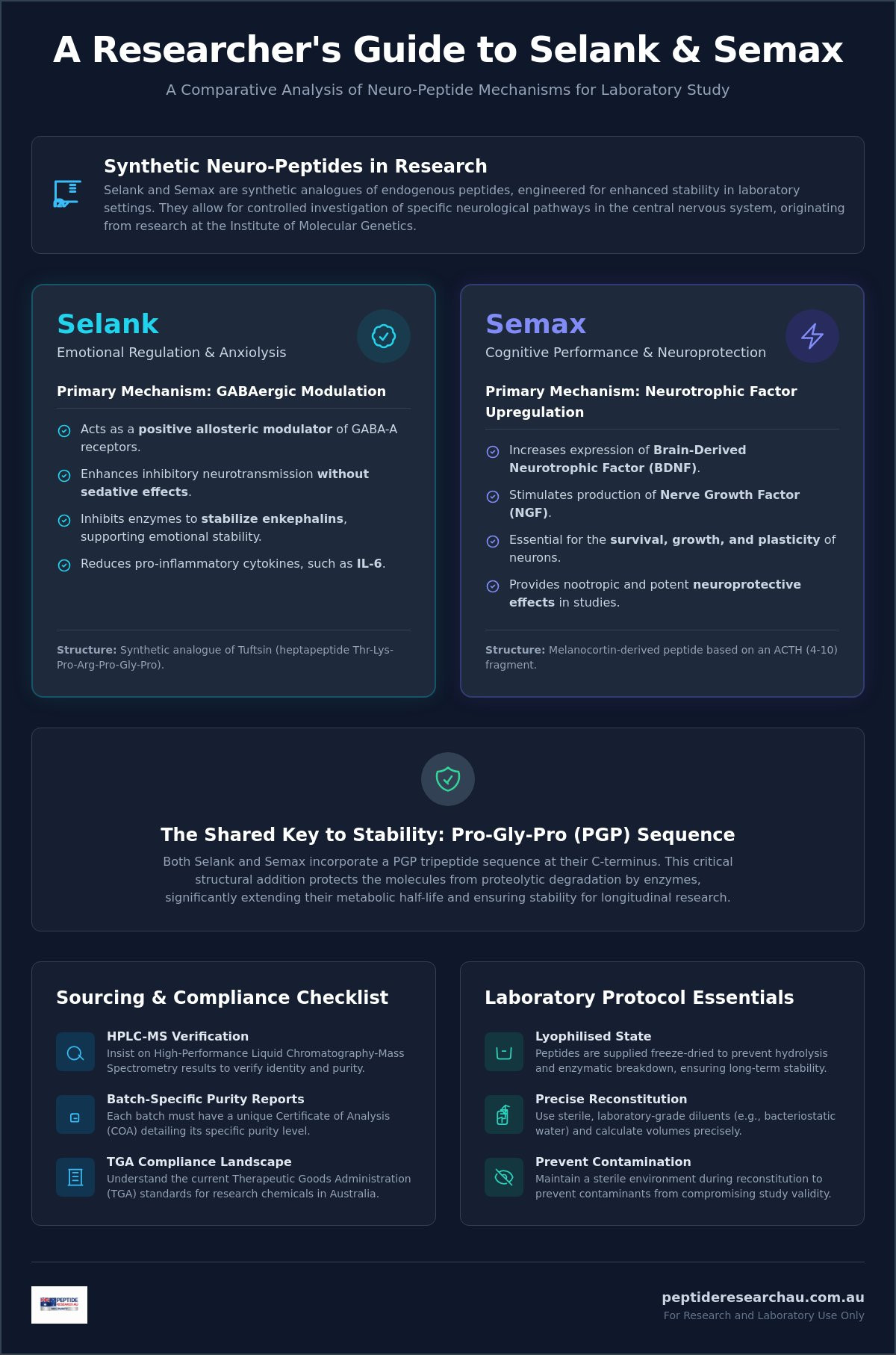
Selank is a synthetic heptapeptide with the sequence Thr-Lys-Pro-Arg-Pro-Gly-Pro. It functions as an analogue of the endogenous tetrapeptide tuftsin, which is naturally involved in immune and neurological modulation. Conversely, Semax is a melanocortin-derived peptide based on a fragment of the adrenocorticotropic hormone, specifically the ACTH (4-10) sequence. Both peptides incorporate a Pro-Gly-Pro (PGP) tripeptide sequence at their C-terminus. This structural addition is vital; it protects the molecules against proteolytic degradation by peptidases, significantly extending their half-life within laboratory environments. It's this metabolic stability that makes them viable for extended longitudinal studies.
The Evolution of Neuro-Peptide Research
The development of these compounds originated at the Institute of Molecular Genetics within the Russian Academy of Sciences. While initially explored for clinical applications, the focus has transitioned toward global laboratory research. By 2026, the Australian research sector has prioritised high-purity domestic supplies to avoid the risks associated with international logistics and inconsistent batch quality. Accessing verified data, such as that found on Selank on Wikipedia, provides a foundational understanding of how these molecules moved from experimental synthesis to standard research tools. Investigators now require domestic inventory to ensure supply chain reliability.
Chemical Stability and Lyophilisation
Maintaining peptide integrity requires specific storage protocols. These research compounds are typically provided in a lyophilised, or freeze-dried, state. This process removes moisture, which prevents hydrolysis and enzymatic breakdown. During manufacturing, vials are often sealed under an inert nitrogen atmosphere to prevent oxidation. When researchers work with selank and semax australia, they must calculate reconstitution volumes based on the specific molecular weight of the batch. This ensures the concentration remains precise for analytical testing. Using high-quality laboratory diluents is essential during this stage to prevent the introduction of contaminants that could compromise the study's validity.
The Science of Synthetic Neuro-Peptides: Mechanisms of Action
The physiological efficacy of synthetic neuro-peptides is defined by their capacity to modulate complex biochemical pathways within the central nervous system. When investigating selank and semax australia, researchers observe a dual-action profile that targets both emotional regulation and cognitive maintenance. These compounds influence neurotransmitter metabolism and gene expression, particularly within the hippocampus, which is the primary site for memory consolidation and stress response. By altering mRNA expression, these peptides induce long-lasting changes in neuronal plasticity that extend beyond their immediate metabolic half-life.
Selank: Anxiolytic Pathways Without Sedation
Selank operates primarily through the modulation of the GABAergic system. It acts as a positive allosteric modulator of GABA-A receptors, enhancing inhibitory neurotransmission without the sedative-hypnotic effects associated with traditional anxiolytics. Laboratory data indicates that Selank also stabilizes enkephalins in the blood plasma by inhibiting the enzymes responsible for their degradation. This mechanism supports emotional stability in stress models. Its immunomodulatory properties are equally significant; studies show a marked reduction in pro-inflammatory cytokines, specifically IL-6, which suggests a role in investigating the link between systemic inflammation and psychological distress.
Semax: Nootropic and Neuroprotective Mechanisms
Semax focuses on the upregulation of neurotrophic factors, specifically Brain-Derived Neurotrophic Factor (BDNF) and Nerve Growth Factor (NGF). These proteins are essential for the survival and growth of neurons. Its regulatory status is a subject of ongoing international scrutiny, as evidenced by the FDA review of Semax regarding its status on the 503A Bulks List. In laboratory settings, Semax stimulates dopamine and serotonin metabolism, which contributes to its reported nootropic effects. It also demonstrates neuroprotective capabilities in models of ischaemia and oxidative stress by maintaining cellular homeostasis during metabolic insults.
The synergistic potential of these peptides remains a primary area of interest for Australian investigators. While Selank provides a stable emotional baseline by modulating the GABAergic and immune systems, Semax promotes the structural plasticity required for cognitive output. This dual-pathway approach allows for a more comprehensive study of neurological resilience. Researchers who require consistent, laboratory-grade materials for these studies can source high-purity research compounds from domestic inventory to ensure experimental reliability and precise results in selank and semax australia trials.
Selank vs. Semax: A Comparative Analysis for Laboratory Study
Choosing between selank and semax australia for a research protocol depends entirely on the specific neurological pathways under investigation. While both are synthetic analogues protected by the Pro-Gly-Pro (PGP) sequence, their molecular structures dictate divergent interactions within the brain. Selank is a heptapeptide derived from the immunomodulatory peptide tuftsin, whereas Semax originates from a fragment of the adrenocorticotropic hormone (ACTH 4-7). These structural differences result in distinct pharmacological profiles; one focuses on the maintenance of emotional homeostasis, while the other prioritises the acceleration of cognitive processes and neuroprotection.
The comparative half-life of these compounds is a critical variable in laboratory settings. The PGP sequence ensures both peptides remain metabolically active for several hours, a significant improvement over their endogenous counterparts. However, the molecular mechanism of Selank involves a more pronounced interaction with the GABAergic system and enkephalin stability. In contrast, Semax exerts a more robust influence on the expression of neurotrophins. Researchers must select their compound based on whether the study aims to observe the mitigation of stress-induced behavioral changes or the enhancement of synaptic plasticity and memory consolidation.
Functional Differences in Research Models
In stress resilience models, Selank is the primary subject of study due to its anxiolytic-like effects that occur without the sedative interference typical of benzodiazepines. It's frequently used to investigate mood regulation and the reduction of inflammatory markers in the hippocampus. Semax research instead prioritises models of learning speed, focus, and recovery from neural injury, such as ischaemic stroke simulations. Selank modulates emotional pathways, while Semax optimises cognitive processing. This distinction allows investigators to target specific symptoms of neurological decline or performance enhancement with high precision.
Synergy and Stackability
The synergistic potential of selank and semax australia is an emerging area of interest for researchers who wish to study dual-peptide protocols. When investigated concurrently, these peptides may provide a balanced model of neuro-inhibition and neuro-excitation. Selank provides the inhibitory stability required to manage the stress response, while Semax provides the excitatory stimulus needed for cognitive output. This combination allows for the study of "flow states" or high-performance cognitive models where emotional interference is minimised. For broader context on combining research compounds, investigators should refer to the Peptides Australia guide on quality sourcing and standards. Proper laboratory protocols must account for the additive effects of these peptides on mRNA expression and neurotransmitter levels to ensure data accuracy.
Sourcing Research-Grade Peptides: Quality and Compliance in Australia
Procuring selank and semax australia for laboratory use requires a rigorous vetting of supply chain standards and analytical verification. In 2026, the Therapeutic Goods Administration (TGA) has intensified its focus on unapproved peptides, making domestic compliance a priority for legitimate researchers. While these compounds are designated for laboratory study, investigators must navigate a landscape where purity and legal standing are paramount. Sourcing from international "grey market" vendors introduces significant risks, including customs seizures and chemical degradation during long-term transit. A joint operation in early 2026 resulted in the seizure of $2 million worth of unapproved peptide products, highlighting the volatility of international procurement.
Domestic Australian supply chains offer a distinct advantage by maintaining temperature-controlled stability from the point of manufacture to the laboratory. High-purity neuro-peptides are sensitive to thermal fluctuations, which can trigger premature degradation of the peptide bonds. By utilising local inventory, researchers ensure that the lyophilised powder has not been exposed to the extreme heat common in international shipping hubs. This logistical control is essential for maintaining the structural integrity required for precise data collection.
The Importance of Third-Party Testing
Analytical verification through High-Performance Liquid Chromatography (HPLC) and Mass Spectrometry (MS) is the only reliable method to confirm peptide quality. A Certificate of Analysis (COA) should demonstrate a purity level of 99% or higher. Lower grades often contain residual solvents, TFA (trifluoroacetic acid), or truncated peptide sequences that can skew research results. HPLC-MS testing protocols in 2026 ensure that the molecular mass matches the theoretical profile of the peptide, confirming that no cross-contamination occurred during the synthesis process. Reproducible data depends entirely on these high manufacturing standards.
Reconstitution and Handling Protocol
Proper preparation is as critical as the sourcing itself. Using bacteriostatic water is the gold standard for diluting research peptides, as the inclusion of 0.9% benzyl alcohol inhibits bacterial growth during the study period. To reconstitute the compound, researchers should follow these steps:
Allow the lyophilised vial to reach room temperature before introduction of the diluent.
Gently aim the stream of bacteriostatic water against the glass wall of the vial.
Avoid direct impingement on the powder to prevent foaming and mechanical stress.
Slowly swirl the vial until the solution is clear; never shake the container.
Once reconstituted, the stability of the peptide decreases significantly. While lyophilised vials remain stable in a controlled environment, liquid solutions must be stored at 2 to 8 degrees Celsius. For investigators requiring the highest standards of purity and domestic reliability, you can secure laboratory-grade research compounds through our verified Australian inventory.
Advancing Cognitive Research with Peptide Research AU
Peptide Research AU facilitates high-level neuro-peptide study by maintaining a consistent supply of verified research compounds. In the evolving landscape of selank and semax australia, the primary challenge for investigators is the gap between synthesis and delivery. We address this by specialising in Australian-based inventory that bypasses the regulatory and environmental risks of international procurement. Our protocols ensure that every vial meets the exact technical specifications required for professional laboratory study, allowing researchers to focus on data acquisition rather than supply chain volatility.
Why Choose Peptide Research AU?
We prioritise the structural integrity of every compound we distribute. Beyond neuro-peptides, our catalog includes authoritative sourcing for high-purity compounds like BPC-157. Each product is housed in clinical-grade packaging with nitrogen-sealed vials. This specific sealing method is vital for preventing oxidation and extending the shelf life of lyophilised sequences. Our commitment to the Australian scientific community is reflected in our logistics; we provide fast, secure domestic shipping that maintains the cold chain requirements necessary for peptide stability during transit.
Our quality control measures are rigorous. Every batch undergoes batch-specific verification to ensure it meets the 99% purity threshold discussed in previous sections. This meticulous approach provides laboratory professionals with the confidence that their reagents won't introduce unwanted variables into their experimental models. We function as a reliable partner for those who value precision, data, and quality control above all else.
Next Steps for Your Research Project
Initiating a new study requires meticulous planning of both the primary compounds and the auxiliary supplies. Researchers must select the appropriate sequence based on their established hypothesis, whether they're focusing on the emotional regulation pathways of Selank or the cognitive output optimisation of Semax. It's equally important to secure necessary laboratory diluents and storage equipment before the reconstitution process begins to prevent degradation.
For those beginning their investigation into selank and semax australia, we recommend consulting our comprehensive research guide for further technical education. Our team provides dedicated support to laboratory professionals to ensure they have the tools and information required for reproducible results. By aligning with a provider that prioritises manufacturing excellence and rigorous methodology, you ensure your research project is built on a foundation of chemical reliability.
Optimising Neuro-Peptide Research Standards
Advancing the study of synthetic neuro-peptides requires a commitment to chemical precision and methodological consistency. As established throughout this guide, the distinction between Selank and Semax allows for targeted investigation into either GABAergic emotional regulation or the upregulation of neurotrophic factors for cognitive output. Achieving reproducible data in selank and semax australia trials necessitates the use of research compounds that have undergone rigorous analytical verification.
Peptide Research AU supports the Australian scientific community by providing reagents with HPLC-MS verified purity. Our inventory is housed in clinical-grade nitrogen sealed vials to ensure maximum shelf life and metabolic stability. By prioritising domestic supply, researchers benefit from same-day Australian dispatch; this eliminates the degradation risks associated with international transit and ensures temperature-controlled stability for every batch.
Secure Laboratory-Grade Selank and Semax for Your Research and ensure your laboratory protocols are built on a foundation of chemical excellence.
Frequently Asked Questions
Is it legal to buy Selank and Semax in Australia for research purposes?
Buying Selank and Semax for laboratory research is legal provided the compounds aren't intended for human therapeutic use. These peptides aren't approved by the TGA and are classified strictly as research compounds. Investigators must ensure compliance with institutional guidelines and understand that the "research use only" designation doesn't permit clinical application or personal consumption under current Australian regulations.
What is the primary difference between Selank and Semax?
Selank is a synthetic analogue of tuftsin that modulates the GABAergic system to study emotional regulation and stress resilience. Semax is derived from an ACTH fragment and focuses on the upregulation of neurotrophic factors like BDNF for cognitive performance research. While both incorporate a Pro-Gly-Pro sequence for metabolic stability, their target pathways in the central nervous system are fundamentally different.
How should I store lyophilised peptides in the Australian summer?
Lyophilised peptides should be stored in a temperature-controlled environment between 2 and 8 degrees Celsius. During the Australian summer, ambient temperatures frequently exceed the stability threshold for freeze-dried sequences. Protecting vials from light and thermal fluctuations in a dedicated laboratory refrigerator ensures the structural integrity of the peptide bonds is maintained for the duration of your long-term study.
Can Selank and Semax be used together in the same research protocol?
Investigators often study selank and semax australia concurrently to evaluate synergistic interactions between inhibitory and excitatory pathways. This dual-peptide protocol allows for the observation of cognitive output while maintaining a stable emotional baseline in laboratory models. Researchers must carefully document the additive effects on mRNA expression and neurotransmitter levels to ensure the accuracy of their reported data.
Why is HPLC-MS testing critical for research peptides?
HPLC-MS testing is critical because it provides a quantitative analysis of peptide purity and confirms the exact molecular mass of the batch. Without this verification, researchers risk using contaminated or truncated sequences that produce unreliable results. High-quality selank and semax australia should demonstrate a purity level of 99% or higher to ensure experimental outcomes are reproducible across different laboratory trials.
How do I reconstitute Selank or Semax vials correctly?
Reconstitution requires the slow introduction of a diluent, such as bacteriostatic water, into the lyophilised vial. The liquid should be aimed at the glass wall rather than directly at the powder to prevent mechanical stress. Once the diluent is added, gently swirl the vial until the solution is clear; never shake the container as this can denature the fragile peptide molecules.
What is the expected shelf life of a reconstituted peptide vial?
A reconstituted peptide vial typically maintains its stability for approximately 30 days when stored at 2 to 8 degrees Celsius. After this period, the peptide begins to undergo gradual degradation, which can compromise the precision of your research outcomes. It's best practice to reconstitute only what is required for the immediate study phase to ensure maximum potency and biochemical integrity.
Does Peptide Research AU ship domestically within Australia?
Peptide Research AU provides domestic Australian shipping for all laboratory-grade research compounds. Our inventory is held locally to ensure rapid dispatch and to eliminate the risks associated with international customs and prolonged transit times. This domestic supply chain allows researchers to receive their materials quickly while maintaining strict control over the temperature and handling of the products.


Comments