
Safe Disposal of Used Peptide Vials: Lab Safety Protocols for 2026
- peptideresearchau
- Jun 7
- 12 min read
Mistaking a contaminated peptide container for standard laboratory glass is a breach of protocol that risks both environmental integrity and personnel safety. While many researchers assume that empty glass follows a simple recycling path, the reality of the safe disposal of used peptide vials involves a complex intersection of chemical neutralization and sharps management. In an era where Australian laboratory standards are becoming increasingly stringent, the margin for error in waste categorization has effectively vanished.
You understand that maintaining a sterile and compliant workspace is non-negotiable for high-level research. This article serves as your definitive 2026 reference guide for navigating the compliant disposal of peptide vials and sharps in accordance with Australian Standards (AS 4031). We will detail the specific protocols for classifying chemical versus biohazardous waste, the requirements for puncture-resistant containers, and the precise steps necessary to ensure your laboratory remains a safe and professional environment.
Key Takeaways
Identify the dual risks of physical injury and chemical contamination to ensure comprehensive laboratory safety.
Differentiate between sharps, contaminated glass, and chemical residue to apply the correct disposal stream.
Adhere to Australian Standard AS 4031:1992 by utilizing color-coded containers for clinical and cytotoxic waste.
Implement a structured protocol for the safe disposal of used peptide vials through immediate segregation and secure capping.
Maintain research integrity by aligning disposal practices with high-quality laboratory management standards.
Table of Contents
Understanding the Risks: Why Safe Disposal of Used Peptide Vials is Critical
Safe disposal of used peptide vials refers to the validated protocol of neutralizing chemical residues and securing the physical glass vessel to prevent environmental or biological contamination. In a research setting, the term "empty" is often a misnomer. Residual concentrations of potent synthetic compounds remain on the interior surfaces of borosilicate glass, necessitating a disposal stream that accounts for both the physical sharp and the chemical active. This process ensures that no hazardous material leaves the laboratory in an uncontrolled state.
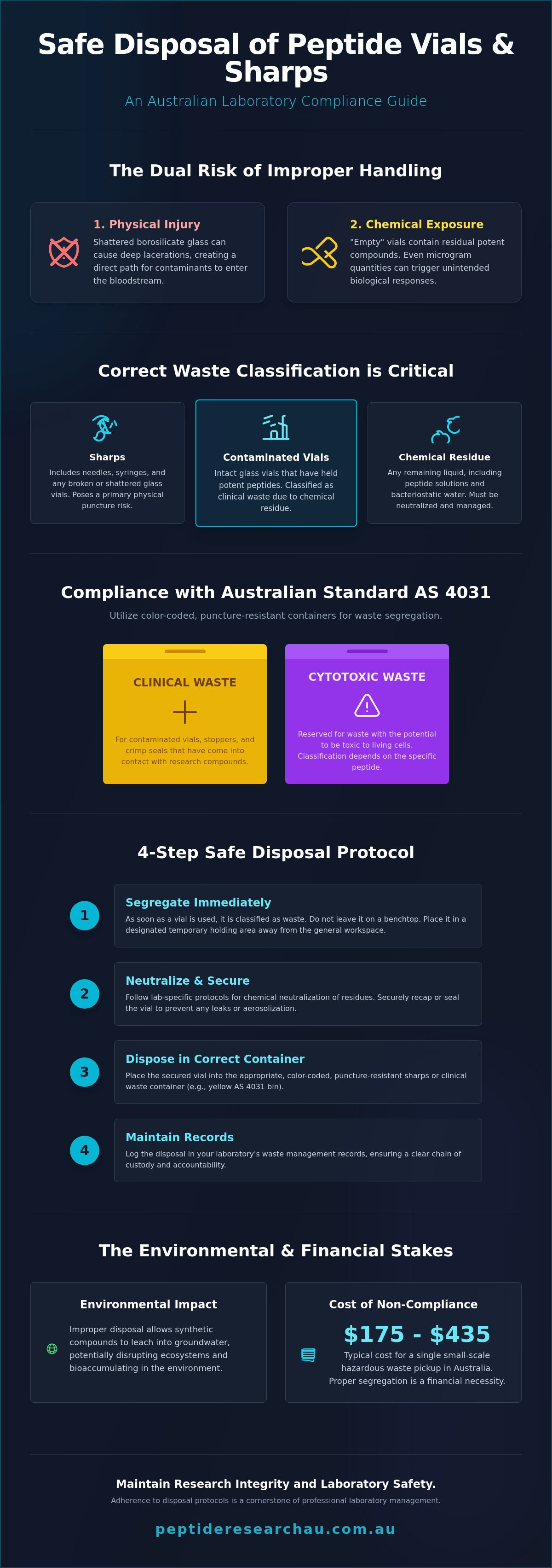
Researchers face a dual risk when handling used vials: physical injury and chemical exposure. A shattered vial can cause deep lacerations, while the residue within can enter the bloodstream through the wound. This is particularly dangerous when working with high-potency research compounds where even microgram quantities can trigger biological responses. Under Australian Work Health and Safety (WHS) laws, the researcher bears the legal responsibility for the waste they generate. Failure to implement a robust protocol for the safe disposal of used peptide vials can lead to institutional non-compliance and significant safety breaches.
The Biological and Chemical Impact of Improper Disposal
Improper disposal leads to significant ecological risks. If research-grade compounds enter general landfill, they can leach into groundwater and disrupt local ecosystems. Unlike standard consumer waste, laboratory waste containing synthetic peptides can bioaccumulate or interact with soil microbiology in unpredictable ways. Proper Sharps waste management ensures these materials are sequestered in puncture-resistant, sealed environments. Adhering to lab safety protocols for handling potent peptides prevents accidental exposure to waste management personnel who aren't equipped with the necessary protective gear. Preventing environmental leaching isn't just a best practice; it's a requirement for maintaining the integrity of the research community.
Glass Integrity and Laboratory Safety
Borosilicate glass is the industry standard for peptide storage due to its thermal resistance and chemical durability. These same properties make it a specific hazard if shattered. Standard municipal recycling bins are inappropriate for laboratory glass because the melting point of borosilicate differs from common soda-lime glass, which can contaminate entire recycling batches. Laboratory waste is defined as any material contaminated with research-grade substances, including vials, stoppers, and crimp seals. These items must be diverted from standard waste streams to specialized clinical or chemical disposal units to maintain a safe laboratory environment.
The financial and regulatory landscape for hazardous waste is shifting. In 2026, the U.S. hazardous waste management market is projected at $4.9 billion, reflecting a global trend toward more rigorous and costly waste management. For Australian laboratories, the cost of non-compliance often exceeds the price of proper disposal equipment. Small-scale hazardous waste pickups can range from $175 to $435, making efficient, on-site waste segregation a financial necessity as well as a safety requirement.
Classifying Laboratory Waste: Sharps, Glass, and Chemical Residue
Laboratory waste categorization is a critical step in maintaining safety. Researchers must distinguish between physical hazards and chemical residues. While needles are obvious sharps, the safe disposal of used peptide vials requires understanding that glass contaminated with potent compounds often falls into the clinical or cytotoxic waste streams. According to the Vanderbilt University chemical waste guide, identifying the specific hazards of a substance is the primary step in determining its storage and disposal path. This classification ensures that hazardous materials don't enter standard waste streams where they could pose a threat to the public or the environment.
Effective segregation starts at the point of research. Vials that have held potent peptides are not standard glass. They're clinical waste. Using a dedicated waste stream for these materials is the only way to ensure compliance with Australian standards. The safe disposal of used peptide vials involves isolating the glass from general recycling and ensuring that any residual liquid is sequestered. This framework prevents the accidental mixing of incompatible waste types, which can lead to dangerous chemical reactions or environmental contamination.
The presence of bacteriostatic water adds a layer of complexity. This diluent typically contains 0.9% benzyl alcohol as a bacteriostatic agent. When combined with peptide residues, the resulting solution must be handled as chemical waste rather than simple biological waste. The alcohol content, though low, requires proper sequestration to prevent the leaching of synthetic compounds into the water table. Researchers should always use high-quality laboratory diluents to ensure predictable chemical behavior during disposal.
Defining Sharps in the Research Context
In the process of peptide reconstitution, several items qualify as sharps. This category isn't limited to needles. It includes:
Hypodermic syringes and drawing needles.
Mixing needles used for diluent transfer.
Broken glass vials or ampoules.
Lancets and scalpels.
Treating the needle and the vial as a single waste unit is a common safety practice. This reduces the need for manual separation, which is the leading cause of accidental needle-stick injuries in laboratory settings. Once a needle has pierced a vial stopper, both components are considered contaminated.
Chemical Residue and Neutralisation
Lyophilised powder remaining in a vial is a concentrated hazard. Rinsing these vials down a domestic or laboratory sink is strictly prohibited under Australian lab safety protocols. Such actions can introduce potent agonists like retatrutide into the municipal water system. These compounds are often classified as clinical or cytotoxic waste due to their high biological activity. Even trace amounts of unmixed powder require sequestration. Any vial containing visible residue should be capped and placed directly into a dedicated chemical waste container for professional incineration.
Required Equipment for Compliant Peptide Waste Management
Maintaining a sterile research environment requires more than procedural knowledge; it demands the deployment of standardized hardware. The safe disposal of used peptide vials cannot be achieved using makeshift containers or standard household plastics. Effective waste management relies on puncture-resistant vessels that meet rigorous structural benchmarks. These units ensure that both the physical sharp and the chemical residue remain sequestered from the moment they leave the research workstation until they reach the point of final destruction.
Australian Standard AS 4031:1992 specifies the requirements for non-reusable sharps containers. This standard is the baseline for laboratory safety in Australia. It ensures the vessel is resistant to penetration and leak-proof under standard handling conditions. When managing borosilicate glass, the container must be able to withstand the impact of shattered fragments without compromising its integrity. Selecting the correct size for a research workstation is equally important. A container that is too large may remain in the lab for too long, increasing exposure risks, while one that is too small leads to overfilling, which is a primary cause of accidental injury.
Color-coding is the primary visual indicator for waste streams in a professional laboratory. Yellow containers are reserved for clinical waste, which includes standard research materials and blood-contaminated sharps. Purple containers signify cytotoxic waste. This stream is mandatory for vials containing potent chemical residues or unmixed lyophilised powders that require high-temperature incineration. Distinguishing between these two streams is a critical component of the safe disposal of used peptide vials, as it dictates the final treatment method used by waste contractors.
The Australian Standard (AS 4031) Explained
A "Standards Approved" container must pass specific tests for impact resistance and vertical load stability. These units feature a permanent locking mechanism that prevents the container from being reopened once it reaches the fill line. DIY containers, such as milk cartons or detergent bottles, fail safety audits because they're easily punctured by needles and lack these secure seals. Using non-compliant equipment puts the researcher and waste management personnel at unnecessary risk of exposure.
Sourcing Laboratory-Grade Disposal Units
Researchers can acquire compliant yellow and purple sharps bins through specialized medical and laboratory supply distributors. It's essential that your peptides australia sourcing and disposal plans are aligned to ensure a continuous safety chain. For large-scale research projects, secondary containment is often required. This involves placing smaller, workstation-sized bins into a larger, wheeled hazardous waste unit for bulk transport. This hierarchical approach minimizes the manual handling of contaminated glass and ensures that all materials are tracked through a compliant disposal manifest.
Step-by-Step Protocol for Handling and Disposing of Potent Peptides
Establishing a repeatable sequence for waste management is the only way to eliminate human error in a laboratory setting. The safe disposal of used peptide vials requires a disciplined approach that begins the moment a research session concludes. By following a structured protocol, researchers ensure that hazardous residues and physical sharps are sequestered before they can pose a risk to personnel or the environment. This methodology aligns with Australian safety benchmarks and institutional compliance requirements.
The disposal process follows five distinct stages of execution:
Step 1: Segregation. Immediately separate used vials, syringes, and packaging. Do not allow research materials to mix with general office or laboratory waste.
Step 2: Securing. Re-secure the vial cap. If a needle was used, do not attempt to recap it manually; use a mechanical device or the one-handed scoop method if a sheath is required.
Step 3: Placement. Deposit the vial and needle into an AS 4031 compliant container. Ensure the items drop freely into the vessel.
Step 4: Documentation. Record the disposal in the laboratory waste log. Include the compound type, quantity, and the date the waste was sequestered.
Step 5: Transport. Once the container reaches its capacity, transport it to an authorized Australian clinical waste facility or arrange for a licensed contractor pickup.
Precision in research extends to the quality of the materials used. Researchers should source their laboratory compounds from providers that maintain rigorous manufacturing standards to ensure waste residues are predictable and manageable.
The "Point of Use" Disposal Rule
Waste should never be transported across the laboratory space in an unsealed state. The "Point of Use" rule dictates that a sharps container must be within arm's reach of the research workstation. This proximity minimizes the window of opportunity for accidental drops or needle-stick injuries. Use a "one-handed" drop technique to deposit waste, keeping the non-dominant hand away from the container opening. If a vial of a compound like tb500 shatters, use forceps rather than gloved hands to collect the fragments. Shattered borosilicate glass is highly irregular and can easily penetrate standard nitrile gloves.
Final Disposal and Local Facilities
Authorized disposal is the final link in the safety chain. In Australia, researchers can often find council-approved collection points or pharmacy-based programs for small-scale sharps disposal. However, professional laboratories must utilize commercial clinical waste contractors for larger volumes. It's critical to monitor the "fill line" on every container. Most compliant bins indicate a maximum fill level of 75-80%. Overfilling a container creates a significant hazard where sharps can protrude from the opening or prevent the lid from locking securely. Once the line is reached, the permanent seal must be engaged immediately to prepare the unit for transport.
Maintaining Excellence in Laboratory Safety Standards
Research integrity is a comprehensive concept that extends beyond the accuracy of data collection. It encompasses the entire lifecycle of a study, including the rigorous management of laboratory waste. The safe disposal of used peptide vials is a critical component of this lifecycle. Negligent disposal practices don't just risk physical injury; they undermine the professional standing of the research institution and the validity of the study environment. A meticulous approach to waste ensures that the laboratory remains a controlled space where variables are minimized and safety is prioritized. Safety is a prerequisite for excellence.
High-quality laboratory supplies play a significant role in reducing the environmental footprint and safety risks of a project. When vials are manufactured to exacting standards, the risk of structural failure during handling or disposal is greatly reduced. This reliability is essential for researchers who demand precision in every phase of their work. Professional research requires professional-grade safety protocols to match the caliber of the compounds being studied. Consistency in hardware leads to consistency in safety outcomes.
The Link Between Quality Supplies and Safety
Utilizing high-grade bpc 157 vials with secure, tamper-evident seals significantly reduces the risk of contamination during both use and disposal. Vials that maintain their structural integrity under pressure ensure that residual peptides remain sequestered until the point of neutralization. The value of consistent laboratory diluents in maintaining a clean workspace cannot be overstated. High-purity diluents ensure that the chemical reactions within the vial remain predictable, which simplifies the waste classification process. Professional research requires professional-grade safety protocols.
Resources for Australian Researchers
Australian researchers must stay informed about evolving state-specific EPA guidelines for clinical and chemical waste. These regulations provide the legal framework for the safe disposal of used peptide vials and other hazardous materials. Maintaining a "Safety First" culture within the independent research community is vital for the long-term viability of the industry. This culture is built on a foundation of continuous education and the use of superior materials. By prioritizing safety, researchers protect themselves and the integrity of their scientific contributions.
Peptide Research AU is committed to supporting excellence in the Australian research community. We provide the technical specifications and high-quality compounds necessary for advanced study. Our mission is to facilitate scientific discovery by offering reliable products that meet the highest manufacturing standards. Safe research practices begin with the right tools and end with compliant waste management. Quality and safety are inseparable in a professional laboratory environment.
Explore our range of laboratory-grade peptides and supplies to ensure your research environment meets the highest standards of safety and precision.
Advancing Laboratory Safety Standards
Adhering to rigorous waste management protocols is a fundamental requirement for any high-integrity research environment. You've established that distinguishing between physical sharps and chemical residues is the first step in ensuring compliance. By utilizing hardware that meets Australian Standard AS 4031:1992 and following a "Point of Use" disposal rule, you eliminate the risks associated with accidental exposure and environmental contamination. The safe disposal of used peptide vials isn't just a regulatory necessity; it's a commitment to the safety of your laboratory personnel and the broader scientific community.
As an Australian-based supplier dedicated to research excellence, we understand that precision starts with procurement. Our laboratory-grade purity standards ensure that your research compounds perform predictably from reconstitution to disposal. Maintaining a sterile and safe workspace allows you to focus on the technical advancements that drive discovery. Browse Laboratory-Grade Research Peptides to secure high-quality materials for your next study. Your commitment to safety ensures the continued success and integrity of your scientific endeavors.
Frequently Asked Questions
Can I dispose of used peptide vials in my household recycling bin?
No, you cannot dispose of used peptide vials in household recycling. Borosilicate glass used in laboratory vials has a significantly higher melting point than standard consumer glass, which contaminates recycling streams. Additionally, the presence of research residue necessitates classification as clinical waste. These materials must be sequestered in authorized laboratory waste streams to prevent environmental leaching and physical hazards to waste management personnel.
What is the correct way to handle a broken glass peptide vial?
Use mechanical tools such as forceps or a dedicated brush and pan to collect fragments. Never attempt to pick up broken borosilicate glass with your hands, even while wearing nitrile gloves, as shards can easily penetrate standard protective layers. All fragments should be placed immediately into a puncture-resistant sharps container to ensure the safe disposal of used peptide vials and prevent accidental lacerations.
Where can I find a sharps disposal bin in Australia?
Compliant sharps bins are available through medical supply distributors and specialized laboratory retailers across Australia. For independent researchers, many local councils and community pharmacies offer authorized collection points for small quantities of waste. Always verify that the container displays the AS 4031:1992 certification mark to ensure it meets the structural requirements for safe laboratory operation and final transport.
Do I need to rinse out the vial before disposing of it?
You should not rinse vials before disposal. Rinsing can introduce concentrated synthetic peptides and solvents into the municipal water system, which is strictly prohibited under Australian lab safety protocols. The correct procedure involves securing the vial cap and depositing the unit directly into the appropriate clinical or cytotoxic waste stream. This method ensures that all chemical residues are destroyed through professional incineration.
Is it legal to use a heavy-duty plastic bottle as a sharps container?
It is neither legal nor safe to use heavy-duty plastic bottles as substitutes for certified sharps containers in a research setting. Australian Standard AS 4031:1992 requires specific penetration resistance and permanent locking mechanisms that household plastics do not provide. Using non-compliant containers poses a significant risk to waste handlers and will result in a failure of institutional safety audits and compliance checks.
What should I do if I accidentally prick myself with a research needle?
Wash the affected area immediately with soap and running water for several minutes without squeezing the wound. Seek an immediate medical evaluation at an emergency department or occupational health clinic to assess the risk of exposure. It is vital to report the incident to your laboratory safety officer and provide the specific chemical nomenclature of the research compound involved to guide medical treatment.
How do I dispose of unused bacteriostatic water?
Unused bacteriostatic water must be treated as chemical waste due to the presence of 0.9% benzyl alcohol. This bacteriostatic agent requires sequestration to prevent it from entering the water table and impacting soil microbiology. Small volumes should be collected in a compatible, labeled chemical waste container for professional pickup rather than being discarded in domestic drainage systems or standard laboratory sinks.
Are there different disposal rules for different types of peptides?
Yes, disposal protocols vary based on the biological potency and chemical characteristics of the compound. Standard research peptides generally require yellow clinical waste containers for safe disposal of used peptide vials. However, potent agonists or compounds with known cytotoxic properties must be placed in purple containers. This color-coding ensures the waste is diverted for high-temperature incineration, which is necessary for the complete destruction of high-potency molecular structures.


Comments