
Retatrutide vs. Tirzepatide for Research: A Technical Comparison of Triple and Dual Agonists
- peptideresearchau
- Jul 3
- 11 min read

Can the addition of a single receptor agonist fundamentally redefine the efficacy of metabolic research models? Many investigators in Australia currently face significant hurdles when evaluating retatrutide vs tirzepatide for research, often encountering inconsistent purity levels or missing HPLC/MS verification from international suppliers. It's a common frustration to find that shipments don't meet the rigorous standards required for sensitive assays, especially as the TGA increases its focus on unapproved peptides in 2026. You likely recognize that the transition from dual to triple agonism requires more than just a new compound; it demands a total recalibration of laboratory handling and reconstitution protocols.
This technical comparison clarifies how the inclusion of glucagon receptor engagement distinguishes triple-agonists from established dual-agonist frameworks. You'll gain a precise pharmacological analysis of these compounds, alongside standardized laboratory protocols for handling complex sequences. We also outline the essential purity requirements and sourcing strategies for HPLC-verified domestic stock to ensure your data remains robust and reproducible. By examining the chemical nuances and 2026 regulatory priorities, this guide helps you determine the appropriate reagent for specific metabolic studies while maintaining strict adherence to Australian laboratory standards.
Table of Contents
Understanding Retatrutide vs. Tirzepatide: The Mechanism of Agonism
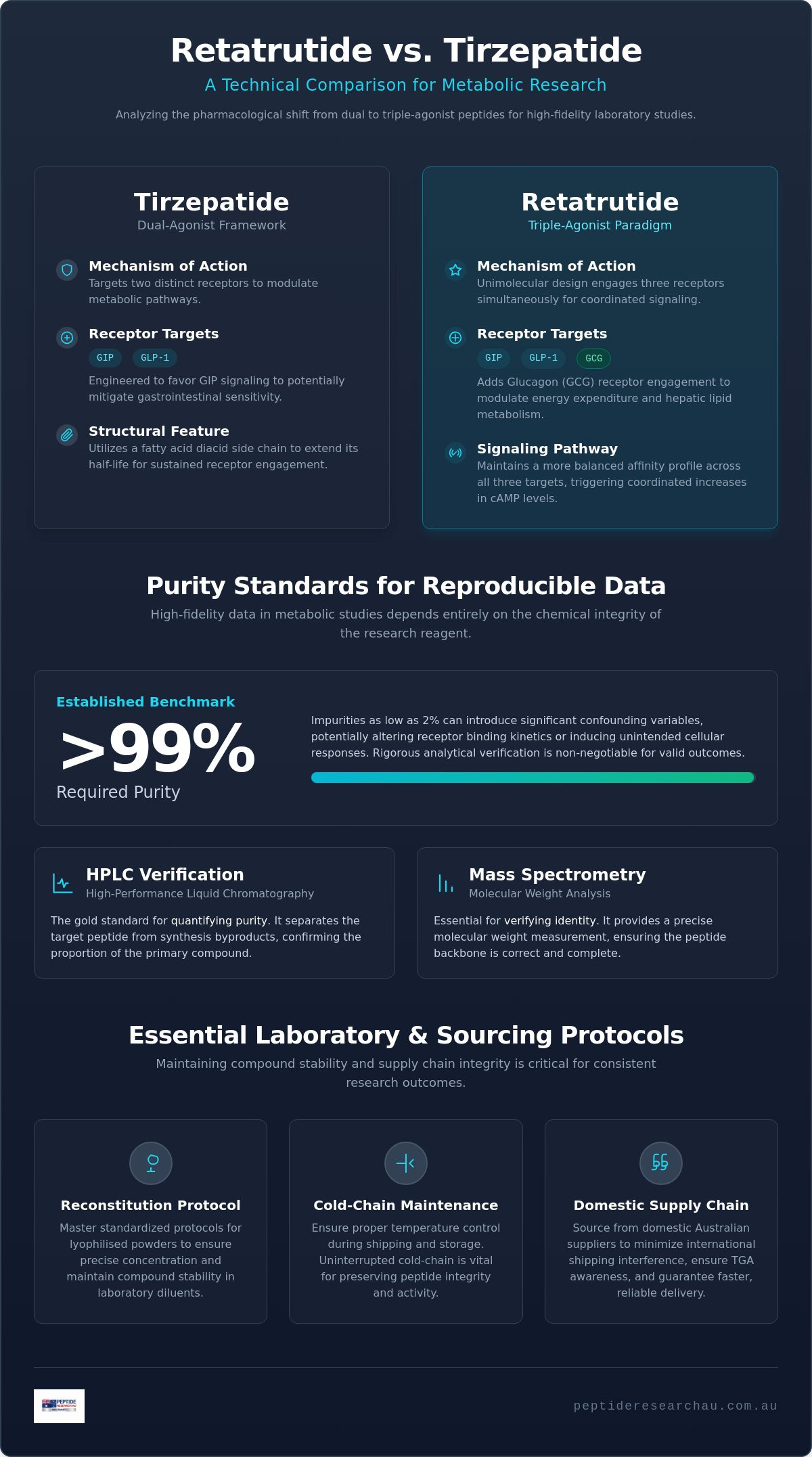
Tirzepatide represents a dual agonist class, targeting both the Glucose-dependent Insulinotropic Polypeptide (GIP) and Glucagon-Like Peptide-1 (GLP-1) receptors. This compound utilizes a fatty acid diacid side chain to extend its half-life, allowing for sustained receptor engagement in metabolic studies. In contrast, retatrutide functions as a unimolecular triple agonist. It engages GLP-1 and GIP receptors while adding a third target: the Glucagon receptor (GCG). When evaluating retatrutide vs tirzepatide for research, investigators must account for this additional GCG activation, which modulates energy expenditure and hepatic lipid metabolism. The unimolecular design is technically significant because it ensures simultaneous activation of all three pathways within a single molecular structure. This prevents the pharmacokinetic variability often seen in co-administered multi-peptide complexes.
Receptor Binding and Signaling Pathways
Retatrutide's triple-agonist mechanism offers a more balanced affinity profile across its three targets compared to tirzepatide's heavy GIP receptor dominance. While tirzepatide is engineered to favor GIP signaling to mitigate gastrointestinal sensitivity, retatrutide maintains potent activity at the GCG receptor to enhance metabolic flexibility. This triple engagement triggers coordinated intracellular signaling, specifically increasing cyclic adenosine monophosphate (cAMP) levels in target tissues. In laboratory models, these elevated cAMP levels serve as a secondary messenger that drives downstream metabolic effects, such as improved insulin secretion and thermogenesis. Researchers must monitor these signaling variations closely. The shift from dual to triple agonism alters the baseline metabolic response in cellular assays.
The Evolution of Metabolic Research Models
The progression of endocrine study has moved rapidly from single-agonist molecules like semaglutide to the sophisticated multi-agonist designs seen today. Studying retatrutide vs tirzepatide for research allows investigators to observe how adding glucagon agonism affects mitochondrial function and lipid oxidation in vitro. Preliminary data suggests that triple agonists may induce higher rates of fatty acid oxidation within hepatocytes compared to dual agonists. This evolution enables more complex study designs that target multiple redundant metabolic pathways simultaneously. Triple agonism represents a paradigm shift in endocrine study by integrating three distinct hormonal pathways into a single peptide sequence to maximize metabolic throughput.
Purity Standards for Triple-Agonist Research Reagents
High-fidelity data in metabolic studies depends entirely on the chemical integrity of the reagent. When comparing retatrutide vs tirzepatide for research, investigators must look beyond the molecular sequence to the analytical data provided by the supplier. A purity level of >99% is the established benchmark for ensuring reproducible outcomes in complex endocrine models. Impurities as low as 2% can introduce significant confounding variables, potentially altering receptor binding kinetics or inducing unintended cellular responses. High-Performance Liquid Chromatography (HPLC) remains the gold standard for quantifying this purity by separating the target peptide from synthesis byproducts based on hydrophobic interactions.
While HPLC confirms the quantity of the primary compound, Mass Spectrometry (MS) is required to verify its identity. For the 39-amino acid retatrutide sequence, MS provides a precise measurement of molecular weight, ensuring the peptide backbone hasn't suffered from truncated sequences or incorrect amino acid insertions. Beyond the peptide itself, researchers should monitor Trifluoroacetic acid (TFA) residues and total salt content. High TFA concentrations can be cytotoxic to cell cultures, while excessive sodium or acetate salts may shift the osmotic balance in delicate in vitro assays. Sourcing quality research peptides requires a commitment to these analytical rigors to maintain the validity of Australian laboratory data.
Interpreting the Certificate of Analysis (COA)
A legitimate third-party COA must be batch-specific rather than a generic representative report. Investigators should look for a clear HPLC chromatogram showing a single, sharp peak and an MS report that aligns with the theoretical molecular weight of the compound. Peptide Research AU prioritizes this level of transparency, as generic reports often mask variations in synthesis quality between different production runs. Verification by an independent laboratory provides an essential layer of security for researchers who don't have in-house analytical capabilities. If you're establishing a new protocol, always request the most recent HPLC-verified data for your specific batch.
Chemical Stability and Degradation
The structural complexity of triple agonists makes them inherently more vulnerable to degradation than simpler peptides. Factors like temperature fluctuations, UV exposure, and improper pH during reconstitution can break down the peptide bonds in the 39-amino acid chain. Lyophilisation is the most effective method for preserving these compounds, as it removes moisture that would otherwise facilitate hydrolytic cleavage during transit. Once a researcher reconstitutes the powder, they should inspect the solution for cloudiness or visible particulates. These are clear signs of peptide aggregation or degradation, which will inevitably compromise the accuracy of any retatrutide vs tirzepatide for research comparison. Maintaining strict cold-chain protocols from the supplier to the freezer is non-negotiable for preserving metabolic activity.
Comparative Analysis: Binding Affinities and Research Applications
When evaluating retatrutide vs tirzepatide for research, the technical distinction lies in the equilibrium dissociation constants (Ki) for each target receptor. Tirzepatide exhibits a pronounced bias toward the GIP receptor, with a Ki value of approximately 0.13 nM, while its GLP-1 receptor affinity is significantly lower at roughly 4.2 nM. Retatrutide maintains a more symmetrical potency across its three targets. Its binding profile shows high affinity for GIPR (0.19 nM) and GLP-1R (0.75 nM), coupled with potent engagement of the GCG receptor at 5.7 nM. This structural divergence dictates the pharmacokinetic profile and the specific intracellular signaling cascades observed during experimentation. The C20 fatty acid diacid side chain in tirzepatide facilitates reversible binding to albumin, which significantly extends its circulating half-life in laboratory models. Retatrutide's backbone is engineered to accommodate the triple-agonist sequence while maintaining stability without the same heavy reliance on albumin-binding moieties.
Metabolic Rate vs. Glucose Homeostasis
Retatrutide is the preferred reagent for studies focusing on thermogenesis and energy expenditure. The inclusion of the glucagon receptor allows researchers to model increases in metabolic rate that aren't achievable with dual agonists alone. In contrast, tirzepatide remains the standard for modeling insulin sensitivity and glucose control due to its potent GIPR-mediated effects on beta-cell function. Laboratory observations often show distinct lipid profile changes between the two. Triple agonists typically induce more significant reductions in hepatic fat accumulation in vitro, while dual agonists excel in stabilizing postprandial glucose fluctuations. Choosing the correct compound depends on whether the research hypothesis prioritizes caloric burning or glycemic stability.
Study Design Considerations
Selecting between dual and triple agonists requires a clear definition of the metabolic pathway under investigation. Research involving systemic repair models often integrates metabolic agonists with regenerative compounds like BPC-157 to study the interplay between energy metabolism and tissue healing. Investigators frequently combine these agonists with other specialised peptides to map the cross-talk between endocrine pathways. Retatrutide is the preferred reagent for complex metabolic signaling due to its concurrent recruitment of the glucagon receptor. This multi-pathway engagement provides a more comprehensive view of metabolic flexibility in advanced research models. When designing retatrutide vs tirzepatide for research protocols, you must account for how triple agonism might mask or amplify the effects of secondary compounds compared to a dual-agonist baseline.
Laboratory Protocols: Reconstitution and Storage of Triple Agonists
Precision in laboratory handling is as critical as the chemical purity of the compound itself. When establishing protocols for retatrutide vs tirzepatide for research, investigators must account for the high sensitivity of multi-agonist sequences to mechanical stress. Precise reconstitution requires specific equipment: sterile insulin-grade syringes for volume accuracy, 70% isopropyl alcohol swabs for septum decontamination, and high-grade laboratory diluents. The 39-amino acid chain of retatrutide is particularly susceptible to denaturation if subjected to rapid pressure changes or aggressive agitation during the mixing process.
A standardized reconstitution protocol involves several controlled steps. First, allow the lyophilised vial to reach room temperature to prevent condensation. Introduce the diluent by aiming the needle at the inner glass wall of the vial, letting the liquid trickle down into the powder. This technique minimizes the risk of peptide shearing. Rather than shaking, gently swirl the vial in a circular motion until the solution is completely clear. Calculating laboratory concentrations requires strict adherence to mcg/mL ratios. For example, reconstituting a 5mg vial with 2mL of diluent yields a concentration of 2500mcg/mL. Maintaining these precise ratios is essential for ensuring the reproducibility of dose-response curves in metabolic assays.
Diluent Selection and Sterility
Bacteriostatic water containing 0.9% benzyl alcohol is the standard diluent for research reagents. It serves a dual purpose: maintaining the stability of the peptide while inhibiting microbial growth during multi-use sampling. Successful reconstitution results in a perfectly clear, colorless solution. Any presence of cloudiness, flocculation, or visible particulates indicates that the peptide has aggregated or degraded. Lyophilised vials should be stored at -20°C for long-term stability. Once reconstituted, retatrutide should be kept at 2-8°C and used within a specific window to ensure the integrity of the triple-agonist sequence remains intact.
Safety and Handling Guidelines
All laboratory procedures must align with "Research Use Only" (RUO) standards. This classification strictly prohibits any clinical or human application of these compounds. Researchers must utilize appropriate Personal Protective Equipment (PPE), including nitrile gloves and lab coats, especially when handling concentrated powders that could become airborne. Waste management is equally vital. All laboratory sharps and chemical waste must be disposed of in accordance with Australian standards, such as AS/NZS 3816:2018 for clinical and related waste management. Adhering to these rigorous safety frameworks ensures that the focus remains on high-quality data collection within a controlled environment.
Sourcing Quality Retatrutide for Australian Research in 2026
Sourcing retatrutide vs tirzepatide for research within Australia eliminates the volatility inherent in international logistics. In June 2026, the TGA officially made unapproved peptides a compliance priority, reflecting a significant scaling up of regulatory attention. This shift increases the risk of customs seizures for investigators attempting to import reagents from international suppliers. Beyond regulatory hurdles, international shipping frequently compromises cold-chain integrity. Complex triple-agonist peptides are thermolabile. Exposure to ambient temperatures during lengthy transit can induce irreversible denaturation. When evaluating retatrutide vs tirzepatide for research, domestic sourcing is the most effective way to mitigate these risks. Sourcing from a domestic provider ensures that materials arrive within required temperature parameters, preserving the fidelity of experimental data.
Peptide Research AU supports the Australian scientific community by maintaining a local inventory of HPLC-verified compounds. Evaluating supplier credentials requires more than just a cursory glance at a website. Legitimate providers must offer transparent, batch-specific testing data that confirms both purity and molecular identity. By centralizing distribution within Australia, researchers gain access to technical support that understands local laboratory standards and regulatory requirements. This proximity is essential for longitudinal studies where consistent reagent availability is non-negotiable. Investigating these compounds requires high-fidelity materials that don't suffer from the batch-to-batch inconsistency often seen in unregulated international markets.
Domestic Supply Chain Reliability
Local shipping provides a controlled environment for maintaining the stability of the 39-amino acid retatrutide sequence. University studies and institutional projects require a predictable supply of reagents to meet strict grant timelines and peer-review milestones. Relying on domestic stock prevents the multi-week delays common with international air freight. Additionally, Australian-based technical support allows for immediate resolution of reconstitution or storage queries. This ensures that laboratory investigators can maintain their workflow without interruption. A secure domestic supply chain is the foundation for reproducible metabolic research.
Future Outlook for Triple-Agonist Research
Through 2026, metabolic research in Australian institutions is projected to shift toward more complex multi-pathway signaling models. The availability of high-purity reagents like retatrutide enables advanced endocrine discovery that was previously limited by dual-agonist constraints. As researchers move toward Phase 3 trial frameworks and beyond, the demand for verified, domestic laboratory compounds will continue to grow. Investigators must prioritize chemical excellence to ensure their findings contribute meaningfully to the global understanding of triple-agonist pharmacology. View our laboratory-grade retatrutide and secure high-purity materials for your next study.
Advancing Metabolic Research Standards in 2026
The transition from dual GLP-1/GIP agonism to the triple-agonist profile of retatrutide allows for a more comprehensive investigation of metabolic pathways, particularly regarding glucagon-mediated energy expenditure. Success in these complex studies depends on the chemical fidelity of the reagents and the precision of laboratory reconstitution protocols. When evaluating retatrutide vs tirzepatide for research, investigators must prioritize compounds that meet strict >99% purity benchmarks verified by independent analytical data. Domestic sourcing remains the most reliable strategy for maintaining cold-chain integrity and navigating the evolving regulatory landscape in Australia.
Secure the technical foundation of your next study with laboratory-grade reagents intended for professional research. We provide batch-specific HPLC/MS verification with every order to ensure data reproducibility and sequence identity. Order HPLC-Verified Retatrutide for Laboratory Research and benefit from domestic Australian shipping for maximum stability. We look forward to supporting your scientific advancements.
Frequently Asked Questions
What is the molecular purity of retatrutide offered for research?
The standard molecular purity for research-grade retatrutide is ≥98%, though ≥99% is preferred for high-precision metabolic assays. This purity level is verified using High-Performance Liquid Chromatography (HPLC) to ensure the absence of synthesis byproducts. Mass Spectrometry (MS) further confirms the identity of the 39-amino acid sequence. Using reagents below these standards can introduce confounding variables that compromise the reproducibility of your laboratory data.
Is retatrutide legal for laboratory research use in Australia in 2026?
Retatrutide is currently an investigational compound permitted for legitimate laboratory research purposes only within Australia. It isn't approved by the TGA for clinical or human use. In 2026, the TGA has designated unapproved peptides as a compliance priority, so investigators must ensure their work remains strictly within a professional research framework. Sourcing from domestic suppliers helps researchers avoid the legal complexities and seizure risks of international importation.
How does retatrutide differ from tirzepatide in receptor engagement?
Retatrutide functions as a unimolecular triple agonist targeting GLP-1, GIP, and GCG receptors, while tirzepatide is a dual agonist targeting only GLP-1 and GIP. When evaluating retatrutide vs tirzepatide for research, the primary technical difference is the inclusion of the glucagon (GCG) receptor. This additional pathway allows for the study of thermogenesis and hepatic lipid metabolism, which aren't activated by dual-agonist compounds in the same manner.
Can retatrutide be reconstituted with sterile water for lab studies?
Bacteriostatic water is the recommended diluent for reconstituting retatrutide because it contains 0.9% benzyl alcohol to inhibit microbial growth. While sterile water is chemically compatible, it doesn't provide the same preservative qualities for multi-use vials. This increases the risk of contamination if the solution is stored in a refrigerator for several days. Researchers should always prioritize bacteriostatic diluents to maintain the stability of the peptide solution during experiments.
What are the optimal storage conditions for lyophilised research peptides?
Lyophilised peptide powders must be stored at -20°C to ensure long-term chemical stability and prevent degradation of the peptide bonds. This temperature range protects the compound's integrity during longitudinal studies. Once the peptide is reconstituted into a liquid solution, it should be kept at 2-8°C and used within a short window. Avoiding repeated freeze-thaw cycles is essential for maintaining the potency of the triple-agonist sequence in a lab setting.
How long does domestic shipping take for research compounds within Australia?
Domestic shipping for laboratory reagents typically takes 1-3 business days, depending on the specific location of the research institution. Fast transit is a critical factor when choosing retatrutide vs tirzepatide for research materials because it minimizes the time compounds spend outside of controlled storage. Local shipping avoids the multi-week delays and customs inspections associated with international suppliers, ensuring that your research project stays on its projected timeline.
Does retatrutide require cold-chain transport to maintain integrity?
Yes, cold-chain transport is vital for preserving the stability of complex triple-agonist peptides during the delivery process. Even in a lyophilised state, exposure to high ambient temperatures can lead to peptide denaturation or aggregation. Professional domestic suppliers use insulated packaging to maintain stable temperatures from the warehouse to the laboratory. This level of care ensures that the reagent arrives with its biological activity fully intact for your assays.
What is the significance of the glucagon receptor in retatrutide research?
The glucagon receptor engagement in retatrutide research is significant because it drives metabolic effects like increased energy expenditure and fatty acid oxidation. This differs from dual agonists which primarily focus on insulin secretion and glucose homeostasis. By activating the GCG receptor, researchers can investigate more complex metabolic signaling pathways. This provides a more comprehensive model for studying weight loss mechanisms and hepatic fat reduction in advanced endocrine research.


Comments