

Retatrutide GLP-1 Research: Exploring the Triple Agonist Frontier in 2026
- peptideresearchau
- 2 days ago
- 11 min read

Can a single molecule simultaneously target three distinct metabolic pathways to achieve results that were biologically impossible just five years ago? As we progress through 2026, retatrutide glp-1 research has transitioned from theoretical modeling to a definitive frontier in clinical metabolic science. You've likely recognized the limitations of traditional single or dual agonists and felt the frustration of navigating fragmented data regarding the Glucagon receptor's specific role. It's a significant challenge for Australian researchers who require precision but often encounter outdated trial summaries and vague handling protocols.
This article provides a comprehensive scientific analysis of Retatrutide's triple agonist mechanism, comparing it directly to standard GLP-1 research compounds. We'll demystify the synergy between GIP, GLP-1, and Glucagon receptors using the latest 2026 data points. You'll gain a clear understanding of the key differences between this new generation of peptides and their predecessors. We'll also outline the exact protocols for handling these innovative laboratory grade compounds and how to identify high quality, research grade sourcing available in Australia to ensure the integrity of your scientific studies.
Key Takeaways
Understand the scientific evolution from mono-agonists to the triple-agonist mechanism, representing the third generation of metabolic research peptides.
Evaluate the latest retatrutide glp-1 research to compare receptor affinity and weight reduction percentages against standard research compounds.
Review updated findings from 2026 Phase 3 trials, including the peptide’s potential impact on liver health and chronic kidney disease in laboratory models.
Explore the synergistic effects of targeting GLP-1, GIP, and glucagon receptors simultaneously to enhance metabolic research outcomes.
Discover why sourcing laboratory-grade compounds within Australia is critical for maintaining peptide integrity and ensuring rigorous purity standards.
Table of Contents The Evolution of Incretin Research: From GLP-1 to Retatrutide Understanding the Triple Agonist Mechanism: GLP-1, GIP, and Glucagon Retatrutide vs. Tirzepatide vs. Semaglutide: A Comparative Analysis Current Research Protocols and Trial Data for 2026 Sourcing Laboratory-Grade Retatrutide in Australia
The Evolution of Incretin Research: From GLP-1 to Retatrutide
Retatrutide (LY3437943) represents the third generation of metabolic research peptides. This molecule signals a definitive shift in how scientists approach obesity and metabolic dysfunction. The transition from mono-agonists like Semaglutide to dual-agonists like Tirzepatide has culminated in the development of triple-agonist pathways. Researchers in Australia are now prioritising retatrutide glp-1 research to understand how targeting three distinct receptors simultaneously can overcome the biological limits of previous therapies.
Triple agonism is currently the gold standard in metabolic study. It targets the glucagon-like peptide-1 (GLP-1), glucose-dependent insulinotropic polypeptide (GIP), and glucagon receptors (GCGR). This multi-pathway approach aims to synchronise insulin regulation, appetite suppression, and energy expenditure. By 2026, the scope of Retatrutide study in Australian laboratories will likely expand to include complex interactions between these receptors and long-term metabolic health markers.
The Limitations of Single-Receptor Agonists
Early incretin research focused almost exclusively on GLP-1 receptor activation. While GLP-1 effectively improves satiety and glucose-dependent insulin secretion, it has inherent biological boundaries. Data from the 2021 STEP clinical trials showed that while participants achieved significant results, many hit a "weight loss plateau" around the 68-week mark. This occurs because the body initiates metabolic adaptation to counter-regulate single-pathway stimulation. Researchers found that mono-agonists often fail to address energy expenditure directly, leading to a search for pathways that could bypass these metabolic roadblocks. Triple agonism addresses this by adding glucagon receptor activity, which potentially increases thermogenesis.
Retatrutide’s Place in the 2026 Research Landscape
Retatrutide is currently the subject of intense investigational study. Phase 2 data published in the New England Journal of Medicine recorded a mean weight reduction of 24.2% at the 48-week mark using a 12mg dose. This exceeds the benchmarks set by earlier mono and dual-agonist compounds. For researchers in Australia, it's vital to distinguish between clinical pharmaceuticals and laboratory-grade research peptides. Laboratory-grade compounds are essential for maintaining the high-precision environment required for 2026 metabolic studies. You can find more foundational data on this molecule in our Retatrutide Pillar. High-purity retatrutide glp-1 research materials ensure that experimental outcomes are not skewed by the fillers or stabilisers found in retail medications.
First Generation: GLP-1 Mono-agonists (e.g., Semaglutide)
Second Generation: GLP-1/GIP Dual-agonists (e.g., Tirzepatide)
Third Generation: GLP-1/GIP/GCGR Triple-agonists (Retatrutide)
Understanding the Triple Agonist Mechanism: GLP-1, GIP, and Glucagon
The 'Triple Agonist' mechanism is the simultaneous activation of GLP-1, GIP, and GCGR receptors for enhanced metabolic flux. This multi-receptor approach creates a synergistic effect where the combined impact on metabolic pathways exceeds what is possible with mono or dual-receptor agonists. By engaging three distinct pathways, Retatrutide replicates the intricate, natural postprandial hormone response more accurately than previous generations of peptides. In long-term laboratory models, Retatrutide demonstrates a pharmacokinetic half-life of approximately 144 hours. This allows for a stable steady-state concentration with once-weekly administration, which is a critical factor for retatrutide glp-1 research focusing on chronic metabolic disorders and sustained weight regulation.
Receptor Synergy: Simultaneous targeting prevents the compensatory mechanisms often seen when only one pathway is stimulated.
Natural Mimicry: The triple action aligns with how the body naturally coordinates insulin secretion, energy usage, and satiety.
Pharmacokinetic Stability: The 6 day half-life ensures consistent receptor occupancy throughout the dosing interval.
GLP-1 and GIP: The Foundation of Insulinotropic Action
GLP-1 (Glucagon-like peptide-1) and GIP (Glucose-dependent insulinotropic polypeptide) provide the essential foundation for glucose management. GLP-1 primarily functions by slowing gastric emptying and acting on the central nervous system to signal satiety. GIP complements this by enhancing insulin secretion in a glucose-dependent manner, which significantly lowers the risk of hypoglycaemia in research models. Data suggests that GIP also plays a vital role in lipid metabolism and acts as a buffer against the nausea often associated with GLP-1 receptor activation. Together, these two pathways stabilise blood glucose while improving the overall insulin sensitivity of the subject.
The Glucagon Receptor (GCGR): The Retatrutide X-Factor
The activation of the Glucagon Receptor (GCGR) is the primary feature that distinguishes Retatrutide from dual agonists like Tirzepatide. While GLP-1 and GIP manage appetite and insulin, GCGR targets energy expenditure and thermogenesis. This receptor increases the resting metabolic rate, providing a metabolic "push" even when the subject is in a caloric deficit. This is particularly relevant for studies involving Metabolic-associated fatty liver disease (MAFLD). Clinical data from 2023 showed that Retatrutide achieved a 100% rate of liver fat reduction of 30% or more in specific high-dose cohorts. For researchers investigating these advanced metabolic shifts, sourcing research grade peptides from a trusted Australian supplier is vital for maintaining experimental integrity. This triple-receptor engagement shifts the research focus from simple calorie restriction to active metabolic enhancement and lipid oxidation.
Retatrutide vs. Tirzepatide vs. Semaglutide: A Comparative Analysis
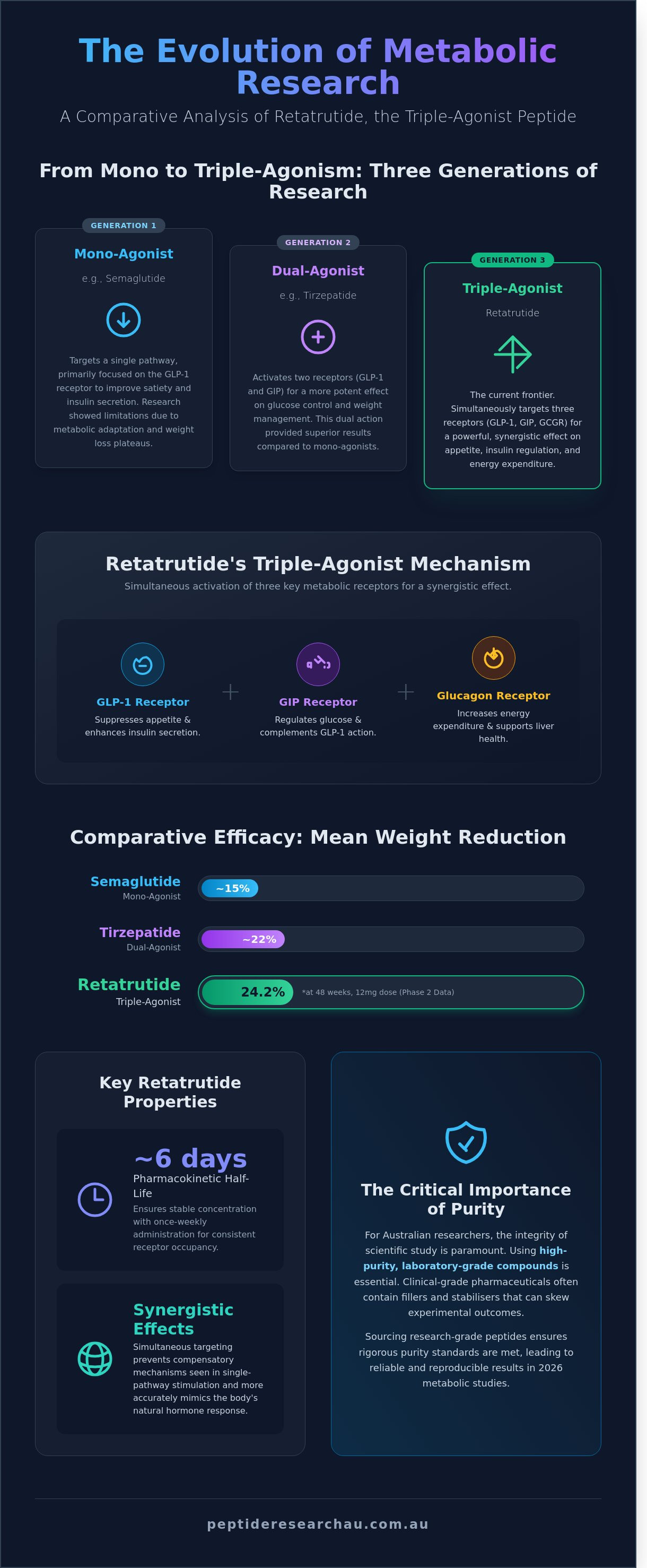
Researchers categorize these peptides by their specific receptor targets. Semaglutide acts as a selective GLP-1 receptor agonist. Tirzepatide functions as a dual agonist for GLP-1 and GIP. Retatrutide represents the next frontier in retatrutide glp-1 research by targeting three distinct pathways: GLP-1, GIP, and the glucagon receptor (GCGR). This triple-agonist approach increases metabolic rate while simultaneously suppressing appetite and improving insulin sensitivity.
Phase 2 data published in the New England Journal of Medicine in June 2023 highlights the performance gap between these compounds. While Semaglutide 2.4 mg typically yields approximately 15% weight reduction over 68 weeks, Retatrutide achieved a 24.2% reduction in just 48 weeks at the 12 mg dose level. This shift represents a move toward "surgical-level" efficacy without invasive procedures. Key metabolic markers also show distinct improvements in laboratory settings:
A1C Reduction: Retatrutide cohorts showed glycaemic control that often surpassed the 2.0% reduction seen in previous dual-agonist studies.
Blood Pressure: Mean systolic reductions reached 14 to 15 mmHg in high-dose subjects by the end of the 48-week period.
Lipid Profile: Researchers observed a 40% reduction in liver fat content within 24 weeks for subjects using triple-agonist compounds.
Handling these laboratory grade compounds requires strict precision. Single agonists like Semaglutide are relatively stable. Triple agonists are more sensitive to thermal degradation and mechanical stress. Australian researchers must maintain cold-chain storage at 2°C to 8°C to ensure peptide integrity. Reconstitution protocols should use bacteriostatic water to prevent premature degradation of the complex triple-binding structure.
Potency and Efficacy in Research Models
Retatrutide's dose-response curve is notably steeper than its predecessors. In the 48-week studies, subjects on the 12 mg dose didn't reach a weight plateau, which suggests even higher efficacy in longer-term trials. This potency allows researchers to achieve results that were once only possible through bariatric surgery. The triple-binding affinity ensures that metabolic pathways remain active even as the body's homeostatic mechanisms attempt to reach a new weight set point.
Safety and Tolerability Profiles in 2026
Gastrointestinal events remain the most frequent side effects in retatrutide glp-1 research. Nausea and vomiting occurred in roughly 45% of subjects during initial dose escalation phases. A unique consideration for Retatrutide is the transient increase in heart rate. This is a known effect of glucagon receptor activation. Laboratory protocols must include regular cardiovascular monitoring. Researchers should implement a slow titration schedule over 16 weeks to mitigate these risks and maintain subject stability.
Current Research Protocols and Trial Data for 2026
The TRIUMPH Phase 3 clinical program reached significant milestones by early 2026. Data from the TRIUMPH-1 trial confirmed that retatrutide achieved a mean weight reduction of 24.2% at 48 weeks in participants without type 2 diabetes. This performance exceeds the 15% to 20% benchmarks set by earlier GLP-1 and GIP dual agonists. Researchers now focus on the TRIUMPH-3 and TRIUMPH-4 cohorts. These studies specifically examine the impact on patients with chronic kidney disease (CKD) and metabolic dysfunction-associated steatohepatitis (MASH). Preliminary 2026 findings indicate that retatrutide's triple-agonist mechanism reduces liver fat by 80% on average within 24 weeks. This data positions retatrutide glp-1 research at the forefront of metabolic medicine.
Reconstitution and Laboratory Handling
Maintaining the integrity of laboratory-grade compounds requires strict adherence to preparation standards. Researchers should use high-quality bacteriostatic water to ensure stability and prevent microbial growth during the study period. When calculating concentrations for micro-dosing, precision is vital. A 5mg vial reconstituted with 2ml of diluent yields a concentration of 2.5mg/ml, allowing for granular control over experimental variables. Proper handling prevents peptide degradation and ensures consistent results across longitudinal studies.
Retatrutide must be stored at -20°C for long-term stability in research environments.
Temperature control is the most critical factor for maintaining potency. While reconstituted peptides are stable at 2°C to 8°C for short periods, they shouldn't remain at room temperature for more than a few hours. Vials must stay shielded from direct light to prevent photo-degradation of the amino acid chain. Scientific accuracy depends on these rigorous storage measures.
Future Directions: Beyond Weight Loss
The scope of retatrutide glp-1 research is expanding into cardiovascular inflammation and organ protection. While weight loss remains a primary focus, the glucagon component of this triple agonist offers unique benefits for liver health. By 2026, clinical interest has shifted toward its potential to reverse fibrosis in MASH patients. Scientists are also investigating its role in reducing major adverse cardiovascular events (MACE) by up to 20% in high-risk groups. The next phase of incretin science involves quadruple agonists. These future compounds may integrate additional pathways like amylin or glucagon-like peptide-2 to further refine metabolic control.
Ensure your laboratory has access to high-purity compounds by browsing the research grade peptides available at Peptide Research AU.
Sourcing Laboratory-Grade Retatrutide in Australia
Securing reliable materials is the cornerstone of successful retatrutide glp-1 research. In the Australian scientific landscape of 2026, researchers face specific logistical and regulatory challenges that require a domestic solution. Importing peptides from overseas often exposes fragile lyophilised powders to extreme temperature fluctuations and prolonged transit times. These factors can lead to peptide degradation before the compound even reaches the laboratory, compromising the accuracy of your data.
Peptide Research AU provides laboratory grade compounds that bypass these risks. By sourcing within Australia, transit times are reduced to 24 to 72 hours. This efficiency ensures the structural integrity of the peptide remains intact. Every batch we supply undergoes rigorous validation to confirm it meets the necessary benchmarks for chemical synthesis and analytical study. We provide a Certificate of Analysis (COA) for every lot, confirming purity levels that consistently exceed 99%.
Legal compliance is equally critical. All compounds are strictly designated for 'Research Purposes Only' in accordance with 2026 Australian regulations. This classification ensures that institutions can acquire the necessary materials for retatrutide glp-1 research without the hurdles associated with clinical-grade pharmaceuticals intended for human consumption. Our focus remains on empowering scientists with the high-purity tools they need for breakthrough discoveries.
Quality Standards for Research Peptides
The 'grey market' for peptides often provides substances with purity levels below 95%. This introduces confounding variables into sensitive experiments. High-Performance Liquid Chromatography (HPLC) and Mass Spectrometry (MS) are non-negotiable tools for verification. An HPLC report should show a single, sharp peak representing the target peptide, while the MS report confirms the molecular weight matches the theoretical value for Retatrutide. We strictly adhere to the Peptides Australia quality standards to ensure every vial is free from TFA salts and residual solvents.
Securing Your Research Supplies
Our logistics network is designed specifically for the Australian climate. We use climate-controlled packaging to maintain stable temperatures during the final mile of delivery to your institution. This precision ensures that the research-grade designation is backed by a product that's chemically stable and ready for immediate reconstitution. We offer streamlined ordering for laboratories, universities, and private research firms across the country. Explore our range of Research-Grade Peptides here to find the high-purity compounds required for your next study.
Advancing the Triple Agonist Frontier in 2026
The transition from single and dual incretin therapies to the triple agonism of retatrutide marks a significant pivot in metabolic science. Current 2026 clinical protocols highlight how the simultaneous activation of GLP-1, GIP, and glucagon receptors achieves weight loss and glycemic control that surpasses the benchmarks set by earlier compounds. This evolution in retatrutide glp-1 research offers Australian scientists a powerful tool for investigating complex endocrine pathways and metabolic resilience. Data from recent trials suggests these triple agonists provide a more comprehensive approach to cellular signaling than their predecessors.
Precision remains the most critical factor for institutional studies. Peptide Research AU provides laboratory-grade compounds that undergo rigorous third-party HPLC and MS testing to ensure a purity level of 99% or higher. We support the local scientific community with discreet express shipping across Australia. It's why we're already a primary supplier for leading Australian research institutions. Scientists can rely on our meticulous quality control standards to maintain the integrity of their data.
Secure Laboratory-Grade Retatrutide for Your Research Today. We're committed to facilitating the next generation of metabolic breakthroughs in Australia.
Frequently Asked Questions
What is the primary difference between Retatrutide and Ozempic (Semaglutide)?
Retatrutide is a triple agonist targeting GLP-1, GIP, and glucagon receptors, while Ozempic only targets the GLP-1 receptor. This triple-action mechanism allows retatrutide to influence energy expenditure and lipid metabolism more broadly than single-receptor agonists. In 2024 clinical trials, this multi-pathway approach showed increased metabolic efficiency compared to the standard GLP-1 therapy found in semaglutide.
Is Retatrutide legal for research use in Australia in 2026?
Retatrutide remains legal in Australia during 2026 exclusively for laboratory research and clinical trials conducted by qualified institutions. It's classified under the Therapeutic Goods Administration (TGA) framework as a research compound not yet approved for general human consumption. Researchers must ensure they possess the necessary permits and adhere to the 2026 biosecurity and chemical handling regulations set by Australian state authorities.
How does the Glucagon receptor in Retatrutide affect weight loss?
The glucagon receptor in retatrutide increases energy expenditure and stimulates thermogenesis within the body. Unlike GLP-1 which primarily focuses on appetite suppression, the glucagon component targets the liver to increase glucose production and fat oxidation. This dual action helps researchers study how retatrutide glp-1 research subjects burn more calories at rest compared to those using traditional GLP-1 or GIP/GLP-1 dual agonists.
What are the common side effects observed in Retatrutide research trials?
Common side effects in Retatrutide research trials include gastrointestinal distress such as nausea in 45% of participants and vomiting in 15% of cases. Researchers also observed a transient increase in heart rate, peaking at 24 weeks before stabilizing. These symptoms are typically dose-dependent and align with the side effect profiles of other incretin mimetics, though the intensity can vary based on the titration schedule used in the laboratory.
Does Retatrutide require a different reconstitution protocol than other peptides?
Retatrutide follows a standard peptide reconstitution protocol using 0.9% bacteriostatic water or sterile saline. Laboratory technicians should apply the diluent down the side of the vial to avoid foaming the delicate lyophilized powder. After adding the liquid, gently swirl the vial until the solution is clear; don't shake the vial, as mechanical stress can denature the peptide sequence and compromise the integrity of the research results.
Can Retatrutide be used for research into Type 2 Diabetes and Liver Disease?
Retatrutide is currently a primary focus for research into Type 2 Diabetes and metabolic dysfunction-associated steatotic liver disease (MASLD). Phase 2 data from 2023 showed that 80% of participants with liver fat over 10% achieved normal liver fat levels after 48 weeks. Its ability to improve glycemic control while simultaneously reducing hepatic fat makes it a critical compound for investigating multi-organ metabolic recovery in clinical settings.
What is the expected weight loss percentage in Retatrutide studies?
Study results published in the New England Journal of Medicine show an average weight loss of 24.2% at the 12mg dose over a 48-week period. This exceeds the 15% loss typically seen with semaglutide and the 20.9% loss associated with tirzepatide in similar timeframes. For retatrutide glp-1 research, these figures represent the highest weight reduction recorded in a Phase 2 pharmacological trial to date.
Where can I buy high-purity Retatrutide for laboratory research in Australia?
You can purchase laboratory-grade Retatrutide from Peptide Research AU, a trusted source for high-purity compounds in Australia. We provide research-grade peptides with a minimum purity of 99% to ensure consistent results in your laboratory environment. Prices for research vials start at approximately A$150, with all orders shipped securely from within Australia to meet the specific requirements of the local scientific community.


Comments