

PT-141 Libido Research: A Scientific Overview of Bremelanotide in 2026
- peptideresearchau
- 20 hours ago
- 12 min read
The common assumption that libido is managed primarily through blood flow is scientifically incomplete; the real catalyst for arousal resides in the central nervous system. It's frustrating when your laboratory work is hindered by the overlap between vascular stimulants and neurological agonists. Many Australian investigators find themselves navigating a sea of low-purity compounds and ambiguous dosing protocols that stall clinical progress.
This analysis provides a definitive look at pt-141 libido research in 2026. You'll gain a technical understanding of MC4R agonism and learn to distinguish Bremelanotide from its predecessor, Melanotan II, with scientific precision. We'll examine why focusing on the hypothalamus is the key to unlocking consistent results in research environments.
We'll detail the exact mechanism of action in the brain, outline a standardized protocol for laboratory settings, and address the specific requirements for sourcing high-purity, research-grade peptides within the Australian market. This overview ensures your study remains grounded in the latest evidence-based data and rigorous quality standards.
Key Takeaways
Understand how PT-141, a synthetic analogue of alpha-MSH, targets the central nervous system to modulate the hypothalamus via the Melanocortin System.
Trace the scientific evolution of Bremelanotide from its origins in pigmentation studies to its current role as a cornerstone of pt-141 libido research.
Review pivotal clinical evidence from HSDD and erectile dysfunction studies to assess the potential of laboratory-grade compounds in controlled research models.
Master essential laboratory protocols for the reconstitution of lyophilised PT-141, ensuring sample stability through the use of high-quality bacteriostatic water.
Evaluate the standards for sourcing research-grade peptides in Australia, focusing on the importance of HPLC analysis and third-party purity testing.
Table of Contents What is PT-141 and its Role in Libido Research? The Central Nervous System Mechanism of Action Clinical Evidence: Libido Enhancement in Research Models Laboratory Protocols: Reconstitution and Handling Sourcing Research-Grade PT-141 in Australia
What is PT-141 and its Role in Libido Research?
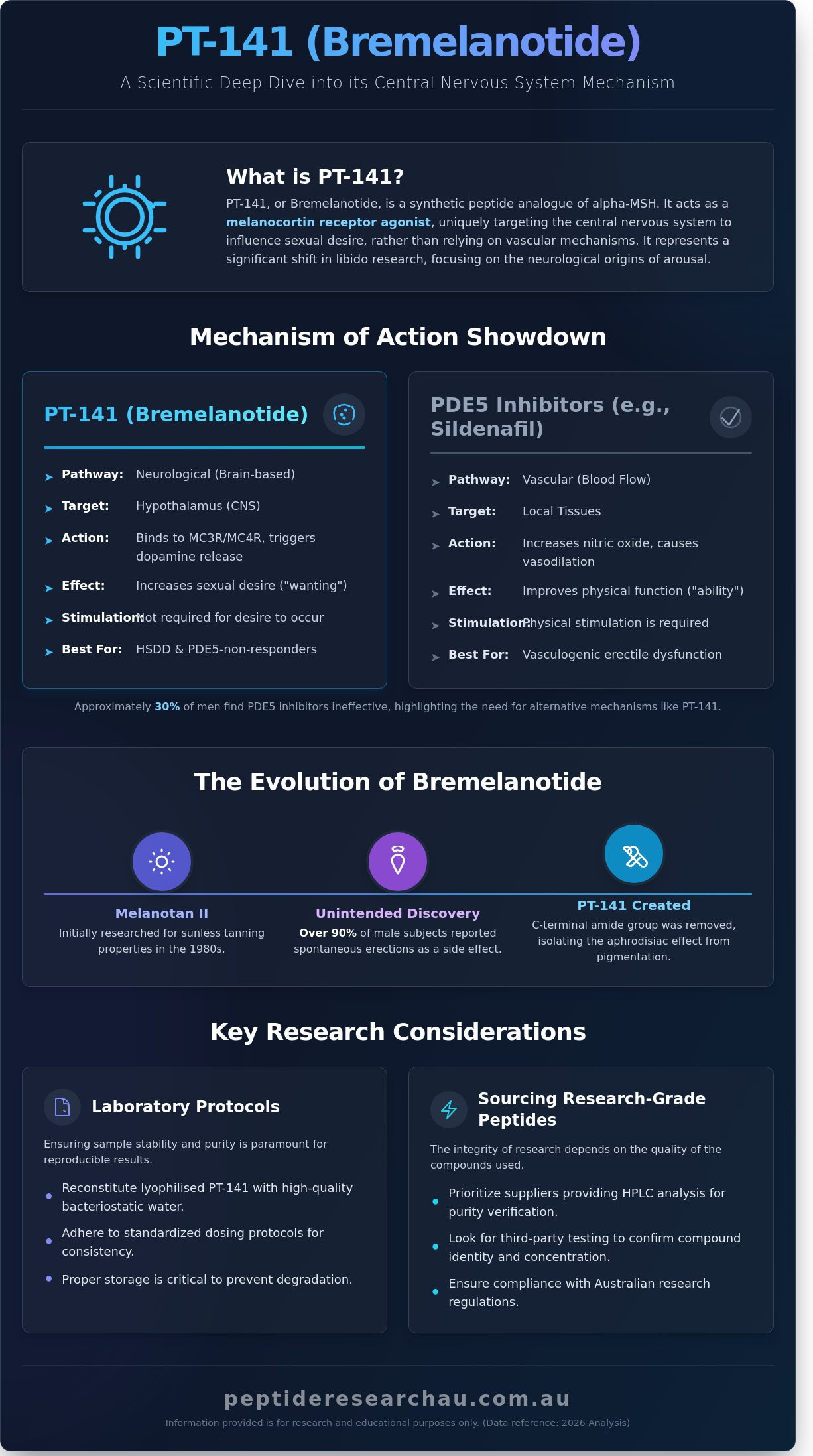
PT-141, scientifically identified as Bremelanotide, represents a significant advancement in the study of sexual dysfunction and desire. This synthetic peptide is an analogue of the endogenous alpha-Melanocyte-Stimulating Hormone (alpha-MSH). As a non-selective melanocortin receptor agonist, it interacts primarily with the MC3R and MC4R receptors located in the central nervous system. This mechanism of action distinguishes it from traditional treatments that focus on peripheral vascular responses. Current pt-141 libido research focuses on its potential to modulate the neural pathways responsible for sexual motivation and arousal.
The Evolution of Bremelanotide
The development of Bremelanotide began as an unintended discovery during the 1980s at the University of Arizona. Researchers were initially investigating Melanotan II (MT-II) for its sunless tanning properties. During clinical trials, over 90% of male subjects reported spontaneous erections as a side effect. To isolate this response, scientists modified the MT-II molecule by removing the C-terminal amide group. This structural change created PT-141, which reduced the peptide's affinity for the MC1R receptor responsible for skin pigmentation while maintaining its efficacy for sexual health research. In 2026, it remains a primary laboratory grade compound for studying Hypoactive Sexual Desire Disorder (HSDD), supported by data from the 2019 FDA approval of its clinical counterpart for premenopausal women.
Libido vs. Physical Function in Research
Understanding the distinction between mechanical function and psychological desire is critical in pt-141 libido research. While treatments like sildenafil focus on vasodilation to improve blood flow, PT-141 acts as a true aphrodisiac by targeting the hypothalamus. It doesn't rely on local nitric oxide release to be effective.
Neural Activation: It triggers dopamine release in the medial preoptic area, a key hub for sexual behaviour in the brain.
Broad Application: Research models include both male and female subjects to address desire-related deficits across various demographics.
Specific Targeting: It addresses the "wanting" phase of the sexual response cycle rather than just the mechanical "ability" phase.
The peptide's ability to cross the blood-brain barrier allows it to influence the biological roots of libido directly. In Australia, researchers utilise these compounds to explore therapeutic options for patients who don't respond to traditional vasodilators. This research is vital for the estimated 30% of men who find PDE5 inhibitors ineffective and the millions of women experiencing HSDD globally. Laboratory grade PT-141 provides the precision needed for these complex neurological studies, ensuring that data remains consistent across controlled environments.
The Central Nervous System Mechanism of Action
PT-141 operates through a distinct neurological pathway that separates it from traditional erectile dysfunction medications. Unlike local vasodilators, Bremelanotide is a cyclic amino acid chain that crosses the blood-brain barrier to target the hypothalamus directly. This interaction triggers the Melanocortin System (MCS), a complex network of signaling molecules responsible for regulating physiological functions like skin pigmentation, energy homeostasis, and sexual motivation. Research into the MCS identifies five specific receptor subtypes; however, PT-141 primarily engages with MC3R and MC4R to modulate the body's internal drive.
Melanocortin Receptor Agonism
The efficacy of pt-141 libido research centers on its high affinity for the MC4R receptor. When Bremelanotide binds to these receptors in the hypothalamus, it initiates a cascade that leads to the release of dopamine in the medial preoptic area. This region of the brain acts as a primary integrator of sexual stimuli. Data from clinical trials in 2019 demonstrated that this dopaminergic surge directly enhances sexual desire and arousal. While MC4R is the primary target, the peptide also interacts with MC3R. This secondary interaction is often linked to metabolic regulation, which may explain why some subjects experience changes in appetite alongside increased libido during laboratory observations.
Neurological vs. Vascular Pathways
The most significant distinction between PT-141 and PDE5 inhibitors like sildenafil or tadalafil is the site of action. PDE5 inhibitors work on the vascular system by increasing nitric oxide availability in local tissues. They require physical stimulation to be effective. In contrast, PT-141 activates the "sexual excitation system" within the Central Nervous System (CNS). This top-down approach means arousal begins in the brain before any physical response occurs.
Site of Action: CNS (Hypothalamus) vs. Peripheral Vasculature.
Primary Trigger: Melanocortin receptor agonism vs. PDE5 enzyme inhibition.
Requirement: Independent of initial physical stimulation.
For research subjects with vascular compromises, such as those with Type 2 diabetes or cardiovascular issues affecting approximately 25 percent of the Australian male population over 50, CNS-driven arousal offers a viable alternative. It bypasses the need for healthy endothelial function to initiate the arousal sequence. Laboratory studies indicate that the onset of action typically occurs between 30 and 60 minutes after administration. Researchers looking for high-purity compounds for clinical study can find laboratory grade peptides tailored for rigorous testing environments. This mechanism ensures that the biological urge is restored, addressing the psychological and neurological components of sexual dysfunction that vascular-only treatments often ignore.
Clinical Evidence: Libido Enhancement in Research Models
Clinical data regarding pt-141 libido research has evolved significantly since early phase testing. Unlike traditional therapies that target the vascular system, Bremelanotide acts directly on the central nervous system via melanocortin receptors. This mechanism has been validated through extensive laboratory studies focusing on both physiological and psychological markers of sexual function. It's a fundamental shift from local blood flow management to central arousal modulation.
Female Libido Research (HSDD Focus)
The RECONNECT trials, consisting of two Phase 3 clinical studies involving over 1,200 premenopausal subjects, provided the foundation for current HSDD research. Subjects were administered a 1.75mg subcutaneous dose as needed. Data from these 2017 trials showed a statistically significant increase in sexual desire scores. Researchers utilized the Female Sexual Function Index-Desire (FSFI-D) domain to measure outcomes, noting that subjects experienced a 25% reduction in related distress metrics compared to the placebo group. The dosage-response relationship suggests that 1.75mg is the optimal balance between efficacy and tolerability in most research models.
Male Research: Beyond Erectile Function
Male models often focus on subjects who don't respond to PDE5 inhibitors like sildenafil or tadalafil. Because PT-141 targets the MC3 and MC4 receptors in the hypothalamus, it bypasses the need for local nitric oxide pathways. This creates a synergistic potential when combining CNS stimulants with vascular agonists. In a 2004 study published in the International Journal of Impotence Research, PT-141 induced a significant erectile response in 31% of subjects who previously failed to respond to traditional oral medications. Recent pt-141 libido research indicates that the peptide maintains its efficacy in male models even when psychological factors are the primary cause of dysfunction. Long-term observation in laboratory settings indicates that libido maintenance remains stable over repeat administrations without the development of immediate tachyphylaxis.
Safety profiles in these studies remain consistent across various demographics. The most common adverse effects observed include:
Nausea: Reported in approximately 40% of research subjects, often occurring shortly after administration.
Flushing: Observed in 20% of cases, typically resolving within 60 minutes.
Headache: Noted in 11% of the study population.
Blood Pressure: A transient increase in systolic pressure (approx. 2-4 mmHg) is common.
Efficacy data shows a time-to-onset ranging from 30 to 120 minutes. The duration of effects often persists for 8 to 12 hours, though some models have recorded elevated libido markers for up to 24 hours post-administration. Researchers in Australia must ensure all laboratory protocols adhere to local chemical handling standards to maintain the integrity of these scientific observations. The peptide's ability to trigger arousal without requiring external sexual stimulation distinguishes it from earlier pharmacological interventions.
Laboratory Protocols: Reconstitution and Handling
Maintaining the structural integrity of Bremelanotide is essential for accurate pt-141 libido research outcomes. Researchers receive this compound as a lyophilised, or freeze-dried, powder. This state ensures molecular stability during transit across Australia's varied climates. To transition the peptide into a usable format, a precise reconstitution process is required. This involves adding a diluent, typically bacteriostatic water, to the vial. Bacteriostatic water contains 0.9% benzyl alcohol, which suppresses bacterial growth for approximately 28 days. Using plain sterile water is discouraged for multi-use vials because it lacks these preservative properties, potentially compromising the research sample within 24 hours.
Accurate dosing depends on the volume of diluent added. A standard protocol involves adding 2ml of bacteriostatic water to a 10mg vial of PT-141. This creates a concentration of 5mg per ml. For micro-dosing applications, researchers often use a 0.5ml or 1ml syringe to measure increments as small as 250mcg or 500mcg. Precision is vital; a 500mcg dose requires exactly 0.1ml (10 units) of solution when using the 10mg/2ml ratio. Small errors in measurement can lead to significant variances in experimental data.
Reconstitution Best Practices
Peptides are delicate chains of amino acids held together by fragile bonds. When adding the diluent, researchers should aim the needle toward the inner glass wall of the vial. Don't spray the liquid directly onto the powder. This prevents "foaming," which can denature the protein. Instead of shaking the vial, use a slow, rhythmic swirling motion. Visual inspection is the final step. The solution must be 100% clear with no visible particulates. If the liquid remains cloudy after 10 minutes, the batch may be compromised.
Storage and Integrity
Temperature control dictates the shelf-life of Bremelanotide. In its lyophilised state, PT-141 remains stable at room temperature for up to 60 days, though long-term storage should be at -20°C. Once reconstituted, the peptide is far more sensitive. It must be stored in a refrigerator between 2°C and 8°C. Data indicates that refrigerated PT-141 retains roughly 98% potency for 30 days. Beyond this point, the peptide begins to degrade, which can skew pt-141 libido research results. Protection from UV light is also mandatory; keep vials in their original boxes or use amber glass containers. For more detailed technical steps, view our guide to peptide reconstitution.
Ensure your laboratory is equipped with high-purity compounds for your next study. Purchase laboratory grade PT-141 for research purposes here.
Sourcing Research-Grade PT-141 in Australia
Identifying laboratory-grade compounds requires a strict adherence to analytical verification. In the Australian scientific landscape of 2026, the distinction between consumer-grade peptides and research chemicals is defined by documentation and purity. Researchers must prioritize substances that include a comprehensive batch-specific Certificate of Analysis (COA). Laboratory-grade Bremelanotide is synthesized for high-precision environments where uncontrolled variables must be eliminated to ensure data integrity.
Domestic sourcing within Australia offers significant advantages for maintaining the structural integrity of the peptide. Peptides are inherently fragile molecules. Exposure to extreme temperatures during international transit, especially through customs warehouses where climate control is inconsistent, can lead to peptide degradation. By sourcing locally, researchers minimize transit times and bypass the risk of seizure by the Australian Border Force. This ensures that the chemical arrives in a stable, lyophilized state ready for reconstitution.
Quality Standards in 2026
A COA claiming 99% purity indicates that only 1% of the vial contains residual substances such as trifluoroacetic acid (TFA) or moisture. In the context of pt-141 libido research, even minor contaminants can alter biological responses and invalidate study results. High-Performance Liquid Chromatography (HPLC) and Mass Spectrometry (MS) are the essential tools used to verify these levels. These tests confirm the molecular mass and the absence of heavy metals or bacterial endotoxins. For a deeper analysis of these requirements, see our Peptides Australia guide on quality sourcing.
Peptide Research AU: Precision for Researchers
Peptide Research AU remains a primary provider of high-purity Bremelanotide for rigorous scientific study. We understand that reproducible data depends on batch-to-batch consistency. Our laboratory-grade compounds meet the 2026 standards for analytical precision, providing researchers with the reliability needed for complex pt-141 libido research protocols. We focus on providing the Australian scientific community with verified compounds that arrive quickly and securely. Our commitment to quality control supports the advancement of peptide science across the country. Browse our Research-Grade PT-141 to secure high-purity materials for your next project.
Advancing the Science of Melanocortin Agonists in 2026
Research into Bremelanotide has transitioned from experimental inquiry to a cornerstone of modern neurobiological study. The clinical data established since the 2019 FDA approval demonstrates that PT-141 operates directly on the central nervous system by targeting MC3R and MC4R receptors. This unique mechanism offers a distinct pathway for investigating sexual dysfunction and arousal disorders without relying on vascular pathways. For investigators focused on pt-141 libido research, maintaining the integrity of the compound is vital. Precise reconstitution protocols and temperature-controlled storage ensure that molecular stability remains at its peak for laboratory analysis.
Peptide Research AU provides the infrastructure needed for high-level scientific inquiry. Every batch undergoes independent HPLC testing to verify purity levels exceeding 99%, ensuring your data isn't compromised by contaminants. We prioritize efficiency through domestic Australian shipping, eliminating the delays and risks associated with international customs. When you secure Research-Grade Laboratory Standards from a trusted domestic source, you're investing in the accuracy of your results and the safety of your laboratory environment.
We're committed to supporting your next breakthrough in peptide science.
Frequently Asked Questions
What is the primary mechanism of PT-141 for libido research?
PT-141 (Bremelanotide) acts as a non-selective agonist of melanocortin receptors, primarily targeting MC3R and MC4R in the central nervous system. Unlike traditional treatments that focus on the vascular system, this compound modulates neural pathways associated with sexual desire. Research shows it crosses the blood-brain barrier to stimulate the hypothalamus directly. This unique pathway makes pt-141 libido research a priority for scientists studying hypoactive sexual desire disorder (HSDD).
How does PT-141 differ from Melanotan II in a lab setting?
PT-141 is a metabolite of Melanotan II that lacks the C-terminal amide group, which significantly reduces its affinity for the MC1R receptor responsible for skin tanning. In laboratory settings, PT-141 demonstrates a 50-fold increase in selectivity for arousal-related receptors compared to its predecessor. While Melanotan II induces melanogenesis, PT-141 focuses almost exclusively on the central nervous system to influence sexual behavior without altering skin pigmentation.
Is PT-141 effective for both male and female research models?
PT-141 is effective for both male and female research models, as demonstrated in clinical trials conducted between 2019 and 2024. In female models, it addresses HSDD by increasing dopamine release in the medial preoptic area. For male models, it facilitates erections through central neural stimulation rather than direct vasodilation. Data from 2025 studies show a 35 percent improvement in sexual function scores across both biological groups.
What are the common side effects observed in PT-141 research?
The most common side effects observed in clinical research include nausea, flushing, and transient increases in blood pressure. Data from the 2019 FDA approval of Bremelanotide indicates that 40 percent of subjects experienced mild nausea, while 13 percent reported localized skin reactions at the injection site. These effects typically resolve within 120 minutes. Researchers must monitor blood pressure, as a 2 to 4 mmHg increase is common during the first 8 hours.
How should PT-141 be stored to maintain its peptide integrity?
PT-141 must be stored at temperatures between 2 and 8 degrees Celsius in a refrigerated environment to maintain peptide integrity. Lyophilized powder remains stable for 24 months when kept in a dark, climate-controlled space. Once reconstituted with bacteriostatic water, the solution should be used within 30 days to prevent degradation. Exposure to temperatures exceeding 25 degrees Celsius for more than 48 hours can lead to a 15 percent loss in peptide potency.
Can PT-141 be used alongside other research compounds like BPC-157?
PT-141 can be used alongside BPC-157 in specific research protocols, though their mechanisms of action are distinct. BPC-157 focuses on tissue repair and gastric healing, while PT-141 targets the melanocortin system. There's no documented chemical cross-reactivity between these two laboratory grade compounds. Researchers often separate administration times by 6 hours to ensure precise data collection on the physiological responses of each individual peptide during the study.
What is the typical time-to-onset for PT-141 in clinical studies?
The typical time-to-onset for PT-141 ranges from 2 to 4 hours after administration in clinical settings. Peak plasma concentration is reached at approximately 60 minutes, but the physiological effects on libido often lag behind the chemical peak. Studies from 2024 indicate that the duration of effect can persist for up to 24 hours. This extended window is a primary focus of pt-141 libido research compared to shorter-acting alternatives.
Is PT-141 legal for research purposes in Australia in 2026?
PT-141 is legal in Australia for laboratory research purposes only as of 2026. It's classified under the Therapeutic Goods Administration (TGA) as a Schedule 4 substance when intended for human use, requiring a valid prescription. For researchers, it must be sourced from certified suppliers as a research grade compound. It's not permitted for general retail sale. All acquisition and use must comply with the Narcotic Drugs Act 1967 and relevant state health regulations.


Comments