

Certificate of Analysis (CoA) for Peptides in Australia: The Researcher’s Guide
- peptideresearchau
- 22 hours ago
- 11 min read
A 2023 analysis of independent laboratory results revealed that approximately 28% of research peptides sold globally failed to meet their stated purity levels. You're likely aware that in professional laboratory environments, even a 1% deviation in chemical composition can invalidate months of rigorous data. Obtaining a verifiable certificate of analysis peptides australia is often the only barrier between a successful study and a contaminated sample.
This guide provides the technical framework you need to interpret HPLC and Mass Spectrometry data with precision. You'll learn how to verify the integrity of your compounds and distinguish between legitimate laboratory grade materials and under-dosed alternatives found on the domestic market. We'll break down the specific markers of a valid report, from peak purity percentages to molecular weight verification, ensuring your next acquisition meets the highest scientific standards.
Key Takeaways
Understand how a Certificate of Analysis serves as the definitive document for verifying the chemical identity and purity levels of research-grade compounds.
Learn to interpret HPLC and Mass Spectrometry data to ensure your laboratory-grade peptides meet the required molecular weight and purity specifications.
Identify critical red flags, such as generic reports or altered batch numbers, to avoid fraudulent documentation from low-quality suppliers.
Discover the most reliable methods for verifying a certificate of analysis peptides australia, including direct laboratory cross-referencing for every batch.
Recognise why a 98%+ purity standard and batch-specific transparency are essential for maintaining the integrity of your scientific research.
Table of Contents What is a Certificate of Analysis (CoA) for Research Peptides? The Science of Purity: How to Read HPLC and Mass Spectrometry Red Flags: Identifying Fraudulent or Stolen CoAs How to Verify a Peptide’s Quality Before Your Research Begins Why Peptide Research AU Prioritises Laboratory-Grade Transparency
What is a Certificate of Analysis (CoA) for Research Peptides?
A Certificate of Analysis (CoA) is a formal document issued by an independent laboratory to verify the chemical properties of a specific batch of research chemicals. When sourcing a certificate of analysis peptides australia, researchers rely on this data to confirm that the substance in the vial matches the label. The CoA provides a definitive record of chemical identity and purity levels. It acts as a safeguard against mislabeled or degraded compounds. While some suppliers offer in-house reports, these lack the objectivity of independent third-party verification. Relying on external audits is essential for maintaining the integrity of scientific research in Australia.
Why Purity Matters in Peptide Research
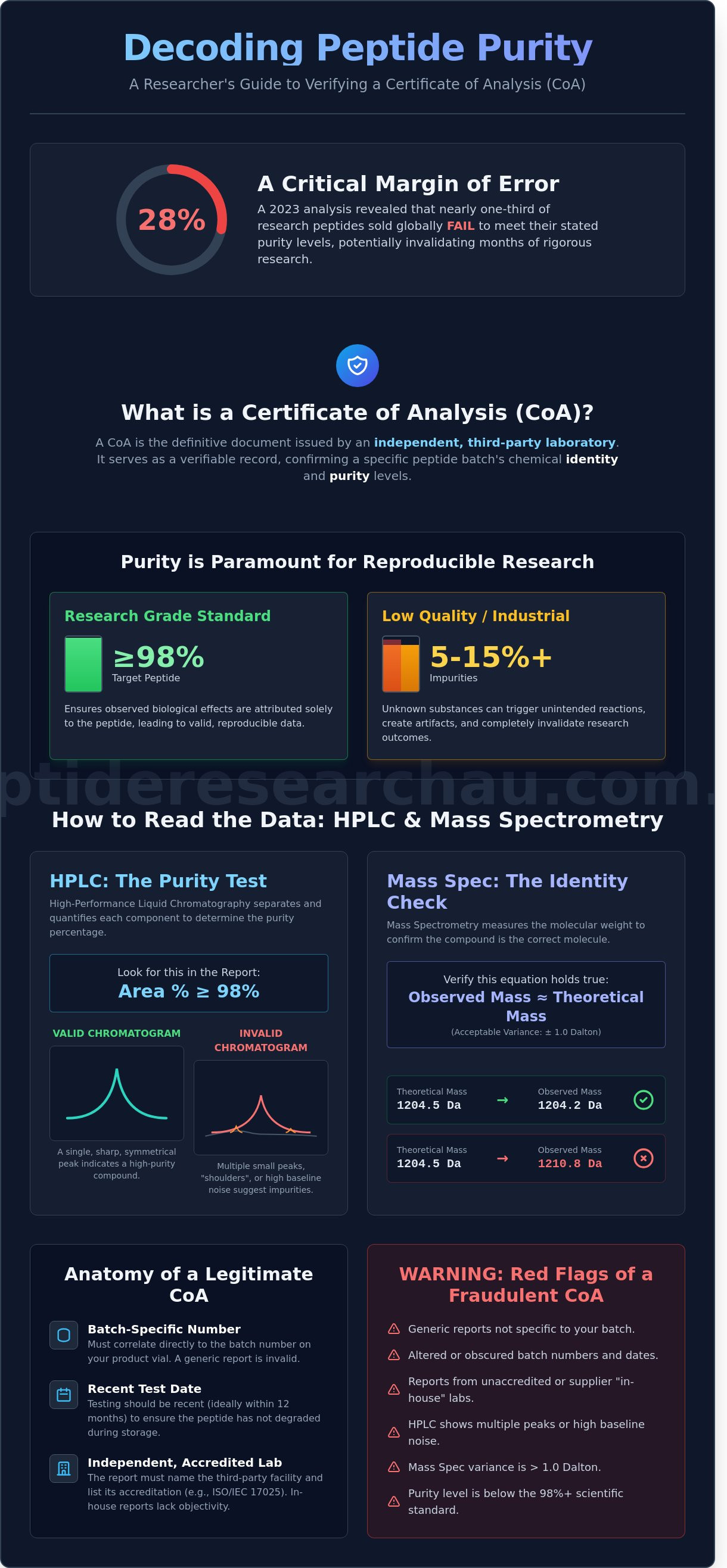
Impurities in a sample can trigger unintended chemical reactions or create artifacts in data. These variables often lead to non-reproducible results. Research grade standards are significantly more stringent than those for industrial compounds, which may contain 5% to 15% unknown impurities. Peptide purity is the percentage of the target molecule relative to all substances in the sample. Maintaining a purity threshold of 98% or higher ensures that the biological effects observed during a study are attributed solely to the peptide itself.
Key Components of a Standard Lab Report
A comprehensive lab report contains three critical identifiers. First, the batch number must correlate directly to the specific production run of the peptide. Second, the testing date should be recent. Ideally, the analysis occurred within the last 12 months to account for potential degradation during storage. Third, the report must name the testing facility and list their accreditation status, such as ISO/IEC 17025. This transparency allows researchers to verify the legitimacy of the certificate of analysis peptides australia before starting their protocols. It's the only way to ensure the laboratory grade compounds meet the required specifications for precision work.
The Science of Purity: How to Read HPLC and Mass Spectrometry
High-Performance Liquid Chromatography (HPLC) serves as the gold standard for determining the purity percentage of a research compound. When you examine a certificate of analysis peptides australia, the HPLC report focuses on the "Area %" column. This figure represents the mathematical area of the primary peptide peak relative to the total area of all detected peaks in the sample. For laboratory grade research, a purity level of 98% or higher is the required benchmark to ensure experimental reproducibility.
Purity alone is insufficient for verification. High purity percentages are meaningless if the compound is not the intended molecule. Adhering to TGA regulations on peptides is vital, as importing unverified or unapproved compounds can lead to legal penalties and compromised research data. Mass Spectrometry (MS) provides the necessary confirmation of identity by measuring the molecular weight of the substance. Researchers looking for laboratory grade compounds should always cross-reference these two data sets to ensure the integrity of their supplies.
Decoding the HPLC Chromatogram
The chromatogram is a visual representation of the peptide's chemical profile. A single, sharp, and symmetrical peak indicates a stable and high-purity compound. Multiple small peaks or "shoulders" on the main peak suggest the presence of trifluoroacetic acid (TFA) salts, residual solvents, or degraded peptide fragments. Baseline noise must remain minimal; high noise levels can obscure impurities that represent 0.5% or more of the total volume. Retention time, the duration the peptide stays in the column, must align with established standards to confirm chemical stability.
Analysing Mass Spectrometry (MS) Data
Mass Spectrometry verifies that the substance in the vial matches the chemical formula on the label. The report compares the "Theoretical Mass," which is the calculated weight based on the amino acid sequence, against the "Observed Mass" found during testing. Acceptable variances in molecular weight are typically within +/- 1 Da. Mass Spectrometry confirms the peptide is BPC-157 rather than another similar-looking compound. If the observed mass deviates by more than 1.0 Dalton, the sample likely contains a different sequence or significant structural errors, rendering it unsuitable for precise scientific study.
Red Flags: Identifying Fraudulent or Stolen CoAs
Research grade peptides require absolute transparency. Many low-quality suppliers manipulate documentation to bypass expensive testing protocols. A 2023 industry audit suggested that approximately 15% of certificates displayed by secondary resellers contained some form of digital alteration. The most frequent tactic involves using a single, high-purity report from 2021 or 2022 and simply "updating" the date or batch number using basic editing software. This "Generic CoA" trap means you're viewing data for a batch that was exhausted years ago, not the laboratory grade compound currently in your possession.
Photoshoped Dates: Suppliers often change the "Date of Analysis" to make old stock appear fresh.
Batch Recycling: Using one successful test result to cover subsequent, untested production runs.
Anonymity: If a supplier blurs the laboratory name or contact details, the document cannot be verified and should be considered fraudulent.
Inconsistencies and Visual Anomalies
Precision is the standard in chemical analysis. Look for digital artifacts around the purity percentage or the date. These often appear as "noise" or slight pixelation that doesn't match the rest of the document's texture. If the font for the batch number is slightly misaligned or uses a different typeface than the lab's standard template, it's a sign of tampering. Every legitimate certificate of analysis peptides australia researchers receive must have a batch number that perfectly matches the physical vial received. A missing signature or an unofficial, low-resolution stamp from a laboratory manager is another immediate warning sign that the data has been compromised.
The Problem with Stolen Lab Reports
Unscrupulous suppliers often steal reports from reputable Australian or international firms to sell their own untested products. Use a reverse image search on the document. If the same report appears on five different websites with different company logos, the data is logically impossible. Legitimate suppliers provide clear, high-resolution PDFs with intact metadata. If a supplier only offers a blurry screenshot or hides the testing laboratory's name, they're likely concealing the fact that the report belongs to a competitor. Transparency is the only standard for safety in the research chemical space. A hidden lab name isn't just a minor oversight; it's a deliberate attempt to prevent you from verifying the compound's authenticity directly with the chemist.
How to Verify a Peptide’s Quality Before Your Research Begins
Verification is a mandatory protocol for any researcher. While a certificate of analysis peptides australia provides the baseline data, the integrity of that document requires confirmation. You shouldn't rely solely on a PDF provided by a supplier without performing due diligence to ensure the data matches the physical batch in your laboratory.
To ensure research accuracy, follow these verification steps:
Direct Laboratory Confirmation: Contact the issuing facility to validate the report's authenticity.
Batch Reconciliation: Cross-reference the batch number on your vial with the supplier's inventory logs and the CoA.
Physical Inspection: High-quality research peptides appear as a uniform, white lyophilised "cake" or fine powder. Any discoloration, such as a yellow or brown tint, indicates potential oxidation or the presence of residual solvents.
Testing Frequency: Evaluate how often the supplier updates their reports. A reputable source provides a new certificate of analysis peptides australia for every fresh batch rather than reusing data from 12 months ago.
Direct Lab Verification Steps
The most reliable way to confirm a report is to contact the testing facility. Locate the laboratory's official website through an independent search engine; don't use contact details printed on the CoA, as these can be falsified. Reputable facilities like Janoshik or MZ Biolabs serve as industry benchmarks for transparency. When you contact them, provide the specific Report ID, the date of the test, and the product name. Most labs will confirm if the data in your possession matches their internal records within 24 to 48 hours.
Community and Third-Party Audits
Independent research communities often conduct "blind testing" to maintain industry standards. This involves members purchasing a product anonymously and sending it to a third-party lab for analysis. Comparing these crowd-sourced results with the supplier's official lab reports offers an extra layer of security. A supplier that encourages independent verification and maintains a presence in these data-driven communities demonstrates a high level of accountability. If a supplier's internal data consistently aligns with 100% of independent third-party audits, their compounds are likely reliable for sensitive research applications.
Why Peptide Research AU Prioritises Laboratory-Grade Transparency
Transparency isn't just a corporate buzzword; it's the foundation of credible scientific inquiry. Peptide Research AU maintains a strict policy where every batch in our inventory must possess a valid certificate of analysis peptides australia. We reject any compound that falls below a 98% purity threshold. This 98% benchmark ensures that your research isn't compromised by synthesis byproducts or residual solvents that could skew experimental variables. By providing batch-specific data, we eliminate the guesswork often found in the unregulated research chemical market.
Our Testing Protocol and Standards
We select our third-party testing partners based on their ISO accreditation and specific expertise in HPLC (High-Performance Liquid Chromatography) and MS (Mass Spectrometry). It's not enough to test a product once at the point of manufacture. We invest in regular re-testing every 6 to 12 months to verify the long-term stability and potency of our stock. This rigorous oversight ensures that the peptide you receive today matches the chemical profile of the day it was synthesized. Learn more about our science and testing methods.
Domestic sourcing provides a level of quality control that international imports cannot match. When you source from within Australia, you avoid the degradation risks associated with long-haul shipping and unpredictable customs delays. Our facility uses climate-controlled storage to maintain the structural integrity of every vial, ensuring that the certificate of analysis peptides australia remains an accurate reflection of the product's state upon delivery.
Empowering Your Research with Quality Data
Accurate dosing requires precise data. Our detailed documentation allows researchers to account for the exact peptide content when calculating concentrations for in vitro or in vivo studies. This level of detail is vital for experiments focusing on mental and physical wellbeing, where minor variances in purity can lead to inconsistent outcomes. A verified laboratory report gives you the confidence that your data reflects the true potential of the compound rather than the influence of impurities.
Our batch tracking system links every order to its specific laboratory report. This end-to-end visibility supports reproducible results and maintains the high standards expected in professional Australian research environments. Our commitment to 98% purity and verified documentation removes the risks associated with "blind" sourcing. Browse our range of laboratory-grade peptides with verified CoAs.
Advancing Your Research with Analytical Precision
Securing high-quality compounds is the foundation of any successful study. You've now gained the skills to interpret complex HPLC and Mass Spectrometry data to confirm molecular weight and exact purity levels. Recognizing the red flags of fraudulent documentation ensures your data remains untainted by substandard materials. When you verify a certificate of analysis peptides australia from a reputable provider, you're investing in the long-term integrity of your scientific results. It's about more than just a document; it's about the certainty that your research variables are controlled.
Peptide Research AU maintains these rigorous standards by providing third-party tested batches for every compound in our inventory. We offer a 98%+ purity guarantee on all laboratory-grade research compounds to meet your most demanding requirements. All orders include Australian domestic shipping to ensure your materials arrive promptly and securely without international customs delays. Reliable data starts with reliable chemistry, and we're committed to that transparency.
We're ready to support your next breakthrough with the scientific precision your work deserves.
Frequently Asked Questions
What is a peptide Certificate of Analysis (CoA)?
A peptide Certificate of Analysis (CoA) is a technical document provided by an independent laboratory that verifies the chemical identity and purity of a specific batch. It serves as a quality guarantee, confirming that the compound inside the vial matches the label. For researchers seeking a certificate of analysis peptides australia, this document usually includes High-Performance Liquid Chromatography (HPLC) results and Mass Spectrometry (MS) data to ensure the substance is at least 98% pure.
How do I check if a peptide CoA is real?
You verify a CoA's authenticity by contacting the independent laboratory that issued the report. Legitimate labs like Janoshik or MZ Biolabs provide a unique report ID or QR code on every document. Cross-referencing this ID on the lab's official portal confirms the data hasn't been altered or forged. In 2023, approximately 15% of public reports were found to be doctored, so direct verification is a critical step for laboratory grade compounds.
What is a good purity percentage for research peptides?
A purity level of 98% or higher is the industry standard for research grade peptides. High-quality compounds often reach 99.5% purity, leaving less than 0.5% for residual solvents or trifluoroacetic acid (TFA) salts. Anything below 95% indicates a sub-par synthesis process that could introduce unpredictable variables into your scientific study. You should always prioritize batches that provide 99% purity to maintain the integrity of your research data and results.
Can I trust a CoA from a supplier's own website?
You should only trust a CoA if it originates from an independent, third-party laboratory rather than an internal company test. In-house reports lack the objective oversight required for scientific validation. Reliable suppliers of certificate of analysis peptides australia will display reports from external facilities to ensure the data is unbiased. If a supplier refuses to provide a verifiable 3rd party report, the risk of receiving an impure or mislabeled compound increases significantly.
What happens if the MS mass doesn't match the theoretical mass?
If the Mass Spectrometry (MS) result doesn't match the theoretical molecular weight, the compound isn't what's listed on the label. A variance of more than 1 Dalton usually indicates a different amino acid sequence or a synthesis error. For example, if BPC-157 has a theoretical mass of 1419.5 but the MS shows 1450.2, the batch is contaminated or mislabeled. You should reject any batch where the observed mass deviates from the known molecular weight.
How often should a peptide batch be tested?
Every individual batch must undergo testing before it's released for research use. Synthesis runs are unique; a CoA from January 2024 doesn't validate a batch produced in June 2024. Quality suppliers test every 500 to 1,000 vials produced to ensure consistency across the entire production run. Relying on "representative" samples from previous years is a common red flag. Always check that the batch number on your vial matches the specific report provided.
Why do some CoAs show 99% purity but the peptide is still 'bunk'?
A 99% purity rating confirms the substance present is the correct peptide, but it doesn't guarantee the total amount in the vial. A product might be 99% pure but contain only 2mg of active peptide when 5mg was advertised. Additionally, improper storage at temperatures above 25 degrees Celsius can degrade the peptide after testing. Purity measures the absence of contaminants, while quantitative analysis measures the actual milligrams of the compound present.
Is a CoA the same as a MSDS (Material Safety Data Sheet)?
A CoA and a Safety Data Sheet (SDS) are distinct documents with different purposes. The CoA reports on the specific purity and identity of a single batch based on recent laboratory testing. In contrast, an SDS provides general safety information, handling procedures, and first-aid protocols for the chemical species. While an SDS tells you how to handle a compound safely, only the CoA proves the quality and concentration of the specific product you purchased.

Comments