


Research Peptide Quality Standards: A Guide to Laboratory Purity
- peptideresearchau
- 2 days ago
- 11 min read
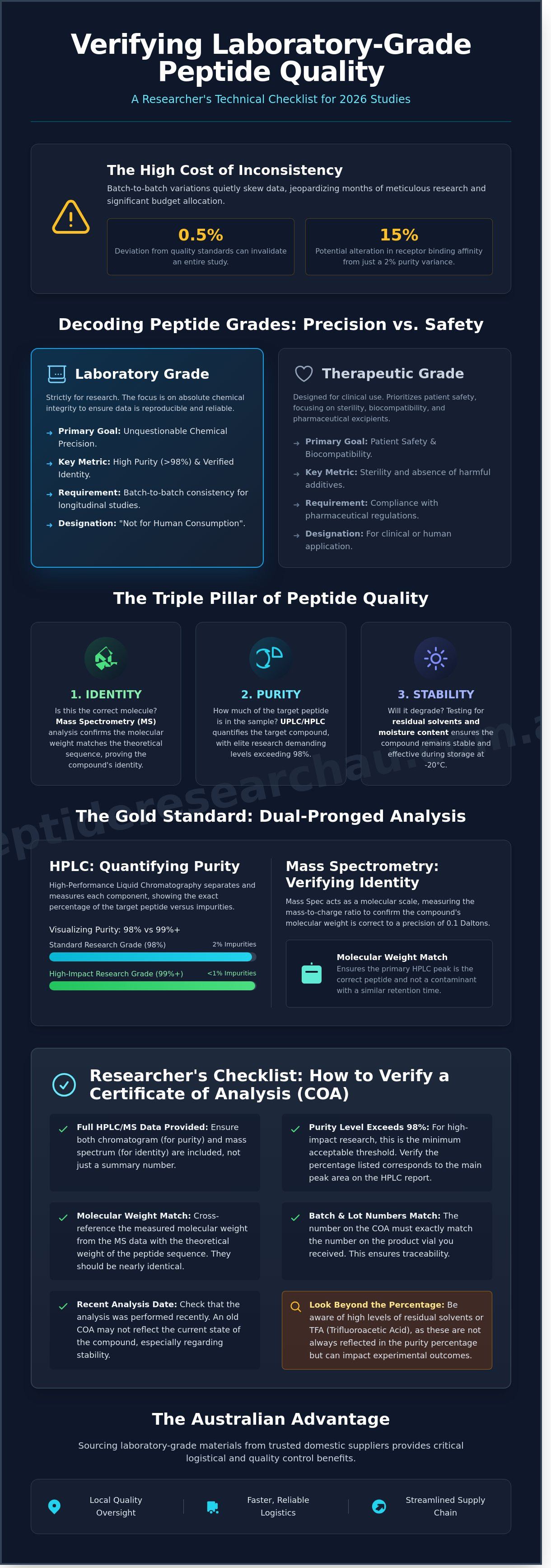
How much of your A$5,000 research budget was lost during 2024 to batch-to-batch inconsistencies that quietly skewed your data? You likely already know that even a 0.5% deviation from established research peptide quality standards can invalidate months of meticulous work. It's frustrating to receive a Certificate of Analysis that feels more like a marketing tool than a scientific guarantee. We understand that your results require absolute precision and that any variable introduced by an impure compound is a risk to your professional standing.
This article provides the technical criteria needed to verify laboratory-grade purity for your 2026 studies. You'll gain a clear checklist for auditing suppliers and learn to distinguish between simple identity and true chemical purity. We'll examine the specific markers that define a trusted research grade peptide, ensuring your next acquisition meets the highest scientific benchmarks in the Australian market.
Key Takeaways
Understand the technical distinctions between 'Research Grade' and 'Laboratory Grade' to ensure your 2026 study outcomes are consistent and reproducible.
Learn why High-Performance Liquid Chromatography (HPLC) and Mass Spectrometry (MS) are the non-negotiable gold standards for verifying compound purity and molecular identity.
Discover why a 99% purity claim can be misleading without evaluating research peptide quality standards regarding residual solvents and TFA levels.
Master a professional researcher's checklist for Certificate of Analysis (COA) verification, including critical batch date and lot number matching protocols.
Recognize the logistical and quality control advantages of sourcing laboratory-grade materials from trusted domestic Australian suppliers.
Table of Contents What are Research Peptide Quality Standards in 2026? The Gold Standard: HPLC and Mass Spectrometry Analysis Beyond the Percentage: Peptide Purity vs. Quality Control How to Verify Quality: A Researcher's Checklist for COAs Sourcing High-Quality Research Peptides in Australia
What are Research Peptide Quality Standards in 2026?
Scientific rigor in 2026 demands a level of precision that transcends traditional manufacturing. Current research peptide quality standards require rigorous validation to ensure that experimental results remain reproducible across different laboratory environments. In Australia, the distinction between a reliable study and a failed experiment often rests on the chemical integrity of the compounds used. Relying solely on basic HPLC testing is no longer sufficient for high-impact research. Modern protocols now integrate Mass Spectrometry and NMR spectroscopy to confirm that the molecular structure is exactly what the researcher expects.
Sub-standard peptides introduce uncontrolled variables into an experiment. If a peptide batch contains 5% unknown impurities, those contaminants can trigger unintended cellular responses. This leads to skewed data. A 2024 analysis of Australian laboratory supplies found that even a 2% variance in peptide purity could alter the binding affinity in receptor assays by as much as 15%. Precision is the only way to maintain data integrity. It's the difference between a breakthrough and a retracted paper.
The Distinction Between Research and Therapeutic Grades
Research grade peptides are strictly designated as "Not for Human Consumption." This isn't just a legal disclaimer; it defines the chemical focus of the product. Therapeutic grades prioritize pharmaceutical excipients and sterility for patient safety. In contrast, laboratory grade focuses on absolute chemical precision. Researchers need to know that the peptide sequence is exact. They require batch-to-batch consistency for longitudinal studies lasting 12 months or longer. Without this consistency, comparing data from January to December becomes impossible.
The Triple Pillar of Peptide Quality
Maintaining high research peptide quality standards involves three critical benchmarks:
Identity: Every batch undergoes Mass Spectrometry (MS) to confirm the molecular weight matches the theoretical sequence. It's the only way to prove the molecule is correct.
Purity: Labs use Ultra-High-Performance Liquid Chromatography (UPLC) to quantify the target peptide. High-end research requires levels exceeding 98%.
Stability: Peptides are sensitive. Standards in 2026 include testing for residual solvents and moisture content to ensure the compound doesn't degrade during storage at -20°C.
At Peptide Research AU, we recognise that the quality of your source material dictates the quality of your findings. Precise chemical synthesis is the foundation of modern science. We don't settle for "good enough" when your data is on the line.
The Gold Standard: HPLC and Mass Spectrometry Analysis
High-Performance Liquid Chromatography (HPLC) and Mass Spectrometry (MS) represent the dual pillars of modern analytical chemistry. Together, they form the foundation of research peptide quality standards, ensuring that every batch meets the rigorous requirements of the Australian scientific community. While HPLC quantifies the purity of a sample, MS confirms its identity. Relying on one without the other leaves a significant gap in the quality profile, as volume doesn't always equate to veracity.
A standard lab chromatogram displays the results of these tests through a series of peaks and troughs along a baseline. A single, sharp peak indicates a homogeneous substance, while secondary peaks, or "troughs" in the baseline, signal the presence of contaminants or degradation products. For a researcher, the goal is a "clean" report where the area under the primary peak accounts for the vast majority of the total detected material.
HPLC: Measuring Chemical Purity
HPLC works by forcing a liquid solvent containing the peptide through a column filled with adsorbent material at high pressure. Different molecules interact with the column at varying rates, causing them to separate. This process isolates the target peptide from residual solvents, salts, and synthesis byproducts. In 2026, HPLC stands as the essential quantitative benchmark for defining peptide concentration within high-specification laboratory environments.
98% vs 99% Ratings: These percentages represent the "peak area" of the target compound relative to the total area of all detected peaks. A 98% rating means that 2% of the sample consists of impurities that could potentially skew experimental data.
Detection Wavelengths: Most labs use 214nm or 220nm to detect peptide bonds, ensuring even minor impurities are visible on the report.
Mass Spectrometry: Verifying Molecular Identity
While HPLC measures how much of a substance is present, it doesn't prove the substance is the correct peptide. Mass Spectrometry solves this by measuring the mass-to-charge ratio of the molecules, verifying the molecular weight down to a precision of 0.1 Daltons. This is vital because different compounds can sometimes have identical "retention times" on an HPLC column. MS ensures that the sequence of amino acids is exactly what was intended during synthesis.
This analysis is specifically designed to catch "truncated sequences," which are peptides that failed to complete their full chain during the manufacturing process. If the theoretical mass of a compound is 1419.5 Da, but the MS peak shows 1306.4 Da, the batch is flawed despite what an HPLC report might suggest. Researchers who require this level of precision often source from providers that offer transparent testing, such as the laboratory grade compounds available at Peptide Research AU. By cross-referencing the HPLC purity with the MS molecular mass, labs can maintain the highest research peptide quality standards for their projects.
Beyond the Percentage: Peptide Purity vs. Quality Control
A 99% purity claim on a Certificate of Analysis (CoA) doesn't guarantee a flawless product. High-performance liquid chromatography (HPLC) measures the target peptide against other peptide impurities, but it often ignores non-peptide components. Adhering to rigorous research peptide quality standards means looking at the full composition of the lyophilizate. Many labs assume that if two suppliers use the same raw manufacturer, the final vials are identical. This is false. The secondary processing, filtration, and bottling environments in Australian facilities significantly dictate the final research outcome.
Lyophilization, or freeze-drying, is the final safeguard for stability. A poorly executed cycle leaves residual moisture above 5%, which triggers rapid degradation at room temperature. High-quality laboratory grade compounds undergo a 48-hour sublimation process to ensure moisture levels remain below 2%. This precision allows the peptide to remain stable during transit across Australia's diverse climate zones, where temperatures can fluctuate by 20 degrees Celsius in a single day.
Managing Residual Solvents and TFA
Trifluoroacetic acid (TFA) is a standard reagent used during the cleavage and purification phases of solid-phase peptide synthesis. While effective for separating sequences, residual TFA can linger in the final powder at concentrations of 10% to 15%. This creates a hidden variable. High TFA levels can drop the pH of a cell culture medium, leading to unintended cytotoxicity or skewed data in sensitive assays. Researchers working with primary cell lines should request acetate or hydrochloride salt exchanges to mitigate these acidic effects and ensure the research peptide quality standards meet their specific experimental needs.
Net Peptide Content vs. Total Mass
A 5mg vial rarely contains 5mg of pure peptide. The total mass includes the peptide, counter-ions, and residual water. This distinction is vital for accurate laboratory dosing. The Net Peptide Content (NPC) typically ranges from 70% to 85% of the total weight. To ensure experimental reproducibility, use this formula to adjust your calculations:
Identify the NPC from the mass spectrometry or amino acid analysis report.
If the NPC is 80%, a 5mg vial contains 4mg of active peptide.
Adjust your diluent volume based on the 4mg figure, not the 5mg label.
Ignoring the NPC leads to a 15% to 30% under-dosing error. Precision in your work requires accounting for these non-peptide masses in every reconstitution step. It's the difference between a failed experiment and a breakthrough.
How to Verify Quality: A Researcher's Checklist for COAs
Precision is the foundation of any successful laboratory study. A Certificate of Analysis (COA) provides the raw data required to uphold research peptide quality standards and ensure experimental reproducibility. Don't accept a supplier's claims without verifying the underlying documentation through these five critical steps.
Step 1: Verify the testing date. Reports issued more than 180 days ago are often outdated. A current batch should have a fresh analysis to account for potential degradation during storage.
Step 2: Match the lot number. The alphanumeric code on your peptide vial must be identical to the one listed on the COA. If these numbers don't align, the data doesn't apply to your specific sample.
Step 3: Analyze the HPLC chromatogram. High-Performance Liquid Chromatography (HPLC) determines purity. Look for a single, sharp peak with a stable baseline. Any "shoulders" or secondary peaks indicate impurities or residual solvents.
Step 4: Cross-reference MS data. Mass Spectrometry (MS) confirms the peptide's identity. The observed molecular weight should match the theoretical weight within a 0.1% margin. For instance, if a compound has a theoretical mass of 3241.6 Da, the report must show a peak within 3.2 Da of that figure.
Step 5: Confirm third-party verification. Internal testing is a start, but independent audits from facilities like Janoshik or MZ Biolabs provide an unbiased layer of security.
Red Flags in Supplier Documentation
Watch for "template" COAs. These are documents that look identical across different product batches, often using the same font spacing and noise patterns in the graphs. It's a clear sign of data fabrication. Another major risk is the total absence of Mass Spectrometry data. HPLC proves a substance is 99% pure, but without MS, you can't be certain the substance is actually the peptide you ordered. In-house testing is prone to bias; it should always be backed by external verification to meet research peptide quality standards.
Questions to Ask Your Peptide Supplier
Direct engagement with a supplier reveals their commitment to quality. Ask if they provide batch-specific COAs for every individual order. It's also vital to know their protocol for synthesis failures. Reliable labs discard any batch that tests below 98% purity rather than attempting to "blend" it with higher quality stock. Finally, request data on the stability of the compound at 25°C. This information is essential for Australian researchers who must account for ambient temperatures during local transit.
Protect the integrity of your study by choosing compounds that undergo rigorous validation. Source laboratory grade peptides that include comprehensive, third-party verified documentation.
Sourcing High-Quality Research Peptides in Australia
Selecting a domestic supplier isn't just about convenience. It's about maintaining research peptide quality standards in a region where environmental factors can compromise molecular integrity. International shipping often exposes sensitive compounds to transit times exceeding 14 days and uncontrolled temperatures in cargo holds. By choosing an Australian source, researchers minimize these variables. Peptide Research AU understands that local logistics are essential for scientific accuracy. We ensure that our supply chain remains robust from the lab to your facility.
Australian summers regularly see temperatures exceed 38°C. This climate presents a unique challenge for peptide stability. We use validated cold-chain protocols to ensure every vial remains stable during transit. We prioritize express domestic logistics that typically deliver within 24 to 48 hours. This speed significantly reduces the window for thermal degradation compared to international alternatives. Data transparency isn't optional; it's the foundation of every study we support.
Peptide Research AU: Our Purity Commitment
Our facility adheres to a meticulous sourcing protocol. We don't settle for industrial grade materials. We only provide Laboratory Grade compounds. Every batch undergoes third-party High-Performance Liquid Chromatography (HPLC) and Mass Spectrometry (MS) to verify a minimum purity of 99%. You can access our full purity and testing standards to review the data yourself. Transparency is our baseline. This commitment ensures that your research peptide quality standards remain uncompromised throughout your experimentation phase.
Supporting the Australian Scientific Community
Local researchers need more than just a product; they need technical reliability. Our team provides expert support tailored to the Australian regulatory and scientific environment. Domestic shipping eliminates the risk of customs seizures or 21-day delays that ruin delicate peptides. We're here to help you achieve better science through consistency and precision. Browse our research-grade peptides to find the specific compounds for your next study. We focus on the data so you can focus on the discovery.
Advancing Your Scientific Precision in 2026
Maintaining rigorous research peptide quality standards requires more than just checking a percentage on a screen. Reliable data stems from precise HPLC and mass spectrometry analysis that confirms both molecular identity and 99% purity levels. It's not enough to rely on generic datasheets. You need batch-specific verification from independent third-party laboratories to ensure your study's results are reproducible. Every compound you introduce into your laboratory environment must meet these strict 2026 benchmarks to protect the integrity of your findings.
As an Australian-owned and operated provider, Peptide Research AU delivers the transparency your work demands. We provide third-party laboratory verified compounds and include batch-specific COAs with every order. This meticulous approach ensures you're working with laboratory grade materials that align with domestic regulatory expectations. Secure the future of your research by sourcing from a partner that prioritizes clinical accuracy and local accountability.
Your commitment to excellence drives scientific progress; we're here to provide the tools that make it possible.
Frequently Asked Questions
What is the difference between 98% and 99% peptide purity?
A 1% difference represents a 50% reduction in total impurities within the vial. A peptide with 98% purity contains 20mg of unknown byproducts per gram, whereas 99% purity contains only 10mg. Adhering to high research peptide quality standards ensures that these minor contaminants don't interfere with your biological assays or produce false positive results during data collection.
Is third-party testing necessary for research peptides?
Independent verification is vital for any laboratory grade compound. You shouldn't rely solely on manufacturer data, as internal reports can lack transparency. Third-party Australian laboratories provide unbiased HPLC and Mass Spectrometry analysis. This process confirms that the batch you receive matches the advertised purity and identity, protecting your research budget from substandard or mislabeled materials.
What does 'Research Grade' actually mean for a peptide?
'Research Grade' specifies that a compound is synthesized for laboratory experimentation with a purity level typically above 98%. It's a technical designation used to distinguish these chemicals from food or cosmetic grades. These products meet stringent research peptide quality standards to ensure consistency across multiple trials, though they aren't intended for human or veterinary clinical use.
Can I use a peptide if the COA is more than a year old?
You shouldn't rely on a Certificate of Analysis (COA) older than 12 months. Peptides can degrade over time even in lyophilized form, so a report from 2022 doesn't reflect the current stability of a batch being sold in 2024. Always request a report from the current production year to ensure you're working with the most accurate purity data available.
How do I know if my peptide has degraded during shipping?
Check the physical state of the lyophilized powder immediately upon arrival. If the white cake has melted into a clear gel or turned a yellowish hue, the peptide has likely suffered heat damage. While most peptides survive 48 hours at 35°C, prolonged exposure to Australian summer temperatures can break peptide bonds, reducing the effective concentration by 10% or more.
Why is Mass Spectrometry important if the HPLC shows 99% purity?
HPLC tells you how much of a substance is in the vial, but Mass Spectrometry tells you exactly what that substance is. You could have a 99% pure vial of the wrong sequence if you only use HPLC. Mass Spectrometry measures the molecular mass to within 0.5 Daltons, confirming the peptide's identity matches its theoretical chemical structure perfectly.
What are the most common impurities found in synthetic peptides?
The most frequent contaminants are truncated sequences where an amino acid failed to attach during synthesis. You'll also find residual salts and solvents like Trifluoroacetic acid (TFA). High-quality batches limit TFA to less than 1% of the total mass. These impurities can alter the pH of your solution or cause unexpected toxicity in cell cultures if they exceed 2% of the total volume.
How should I store my peptides to maintain their quality standards?
Keep your vials in a freezer at -20°C for long-term storage to prevent degradation for up to 2 years. If you plan to use the peptide within 30 to 60 days, a refrigerator at 4°C is acceptable. Always store them in a dark, airtight container with desiccant. This prevents moisture from entering the vial, which can cause hydrolysis and maintain research peptide quality standards.


Comments