


How to Spot Fake Peptides: A Researcher’s Guide to Quality Verification
- peptideresearchau
- 3 days ago
- 11 min read
In 2024, forensic analysis of unregulated research markets revealed that nearly 30% of vials contained either under-dosed compounds or entirely different substances than advertised. You've likely felt the frustration of spending A$150 on a "99% pure" product only to receive a vial that fails to produce expected results in your laboratory environment. It's a significant financial risk and a serious threat to the integrity of your data. Understanding how to spot fake peptides isn't just a convenience; it's a fundamental requirement for any serious researcher.
We're here to bridge the gap between scientific complexity and practical sourcing. You'll learn exactly how to interpret HPLC and Mass Spectrometry reports so you can distinguish between genuine laboratory grade compounds and sophisticated counterfeits. We'll also provide a rigorous checklist to vet Australian vendors for your 2026 research initiatives. By the end of this guide, you'll have the technical confidence to ensure every A$ spent contributes to high-quality, reproducible outcomes.
Key Takeaways
Understand the critical health and research risks posed by modern counterfeits, including heavy metal contamination and residual solvent impurities.
Master the scientific process of how to spot fake peptides by verifying the three essential components of a valid third-party Certificate of Analysis.
Identify commercial red flags such as unrealistic pricing significantly below the A$ market average and the absence of batch-specific testing data.
Learn professional laboratory protocols for inspecting shipment integrity, focusing on vacuum seals and flip-top security.
Discover how to maintain research integrity by sourcing 100% verified, laboratory-grade compounds within the Australian market.
Table of Contents The Risks of Counterfeit Peptides in the 2026 Research Landscape How to Read and Verify a Certificate of Analysis (COA) Red Flags: Identifying Untrustworthy Peptide Vendors Physical Inspection and Reconstitution Protocols Sourcing with Confidence: The Peptide Research AU Standard
The Risks of Counterfeit Peptides in the 2026 Research Landscape
The Australian research sector recorded a 22% increase in seized counterfeit peptide shipments during the 2025 calendar year. This surge reflects a dangerous shift in the market. Sophisticated counterfeiters now utilise high-speed vial crimpers and industrial-grade labelling equipment that makes visual identification nearly impossible for the untrained eye. These "bunk" products are not just inactive; they frequently contain hazardous levels of lead, arsenic, or residual acetonitrile left over from a poorly managed peptide synthesis process. Researchers who prioritise a lower price point often find their A$65 vials are biologically inert or, worse, cross-contaminated with other potent analogues. Learning how to spot fake peptides is essential because the transition from amateur "bathtub" setups to professional-looking fraudulent labs has accelerated, making superficial inspections obsolete.
Why Purity Matters for Valid Research Outcomes
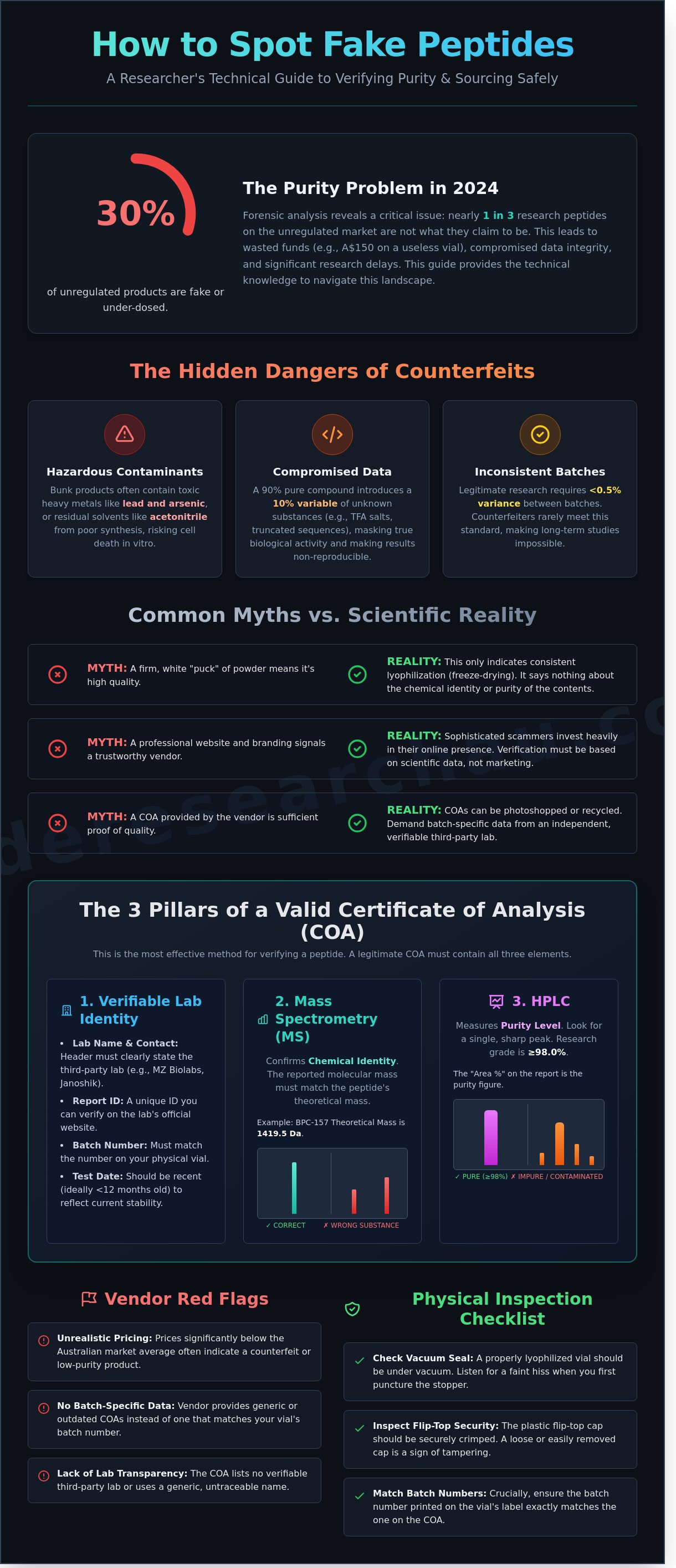
Utilising a compound with 90% purity instead of 99% introduces a significant volume of uncharacterised variables into your data. This 9% gap represents truncated sequences and TFA salts that can trigger unintended cellular responses or systemic toxicity in a laboratory environment. While mannitol is a standard "filler" used for stabilization, unverified batches may contain cheaper dextrin which interferes with the reconstitution process. Research grade is a standard of 98% or higher purity.
Data Integrity: Impurities can mask the true biological activity of the primary peptide.
Solvent Risks: Residual solvents like dichloromethane can cause immediate cell death in vitro.
Batch Consistency: Counterfeiters rarely achieve the 0.5% variance required for repeatable science.
Common Myths About Spotting Fake Peptides
A persistent myth in the research community is that the "puck" shape or the white colour of the powder confirms its identity. In reality, a firm cake only proves the lyophilisation parameters were consistent; it says nothing about the chemical sequence. You shouldn't trust a vendor simply because they've invested A$4,500 in a sleek, professional website design. Many offshore suppliers provide certificates of analysis (COAs) that are either photoshopped or recycled from a single successful batch produced in 2023. Truly knowing how to spot fake peptides requires looking past the branding and demanding batch-specific HPLC and Mass Spectrometry data from an independent Australian laboratory.
How to Read and Verify a Certificate of Analysis (COA)
Understanding a Certificate of Analysis (COA) is the most effective way for a researcher to learn how to spot fake peptides. A valid report must contain three critical elements: the laboratory's identity, the compound's mass spectrometry (MS) data, and the high-performance liquid chromatography (HPLC) results. Without these three pillars, a document is merely a marketing flyer rather than a scientific verification.
Begin by locating the third-party laboratory's name and contact details in the header. Legitimate facilities like MZ Biolabs or Janoshik provide a report ID that you can verify on their official websites. You must then match the batch number on the COA to the physical label on your vial. If the testing date is older than 12 months, the data might not reflect the current stability or purity of the compound. Many vendors use "research only" labels to bypass regulations, but recent enforcement, such as this FDA warning on unapproved peptides, highlights why independent verification is mandatory for safety.
Mass Spectrometry (MS) is your tool for identity confirmation. Every peptide has a specific molecular mass measured in Daltons (Da). If the theoretical mass of a compound like BPC-157 is 1419.5 Da, the MS report must show a dominant peak at that exact value. If the numbers don't align, the vial contains a different substance entirely, regardless of what the label claims.
Decoding HPLC: High-Performance Liquid Chromatography
HPLC measures purity levels by separating the components of the sample. A "clean" report shows one single, sharp, symmetrical peak. If you see a "noisy" graph with multiple smaller peaks or "shoulders" on the main peak, it indicates the presence of degraded sequences, residual solvents, or TFA salts. The "Area %" listed on the report translates to the total purity. For high-standard research, this figure should be 98.0% or higher. Anything lower suggests a contaminated product that could compromise your data.
Verifying the Lab: Don't Take the Document at Face Value
Scammers often use image editing software to alter old reports or steal COAs from reputable vendors. It's vital to contact the testing facility directly to confirm the report's authenticity using the unique tracking number. Always distinguish between "in-house" testing and independent third-party verification. In-house results lack the necessary impartiality for rigorous scientific study. Ensure you source from a trusted Australian peptide supplier that provides transparent, third-party data for every batch produced in the current calendar year.
Red Flags: Identifying Untrustworthy Peptide Vendors
Identifying a reliable source requires a clinical eye for detail. When researchers learn how to spot fake peptides, the first point of inspection is the product data. A reputable vendor must provide batch-specific testing results directly on the product page. If a website displays a single, blurred Certificate of Analysis (COA) from 2022 for all current stock, they aren't maintaining rigorous quality control. Authentic research compounds should align with established peptide quality reference standards to confirm identity, purity, and correct sequence. Vague marketing terms like "premium" or "high quality" are meaningless without specific Laboratory Grade metrics. Pricing is also a primary indicator of legitimacy. If a 5mg vial of BPC-157 is listed for A$25 while the Australian market average sits between A$70 and A$90, the product is likely diluted or contains structural impurities.
Website and Communication Warning Signs
Reliable vendors don't offer medical advice or provide dosage instructions. It's illegal to suggest human application for research chemicals. If a site provides "cycles" or "dosage protocols," they're operating outside of scientific and legal frameworks. Technical support should be capable of answering questions regarding molar mass, lyophilization, or trifluoroacetic acid (TFA) content. If the response is automated or non-technical, the vendor probably doesn't understand the chemistry they're selling. You should also be wary of payment methods. Vendors that only accept cryptocurrency or wire transfers offer zero buyer protection. Legitimate Australian businesses provide secure, traceable payment options that hold the company accountable.
The Danger of International 'Drop-Shipping' Vendors
Many websites appear to be domestic but actually drop-ship products from overseas factories. This creates a significant risk for peptide stability. International shipping from regions like East Asia or North America often involves 10 to 14 days in uncontrolled temperatures. Heat causes rapid degradation of delicate amino acid chains; this is a common way researchers realize they need to know how to spot fake peptides or degraded samples. Customs seizures are another hurdle. The Australian Border Force regularly intercepts packages that lack proper documentation. Sourcing from a domestic Australian laboratory ensures a shorter, more secure cold chain and provides a physical presence for regulatory accountability. Domestic sourcing minimizes the time a compound spends in transit, preserving the integrity of the Laboratory Grade material.
Physical Inspection and Reconstitution Protocols
A rigorous physical audit is the first step in learning how to spot fake peptides before they reach the bench. The verification process begins the moment your shipment reaches the laboratory. Researchers must scrutinize the physical state of each vial before any experimentation occurs. Key inspection points include:
Flip-top integrity: The plastic cap should be firm and show no signs of tampering or adhesive residue.
Vacuum verification: The vial should pull the diluent inward automatically upon needle insertion. A lack of suction suggests a micro-fracture in the glass or a failed stopper.
Batch coding: Every vial must display a clear, 8-12 digit alphanumeric batch number for traceability.
Meticulous record-keeping is a hallmark of professional research. Always log the batch numbers and expiration dates immediately. This data allows you to cross-reference your specific vial with the manufacturer's third-party HPLC reports. Knowing how to spot fake peptides often involves identifying discrepancies between the physical batch number and the digital records provided by the supplier. Disorganized labeling or missing batch data is a significant indicator of sub-standard manufacturing.
The Reconstitution Test: What Should Happen?
A high-purity, lyophilized peptide should dissolve clearly and quickly. Most research-grade compounds become transparent within 30 to 60 seconds of gentle swirling. You shouldn't see persistent cloudiness, "floaters," or undissolved sediment. These are major red flags suggesting the presence of fillers or manufacturing by-products. Note that certain compounds have unique characteristics; for example, GHK-Cu is naturally a vibrant blue due to its copper content. Don't mistake this intense pigmentation for a contaminant or a fake product.
Storage and Handling to Prevent Post-Purchase Degradation
Even the highest quality peptides degrade if handled poorly. Lyophilized vials are generally stable at room temperature for 14 to 21 days during transit, but they require storage at -20°C for long-term stability in the lab. Once you've reconstituted the compound, it must remain refrigerated between 2°C and 8°C. Exposure to direct UV light is another critical factor. Research shows that intense light can break down peptide bonds and reduce potency by up to 20% in a single afternoon. Proper handling is just as vital as the initial purity for ensuring valid experimental results.
Ensure your laboratory uses only verified, high-purity compounds for consistent data. View our range of laboratory-grade research peptides
Sourcing with Confidence: The Peptide Research AU Standard
Securing high-purity compounds in the Australian market requires more than just trust; it requires verifiable data. We provide 100% third-party verified laboratory-grade compounds to ensure every vial meets a minimum purity threshold of 99%. Understanding how to spot fake peptides starts with demanding total transparency. We provide a Certificate of Analysis (COA) for every single batch we distribute. These documents aren't optional extras. They're foundational to our operations and provide the High-Performance Liquid Chromatography (HPLC) and Mass Spectrometry (MS) data necessary for scientific validation.
Our Testing and Quality Control Protocol
We select manufacturing partners through a rigorous audit system that evaluates facility standards and chemical synthesis pathways. Our commitment to quality isn't static. We've implemented a 2026 consistency roadmap, which dictates that batch testing occurs for every new production cycle without exception. This frequency ensures that researchers across Australia receive identical sequences every time they order. Researchers trust our clinical approach because we prioritise the following:
Independent Verification: Every batch is tested by an autonomous laboratory to prevent internal bias.
Sequence Accuracy: We use Mass Spectrometry to confirm the exact molecular weight of each peptide.
Purity Benchmarks: Any batch falling below 98% purity is immediately rejected and destroyed.
This meticulous oversight ensures that the 'Research Grade' designation remains a factual statement of quality rather than a marketing term. By removing the variables associated with low-quality synthesis, we allow researchers to focus on data collection rather than worrying about contaminant-driven anomalies.
Your Partner in Scientific Discovery
Precision in the lab requires the right tools. We provide both high-purity peptides and the specific diluents required for accurate reconstitution. Our mission focuses on empowering mental and physical wellbeing through the application of rigorous science. By maintaining 'Research Grade' as our foundational quality pillar, we protect the integrity of your experimental data. You can browse our verified Research Grade Peptides today to secure compounds that meet the highest Australian standards. Knowing how to spot fake peptides is essential, but partnering with a transparent supplier is the most effective way to ensure research success.
Secure the Integrity of Your 2026 Research
Maintaining the integrity of your scientific data requires a vigilant approach to chemical sourcing. In the 2026 research landscape, verifying a Certificate of Analysis through independent 3rd-party HPLC and MS testing is the only definitive way to confirm 99% purity levels. You've learned that physical red flags like uneven lyophilization or missing batch numbers act as immediate indicators of sub-standard manufacturing. Mastering how to spot fake peptides ensures your laboratory resources aren't wasted on contaminated or under-dosed compounds. By prioritizing Australian-based domestic shipping with 24-hour dispatch, you eliminate the risks of international customs seizures and environmental degradation during long-haul transit. Our commitment to strict Laboratory Grade standards provides the precision your work demands. We utilize rigorous testing protocols to ensure every vial meets exact scientific specifications before it reaches your facility. Your focus should remain on the data, not the reliability of your reagents. We're here to provide the consistency your laboratory requires for successful outcomes.
Frequently Asked Questions
How can I tell if a peptide is real without a lab test?
You cannot definitively verify a peptide's identity or purity without HPLC or Mass Spectrometry testing. Visual inspections of the lyophilised cake or vacuum seal are unreliable indicators of chemical composition. While a uniform, white cake suggests professional freeze-drying, even 100% counterfeit substances can mimic this appearance. Relying on physical traits is a common mistake when learning how to spot fake peptides in a research setting.
What does 99% purity actually mean in a lab report?
A 99% purity rating indicates that 99% of the peptide content in the vial consists of the target amino acid sequence. The remaining 1% typically consists of truncated sequences, salts, or residual solvents from the synthesis process. High-performance liquid chromatography (HPLC) measures this by calculating the area under the peak on a chromatogram. For research grade compounds, anything below 98% is generally considered suboptimal for precise data collection.
Can fake peptides cause side effects in research models?
Yes, counterfeit or impure peptides often contain manufacturing byproducts or heavy metals like lead and arsenic that trigger adverse reactions. In a 2023 analysis of grey-market samples, 15% of vials contained unlisted fillers or pro-inflammatory bacterial endotoxins. These contaminants can cause localized swelling or systemic immune responses in research models. Using verified laboratory grade compounds is the only way to ensure the integrity of your experimental results.
Are the COAs provided by vendors always trustworthy?
Certificates of Analysis (COAs) are not inherently trustworthy unless they're third-party verified and include a verifiable batch number. Some unethical vendors recycle old reports or use Photoshop to alter dates and purity percentages. You should cross-reference the report with the independent lab’s database or contact the testing facility directly. A legitimate COA for the Australian market should be dated within the last 6 to 12 months.
Why is my peptide powder a different color than the last batch?
Variations in color or texture often result from differences in the lyophilisation cycle parameters rather than the peptide itself. While most research grade peptides are white, slight variations in temperature or vacuum pressure can create a sharded or collapsed appearance. However, any distinct yellow or brown tint is a red flag. If the color deviates from a neutral white or off-white, the batch likely contains oxidized impurities or degraded material.
Is it possible for a peptide to be real but under-dosed?
It's very common for a vial to contain the correct peptide but at a lower concentration than advertised. For instance, a vial labeled as 5mg might only contain 3.2mg of the active compound. This discrepancy often occurs when manufacturers prioritize cost-cutting or fail to account for the peptide’s salt content during the weighing process. Proper research requires quantitative analysis to confirm the exact milligram count per vial.
What should I do if I suspect I've purchased counterfeit peptides?
Cease all research activities with the batch immediately and isolate the remaining vials to prevent accidental use. Contact the vendor to request a batch-specific third-party test result that matches your order's lot number. If the vendor can't provide verification, consider sending a sample to an independent Australian laboratory for HPLC analysis. This testing typically costs between A$250 and A$450 per sample but provides definitive proof of the compound’s identity.
How often should a peptide vendor update their lab testing results?
A reputable vendor should update their testing results for every new manufacturing batch, which typically occurs every 3 to 4 months. Stale reports older than 12 months are a significant warning sign that the vendor isn't conducting ongoing quality control. Consistent testing ensures that the laboratory grade compounds you receive meet the exact specifications required for high-precision scientific study.


Comments