
Research Peptide Forums Australia: Navigating Quality and Sourcing in 2026
- peptideresearchau
- May 30
- 12 min read
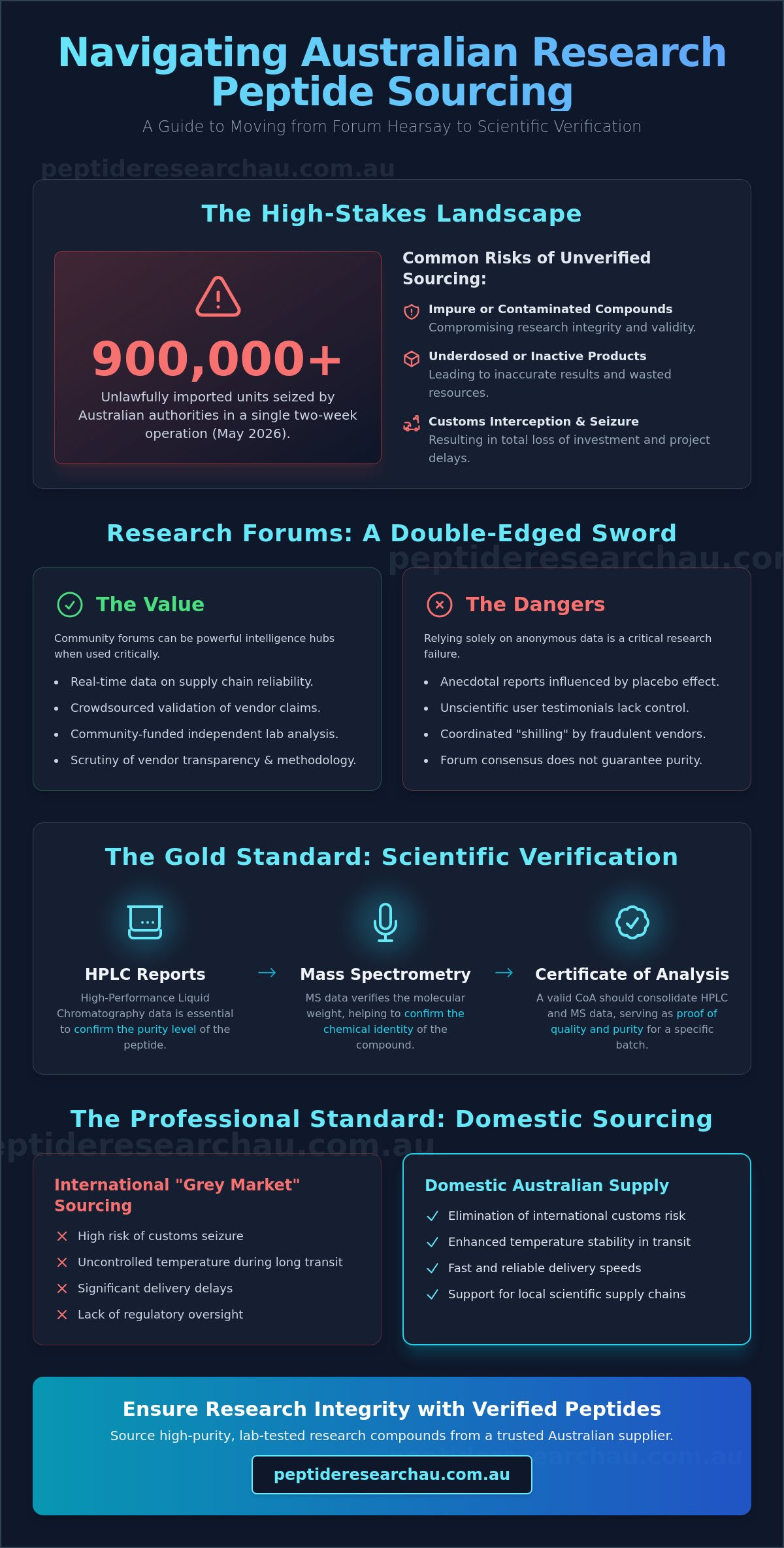
Did you know that Australian authorities seized over 900,000 units of unlawfully imported therapeutic goods, including peptides, during a single two-week crackdown in May 2026? For those monitoring research peptide forums australia, this statistic highlights the volatility of the current market and the significant risks of relying on unverified international sourcing. It's understandable to feel overwhelmed by conflicting user reviews while fearing that your research compounds might be underdosed, impure, or intercepted by customs.
This article provides a structured framework to help you move past anecdotal hearsay and identify high-purity sources through objective scientific verification. You'll gain the clarity needed to evaluate forum data critically and establish reliable criteria for domestic sourcing. We'll examine how to confirm the technical specifications of research peptides and laboratory diluents, ensuring your work is supported by precise data rather than community speculation.
Key Takeaways
Distinguish between anecdotal claims and peer-reviewed methodology to ensure your research data remains objective and reproducible.
Identify common red flags and "shilling" tactics used by unregulated vendors on research peptide forums australia to protect your laboratory from fraudulent sources.
Master the technical interpretation of HPLC and Mass Spectrometry reports to confirm the chemical identity and purity of research compounds.
Evaluate the logistical benefits of domestic Australian supply chains, focusing on temperature stability and the elimination of international customs risks.
Establish a rigorous verification protocol for Certificates of Analysis to maintain high manufacturing and research standards.
Table of Contents
The Role of Research Peptide Forums in the Australian Scientific Community
Peer-to-peer communities serve as a primary intelligence hub for the Australian scientific community. Researchers often utilize research peptide forums australia to gather real-time data on supply chain reliability and batch consistency. Because the regulatory environment is complex, these digital spaces offer a layer of transparency that traditional procurement channels sometimes lack. They provide a platform where methodology is debated and vendor transparency is scrutinized by those with technical expertise.
Before evaluating these communities, it's essential to understand the fundamental biochemistry involved. What are peptides? At their core, they are short chains of amino acids linked by peptide bonds, serving as essential tools in molecular biology and biochemical research. Because these compounds are sensitive to environmental factors, the sourcing of high-purity research compounds and laboratory diluents requires rigorous verification.
The landscape shifted significantly in early 2026. Following the seizure of over 900,000 units of unlawfully imported therapeutic goods by the TGA in May 2026, forum discussions have transitioned away from international "grey market" vendors. The focus now rests almost exclusively on domestic Australian suppliers. This shift is driven by a need for stability, speed of delivery, and the mitigation of customs-related risks. Community-led testing initiatives have become the new standard, where members pool resources to fund independent laboratory analysis of available batches.
Why Australian Researchers Prioritize Community Feedback
Navigating the domestic landscape requires more than just reading a supplier's marketing copy. Researchers seek validation of third-party testing protocols and manufacturing standards. Forums allow for the verification of vendor claims through collective experience. This crowdsourced approach helps identify which suppliers consistently deliver high-purity research peptide forums australia recommendations and which fail to meet technical specifications. It's about finding data that isn't readily available through standard commercial channels.
The Limitations of Anonymous Forum Data
While community feedback is useful, it isn't a substitute for clinical verification. Anecdotal reports often fall victim to the placebo effect or unscientific methodologies. These reports lack controlled environments and standardized protocols. You'll find that forum consensus doesn't guarantee chemical purity. Scientific validity requires empirical data, such as HPLC results and Mass Spectrometry, rather than subjective user testimonials. Relying solely on hearsay can compromise the integrity of research outcomes.
Evaluating the Landscape of Australian Peptide Communities
Identifying reliable information within the ecosystem of research peptide forums australia requires a structured analytical approach. The digital environment is divided between public platforms like Reddit and gated communities on encrypted messaging apps. While these spaces facilitate knowledge sharing, they also introduce significant variables regarding data integrity. Researchers must distinguish between coordinated marketing campaigns and empirical user data to maintain the validity of their work.
This distinction is critical because of the inherent risks associated with unregulated procurement. The TGA warning on unapproved peptides highlights how products sold through online channels often bypass essential safety and quality checks. Relying on anonymous forum endorsements without technical verification exposes research projects to contaminated or improperly synthesized compounds. Verification should always precede procurement.
Reddit and the r/Peptides Ecosystem
Reddit remains a primary aggregator for sourcing data. Users leverage historical search functions to track the long term reliability of specific Australian vendors. It is advisable to prioritize contributors with "Expert" flairs or those who consistently post third-party laboratory results. However, Reddit sitewide policy changes frequently restrict direct sourcing discussions. This often migrates the most valuable technical data into private subreddits or off-platform mirrors, which requires researchers to be more diligent in their verification processes.
Specialized Research Boards and Their Utility
Boards like Evolutionary.org and Professional Muscle often feature dedicated Australian sections. These communities frequently intersect with SARMs and performance-enhancing compound discussions. While their "vetted" lists provide a starting point, they are often susceptible to commercial bias or paid sponsorships. The signal-to-noise ratio is generally lower here than on dedicated biochemical research platforms. Serious researchers should prioritize threads that focus on HPLC (High-Performance Liquid Chromatography) analysis rather than subjective physical feedback.
Assessing the technical expertise of a community is essential for data security. A reliable forum base will demand rigorous documentation, such as batch-specific Certificates of Analysis. If a community prioritizes anecdotal reports over chemical nomenclature and purity percentages, its utility for professional study is limited. For those requiring verified materials, sourcing high-purity research compounds from established domestic providers ensures that laboratory standards are consistently maintained.
Private Discord and Telegram groups represent the most volatile segment of the landscape. These "underground" channels lack public oversight and archival history. This makes it nearly impossible to verify a vendor's long-term track record or the validity of their shared testing data. The absence of accountability in these encrypted spaces significantly increases the probability of receiving substandard or mislabeled research materials. Avoiding these channels is often the safest path for legitimate research purposes.
Identifying Scams and Shills in Online Research Communities
Maintaining a rigorous skeptical framework is essential when utilizing research peptide forums australia for sourcing data. As the domestic market matures, fraudulent actors have developed sophisticated methods to mimic legitimate suppliers. Distinguishing between a verified researcher and a coordinated marketing campaign requires an analytical approach to user history and technical documentation. Relying on superficial endorsements often leads to the procurement of underdosed or contaminated compounds.
Post history serves as a primary metric for reliability. A "new account" bias often indicates a disposable identity created solely for promotional purposes. When evaluating a source, researchers should examine the account's longevity and its history of technical contributions. If an account's only activity involves praising a specific vendor without providing empirical data, it should be treated as a high-risk information source. Protecting your research integrity requires moving beyond these curated testimonials.
The Anatomy of a Peptide Scam
Fraudulent vendors often lack professional digital infrastructure. A reliance on Telegram-only ordering or Discord channels is a significant red flag. These platforms allow for the rapid deletion of evidence and lack the accountability of a formal business presence. Additionally, unrealistic pricing models that fall significantly below the known costs of peptide synthesis and purification suggest a compromised product. Synthesis is a precise, resource-intensive process. If a price seems statistically improbable, the compound is likely impure or mislabeled. Scammers also frequently utilize stolen or doctored Certificates of Analysis (COAs). You can verify these reports by contacting the issuing laboratory directly to confirm the batch number and results match the vendor's claims.
Spotting Shills and Coordinated Marketing
Shilling is the practice of using covert paid promotion to manufacture artificial trust. These "success stories" often appear too polished, lacking the nuanced technical details typical of legitimate research. They often follow a predictable narrative arc designed to trigger emotional rather than analytical responses. Another common tactic is "Source Baiting," where multiple accounts create a false sense of demand or scarcity for a specific vendor's stock. This creates an environment of urgency that discourages proper due diligence. To counter this, researchers should cross-reference reviews across multiple independent platforms. Consistency in batch performance across disparate communities is a stronger indicator of quality than a high volume of reviews on a single forum.
Security extends beyond product purity. Anonymous spaces pose risks to your financial information and research data. Utilizing secure, encrypted payment methods and avoiding the disclosure of sensitive laboratory details is standard protocol. By prioritizing vendors who provide transparent, verifiable laboratory data and maintain a professional domestic presence, researchers can mitigate the risks inherent in anonymous digital communities. Verification remains the only defense against the sophisticated deception found in unregulated spaces.
Beyond Forum Anecdotes: Scientific Standards for Peptide Verification
Subjective reports found on research peptide forums australia cannot replace empirical laboratory data. While community feedback helps identify operational reliability, only rigorous analytical chemistry confirms the molecular identity of a compound. Researchers must prioritize objective metrics over user testimonials to ensure the integrity of their study. Validating the chemical composition of research peptides requires a systematic approach to technical documentation and laboratory verification.
The transition from international to domestic sourcing in 2026 has increased the importance of localized testing. Domestic batch-specific analysis ensures that compounds haven't degraded during transit or through improper storage. Relying on "static" reports—outdated documents that don't correspond to the current batch—is a common error that compromises research safety. High-purity standards are maintained only when every unique synthesis undergoes individual verification.
Understanding HPLC and Purity Percentages
In a professional laboratory setting, a purity rating of 99% indicates that 99% of the analyzed sample consists of the target peptide sequence. The remaining 1% typically comprises residual salts, water, or amino acid byproducts from the synthesis process. Low-grade manufacturing often leaves behind unreacted reagents or truncated sequences that can interfere with research outcomes. HPLC is the definitive method for peptide identification and purity quantification. By examining the chromatogram, researchers can identify the primary peak and ensure that impurities remain within acceptable technical tolerances.
Verifying Third-Party Laboratory Reports
Authenticating a Certificate of Analysis (COA) is a mandatory step in the procurement process. Fraudulent vendors often distribute doctored reports with altered dates or batch numbers. To confirm a report's validity, you should contact the testing facility directly. Most reputable laboratories provide a verification portal where you can enter the report ID to cross-reference the results. You can find more information on maintaining these quality standards in our guide on peptides australia.
Consistency in laboratory letterheads, signatures, and technical nomenclature is a sign of a legitimate report. If a vendor provides a COA that lacks a specific batch number or testing date, the document is statistically irrelevant to the product you've received. For researchers who demand precision, sourcing high-purity research compounds from providers who offer transparent, batch-specific HPLC data is the only way to eliminate chemical variables. Verification is not an optional step; it's the foundation of credible scientific study.
Sourcing Reliable Research Peptides in Australia: The Professional Standard
The evolution of the Australian peptide market has led to a clear divergence between community-led sourcing and professional laboratory standards. While research peptide forums australia provide a baseline for identifying operational trends, they're increasingly viewed as a secondary resource compared to established domestic suppliers. Professional laboratory-grade suppliers have replaced the 'forum-vetted' model by providing the one thing anonymous communities cannot: legally accountable, batch-specific verification. This shift ensures that researchers receive compounds synthesized under rigid quality control protocols rather than relying on the fluctuating reputation of international vendors.
Integrating community feedback with rigorous internal quality control creates a more robust procurement framework. While forum data can highlight shipping delays or packaging issues, internal verification focuses on chemical nomenclature and molecular integrity. For the serious researcher, the goal isn't merely to find a vendor that "others use," but to identify a partner that provides transparent, empirical data for every research compound and multi-peptide complex provided. This professional standard eliminates the guesswork inherent in peer-to-peer recommendations.
The Benefits of Domestic Australian Sourcing
Domestic sourcing offers significant technical advantages regarding product stability. Peptides are inherently fragile molecules. Extended transit times associated with international shipping increase the risk of thermal degradation, especially when packages are held in unconditioned customs facilities. By utilizing domestic channels, researchers ensure that compounds remain within stable temperature ranges from the laboratory to the bench. Furthermore, domestic sourcing ensures compliance with Australian research regulations and standards, mitigating the legal risks highlighted by the TGA in May 2026. For those conducting specific studies, you can review our specific research overview on bpc 157 to understand the quality requirements for high-purity sequences.
Peptide Research AU: A Commitment to Transparency
Peptide Research AU aligns with the highest scientific standards by providing the data that users on research peptide forums australia actually require for their work. We recognize that community-led testing is a response to a lack of vendor transparency. We address this by providing batch-specific HPLC and Mass Spectrometry data as a standard component of our service. Our approach to third-party verification ensures that every research compound and laboratory diluent meets its stated purity and concentration specifications. We don't rely on static, outdated reports. Instead, we maintain a continuous cycle of testing that reflects the actual inventory available for study.
Reliability in research is built on the elimination of variables. By choosing a professional domestic supplier, you secure a supply chain that prioritizes speed, stability, and scientific accuracy. Our commitment to transparency provides the technical foundation necessary for reproducible results and high-standard methodology. Explore our laboratory-grade research peptides to see how we maintain the professional standard for the Australian scientific community.
Advancing Scientific Integrity in 2026
The evolution of the Australian research landscape requires a transition from community-led anecdotal data to rigorous scientific verification. While monitoring research peptide forums australia provides a baseline for identifying market trends, it's not a substitute for objective laboratory analysis. Prioritizing domestic supply chains is essential for maintaining compound stability and ensuring adherence to local regulatory standards. By demanding batch-specific HPLC and Mass Spectrometry testing, you eliminate the chemical variables that compromise research reproducibility and laboratory safety.
Peptide Research AU provides the technical infrastructure necessary for high-precision study. We maintain clinical-grade purity standards through comprehensive third-party verification for every batch. Our domestic shipping protocols ensure maximum stability by minimizing transit times and environmental exposure. Establishing a reliable, data-driven supply chain is the final step in securing the validity of your scientific outcomes. You can move forward with the confidence that your research materials meet the highest benchmarks of chemical excellence.
Secure Laboratory-Grade Research Peptides from a Trusted Australian Supplier
Frequently Asked Questions
Are research peptide forums in Australia reliable for finding sources?
Forums provide anecdotal data but lack scientific accountability. While they help identify operational trends, they shouldn't be the sole basis for sourcing. research peptide forums australia often contain outdated or biased information that contradicts current regulatory standards. Relying on community consensus rather than batch-specific laboratory verification introduces unnecessary variables into your research project. Scientific integrity requires empirical data rather than peer popularity.
How can I tell if a peptide review on Reddit is a paid shill?
Identifying shills requires analyzing account history and post patterns. Red flags include accounts created within the last 30 days that exclusively promote one vendor without providing technical data. Reviews that appear overly polished or use emotional language rather than clinical descriptors are likely coordinated marketing. Legitimate researchers prioritize chemical nomenclature and HPLC results over subjective success stories that lack measurable data.
What is the most important laboratory test for verifying peptide purity?
High-Performance Liquid Chromatography (HPLC) is the definitive test for quantifying peptide purity. This method separates the target peptide from synthesis byproducts and contaminants. Mass Spectrometry (MS) is also essential to confirm the molecular weight and identity of the compound. Together, these tests provide a comprehensive profile of the research compound's chemical integrity. You shouldn't accept any batch that lacks these specific reports.
Is it legal to discuss peptide sourcing on Australian forums?
Discussing the methodology and sourcing of research compounds is generally permitted in educational and scientific contexts. However, the promotion of unapproved therapeutic goods for human use violates TGA regulations. Forums often restrict direct sourcing links to remain compliant with sitewide policies and Australian law. It's essential to distinguish between academic discussion and the illegal advertising of restricted substances to maintain your professional standing.
Why do some Australian peptide vendors only use Telegram or encrypted apps?
Vendors often use encrypted apps to avoid the accountability and transparency required of a legitimate business entity. This practice allows for the rapid deletion of transaction history and limits the ability of researchers to verify a supplier's long-term track record. A lack of professional web infrastructure is a primary red flag for fraudulent activity or substandard manufacturing practices. Professional suppliers maintain transparent, accessible communication channels.
How do I verify a Certificate of Analysis (COA) provided by a vendor?
Verification involves contacting the independent laboratory that issued the report. You should cross-reference the batch number and testing date with the lab's internal database. Most reputable facilities provide a verification portal for this purpose. If a vendor on research peptide forums australia provides a report that lacks a unique identifier or appears doctored, the data is invalid. Always confirm that the report corresponds to your specific batch.
What are the risks of buying from an 'internationally vetted' source in Australia?
International sources carry significant risks related to transit stability and customs interception. Peptides are sensitive to temperature fluctuations; prolonged transit can cause thermal degradation. Additionally, the TGA seizure of over 900,000 units in May 2026 demonstrates the high probability of delivery failure. Domestic sourcing ensures better stability and compliance with local research standards. It's the only way to guarantee the arrival of viable compounds.
Can I trust 'crowdsourced' lab testing results found on forums?
Crowdsourced results provide a snapshot of batch quality but lack the chain of custody found in professional testing. While these reports are more reliable than anecdotal reviews, they can still be manipulated or misread by non-technical users. Researchers should prioritize vendors who provide their own batch-specific, third-party verified data as a standard component of their quality control protocol. Independent verification remains the gold standard for laboratory research.


Comments