
PT-141 Research Australia: A Comprehensive Guide for 2026
- peptideresearchau
- 3 days ago
- 11 min read
The assumption that PT-141 research Australia can bypass strict TGA oversight by utilizing "research only" labels is a critical misconception in the current laboratory landscape. As of 2026, Bremelanotide remains a Schedule 4 Prescription Only Medicine, making adherence to domestic legal standards as vital as the purity of the peptide itself.
You likely recognize the difficulty of sourcing laboratory-verified compounds while ensuring full compliance with Australian health regulations and avoiding inconsistent reconstitution data. This comprehensive guide delivers a technical overview of PT-141, focusing on its specific activation of MC3R and MC4R receptors within the hypothalamus. We provide a definitive framework for peptide preparation and a clear map of the regulatory requirements necessary for professional study. By the end of this analysis, you'll have the technical data required to identify reputable Australian suppliers and execute precise, compliant research protocols that meet the highest industry standards.
Table of Contents
Understanding PT-141 (Bremelanotide) in a Research Context
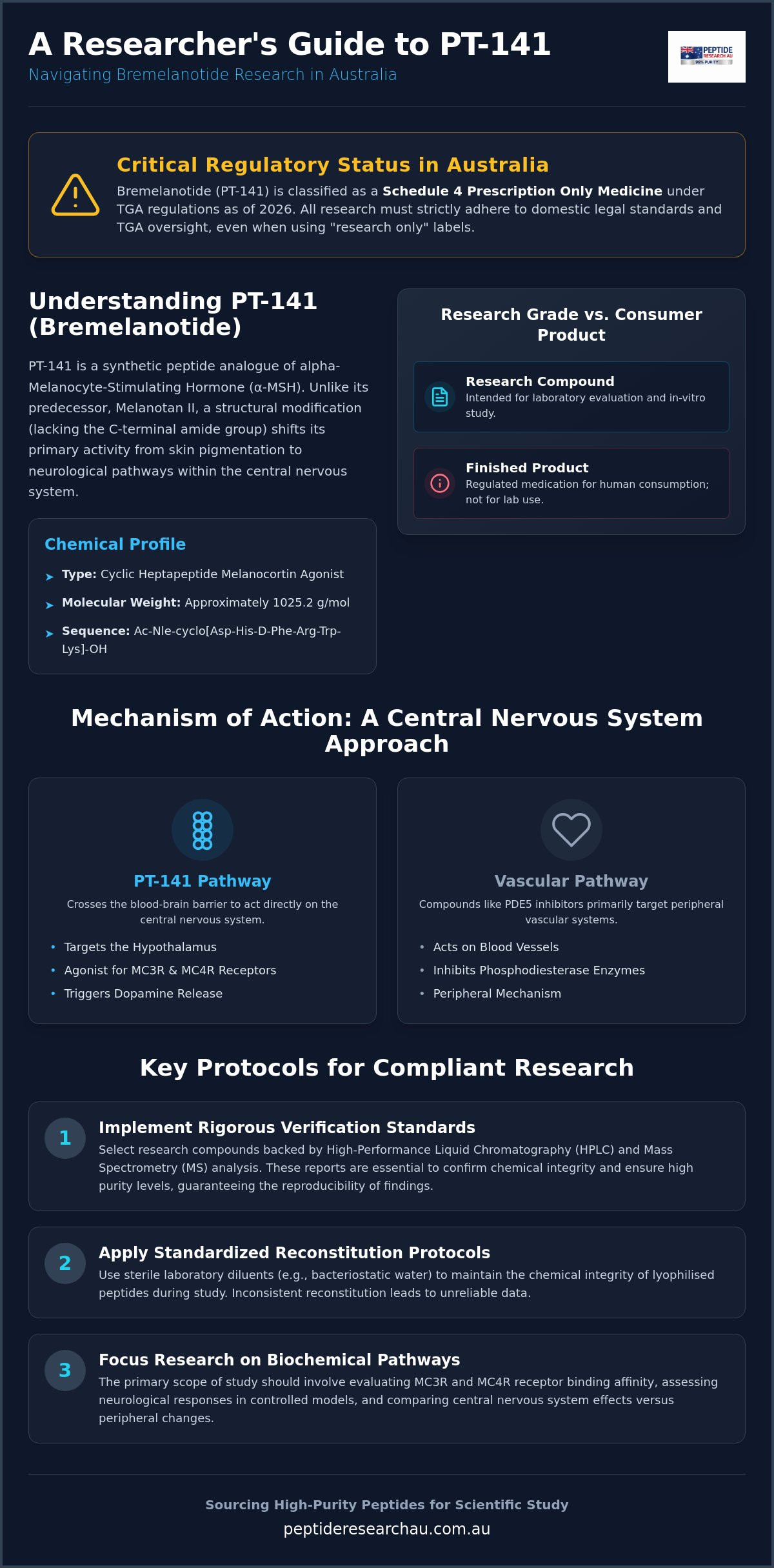
Scientists categorize Bremelanotide (PT-141) as a synthetic peptide analogue of the endogenous hormone alpha-Melanocyte-Stimulating Hormone (α-MSH). It shares a common ancestry with Melanotan II. However, PT-141 lacks the C-terminal amide group found in its predecessor. This specific structural modification shifts the compound's primary activity away from melanocyte stimulation and toward neurological pathways. Historical data shows that while early studies focused on skin pigmentation, researchers quickly pivoted when central nervous system effects became apparent. The evolution of this peptide marks a transition from dermatological study to complex endocrine research.
Chemical Structure and Composition
The molecular sequence of this compound is Ac-Nle-cyclo[Asp-His-D-Phe-Arg-Trp-Lys]-OH. PT-141 is a cyclic heptapeptide melanocortin agonist. Its molecular weight is approximately 1025.2 g/mol. Precision in PT-141 research Australia requires compounds with verified chemical integrity. Laboratory-grade purity is essential. It's a foundational requirement because trace contaminants can skew data in metabolic and neurological studies. High manufacturing standards ensure that the lyophilised powder remains stable for laboratory use. Reliable suppliers provide HPLC and Mass Spectrometry reports to confirm that the sequence matches the intended nomenclature. Without these verification steps, researchers don't have the assurance required to guarantee the reproducibility of their findings.
Intended Use and Research Scope
Current studies distinguish between finished consumer products and research compounds. It's essential to delineate between research compounds and consumer medications. Research peptides are intended for laboratory evaluation rather than human consumption. The scope of PT-141 study primarily involves the central nervous system. Unlike vascular-acting compounds, PT-141 interacts with melanocortin receptors in the hypothalamus. This interaction allows scientists to evaluate the melanocortin system's role in sexual arousal and appetite regulation. In 2026, PT-141 research Australia continues to explore these neurological triggers within controlled environments. The research scope includes:
Evaluation of MC3R and MC4R receptor binding affinity.
Assessment of neurological responses in animal models.
Study of the peptide's stability in various laboratory diluents.
Comparison of central nervous system effects versus peripheral vascular changes.
The distinction between research-grade materials and clinical applications is vital. Investigators must prioritize compounds that meet strict laboratory standards to ensure the data's validity. This rigorous approach supports the development of technical protocols that define the peptide's utility in modern science.
The Mechanism of Action: MC3R and MC4R Pathways
PT-141 functions as a non-selective agonist for the melanocortin receptor system. It demonstrates high affinity for several subtypes, specifically targeting MC3R and MC4R. Unlike traditional phosphodiesterase inhibitors that act primarily on the vascular system, PT-141 initiates physiological responses through the central nervous system. A detailed Bremelanotide Scientific Review highlights how these pathways differ from peripheral mechanisms. This distinction is vital for investigators conducting PT-141 research Australia in 2026. The compound triggers a cascade within the hypothalamus, which is the region responsible for regulating autonomic functions and homeostasis.
The binding affinity of PT-141 is particularly significant in the context of receptor selectivity. While it interacts with multiple receptors, its primary research value lies in its influence over the MC4R pathway. Recent comparative analyses indicate that PT-141 possesses a more favorable binding profile than earlier analogues like Melanotan II. It shows reduced activity at the MC1R site, which is responsible for skin pigmentation. This allows researchers to isolate neurological effects with greater precision. Scientists often utilize high-purity research peptides to ensure that binding studies remain free from the interference of manufacturing impurities.
Neurological Pathways and Signalling
PT-141 crosses the blood-brain barrier effectively. It interacts directly with neurons in the medial preoptic area of the hypothalamus. The activation of MC4R results in the release of dopamine. This neurotransmitter serves as a key modulator of arousal and behavioral responses. The cyclic structure of the heptapeptide is critical for this process. It provides the necessary conformational stability for high-affinity receptor binding. This stability ensures that the ligand remains active long enough to initiate intracellular signaling. Research protocols often require the use of specialized laboratory diluents to maintain this structural integrity during administration in study models.
Research Findings in Animal Models
Studies in rat models have consistently demonstrated that PT-141 induces dose-dependent responses. In female rats, researchers observe increased proceptive behaviors. In male rats, the peptide facilitates erectile responses via spinal and supraspinal pathways. Non-human primate data suggests that these effects are mediated by the central melanocortin system rather than direct smooth muscle relaxation. As of 2026, the scientific consensus identifies PT-141 as a potent MC4R agonist with significant regulatory influence over metabolic and reproductive pathways. This data supports the ongoing requirement for standardized materials in PT-141 research Australia to ensure results are reproducible across different laboratory settings.
Laboratory Protocols for PT-141 Reconstitution and Handling
Maintaining aseptic conditions is the primary requirement for any laboratory conducting PT-141 research Australia. Contamination doesn't just compromise the chemical profile of the peptide; it invalidates the resulting experimental data. Researchers must utilize a dedicated workspace, preferably a laminar flow hood, to ensure the integrity of the compound during preparation. This protocol begins with the selection of appropriate laboratory diluents. Bacteriostatic water is the industry standard for reconstituting research peptides. It contains 0.9% benzyl alcohol, which serves as a preservative to inhibit the growth of bacteria over the course of the study. Using sterile water without a bacteriostatic agent is only suitable for single-use applications where the solution is utilized immediately.
Precision in concentration calculation is vital for reproducible results. When a researcher adds 2ml of diluent to a 10mg vial of PT-141, the resulting solution has a concentration of 5mg/ml. Investigators must document these ratios meticulously to ensure consistency across multiple assays. Using calibrated micropipettes for diluent transfer reduces the margin of error in these measurements. It's a foundational step that prevents dosing variances in animal models or binding affinity studies.
Storage and Stability Standards
Lyophilised PT-141 powder is remarkably stable, but it remains sensitive to environmental factors. For short-term use, researchers should store the vials at temperatures between 2°C and 8°C. If the study duration exceeds 90 days, storage at -20°C is necessary to prevent primary structure degradation. Vials must remain protected from direct light exposure and mechanical stress. Signs of degradation include visible cloudiness, particulate matter, or a change in the solution's color after reconstitution. If these occur, the sample should be discarded immediately to avoid skewed data.
Reconstitution Best Practices
The physical process of mixing requires a delicate approach. Most high-purity vials are vacuum-sealed. This pressure difference can cause the diluent to spray forcefully into the vial, potentially shearing the peptide chains. Researchers should angle the needle against the glass wall of the vial, allowing the liquid to flow down slowly. Swirling the vial gently is the only acceptable method for mixing. Agitation or shaking will denature the peptide and render it useless for study. For more detailed guidance on these technical steps, investigators can review our guide on how to mix peptides. This ensures the chemical bonds remain intact for accurate receptor binding analysis in PT-141 research Australia.
Navigating the Legal and Regulatory Framework in Australia
The regulatory framework for PT-141 research Australia is governed by the Therapeutic Goods Administration (TGA). As of 2026, Bremelanotide remains classified under Schedule 4 of the Poisons Standard. This designation identifies it as a Prescription Only Medicine. While many vendors market the compound under the "Research Use Only" disclaimer, this label doesn't grant an automatic exemption from federal or state laws. Possessing or distributing PT-141 without appropriate legal authorization or a valid prescription is prohibited. Penalties for non-compliance are severe. They can include fines up to $2,200 and potential imprisonment for up to two years. It's a serious landscape that requires meticulous attention to detail.
Institutional researchers must ensure their protocols align with the Office of Chemical Safety standards. Private investigators face similar obligations. The TGA has historically taken enforcement action against entities that advertise Schedule 4 substances directly to the public. Establishing a clear, documented intent for laboratory study is a prerequisite for any procurement. This documentation serves as the primary defense against claims of non-therapeutic use. It's the researcher's responsibility to maintain these records throughout the duration of the study.
TGA Scheduling and Compliance in 2026
Compliance begins with understanding the specific entry for Bremelanotide in the Poisons Standard. It's not a prohibited substance like those in Schedule 9, but its restricted status requires strict adherence to handling and procurement laws. Researchers are responsible for verifying that their source operates within the legal parameters of the Australian market. This involves ensuring that the compound is utilized strictly for in vitro or animal model studies. For a broader perspective on regulatory alignment, investigators should consult our guide on peptides australia. This resource outlines the necessary quality standards for domestic laboratory work.
The Importance of Domestic Sourcing
Importing laboratory compounds from international vendors introduces significant logistical and legal risks. Australian Customs and Border Protection Service (ACBPS) frequently intercepts scheduled substances that lack the required importation permits. Seizure of materials doesn't just result in financial loss; it can trigger regulatory audits of the research facility. Sourcing from a domestic provider mitigates these risks. Domestic suppliers ensure that the compounds remain within a controlled cold chain. This is vital for maintaining the peptide's biochemical integrity. Faster delivery times also prevent the degradation that often occurs during lengthy international transit. When you source research compounds from established Australian entities, you gain access to batch-specific verification data that international vendors rarely provide. This commitment to domestic quality control is the most reliable way to maintain the high standards required for PT-141 research Australia.
Sourcing High-Purity PT-141 for Scientific Study
Selecting a supplier for PT-141 research Australia requires a meticulous evaluation of manufacturing standards and data transparency. In a landscape where "research grade" is often used loosely, investigators must demand empirical proof of purity. A reputable supplier doesn't just claim quality; they provide the analytical data to support it. This data ensures that experimental variables remain controlled and that the peptide's interaction with MC3R and MC4R receptors isn't masked by secondary compounds or synthesis byproducts. Peptide Research AU is positioned as a leader in this sector by maintaining rigorous domestic standards and providing the necessary laboratory diluents required for precise preparation. Accuracy in these initial stages is the only way to guarantee the integrity of your longitudinal data.
The Australian laboratory environment in 2026 demands higher accountability than previous years. Researchers can't afford the risks associated with international "grey market" vendors who bypass quality control. Domestic sourcing ensures that the compound hasn't been exposed to extreme temperature fluctuations during transit, which is a common cause of peptide denaturation. When you're conducting PT-141 research Australia, the proximity of the supplier allows for a more reliable chain of custody. This reliability is foundational for peer-reviewed studies where the source of materials must be disclosed and defended.
Quality Assurance and Testing Protocols
The gold standard for peptide verification involves High-Performance Liquid Chromatography (HPLC) and Mass Spectrometry (MS). HPLC determines the purity level by separating the components of the mixture. A purity rating of 98% or higher is the baseline for professional study. Mass Spectrometry confirms the molecular mass, ensuring the peptide sequence is accurate and free from truncated sequences. Every batch should be accompanied by a Certificate of Analysis (COA). This document provides a transparent record of the third-party laboratory verification. It confirms the absence of heavy metals, residual solvents, and unreacted reagents. Without this level of scrutiny, researchers risk utilizing materials that could produce anomalous results or compromise animal model health. Reliable data starts with a clean sample.
Initiating Your Research Project
Before beginning an assay, investigators should finalize a checklist to ensure all variables are addressed. This includes verifying the TGA compliance status discussed previously and securing a sterile environment for reconstitution. Selecting the appropriate quantity is also vital. Most studies utilize 10mg vials to maintain a balance between volume and stability. For those needing a deeper dive into the biochemical specifics, our PT-141 research guide provides exhaustive data on receptor binding and metabolic pathways. Establishing a consistent concentration early in the project prevents longitudinal data errors. Once your protocol is established, you can explore our laboratory-grade PT-141 for your research needs to ensure your study utilizes only the highest caliber of synthetic peptides available in the Australian market.
Standardizing Future Laboratory Protocols
Successful laboratory study requires a synthesis of biochemical precision and regulatory compliance. Investigators must prioritize the activation of central MC3R and MC4R pathways while maintaining strict adherence to the 2026 TGA Poisons Standard. Utilizing verified reconstitution protocols ensures that the peptide's cyclic structure remains intact for accurate data collection. It's a foundational requirement for any professional conducting PT-141 research Australia. Without these rigorous standards, the reproducibility of neurological and metabolic data is significantly compromised.
Reliability in sourcing is the final pillar of a successful project. Peptide Research AU provides specialized research-grade compounds backed by rigorous laboratory testing for purity. Our commitment to excellence includes domestic Australian shipping, which ensures that temperature-sensitive materials maintain their integrity during transit. We also provide essential diluents to support your study from inception to completion. Order Laboratory-Grade PT-141 from Peptide Research AU to ensure your laboratory meets the highest benchmarks for scientific integrity. Your dedication to precise methodology drives the advancement of modern endocrinology.
Frequently Asked Questions
Is PT-141 legal to buy for research in Australia?
PT-141 is classified as a Schedule 4 Prescription Only Medicine under the TGA Poisons Standard. It's illegal to possess or sell the compound without a valid prescription or specific legal authorization for laboratory study. While some vendors use "research only" labels, this doesn't exempt the substance from regulatory oversight. Unauthorized procurement for PT-141 research Australia can result in significant legal penalties, including fines of up to $2,200 and potential imprisonment.
What is the correct way to store PT-141 in a laboratory setting?
Lyophilised PT-141 powder requires storage at temperatures between 2°C and 8°C for short-term laboratory use. For long-term preservation exceeding 90 days, investigators must store the vials at -20°C to prevent primary structure degradation. Vials should remain in their original packaging to ensure protection from light exposure. Once reconstituted, the solution must be refrigerated and utilized within a specific timeframe to maintain biochemical integrity and prevent potency loss.
How much bacteriostatic water should be used for PT-141 reconstitution?
Most laboratory protocols utilize 1ml or 2ml of bacteriostatic water for a standard 10mg vial of PT-141. Adding 2ml of diluent results in a concentration of 5mg/ml, which allows for precise measurement during assays. Researchers should select the volume based on the required concentration for their specific study model. It's essential to use sterile bacteriostatic water containing 0.9% benzyl alcohol to inhibit bacterial growth during the research period.
What is the difference between PT-141 and Bremelanotide?
There's no chemical difference between the two terms. Bremelanotide is the international nonproprietary name (INN) for the compound, while PT-141 is the developmental code used during its initial research phases. Both refer to the same synthetic cyclic heptapeptide. In a laboratory context, the terms are used interchangeably to describe this specific melanocortin receptor agonist and its interaction with the central nervous system pathways in the hypothalamus.
Can PT-141 be used for human clinical trials in Australia?
Human clinical trials involving PT-141 in Australia require formal approval from the TGA under the Clinical Trial Notification (CTN) or Clinical Trial Approval (CTA) schemes. Researchers cannot conduct human studies using compounds marketed strictly for laboratory use. These trials must adhere to Good Clinical Practice (GCP) standards and receive oversight from a Human Research Ethics Committee (HREC). Unauthorized human application of research-grade peptides is prohibited under Australian law.
What purity levels should be expected for laboratory-grade PT-141?
Professional laboratory-grade PT-141 should demonstrate a purity level of 98% or higher as verified by HPLC analysis. This high standard ensures that experimental results aren't skewed by synthesis byproducts or residual reagents. Investigators should always review the Certificate of Analysis (COA) to confirm the batch-specific purity and molecular mass. Lower purity levels often indicate a lack of rigorous manufacturing standards, which can compromise the validity of PT-141 research Australia.
How does PT-141 differ from other melanocortin agonists like Melanotan?
PT-141 is a derivative of Melanotan II that lacks the C-terminal amide group. This structural modification reduces its affinity for the MC1R receptor, which is responsible for skin pigmentation. Instead, PT-141 acts as a non-selective agonist with a primary focus on MC3R and MC4R pathways in the hypothalamus. This makes it a specialized tool for studying neurological and endocrine responses rather than dermatological changes or tanning effects associated with earlier melanocortins.
What happens if PT-141 is not stored at the correct temperature?
Exposure to temperatures outside the recommended range leads to the denaturation of the peptide chains. This structural change renders the compound biologically inactive and results in a total loss of receptor binding affinity. In a laboratory environment, using degraded peptides produces inconsistent data and invalidates study results. Visible signs of improper storage include the formation of particulates or a change in the solution's clarity after the reconstitution process is complete.


Comments