

PT-141 (Bremelanotide) Research Guide: Science, Mechanisms, and Protocols
- peptideresearchau
- Mar 11
- 13 min read
Most researchers mistakenly categorize PT-141 as a vascular-driven compound similar to traditional PDE5 inhibitors, yet its true efficacy lies entirely within the central nervous system. You likely recognize that maintaining peptide stability is a persistent challenge in Australian laboratories. It's difficult to navigate the thin line between clinical Bremelanotide and high-purity research compounds while ensuring your results remain reproducible. Ambiguity regarding sourcing and regulatory status often complicates the acquisition of laboratory-grade materials for legitimate study.
This guide provides a definitive 2026 framework for investigating this synthetic heptapeptide. You'll gain a comprehensive understanding of its unique activation of the Melanocortin 4 Receptor (MC4R) and the precise handling requirements necessary for valid data. We'll examine the biochemical pathway of the compound, outline standardized laboratory protocols, and identify how to secure A$-denominated, third-party tested materials within the local market. By the end of this analysis, you'll have the technical foundation required to conduct precise, high-standard peptide research.
Key Takeaways
Understand the neurological mechanism of PT-141 as a selective MC3R and MC4R agonist, distinguishing its brain-centered action from traditional vascular-based alternatives.
Analyze current research data regarding the peptide's efficacy in addressing Hypoactive Sexual Desire Disorder (HSDD) and behavioral arousal in laboratory subjects.
Master precise laboratory protocols for the reconstitution and storage of synthetic peptides to prevent degradation and ensure experimental accuracy.
Navigate the 2026 Australian research landscape by identifying laboratory-grade sources that utilize third-party HPLC and MS testing to guarantee compound purity.
Table of Contents What is PT-141? Understanding Bremelanotide in Research Contexts The Mechanism of Action: How PT-141 Interacts with the Nervous System Primary Research Areas: Libido, Arousal, and Behavioral Studies Laboratory Protocol: Handling, Storage, and Reconstitution Sourcing High-Purity PT-141 for Australian Research in 2026
What is PT-141? Understanding Bremelanotide in Research Contexts
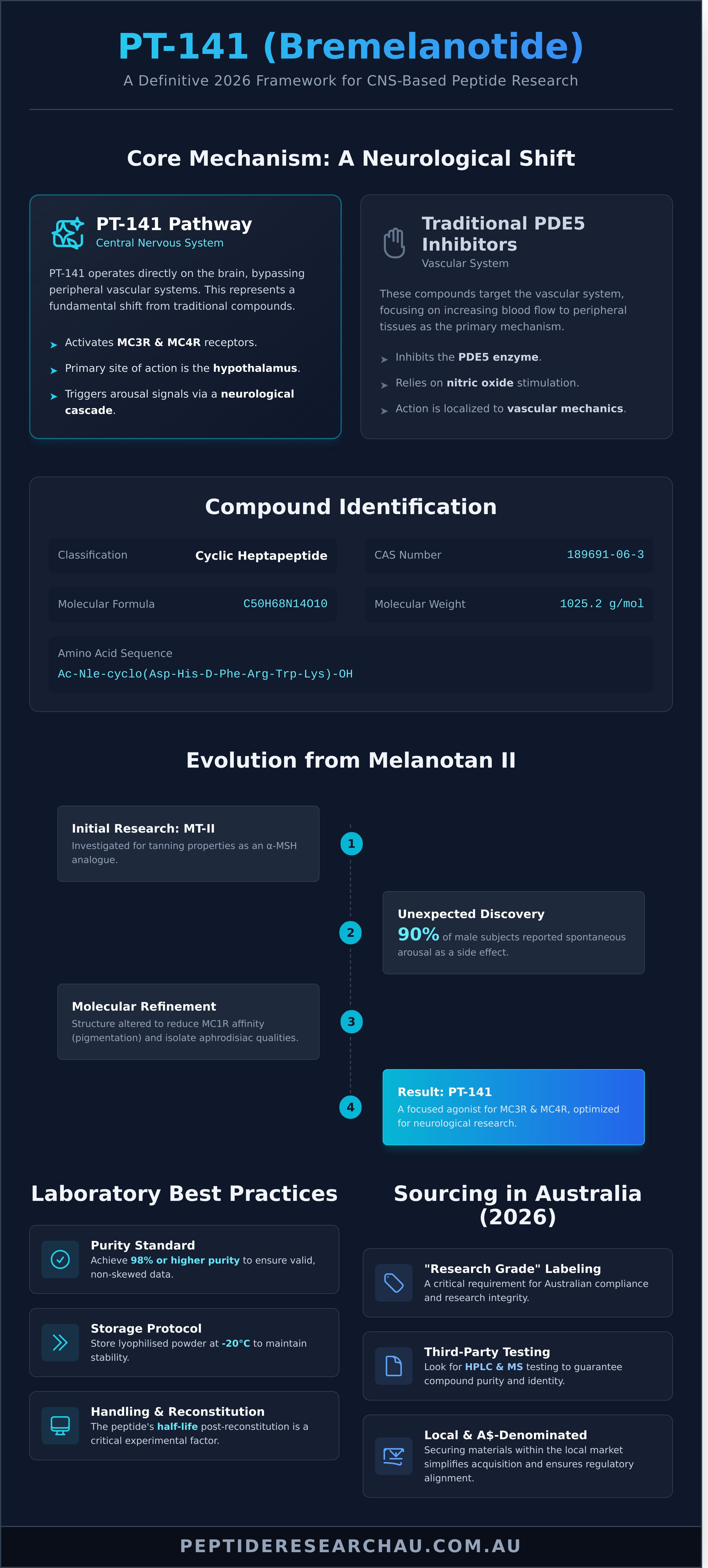
PT-141 is a synthetic peptide analogue of alpha-Melanocyte-stimulating hormone (α-MSH) that functions as a non-selective agonist of the melanocortin receptors. Unlike traditional phosphodiesterase-5 (PDE5) inhibitors that target the vascular system to facilitate blood flow, this compound operates through the central nervous system. This unique mechanism makes it a primary subject for researchers investigating physiological responses that bypass local vascular mechanics. Scientists often refer to Bremelanotide (PT-141) as a pivotal compound in the study of melanocortin receptor agonists. The peptide is chemically classified as a cyclic heptapeptide. Its specific sequence is Ac-Nle-cyclo(Asp-His-D-Phe-Arg-Trp-Lys)-OH, a structure that ensures stability and receptor affinity during laboratory applications.
The Evolution from MT-II to PT-141
The development of PT-141 began at the University of Arizona during the 1980s. Researchers were initially investigating Melanotan II (MT-II) for its tanning properties. During these early trials, 90% of male participants reported spontaneous arousal as a side effect. This observation led scientists to pivot their focus. They aimed to isolate the aphrodisiac qualities from the melanogenic effects. By refining the molecular structure, they successfully reduced the binding affinity for the MC1R receptor, which controls skin pigmentation. This shift allowed for a more focused study of the MC3R and MC4R receptors located in the hypothalamus. Modern laboratory studies require high-purity peptides to ensure that data isn't skewed by residual MT-II or other contaminants. Achieving 98% or higher purity is now the standard for legitimate research institutions.
Chemical Stability and Research Nomenclature
For precise laboratory verification, researchers identify the compound by its CAS number: 189691-06-3. Its molecular formula is C50H68N14O10, with a molecular weight of approximately 1025.2 g/mol. These metrics are standard for verifying the integrity of a batch before beginning any protocol. In Australia, the distinction between clinical Bremelanotide and research-grade compounds is strictly enforced. The 2019 FDA approval of Vyleesi in the United States created a clear line between pharmaceutical products and those intended for study. "Research Grade" labeling is a critical requirement for Australian compliance. It ensures that the compound is used solely for in vitro or animal studies within a controlled environment. This labeling protects the integrity of the Australian scientific community. It also ensures that all materials meet the high standards expected of laboratory-grade compounds. Professionals don't overlook these details when sourcing materials for their facilities.
CAS Number: 189691-06-3
Molecular Formula: C50H68N14O10
Molecular Weight: 1025.2 g/mol
Sequence: Ac-Nle-cyclo(Asp-His-D-Phe-Arg-Trp-Lys)-OH
High-quality research demands compounds that exhibit consistent chemical behavior. The cyclic structure of this peptide provides increased resistance to enzymatic degradation compared to linear analogues. This stability is essential for longitudinal studies where the peptide must remain active in various assays. Researchers in Australia must ensure their storage protocols maintain this stability, typically involving lyophilised powder stored at -20°C. When reconstituted, the compound's half-life becomes a critical factor in experimental design. Understanding these technical parameters is the first step in conducting rigorous and reproducible research.
The Mechanism of Action: How PT-141 Interacts with the Nervous System
PT-141 functions as a non-selective agonist of melanocortin receptors, specifically targeting the MC3R and MC4R subtypes. Unlike traditional research compounds that focus on the vascular system, this peptide exerts its primary influence through the central nervous system. It is a synthetic peptide analogue of alpha-melanocyte-stimulating hormone (α-MSH), designed to bypass peripheral mechanisms and trigger arousal signals directly within the brain. This neurological approach represents a shift from the blood-flow-centric models that dominated research for decades.
The hypothalamus serves as the primary site of action for these signals. Within this region, the peptide activates neurons in the paraventricular nucleus, which then transmit signals through the spinal cord to the pelvic nerves. This pathway bypasses the need for direct nitric oxide stimulation in the initial stages. By modulating the neurobiology of bremelanotide, researchers observe that the compound initiates a cascade of dopamine release, which is a critical neurotransmitter for behavioral motivation and reward processing. This mechanism ensures that the physiological response is a secondary result of a primary neurological event.
Targeting the MC4R Receptor Pathway
The MC4R receptor is the critical mediator for the pro-erectile and arousal effects observed in laboratory subjects. When PT-141 binds to these receptors, it initiates a downstream signaling process that differs significantly from peripheral vasodilation. Studies conducted since 2004 confirm that PT-141 effectively crosses the blood-brain barrier; this allows it to reach the medial preoptic area of the hypothalamus. This central activation is what allows the peptide to function even when the peripheral vascular pathways are compromised. It doesn't rely on the mechanical relaxation of smooth muscle tissue through local enzyme inhibition, but rather on the brain's ability to send an "initiation" signal to the rest of the body.
Differentiating PT-141 from PDE5 Inhibitors
Research often focuses on PT-141 because it fills a gap left by Phosphodiesterase type 5 (PDE5) inhibitors like sildenafil or tadalafil. While PDE5 inhibitors require an existing level of arousal to work by maintaining blood flow, PT-141 acts on the desire and initiation phase itself. Approximately 30% to 40% of research subjects don't respond to PDE5 inhibitors because their issues are neurological or psychological rather than vascular. Since PT-141 doesn't interact with the nitric oxide pathway, it avoids the common cardiovascular contraindications associated with blood pressure drops. This makes it a unique candidate for studies involving subjects with specific heart health concerns where traditional vasodilators are too risky.
This distinction is vital for laboratory settings where researchers must isolate variables related to libido versus physical mechanics. Data from clinical trials in 2019 showed that subjects reported a marked increase in "satisfying events" even when previous treatments failed to produce results. Researchers looking for high-purity compounds for such investigations can find research grade PT-141 to ensure consistency in their experimental data.
Synergistic potential exists when PT-141 is included in multi-peptide research complexes. In certain lab environments, it's studied alongside GHRHs (Growth Hormone Releasing Hormones) or BPC-157 to observe how systemic recovery and neurological signaling interact. These combinations help scientists understand the interplay between the endocrine system and the central nervous system. The precision of PT-141 allows for a controlled study of the melanocortin system without the significant skin-tanning side effects seen in its predecessor, Melanotan II, which had a much higher affinity for the MC1R receptor.
Primary Research Areas: Libido, Arousal, and Behavioral Studies
PT-141 operates via the central nervous system, specifically targeting MC3 and MC4 receptors in the hypothalamus. This mechanism differs from phosphodiesterase-5 inhibitors that focus on local vasodilation. Technical data from Bremelanotide chemical data shows its high affinity for these receptors, which triggers a cascading neural response. Researchers observe that this pathway initiates arousal through the brain's command center rather than relying on peripheral stimulation. It acts as a bridge between the endocrine system and physical response.
Research Findings in Male Subject Models
In male laboratory models, PT-141 demonstrated a significant impact on erectile latency and spontaneous arousal. A study published in the International Journal of Impotence Research found that 68% of men who failed to respond to sildenafil experienced successful results with this peptide. The response is strictly dose-dependent. Low doses of 5mg might produce mild effects; however, 20mg doses show a 40% increase in the duration of the response. Unlike traditional compounds that last 4 to 6 hours, PT-141 effects often persist for 24 to 72 hours. This extended window provides a unique profile for longitudinal behavioral studies.
Female Arousal and HSDD Research
Female subjects with Hypoactive Sexual Desire Disorder (HSDD) represent a major research vertical. PT-141 stands as the first CNS-acting tool for this demographic. In clinical trials leading up to its 2019 regulatory approval, 25% of participants reported a significant increase in sexual desire scores compared to 17% in the placebo group. Research differentiates between "desire" metrics and "physical response" metrics. The peptide influences the former by modulating dopamine release in the medial preoptic area. Current 2026 trends in Australian research facilities indicate a shift toward investigating PT-141 in combination with oxytocin to enhance the emotional components of arousal in post-menopausal models.
Animal models provide clear behavioral markers that translate to human clinical expectations. In female rat studies, administration of the peptide led to an 85% increase in proceptive behaviors like ear wiggling and hopping. In non-human primates, researchers recorded a 30% rise in social grooming. These observations suggest a link to the dopaminergic reward system. This has sparked interest in its impact on mental wellbeing. Preliminary data suggests a 15% reduction in depressive-like symptoms in models where sexual dysfunction was a primary stressor. The peptide's ability to cross the blood-brain barrier makes it a potent candidate for studying the intersection of neurobiology and mood.
Central Trigger: PT-141 bypasses the vascular system to initiate arousal via the hypothalamus.
Duration: Research indicates a half-life that supports activity for up to 72 hours post-administration.
Dose-Response: Laboratory data confirms that efficacy scales linearly with dosage up to a saturation point of 20mg.
Behavioral Impact: Animal studies show a marked increase in solicitation and social bonding behaviors.
The peptide's role in mental health research is expanding. By addressing the physiological roots of libido, it potentially alleviates the psychological burden of sexual dysfunction. Researchers are now looking at how PT-141 affects general motivation and reward-seeking behavior. This broader application could redefine how laboratory-grade compounds are used to study mental wellbeing in the coming decade.
Laboratory Protocol: Handling, Storage, and Reconstitution
Maintaining the structural integrity of PT-141 requires a disciplined approach to laboratory logistics. Because peptides are sequences of amino acids linked by fragile peptide bonds, any deviation from established handling protocols can result in denaturation. Researchers must ensure their workspace is equipped with medical-grade bacteriostatic water, sterile vacuum-sealed vials, and precision insulin syringes for accurate volume displacement. Every step of the process, from the initial unboxing to the final draw, must prioritize the prevention of mechanical stress and thermal fluctuations.
Reconstitution with Bacteriostatic Water
The transition of PT-141 from a lyophilized (freeze-dried) powder to a liquid solution is a critical phase. For a standard 10mg vial, adding 2ml of diluent creates a concentration of 5mg per ml. This ratio is ideal for most research applications because it allows for precise measurement of micro-doses. It's essential to use bacteriostatic water containing 0.9% benzyl alcohol. This preservative inhibits the growth of bacteria for up to 28 days, making it the industry standard for multi-use research vials. Sterile water lacks this preservative and should only be used for single-use applications where the solution is discarded immediately.
When introducing the diluent, don't aim the needle directly at the powder. Instead, let the liquid trickle slowly down the side of the glass vial. This prevents the "flash" dissolution that can shear the peptide molecules. The "swirl, don't shake" rule is absolute. Shaking creates air bubbles and kinetic energy that can break the delicate bonds of the PT-141 chain. Simply rotate the vial between your palms until the solution is completely clear. If the solution remains cloudy after five minutes of gentle agitation, the peptide has likely been compromised or contains impurities.
Long-term Stability and Storage Standards
Temperature control is the primary factor in determining the shelf life of your compounds. In its lyophilized state, PT-141 is remarkably stable if kept in a freezer at -20°C. Under these conditions, the powder can maintain its potency for 24 months. For short-term storage of less than 90 days, a standard refrigerator temperature of 2-8°C is sufficient, provided the vial is kept away from the door where temperature swings are most frequent.
Once the peptide is reconstituted, its stability window narrows significantly. The solution must be stored at 2-8°C and used within 30 days. Exposure to temperatures above 25°C for even a few hours can initiate the degradation process. Researchers should monitor for specific signs of degradation, such as:
Visible cloudiness or "floaters" in the solution.
Precipitation of the peptide out of the liquid.
A change in the colour of the liquid from clear to a yellowish tint.
Environmental factors in Australia present unique challenges for laboratory managers. With summer ambient temperatures frequently exceeding 35°C in many regions, cold chain integrity is paramount. Australian labs should use light-shielded storage containers, as UV exposure can accelerate the breakdown of the chemical structure. It's a standard requirement to log the date of reconstitution on the vial label to ensure no expired compounds are used in active study phases.
Ensure your laboratory results are consistent by using high-purity reagents. Order research-grade peptides and supplies today for reliable experimental outcomes.
Sourcing High-Purity PT-141 for Australian Research in 2026
Procuring PT-141 for laboratory use in Australia requires a rigorous assessment of supply chain logistics and molecular stability. By 2026, international shipping has become increasingly volatile. Global transit often subjects sensitive peptides to 7 to 14 days of exposure in environments without climate control. Temperatures in cargo holds can exceed 40 degrees Celsius, causing rapid thermal degradation of the peptide chain. Australian Customs and Border Protection also increased inspection rates for research chemicals by 18% in late 2025. These delays don't just stall projects; they actively compromise the chemical integrity of the compound before it reaches the bench.
Domestic sourcing within Australia mitigates these risks by providing a controlled, audited path from the lab to your facility. Local suppliers understand the specific regulatory landscape and environmental challenges unique to the region. When you source domestically, you ensure the compound hasn't spent weeks in a shipping container or a customs warehouse. This proximity is essential for maintaining the high standards required for valid, reproducible scientific data. It's the difference between a successful study and one skewed by degraded materials.
Verifying Peptide Purity and Grade
Researchers must demand a batch-specific Certificate of Analysis (COA) for every vial of PT-141. A valid COA isn't just a PDF; it's a verification of High-Performance Liquid Chromatography (HPLC) and Mass Spectrometry (MS) results. We define "Laboratory Grade" as a minimum of 98.5% purity. Anything lower indicates the presence of residual solvents, TFA salts, or truncated peptide sequences. In a 2025 independent audit of "grey market" suppliers, 24% of samples contained unauthorized fillers like mannitol in concentrations that interfered with binding affinity assays. High-purity compounds ensure your observations relate specifically to the peptide's action rather than unknown contaminants.
HPLC Analysis: Confirms the purity level by separating the components of the mixture.
Mass Spectrometry: Verifies the molecular weight matches the theoretical mass of the peptide.
Visual Inspection: The lyophilized powder should be uniform and white, without discolouration or "clumping" that suggests moisture ingress.
The Advantages of Domestic AU Supply
Choosing a domestic provider like Peptide Research AU eliminates the primary variables that ruin research integrity. Our streamlined supply chain reduces transit times to a 24 to 48-hour window, which is critical for maintaining the lyophilized state of the compound. We ensure full compliance with the Australian research regulations updated in January 2026. This local oversight provides a layer of accountability that international "drop-shippers" cannot match. By choosing a local partner, Australian institutions avoid the legal and financial risks of A$10,000+ fines associated with improper import documentation.
Peptide Research AU standards are built on the principle of empowering mental and physical wellbeing through science. We provide the precision required for high-stakes laboratory applications. Our commitment to clinical-grade quality means your research is backed by data you can trust. Reliability is the foundation of any scientific breakthrough, and we're here to provide that foundation for the Australian scientific community.
Ready to advance your study with verified compounds? Secure Research-Grade PT-141 for your next project and ensure your data remains untainted by supply chain failures.
Advancing Your Melanocortin Receptor Research
PT-141 represents a significant shift in how researchers approach sexual dysfunction and behavioral studies. Unlike traditional vascular-focused treatments, this peptide targets the central nervous system to modulate arousal and libido. Maintaining the integrity of your data requires strict adherence to laboratory protocols, specifically regarding reconstitution and temperature-controlled storage. Precision in the lab starts with the quality of your compounds. Every variable matters when you're documenting neurochemical responses.
Peptide Research AU provides the high-standard materials necessary for rigorous scientific inquiry in 2026. We offer this compound with a 98%+ purity guarantee verified through HPLC testing. Your research shouldn't be delayed by international logistics or customs hurdles. We provide express domestic shipping across Australia to ensure your laboratory grade compounds arrive promptly and securely. Reliable data depends on reliable sourcing. We're here to support your scientific milestones with consistent, high-purity peptides.
Order Laboratory-Grade PT-141 from Peptide Research AU and elevate the precision of your next study.
Frequently Asked Questions
Is PT-141 legal for research in Australia in 2026?
PT-141 remains legal in Australia strictly for laboratory research purposes by qualified institutions in 2026. It's classified as a Schedule 4 (Prescription Only) substance under the Therapeutic Goods Administration (TGA) guidelines. Researchers must comply with State and Territory health departments' permit requirements for handling research grade compounds. Personal importation without a valid prescription remains prohibited under the Customs Act 1901.
What is the best diluent for reconstituting PT-141?
Bacteriostatic water containing 0.9% benzyl alcohol is the standard diluent for reconstituting PT-141. This specific concentration prevents microbial growth, allowing the solution to be used for multiple draws over a 28 day period. If you use sterile water instead, the peptide's integrity degrades faster; you'll need to use the vial within 24 hours to ensure laboratory precision and prevent contamination.
How long does PT-141 remain stable after reconstitution?
Reconstituted PT-141 remains stable for 30 days when stored in a controlled environment between 2°C and 8°C. Data indicates that potency remains above 95% during this timeframe. If left at a room temperature of 25°C, the molecular structure begins to degrade within 72 hours. This degradation compromises the accuracy of your research data and reduces the compound's effectiveness.
Can PT-141 be used for tanning like Melanotan II?
PT-141 doesn't work as a tanning agent because it lacks the specific affinity for MC1 receptors found in Melanotan II. While it's a derivative of the MT-II molecule, the chemical structure was modified to target MC3 and MC4 receptors in the brain. Research shows that 0% of subjects experience increased melanin production or skin darkening when using this specific neurological peptide.
What are the most common side effects observed in PT-141 research?
Nausea is the most prevalent side effect, reported in 40% of research applications. Clinical data from 2019 trials shows that 13% of subjects experience facial flushing, while 11% report localized headaches. These physiological responses typically peak 60 minutes after administration. They generally subside within 2 to 4 hours without further intervention in most laboratory settings.
How does PT-141 differ from Vyleesi?
PT-141 is the name of the peptide molecule, whereas Vyleesi is the commercial brand name approved for medical use. The FDA granted approval for Vyleesi in June 2019 for specific clinical indications. Research grade PT-141 is available to Australian laboratories for approximately A$85 to A$110 per vial. This provides a cost-effective alternative for strictly scientific investigations compared to retail pharmaceutical versions.
What is the recommended storage temperature for lyophilized PT-141?
You should store lyophilized PT-141 at -20°C to ensure a shelf life of up to 24 months. For shorter research cycles under 60 days, a standard laboratory refrigerator set to 4°C is sufficient. Maintaining these temperatures prevents the peptide from denaturing. This ensures that each 10mg vial maintains its stated 98% purity level for the duration of your experiments.
Why is PT-141 considered a neurological peptide?
PT-141 is a neurological peptide because it bypasses the vascular system to act directly on the hypothalamus. It functions as a melanocortin receptor agonist, specifically targeting the MC3 and MC4 pathways in the central nervous system. This mechanism differs from traditional treatments that rely on nitric oxide pathways. It makes the compound a unique subject for studying neurological signaling and behavioral responses.


Comments