
Peptides for Joint Repair Studies: A 2026 Scientific Review of Research Compounds
- peptideresearchau
- Jun 19
- 10 min read
Updated: Jun 30
While nutritional collagen provides the structural bricks for connective tissue, signalling peptides like BPC-157 and TB-500 act as the precise architectural blueprint for complex cellular repair. Distinguishing between general wellness supplements and laboratory-grade research compounds is a primary challenge for scientists navigating the current regulatory environment. You've likely encountered conflicting data regarding the molecular efficacy and legal status of these molecules, especially following the TGA’s June 2026 compliance priorities. This review provides an authoritative analysis of the molecular pathways and laboratory data currently defining peptides for joint repair studies.
We'll evaluate the specific signalling mechanisms of BPC-157 and TB-500 through the lens of recent clinical interest. This analysis clarifies the distinction between dietary proteins and synthetic signalling sequences while addressing the strict Schedule 4 requirements for Australian research. You'll gain a technical understanding of current laboratory data, the importance of chemical nomenclature in sourcing, and the rigorous standards required for high-purity methodology in 2026.
Table of Contents
The Science of Joint Degradation and the Role of Signalling Peptides
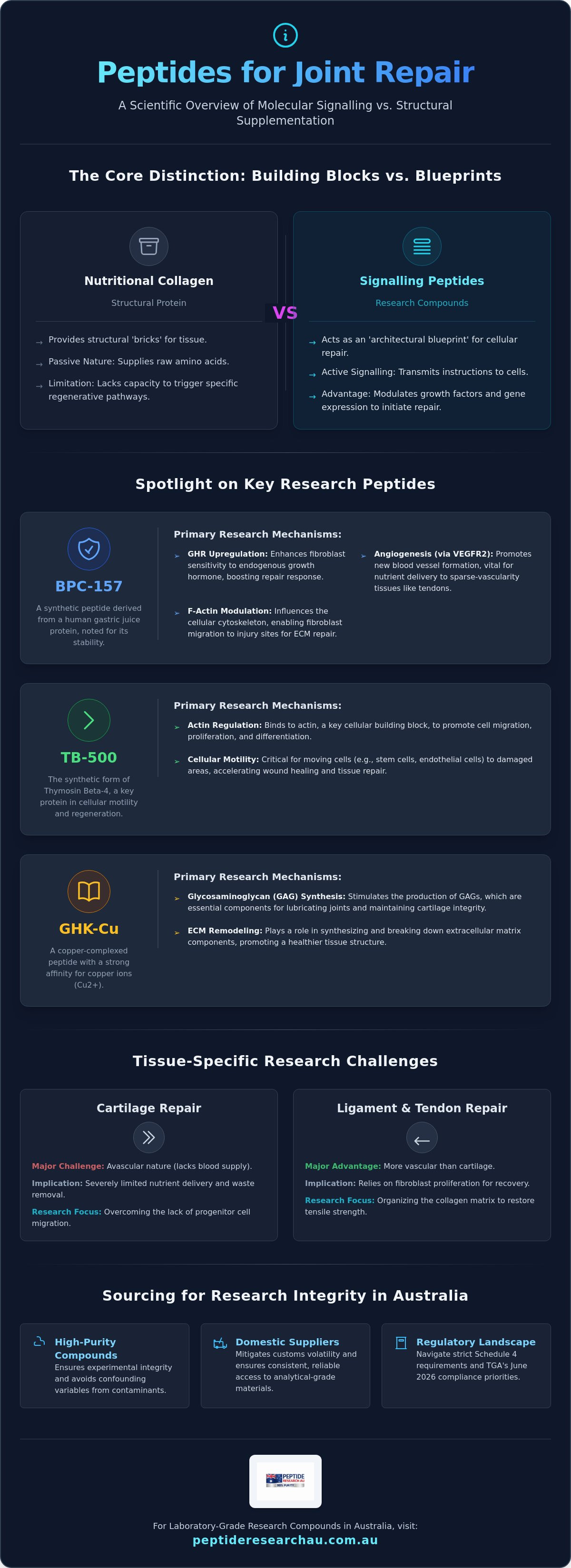
Joint degradation involves the progressive breakdown of the extracellular matrix (ECM) and the loss of chondrocyte viability. Conventional research often focuses on structural replenishment, yet current peptides for joint repair studies indicate a shift toward biochemical intervention. Unlike structural proteins such as collagen, which serve as inert building blocks, signalling peptides are short chains of amino acids that actively modulate cellular activity and gene expression. These molecules don't just provide material; they transmit instructions to the cells responsible for tissue maintenance.
The limitation of oral collagen lies in its passive nature. It provides the necessary amino acids for protein synthesis, but it lacks the capacity to trigger specific regenerative pathways. Signalling peptides interact directly with Growth Factors and the ECM to initiate repair. This represents a transition from passive supplementation to active biochemical signalling, where the goal is to alter the metabolic environment of the joint. By binding to specific cell-surface receptors, these compounds can influence the synthesis of type II collagen and aggrecan, the primary components of healthy cartilage.
Cartilage vs. Ligament: Different Research Challenges
Cartilage repair presents unique obstacles due to its avascular nature. Since it lacks a direct blood supply, nutrient delivery and waste removal are limited, complicating traditional healing models. In contrast, ligamentous tissue is more vascular and relies heavily on fibroblast proliferation for recovery. Researchers target specific peptide sequences to address these differences. Some sequences focus on chondrocyte proliferation in cartilage, while others prioritize the collagen-linkage processes within tendons and ligaments.
Cartilage research focuses on overcoming the lack of progenitor cell migration.
Ligament studies prioritize the organization of the collagen matrix to restore tensile strength.
Specific peptides for joint repair studies are designed to interact with the unique mechanical demands of each structure.
Molecular Signalling Pathways in Joint Homeostasis
Maintaining joint integrity requires a delicate balance of anabolic and catabolic signals. Transforming Growth Factor-beta (TGF-beta) and Bone Morphogenetic Proteins (BMPs) are critical regulators of this homeostasis. Research suggests that certain signalling peptides may modulate inflammatory cytokines like Interleukin-6 (IL-6), potentially reducing the degradation rate of the ECM. Peptide signalling in the context of chondrocyte health is the targeted activation of intracellular pathways to maintain the structural and functional integrity of the articular matrix.
Investigating BPC-157: Mechanisms in Tendon and Ligament Repair Studies
BPC-157, or Body Protection Compound 157, is a synthetic pentadecapeptide derived from a protein sequestered in human gastric juice. While its origins lie in gastrointestinal research, its application in peptides for joint repair studies has become a focal point for musculoskeletal science. Unlike many growth factors that possess short half-lives, BPC-157 exhibits remarkable stability in various environments. Its primary mechanism involves the up-regulation of the Growth Hormone Receptor (GHR) pathway. This interaction enhances the sensitivity of fibroblasts to endogenous growth hormone, facilitating a more robust repair response in connective tissues without altering systemic growth hormone levels.
A critical pathway identified in laboratory settings is the up-regulation of Vascular Endothelial Growth Factor Receptor 2 (VEGFR2). This process is central to angiogenic repair, particularly in tendons where blood supply is naturally sparse. By triggering VEGFR2, BPC-157 promotes the formation of new blood vessels, a prerequisite for delivering nutrients to damaged zones. Beyond vascular effects, the compound influences the F-actin cytoskeleton. This structural modulation is essential for fibroblast migration, allowing cells to move effectively to the site of injury and initiate the repair of the extracellular matrix.
Angiogenesis and Blood Flow in Joint Recovery
Vascularisation is often the bottleneck in joint recovery. Without adequate blood flow, damaged cartilage and ligaments remain in a state of chronic degradation. Studies show that BPC-157 modulates Nitric Oxide (NO) levels, which regulates vascular tone and blood pressure at the micro-level. In animal models, researchers have observed that BPC-157 accelerates the healing of transected Achilles tendons more efficiently than traditional healing accelerators. This suggests a superior capacity for stimulating blood vessel growth in traditionally "dead" tissue zones.
Fibroblast Migration and Collagen Organisation
The quality of repair is as critical as the speed. BPC-157 influences the alignment of collagen fibres, ensuring they organize in a linear fashion rather than as disorganized scar tissue. This structural organization is vital for restoring the tensile strength required for joint function. For a deeper technical analysis of these processes, researchers can consult this BPC-157 guide for scientific research. When conducting peptides for joint repair studies, maintaining high experimental standards is paramount. Accessing high-purity research compounds ensures that molecular observations accurately reflect the peptide's biological potential.
TB-500 (Thymosin Beta-4) and Actin Regulation in Joint Research
TB-500 is a synthetic peptide fragment representing the active domain of the naturally occurring protein Thymosin Beta-4. While the parent protein contains 43 amino acids, TB-500 is a shorter, 17-amino acid sequence designed for specific bioavailability in laboratory settings. Its inclusion in peptides for joint repair studies centers on its unique capacity to regulate G-actin. This globular protein is a fundamental building block of the cellular cytoskeleton. By sequestering G-actin, TB-500 prevents its premature polymerization into F-actin, maintaining a reservoir of monomers that cells utilize for rapid structural reconfiguration.
This regulation is the primary driver of cellular motility. In the context of joint research, this mechanism facilitates the recruitment of progenitor cells to the site of tissue damage. Beyond migration, TB-500 demonstrates significant anti-inflammatory activity within the synovial fluid. By modulating the local biochemical environment, it potentially reduces the concentration of catabolic enzymes that contribute to chronic joint degradation. This dual action of promoting cell movement while dampening inflammation makes it a primary compound for investigating complex tissue regeneration.
Cellular Migration: The Key to Cartilage Repair
Cartilage lacks a robust intrinsic repair mechanism because it's avascular and has low cellular density. TB-500 addresses this limitation by enabling chondrocytes to migrate into damaged cartilage defects. This migration is mediated by the 'LKKTET' amino acid sequence, which is the specific site responsible for actin binding and subsequent cellular movement. While TB-500 prioritizes the physical mobilization of repair cells through actin regulation, BPC-157 focuses on the vascular and growth factor receptor pathways discussed in previous sections.
Synergistic Effects in Multi-Peptide Research
Modern laboratory models increasingly investigate the efficacy of multi-peptide complexes rather than isolated compounds. Researchers often combine BPC-157 and TB-500 because their mechanisms are complementary. BPC-157 initiates the angiogenic response, creating the necessary vascular infrastructure to support new tissue. Simultaneously, TB-500 drives the migration of fibroblasts and chondrocytes into these newly vascularized zones. Observed outcomes in musculoskeletal research suggest that this dual approach addresses both the nutritional delivery and the cellular recruitment required for peptides for joint repair studies to yield significant data.
Emerging Peptides in Joint Integrity: GHK-Cu and Beyond
While BPC-157 and TB-500 dominate current literature, GHK-Cu (Glycyl-L-histidyl-L-lysine copper) is gaining traction in peptides for joint repair studies. This tripeptide functions as a critical copper transport molecule. Copper is an essential cofactor for several enzymes involved in tissue remodelling. Research indicates GHK-Cu stimulates the synthesis of glycosaminoglycans. These molecules are vital for maintaining the structural integrity and hydration of joint cartilage. By fostering a more resilient extracellular matrix, GHK-Cu provides a different angle of study compared to angiogenic or migratory peptides.
Chondrocyte health depends on a stable redox environment. GHK-Cu exhibits potent antioxidant properties. It shields these cells from oxidative stress. This protection is vital in chronic degradation models. Reactive oxygen species often accelerate matrix breakdown. Additionally, studies observe that GHK-Cu modulates systemic inflammatory markers. Reducing the overall inflammatory load may slow the progression of joint wear. It's a key area of interest for 2026 research protocols focusing on long-term joint maintenance.
Copper Peptides and Extracellular Matrix Stability
GHK-Cu influences the production of decorin and biglycan. These proteoglycans are essential for the proper assembly and stability of connective tissues. Without them, collagen fibres fail to organize correctly. Copper ions are also necessary for the activity of lysyl oxidase. This enzyme facilitates the cross-linking of collagen and elastin. This ensures the joint can withstand mechanical stress. For a deeper analysis of these molecular interactions, refer to the GHK-Cu research guide.
Future Directions: Triple Agonists and Metabolic Health
Research is expanding to include metabolic signalling molecules like retatrutide. This triple agonist targets GLP-1, GIP, and glucagon receptors. While primarily studied for metabolic outcomes, its impact on joint health is significant. Metabolic dysfunction often accelerates joint degradation. It does this through increased systemic inflammation and mechanical loading. Improving metabolic health through these signalling molecules may indirectly preserve joint integrity. This could potentially reduce the frequency of surgical interventions in research populations. Researchers looking to investigate these pathways can find high-purity research compounds for their laboratory studies.
Sourcing Laboratory-Grade Peptides for Research in Australia
The validity of peptides for joint repair studies depends entirely on the chemical purity and molecular integrity of the compounds used. Analytical verification through third-party High-Performance Liquid Chromatography (HPLC) and Mass Spectrometry (MS) is non-negotiable for modern research. These tests confirm the peptide sequence and ensure the absence of residual reagents or heavy metals that could confound experimental data. In the 2026 research environment, where the TGA has scaled up regulatory attention on unapproved substances, maintaining a transparent chain of custody is essential for laboratory compliance.
Researchers in Australia increasingly prefer domestic suppliers to mitigate customs volatility. The Australian Border Force and TGA have prioritized the interception of illegally imported research chemicals, leading to significant logistical delays and financial loss for institutions. Sourcing from a domestic provider ensures that peptides for joint repair studies arrive without the risk of destruction at the border. Beyond sourcing, the technical handling of these molecules requires precision. Reconstitution must be performed using high-quality laboratory diluents to maintain the stability of the peptide bonds and ensure consistent concentration across all study samples.
Maintaining Research Integrity: Storage and Protocols
Lyophilised peptides are highly sensitive to environmental factors. Exposure to light and temperature fluctuations can lead to rapid degradation of the amino acid chain. For short-term use, maintaining compounds at 4°C is generally sufficient; however, long-term storage requires temperatures of -20°C or -80°C to preserve signalling bioactivity. When researchers initiate reconstitution, they must avoid vigorous agitation. Mechanical stress can shear the delicate peptide structures, rendering the compound inactive for cellular signalling studies.
Store lyophilised vials in a dark, desiccated environment to prevent moisture absorption.
Aliquot reconstituted solutions to minimize freeze-thaw cycles.
Use sterile, analytical-grade diluents to prevent microbial contamination of the sample.
Navigating Australian Research Regulations
In 2026, the distinction between clinical applications and "research purposes only" is strictly enforced. Compounds like BPC-157 and TB-500 are classified as Schedule 4 substances in Australia, meaning their possession for human use without a prescription is prohibited. Research institutions must ensure their procurement protocols align with these legal frameworks. Sourcing from a provider like Peptide Research AU ensures consistency in manufacturing standards and documentation. To advance your methodology with reliable data, you can explore high-purity research peptides for your next study through our verified laboratory catalogue.
Advancing Musculoskeletal Research through Molecular Precision
Ensuring experimental validity in the 2026 Australian regulatory landscape necessitates sourcing from providers that prioritize transparency and quality control. We provide laboratory-grade research compounds backed by third-party purity verification and reliable domestic Australian shipping. It's the standard of these materials that determines the reliability of your findings. Explore high-purity research peptides for your next study and contribute to the next generation of musculoskeletal breakthroughs.
Frequently Asked Questions
What is the most effective peptide for joint repair studies?
Research efficiency depends on the specific tissue under investigation. BPC-157 is frequently utilized in peptides for joint repair studies involving tendons and ligaments due to its angiogenic properties. TB-500 is often preferred for studies focusing on chondrocyte migration and acute cellular recruitment. The most effective compound is determined by the experimental model's requirement for either vascular support or physical cellular motility.
How do BPC-157 and TB-500 differ in their mechanism of action?
BPC-157 primarily functions by up-regulating the Growth Hormone Receptor (GHR) pathway and VEGFR2 to promote angiogenesis and blood flow. TB-500 operates through G-actin sequestering, which facilitates the physical movement and recruitment of progenitor cells to injury sites. While BPC-157 builds the vascular infrastructure, TB-500 manages the cellular migration necessary for tissue remodeling. These distinct pathways are why they're often studied in combination.
Can GHK-Cu be used in joint repair research?
GHK-Cu is an emerging focus in joint research because it facilitates copper transport, an essential cofactor for collagen cross-linking via the enzyme lysyl oxidase. It also stimulates the synthesis of glycosaminoglycans, which are critical for cartilage hydration and structural resilience. Its antioxidant properties protect chondrocytes from oxidative stress in chronic degradation models. This makes it a valuable compound for investigating long-term joint integrity.
What are the legal requirements for buying research peptides in Australia?
In Australia, peptides like BPC-157 and TB-500 are classified as Schedule 4 prescription-only medicines as of June 2026. Sourcing these compounds for laboratory research requires they be designated for research purposes only and not for human consumption. Researchers must ensure compliance with TGA and Australian Border Force regulations, as illegal importation or possession without a valid prescription for therapeutic use carries significant penalties.
How should research peptides be stored to maintain their purity?
Lyophilized peptides should be stored in a dark, desiccated environment at temperatures between -20°C and -80°C to ensure long-term stability. Once reconstituted, the solution must be kept in a laboratory refrigerator at approximately 4°C. Exposure to UV light and repeated freeze-thaw cycles must be avoided. These conditions prevent the degradation of the amino acid sequence and maintain the purity required for peptides for joint repair studies.
Why is bacteriostatic water necessary for peptide reconstitution?
Bacteriostatic water is used for reconstitution because it contains 0.9% benzyl alcohol, which acts as a preservative to inhibit bacterial growth. This is critical for multi-dose vials used over several days in a laboratory setting. Without this preservative, a reconstituted peptide solution is highly susceptible to microbial contamination. Such contamination can degrade the compound and compromise the integrity of the research data.
Are there any published human clinical trials for these peptides in joint repair?
Published human clinical trials for these specific peptides in joint repair are currently limited. Most existing data is derived from animal models or in vitro studies focusing on molecular pathways. The lack of large-scale, peer-reviewed human trials is a primary reason the TGA maintains a restrictive stance on these compounds. Researchers should rely on laboratory data and preclinical models when evaluating the current state of joint repair research.
How do I verify the quality of research peptides purchased online?
Verifying quality requires reviewing third-party High-Performance Liquid Chromatography (HPLC) and Mass Spectrometry (MS) reports for every batch. These documents confirm the peptide's identity and purity levels, typically aiming for 98% or higher. Researchers should prioritize domestic suppliers that provide transparent testing data and clear batch numbers. Avoiding overseas sellers reduces the risk of receiving mislabeled or contaminated compounds that could invalidate experimental results.


Comments