
Ipamorelin Australia: A Comprehensive Research Guide for 2026
- peptideresearchau
- 8 hours ago
- 11 min read
Unlike earlier growth hormone secretagogues, Ipamorelin maintains a precise pharmacological profile that avoids the cortisol and prolactin spikes common in its predecessors. For researchers investigating Ipamorelin Australia, the primary challenge isn't just understanding the peptide's selective mechanism, but navigating a complex and often restrictive regulatory environment. You likely recognize that obtaining high-purity, batch-tested compounds is becoming more difficult as TGA scrutiny of the peptide market continues to intensify. It's difficult to manage the ambiguity of Schedule 4 classifications while trying to maintain the rigorous standards required for legitimate laboratory study.
This comprehensive guide provides a technical analysis of Ipamorelin's pharmacology and its synergistic potential when paired with GHRH analogues like CJC-1295. We'll clarify the current 2026 regulatory landscape for Australian laboratories and detail the essential protocols for reconstitution, storage, and handling. This report aims to bridge the gap between theoretical knowledge and practical laboratory application. By the end of this analysis, you'll have the data required to establish a precise experimental framework and identify reliable, laboratory-grade sources for your research requirements.
Table of Contents
What is Ipamorelin? An Introduction to the Pentapeptide
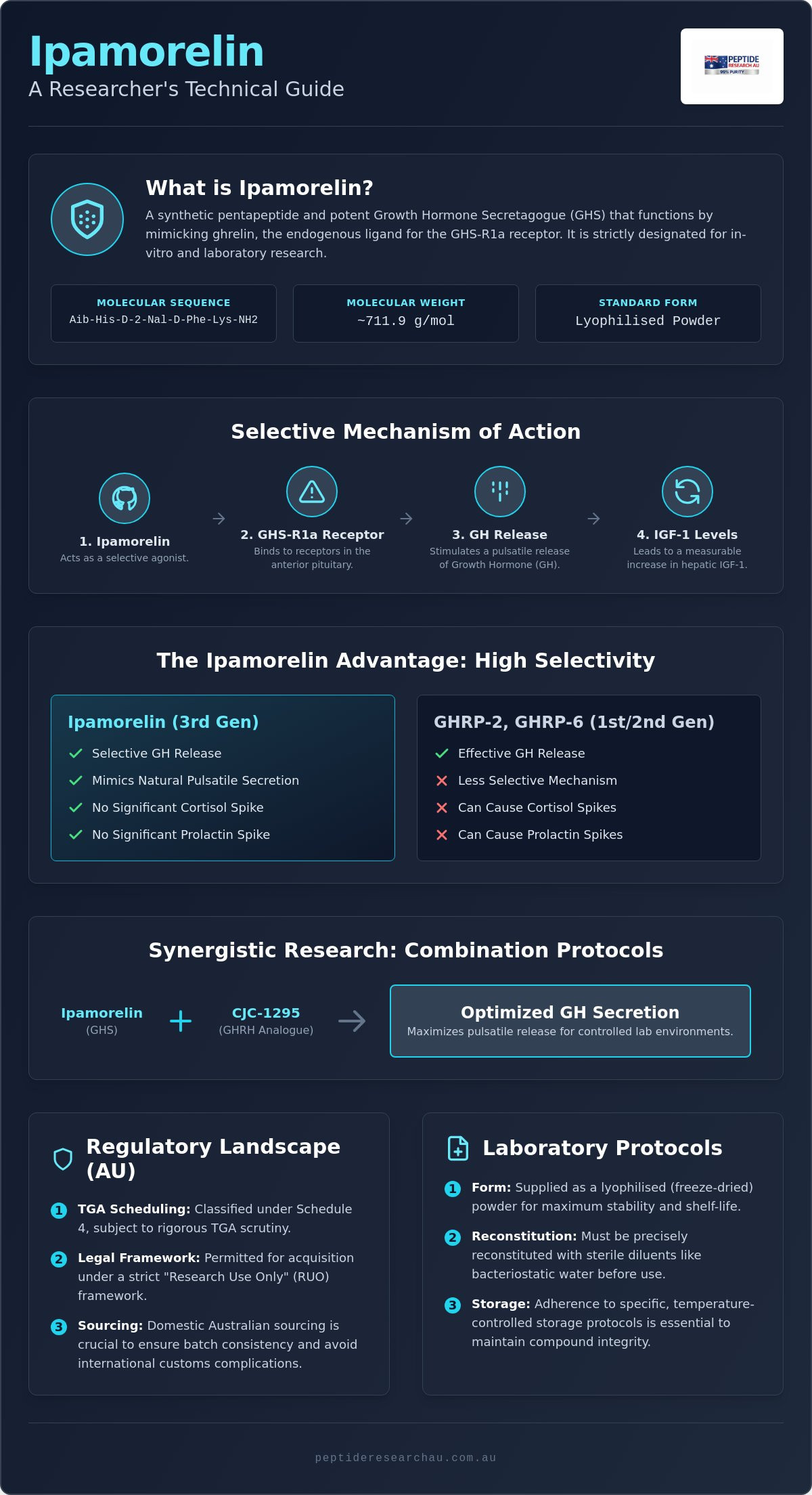
Ipamorelin is a synthetic pentapeptide with the molecular sequence Aib-His-D-2-Nal-D-Phe-Lys-NH2. As a potent growth hormone secretagogue, it functions by mimicking the action of ghrelin, the endogenous ligand for the growth hormone secretagogue receptor (GHS-R1a). Within the Australian scientific community, studies involving Ipamorelin Australia focus on its ability to stimulate the pituitary gland to release growth hormone without significantly impacting other endocrine axes. It's essential to recognize that this compound is strictly designated for in-vitro and laboratory research use. It isn't intended for human consumption or therapeutic applications outside of authorized clinical trials.
The Evolution of Growth Hormone Secretagogues
The development of growth hormone secretagogues (GHS) represents a progression toward greater ligand specificity. First-generation compounds, such as GHRP-6 and GHRP-2, demonstrated high efficacy in stimulating growth hormone release but suffered from a lack of selectivity. These earlier peptides often resulted in the unintended secretion of cortisol and prolactin, which can complicate research data and physiological outcomes. Ipamorelin emerged as a third-generation alternative designed specifically to decouple growth hormone release from these secondary hormonal responses. By selectively targeting the ghrelin receptor, it provides a "clean" research profile. This selectivity is paramount. It's now the preferred choice for investigators who require precise control over growth hormone levels without the confounding variables introduced by stress hormone elevation.
Chemical Properties and Molecular Structure
The structural integrity of Ipamorelin is defined by its five-amino acid sequence. A critical component of this structure is the inclusion of Aib (aminoisobutyric acid), which enhances the peptide's resistance to enzymatic degradation. This modification increases the half-life of the compound compared to natural ghrelin, allowing for more sustained observation during longitudinal research protocols. In laboratory settings, the peptide is typically provided as a lyophilised (freeze-dried) powder. This state ensures maximum stability and shelf-life during transit and storage. Researchers must reconstitute the compound using sterile laboratory diluents before application. The molecular weight of approximately 711.9 g/mol allows for high-precision dosing in microgram quantities, which is standard for most GHRP-based research models. Maintaining this high degree of purity is vital for achieving reproducible results in Australian laboratories.
Mechanism of Action: Selectivity and Pulsatile GH Release
Ipamorelin functions as a selective agonist of the growth hormone secretagogue receptor (GHS-R1a) located in the anterior pituitary gland. By binding to this specific receptor, it initiates a signaling cascade that stimulates the somatotrophs to release growth hormone (GH). Unlike earlier compounds that cause a sustained "bleed" of GH, this peptide facilitates a pulsatile release. This mechanism is critical for researchers because it closely mimics natural physiological GH secretion patterns, allowing for more accurate data collection in endocrine studies. For investigators analyzing Ipamorelin Australia, this pulsatile nature provides a distinct advantage in maintaining receptor sensitivity over extended research periods.
The downstream effects of these GH pulses include a measurable increase in hepatic Insulin-like Growth Factor 1 (IGF-1) levels. During prolonged laboratory study, this elevation in IGF-1 serves as a primary marker for the compound's anabolic potential. Because Ipamorelin doesn't interfere with the body's natural GH production rhythm, it allows for the observation of growth-related processes without the typical feedback inhibition seen with exogenous GH administration. When designing these protocols, utilizing high-purity research peptides ensures that the observed physiological responses are attributed solely to the compound's mechanism rather than contaminants.
The Absence of Cortisol and Prolactin Spikes
A defining characteristic of Ipamorelin is its extreme selectivity. While GHRP-6 and GHRP-2 are known to activate the hypothalamic-pituitary-adrenal (HPA) axis, Ipamorelin doesn't trigger the ACTH pathway. This means researchers don't observe the spikes in cortisol or prolactin that typically confound data in GHRP studies. According to primary research on Ipamorelin's selectivity, the peptide maintains baseline levels of these stress hormones even at high saturation doses. This preservation of hormonal homeostasis is vital for research data integrity, particularly in metabolic studies where cortisol elevation would otherwise skew results. Additionally, unlike GHRP-6, Ipamorelin doesn't significantly stimulate the hunger-inducing effects of ghrelin, allowing for more controlled nutritional variables in laboratory models.
Ipamorelin vs. GHRP-2 and GHRP-6
When comparing receptor affinity, Ipamorelin demonstrates a potency similar to GHRP-6 but with a superior safety profile for longitudinal study. The concept of the "saturation dose" is central to its application; research suggests that once the pituitary receptors are fully occupied, additional quantities don't yield proportional increases in GH release. This ceiling effect prevents the extreme overstimulation often associated with non-selective secretagogues. Ipamorelin is consistently preferred for long-term research because it doesn't lead to the rapid desensitization or "tachyphylaxis" seen with GHRP-2. This stability makes it the gold standard for investigating the long-term impacts of GH secretagogues on cellular repair and protein synthesis within Australian research facilities.
Synergistic Research: Combining Ipamorelin with CJC-1295
The "GHRH + GHRP" combination is the established gold standard in contemporary peptide research. While Ipamorelin acts as the primary trigger for growth hormone secretion, CJC-1295 functions as the amplifier. This dual-pathway approach ensures a more robust physiological response than either compound can achieve in isolation. Researchers investigating Ipamorelin Australia frequently utilize this synergy to explore the upper limits of endogenous growth hormone secretion within controlled laboratory models. By combining these two distinct classes of secretagogues, investigators can observe an exponential increase in GH output that mimics natural biological rhythms more effectively than exogenous GH administration.
Distinguishing between CJC-1295 with DAC (Drug Affinity Complex) and CJC-1295 No DAC (often referred to as Tetrasubstituted GRF 1-29) is vital for protocol design. Most synergistic models prefer the "No DAC" variant to preserve the pulsatile nature of GH release. The DAC version creates a continuous, long-acting "bleed" of growth hormone, which may lead to receptor desensitization or "tachyphylaxis" in long-term studies. For researchers specifically focused on complex tissue recovery and regenerative pathways, exploring the BPC-157 guide provides additional context on how multi-peptide complexes can be structured for maximum scientific utility.
The Mechanism of Double Signalling
The efficacy of this combination relies on a specific "double signaling" mechanism at the pituitary level. Growth Hormone Releasing Hormones (GHRHs), such as CJC-1295, work by increasing the total number of pituitary somatotrophs participating in a pulse. Conversely, Ipamorelin, as detailed in foundational research on Ipamorelin, increases the specific volume of growth hormone released by each individual cell. This interaction produces an exponential rather than additive result. It's a biological multiplication that maximizes the pituitary's output during the research window, providing a clearer picture of the somatotropic axis's capacity for upregulation.
Research Protocols for Combined Peptides
Timing is paramount in these laboratory models to ensure maximum pulse amplitude. Administering the compounds simultaneously allows the GHRH to prime the somatotrophs just as the GHRP triggers the release. Maintaining a strict fasting state is mandatory for observing GH secretagogue efficacy. Elevated blood glucose or insulin levels significantly blunt the response by stimulating the release of somatostatin. Somatostatin acts as the primary inhibitory hormone for growth hormone; therefore, maintaining a low-somatostatin environment is essential for observing the maximum potential of the Ipamorelin and CJC-1295 synergy. Most protocols prioritize administration during periods of low glycemic activity to ensure data consistency across multiple test subjects.
Sourcing and Regulatory Compliance in Australia (2026)
In 2026, the Therapeutic Goods Administration (TGA) maintains a rigorous classification system for growth hormone secretagogues. Ipamorelin remains a Schedule 4 substance, meaning it's a prescription-only medicine when intended for human therapeutic use. For laboratories and scientific institutions, the "Research Use Only" (RUO) designation provides the necessary framework for acquisition. This designation strictly prohibits human consumption and mandates that the compounds be used exclusively for in-vitro or animal-based study. Navigating the legalities of Ipamorelin Australia requires a clear understanding that these products are tools for data collection, not consumer goods.
Securing high-purity compounds within this regulatory environment is often a primary hurdle for researchers. Domestic sourcing has become the preferred strategy to mitigate the logistical and legal complexities associated with international procurement. Local suppliers operate under Australian trade laws, providing a layer of accountability that's absent in overseas transactions. For a deeper analysis of these standards, researchers should consult the detailed guide on peptides in Australia. Ensuring your laboratory adheres to these sourcing protocols is essential for maintaining the validity of your research outcomes.
Customs and International Importation Risks
The Australian Border Force (ABF) has significantly increased its scrutiny of incoming peptide shipments over the last few years. Importing Schedule 4 substances without the appropriate permits often results in immediate seizure and potential legal ramifications for the recipient. Beyond the risk of loss, international "grey market" sourcing frequently involves products that are underdosed or cross-contaminated with other secretagogues. Transit times also pose a threat to molecular stability. International shipping rarely maintains the strict cold-chain integrity required for peptides, which can lead to degradation before the compound even reaches the lab. Domestic shipping ensures that the time between the laboratory shelf and your facility is minimized.
Identifying High-Quality Research Suppliers
Meticulous researchers must demand transparency from their suppliers. A legitimate Certificate of Analysis (CoA) is non-negotiable and should include both High-Performance Liquid Chromatography (HPLC) and Mass Spectrometry (MS) results. These tests confirm both the identity of the peptide and its purity levels. For Ipamorelin Australia, a purity threshold of 98% or higher is the industry standard for professional study. Batch testing ensures that the specific vial you receive meets the technical specifications listed on the label. If a supplier cannot provide recent, third-party verified data, the integrity of your entire research project is at risk. You can secure your project's data integrity by sourcing laboratory-grade research peptides from verified domestic providers.
Laboratory Handling: Reconstitution and Storage Protocols
Proper laboratory handling is the final determinant of research accuracy. Even the highest purity Ipamorelin Australia will fail to produce reliable data if the peptide structure is compromised during preparation. Because peptides are fragile chains of amino acids held together by sensitive bonds, they require specific environmental controls. For multi-use research vials, the use of bacteriostatic water is mandatory. This diluent contains 0.9% benzyl alcohol, which inhibits the growth of bacteria that could otherwise contaminate the solution over the course of a multi-day experiment. Using plain sterile water is insufficient for vials that will be accessed more than once, as it lacks the necessary antimicrobial properties.
Researchers must also account for the peptide's sensitivity to physical and environmental stressors. Kinetic energy and light exposure are the primary catalysts for molecular breakdown. Physical agitation, such as shaking a vial, can shear the delicate peptide bonds and render the compound biologically inactive. Similarly, UV light can degrade the molecular sequence over time. Maintaining a controlled, dark, and stable environment is essential for preserving the integrity of the compound from the moment it arrives in the laboratory until the final data point is recorded.
Step-by-Step Reconstitution Protocol
Precision begins with the introduction of the diluent. Before adding liquid, it's necessary to equalize the vial's internal pressure. This is achieved by injecting a volume of air into the vial that matches the volume of diluent you intend to add. This prevents a vacuum from pulling the liquid in too forcefully. When introducing the bacteriostatic water, use the "slow drip" method. Aim the needle at the inner glass wall so the liquid trickles down slowly onto the lyophilized powder. You must never inject the diluent directly onto the peptide cake. Once the liquid is added, gently swirl the vial until the powder is completely dissolved. Never shake the vial. Calculating the final concentration is vital for dosing accuracy; for example, adding 2mL of diluent to a 5mg vial results in a concentration of 2.5mg/mL.
Long-term Storage and Stability
Temperature management is critical for preventing premature degradation of Ipamorelin Australia. In its lyophilized state, the peptide should be stored in a freezer at -20°C for long-term stability. While it can survive short periods at room temperature during transit, sub-zero storage is the only way to ensure a shelf life of up to 24 months. Once reconstituted, the solution is significantly more vulnerable. It must be stored in a laboratory refrigerator at 2–8°C. Under these refrigerated conditions, the peptide typically maintains its potency for approximately four weeks. Researchers should inspect the solution before every use. A clear, colorless liquid indicates a stable compound. If you observe cloudiness, precipitation, or "floaters," the peptide has likely degraded and must be discarded to protect the integrity of your research data.
Advancing Endocrine Research Standards in 2026
Ipamorelin's role in contemporary endocrinology research remains significant due to its unique ability to decouple growth hormone release from adrenal axis stimulation. By mastering the selective mechanism of this pentapeptide and utilizing synergistic protocols with GHRH analogues, researchers can achieve a level of data precision previously unavailable with non-selective secretagogues. Maintaining these standards requires a commitment to rigorous laboratory protocols and an uncompromising approach to compound quality. It's the difference between fragmented observations and reproducible, high-fidelity scientific data.
Navigating the procurement of Ipamorelin Australia doesn't have to be a logistical hurdle. You can protect your study's integrity by selecting a domestic provider that prioritizes technical transparency and batch consistency. We provide independent batch testing for 98%+ purity to ensure your results are accurate and verifiable. Our focus remains on supporting the Australian scientific community with reliable materials and efficient logistics.
Secure your next phase of study with confidence. Source High-Purity Ipamorelin for Your Research and benefit from fast, discreet domestic shipping across Australia and secure laboratory-grade packaging. We're here to provide the precision tools you need for excellence in your laboratory research.
Frequently Asked Questions
Is Ipamorelin legal to buy in Australia for research?
Acquisition of Ipamorelin Australia is legal for laboratory and scientific research purposes under the Research Use Only (RUO) framework. This classification explicitly prohibits human administration and consumption. While the TGA classifies it as a Schedule 4 substance for therapeutic use, researchers can source it for in-vitro or animal-based studies through domestic suppliers that adhere to Australian trade and safety regulations.
What is the difference between Ipamorelin and CJC-1295?
The primary distinction lies in their pharmacological classification and specific mechanism within the somatotropic axis. Ipamorelin is a Growth Hormone Releasing Peptide (GHRP) that mimics ghrelin to trigger a growth hormone pulse. CJC-1295 is a Growth Hormone Releasing Hormone (GHRH) analogue that amplifies the pulse's intensity by increasing the number of secreting somatotrophs. They're often combined in research to achieve a synergistic, exponential effect on GH output.
Does Ipamorelin cause increased hunger like GHRP-6?
No, Ipamorelin doesn't stimulate the intense hunger response typically associated with first-generation peptides like GHRP-6. This is because Ipamorelin is highly selective for the growth hormone secretagogue receptor and doesn't significantly activate the gastric ghrelin pathways. This selectivity makes it an ideal compound for metabolic research where appetite stimulation would be a confounding variable in the collected data.
How should I store Ipamorelin to ensure maximum stability?
Lyophilised vials should be stored in a freezer at -20°C for long-term stability of up to 24 months. Once the compound is reconstituted, it must be kept in a laboratory refrigerator at 2–8°C. Protecting the vials from UV light and avoiding physical agitation is essential for maintaining molecular integrity. Reconstituted solutions should generally be used within four weeks to ensure the peptide's structural sequence remains intact for study.
Can Ipamorelin be used for fat loss research in laboratory models?
Yes, Ipamorelin is frequently used in laboratory models to investigate lipid metabolism and adipocyte regulation. By stimulating pulsatile growth hormone release, it facilitates the study of lipolysis and cellular energy expenditure. Researchers use these models to observe how GH secretagogues influence body composition and metabolic rate without the confounding effects of elevated cortisol or prolactin levels found in non-selective secretagogues.
What diluent should be used to reconstitute Ipamorelin 10mg?
Bacteriostatic water is the required diluent for reconstituting Ipamorelin 10mg vials intended for multi-use research. The 0.9% benzyl alcohol in bacteriostatic water prevents microbial growth, ensuring the solution remains sterile throughout the experimental period. For a 10mg vial, adding 2mL of diluent creates a concentration of 5mg/mL. This allows for precise micro-dosing measurements in a controlled laboratory setting.
Why is Ipamorelin considered safer than earlier GHRPs in research?
Ipamorelin is considered a superior research tool because it doesn't stimulate the hypothalamic-pituitary-adrenal axis. Earlier peptides like GHRP-2 and GHRP-6 often cause unintended elevations in cortisol and prolactin. Because Ipamorelin avoids these secondary hormonal spikes, it provides a more isolated environment for studying growth hormone. This selectivity reduces the risk of data interference from stress-related hormones during sensitive endocrine investigations.
What is the purity standard for research-grade Ipamorelin in Australia?
The industry standard for Ipamorelin Australia in a professional research context is a purity level of 98% or higher. This purity must be verified by independent laboratory testing using High-Performance Liquid Chromatography (HPLC) and Mass Spectrometry (MS). High purity levels are non-negotiable for serious researchers. They ensure that the observed physiological responses are the result of the peptide itself rather than residual manufacturing contaminants or solvents.


Comments