
Peptide Reconstitution Errors to Avoid: A Guide to Laboratory Precision
- peptideresearchau
- Jun 28
- 12 min read
A single vigorous shake of a vial can irreversibly denature a delicate peptide sequence, rendering an expensive research compound biologically inert. You likely recognize that laboratory precision is non-negotiable, yet the nuances of solvent selection and storage variables often lead to procedural uncertainty. It's a significant risk to the integrity of your data when handling errors compromise the stability of a sample. This guide identifies the critical peptide reconstitution errors to avoid to ensure your compounds maintain their structural specifications and intended potency.
By implementing standardized preparation protocols, you can secure a stable, sterile, and accurately dosed solution. We'll detail the technical distinctions between bacteriostatic and sterile water, the mechanical risks of rapid diluent injection, and updated storage requirements for 2026. This analysis provides the technical foundation needed to eliminate common mistakes and preserve the longevity of your reconstituted compounds throughout their entire research lifecycle. You'll move forward with the confidence that your methodology reflects the highest standards of laboratory excellence.
Table of Contents
Why Peptide Reconstitution is the Most Vulnerable Phase
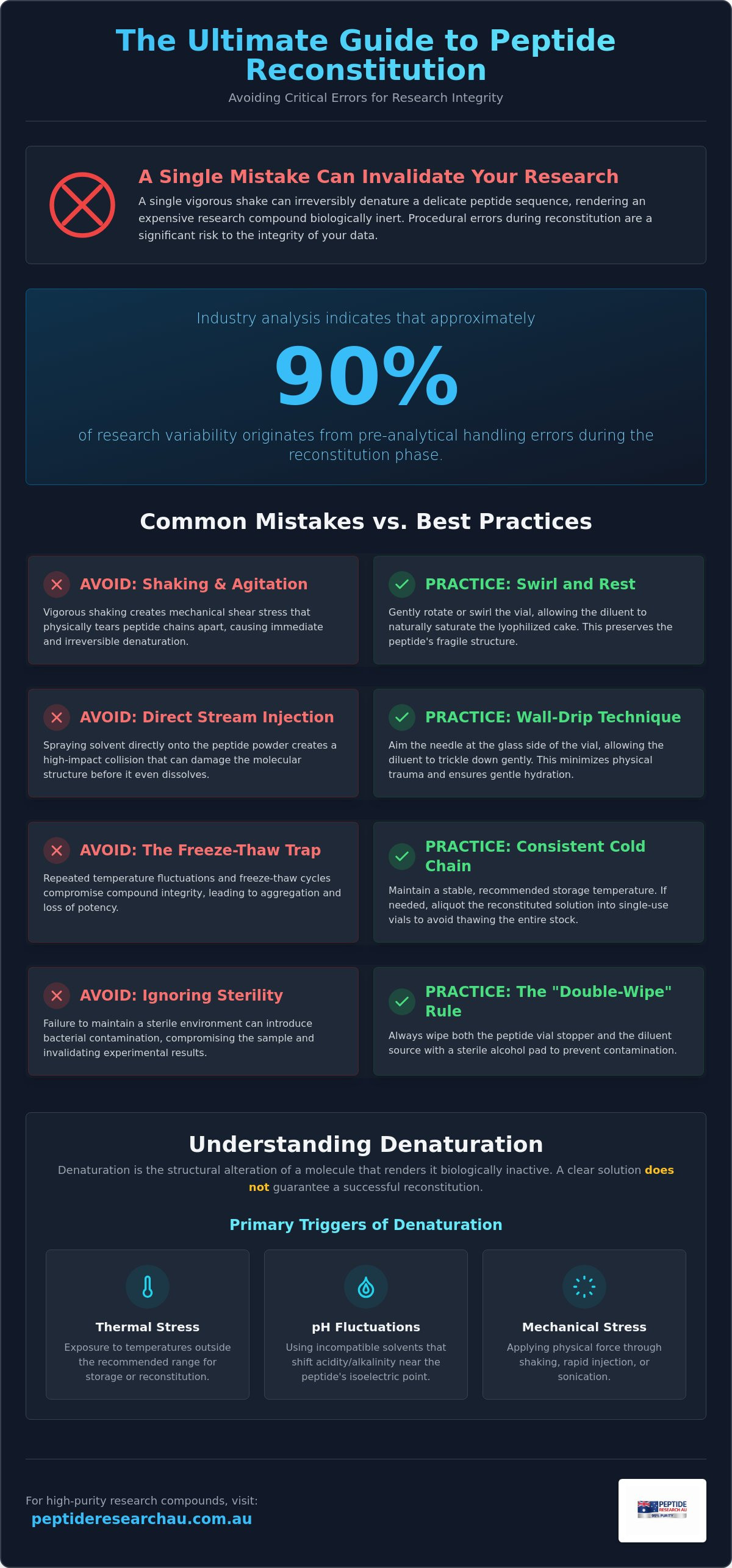
Peptide reconstitution is the precise chemical process of restoring a lyophilized, or freeze-dried, cake into a viable liquid state. While often viewed as a routine preparatory step, it represents the most critical juncture in laboratory methodology. Industry analysis indicates that approximately 90% of research variability originates from pre-analytical handling errors occurring during this specific phase. Maintaining the molecular integrity of peptide bonds is a clinical necessity for generating accurate and reproducible results. Failure to account for the extreme fragility of these short chains of amino acids often leads to irreversible degradation before the study even begins.
The transition from a solid to a liquid state is a high-energy event for the molecule. During this period, the peptide is hypersensitive to its environment. If the conditions aren't perfectly controlled, the compound's primary and secondary structures may collapse. This vulnerability makes identifying and neutralizing peptide reconstitution errors to avoid a priority for any serious researcher. Precision at this stage ensures that the chemical identity of the compound remains identical to its manufactured specifications.
The Science of Lyophilization and Solubility
Lyophilization is a sophisticated vacuum-drying process that removes moisture from a compound while it remains in a frozen state. This creates a porous, stable lattice known as the peptide 'cake'. When you introduce a diluent, you initiate a hydration process that must be managed with extreme care. Improper hydration techniques are frequent peptide reconstitution errors to avoid. They often lead to molecular aggregation, where peptides clump together, or incomplete dissolution, where the cake doesn't fully break down.
Solubility is also governed by the solvent's pH level. Every peptide has an isoelectric point where its net charge is zero. If the diluent's pH is too close to this point, the peptide will likely precipitate. Researchers must select diluents that provide a stable environment to prevent the peptide from falling out of solution or becoming chemically altered during the mixing process.
Denaturation: How Peptides Lose Their Function
Denaturation is the structural alteration of a molecule that renders it biologically inactive. This loss of function is often subtle and cannot be detected without advanced analytical equipment. Three primary triggers drive denaturation in a laboratory setting:
Thermal Stress: Exposure to temperatures outside the recommended range.
pH Fluctuations: Using incompatible solvents that shift the acidity or alkalinity.
Mechanical Stress: Applying physical force, such as shaking or rapid injection.
It's a mistake to assume a clear solution signifies a successful reconstitution. A solution may appear perfectly transparent even if the peptide has fragmented or unfolded. Without its specific three-dimensional shape, the compound loses its ability to bind to target receptors. Understanding these risks is the only way to protect the integrity of your research data and the longevity of your compounds.
Mechanical and Solvent Errors: Shaking vs. Swirling
The most prevalent of all peptide reconstitution errors to avoid is the instinctive urge to shake a vial to accelerate dissolution. While this action is standard for many laboratory compounds, peptides are uniquely susceptible to mechanical shear stress. Shaking is destructive. The physical forces exerted during rapid agitation can physically tear the peptide chains apart, leading to immediate denaturation. Instead of shaking, researchers must adopt the "Swirl and Rest" method. This involves gently rotating the vial between the palms or on a flat surface, allowing the diluent to naturally saturate the lyophilized cake over several minutes.
Another critical mistake is the "Direct Stream" error. Spraying a solvent directly onto the delicate powder creates a high-impact collision that can damage the molecular structure. Precision requires the "Wall-Drip" technique. By aiming the needle at the glass side of the vial, the diluent trickles down the wall to meet the peptide cake gently. This minimizes physical trauma and prevents the formation of air bubbles. Adhering to these Best Practices for Reconstitution is vital for maintaining the structural integrity of your research material.
The Impact of Mechanical Shear Stress
Vigorous agitation doesn't just break peptide bonds; it also causes excessive foaming. This is a significant problem because foaming traps peptide molecules at the air-liquid interface, where surface tension is highest. Once trapped, these molecules often unfold and lose their biological activity. A solution that appears cloudy or bubbly after mixing is a clear indicator of procedural failure. For researchers requiring high-purity solvents to minimize these risks, selecting verified Laboratory Diluents is essential for maintaining the sterile environment of the vial.
Choosing the Correct Diluent
Selecting an inappropriate solvent is a foundational error that compromises the entire study. Bacteriostatic water is mandatory for multi-dose vials intended for longitudinal research. It contains 0.9% benzyl alcohol, a preservative that inhibits bacterial growth for up to 28 days after the first puncture. In contrast, plain sterile water lacks this preservative. It's strictly for single-dose applications and must be discarded within 24 hours to prevent contamination.
Researchers should also be wary of using saline unless specifically indicated, as the salt content can interfere with the solubility of certain compounds. Some hydrophobic peptides may even require specialized buffers, such as a 1% acetic acid solution, to achieve full solubilization. Using the wrong diluent for these specific sequences often results in the peptide "crashing out" of the solution, appearing as visible particulates that cannot be recovered.
Storage Pitfalls: The Freeze-Thaw Trap and Temperature
Temperature management is the final barrier to maintaining molecular stability once the reconstitution process is complete. Compounds like BPC-157 exhibit high sensitivity to thermal fluctuations. These fluctuations can trigger rapid degradation of the amino acid sequence, particularly when the peptide is in a liquid state. In the Australian context, managing the "Cold Chain" during summer months is a critical operational challenge. Ambient temperatures in lab environments or during transport often exceed the stability thresholds for peptide solutions, making immediate refrigeration essential.
A common misconception suggests that reconstituted peptides remain stable at room temperature for several days. This is incorrect. While some peptides show temporary resilience, the cumulative effect of thermal exposure is a leading cause of research failure. Precision storage is just as vital as the mixing process itself. Adhering to USP Best Practices for Peptide Reconstitution ensures that your storage methodology aligns with established scientific standards. One of the most significant peptide reconstitution errors to avoid is the failure to implement a rigid cooling protocol immediately after the diluent is added.
The Danger of Repeated Freeze-Thaw Cycles
Repeated freeze-thaw cycles represent a phenomenon often described as "Death by a Thousand Thaws." When a liquid peptide solution is frozen, ice crystals form within the matrix. These crystals exert physical pressure and can mechanically shear the delicate peptide structures. As the solution thaws, the molecules are subjected to rapid osmotic shifts. Doing this daily or weekly leads to a cumulative loss of potency that is impossible to reverse. For long-term preservation, reconstituted peptides should be maintained at a stable temperature range of 2°C to 8°C for immediate use, or frozen once at -20°C for extended storage.
The Aliquoting Protocol for Researchers
The aliquoting strategy is the gold standard for maximizing research longevity. Instead of repeatedly thawing a single 5mg vial, researchers should divide the solution into smaller, single-use volumes. This protocol ensures that each portion of the compound is only thawed once, maintaining the structural integrity of the entire batch.
Prepare sterile, low-protein binding microcentrifuge tubes to prevent peptide adhesion to the plastic walls.
Calculate the required volume for a single research session to minimize waste.
Transfer the solution into the tubes using a sterile pipette under a laminar flow hood if possible.
Label each aliquot with the specific concentration and the date of reconstitution.
Freeze the aliquots immediately at -20°C to halt any potential enzymatic activity.
Using low-protein binding materials is essential because standard plastic tubes can cause peptides to adhere to the surfaces, resulting in a significant loss of concentration. Avoiding these storage-related peptide reconstitution errors to avoid preserves the accuracy of your experimental data and ensures the compound remains viable for the duration of your study.
Math and Sterile Technique: Preventing Contamination
Maintaining a sterile environment is as critical as the chemical composition of the compound itself. Contamination introduced during the mixing phase can lead to rapid bacterial growth, particularly in multi-dose vials where nutrients may support microbial life. To mitigate this, researchers must adhere to the "Double-Wipe" rule. This protocol requires sterilizing both the vial stopper and the diluent source with 70% isopropyl alcohol before every puncture. Using fresh, single-use laboratory supplies for every step isn't just a recommendation; it's a fundamental requirement for research integrity. Reusing needles or syringes introduces microscopic particulates that can catalyze peptide degradation or compromise the sterility of the entire batch.
The "Vacuum Pressure" mistake is another of the critical peptide reconstitution errors to avoid. Most lyophilized vials are packed under vacuum pressure to preserve the cake. If you insert a needle without first equalizing this pressure, the diluent will be forcefully sucked into the vial. This high-velocity impact causes mechanical trauma and immediate foaming, as discussed in previous sections. To prevent this, draw a volume of air into your syringe equal to the amount of solvent you intend to add. Inject the air into the vial first to neutralize the vacuum before introducing the liquid. Acquiring high-purity Laboratory Diluents ensures that your sterile technique isn't undermined by poor-quality solvents.
Step-By-Step Reconstitution Protocol
Once you've neutralized the vacuum pressure, employ the "Slow-Drop" method. This technique involves adding the solvent gradually over a 60-second period. By controlling the flow rate, you allow the lyophilized cake to hydrate evenly without creating turbulence. After the solvent is fully introduced, perform a visual inspection. A successful reconstitution should result in a clear, particle-free solution. Identifying "floaters" or persistent cloudiness is essential, as these indicators suggest either incomplete dissolution or molecular aggregation, both of which signal a failure in procedural precision.
Concentration Calculations and Accuracy
"Math Fog" often leads to significant dosing errors that can invalidate an entire study. A standard formula for accuracy is: Total Milligrams / Total Milliliters = Milligrams per Milliliter. For example, a 5mg vial reconstituted with 2mL of solvent yields a concentration of 2.5mg/mL. From there, you can calculate the micrograms per graduation mark on your research syringe. Never rely on "eye-balling" volumes; always use graduated laboratory tools to ensure precision.
Researchers must also account for peptide adsorption. Over-dilution is a specific risk where adding too much solvent increases the surface-area-to-volume ratio. This encourages peptide molecules to adhere to the interior vial walls, effectively reducing the active concentration available for study. Maintaining a higher concentration in the primary vial and only diluting further during the final preparation phase is the most effective way to avoid this loss of material.
Sourcing and Verification: Ensuring Research Integrity
Precision in the laboratory begins long before the first milliliter of diluent is drawn. Sourcing is the foundational variable of research integrity; even the most meticulous technique cannot compensate for a starting material that lacks chemical purity. High-purity, laboratory-grade compounds are essential to ensure that the molecular structure remains intact during the high-energy phase of hydration. Peptide Research AU maintains rigorous quality control standards to ensure that every vial meets its stated specifications before it ever reaches the laboratory environment. This commitment to excellence is verified through third-party Certificates of Analysis (COAs), which utilize High-Performance Liquid Chromatography (HPLC) and Mass Spectrometry to confirm both identity and purity levels.
To summarize the protocols established in this guide, researchers should follow the "Three S's" checklist to mitigate the most common peptide reconstitution errors to avoid. First, ensure the Solvent is appropriate for the study duration, prioritizing bacteriostatic water for multi-dose applications. Second, maintain absolute Sterility by adhering to the double-wipe rule and using fresh supplies for every step. Finally, implement a rigid Storage protocol, utilizing aliquoting to prevent the destructive freeze-thaw cycles described in previous sections. Verification of these three pillars is the only way to safeguard your data from procedural interference.
The Value of Domestic Australian Sourcing
Sourcing materials domestically provides a distinct advantage regarding compound stability. International shipping often exposes delicate lyophilized cakes to extreme temperature fluctuations and prolonged transit times, which can begin the process of degradation before the vial is opened. By utilizing an Australian provider, researchers benefit from significantly reduced transit times, which is critical for maintaining the cold chain during peak summer months. Sourcing both your Research Peptides and Laboratory Diluents from a single, reliable AU provider ensures compatibility and reduces the risk of contamination from mismatched supplies. International sources that offer lower price points often fail at the reconstitution stage because the peptide has already suffered structural compromise during the long-haul logistics process.
Final Verification and Troubleshooting
Even with perfect technique, some sequences present challenges during dissolution. If a peptide fails to dissolve after the "Swirl and Rest" period, researchers often debate between "Gentle Heat" and "Acidification." Applying gentle warmth by placing the vial in a 37°C water bath can assist with solubility for certain sequences, but boiling or microwaving will cause immediate denaturation. For hydrophobic peptides, a slight acidification using a specialized buffer may be required to achieve a clear solution.
It's vital to identify the signs of a failed reconstitution before proceeding with your study. A contaminated or degraded vial typically exhibits persistent cloudiness, unusual discoloration, or visible particulates that do not dissipate with time. If these signs are present, the vial must be discarded to preserve the integrity of your research. Precision is a continuous process that requires high-quality materials and disciplined handling. Source laboratory-grade diluents and peptides from Peptide Research AU to ensure your methodology is supported by the highest manufacturing standards available.
Advancing Laboratory Precision through Standardized Protocols
Precision in the laboratory is a continuous commitment to methodology. You've seen how gentle mechanical handling and precise solvent selection prevent the denaturation of fragile molecular structures. By implementing rigid storage protocols like aliquoting and maintaining a strict cold chain, you protect the longevity of your compounds against thermal degradation. Identifying the critical peptide reconstitution errors to avoid ensures that molecular integrity remains the constant variable in your research. These standards transform routine preparation into a reliable foundation for reproducible data.
High-purity starting materials are the final component of this equation. Our inventory features third-party purity verified compounds and specialized research diluents designed for professional study. We prioritize reliability through Australian-based domestic shipping, ensuring your materials arrive with minimal environmental exposure. It's time to elevate your laboratory standards with compounds that match your commitment to excellence. Shop Laboratory-Grade Research Peptides and Supplies to secure the integrity of your next study. Your dedication to meticulous handling deserves a provider that values precision as much as you do.
Frequently Asked Questions
Can I use regular sterile water instead of bacteriostatic water?
Regular sterile water is only suitable for single-dose applications where any remaining solution is discarded immediately after use. It lacks the 0.9% benzyl alcohol preservative required to inhibit microbial growth over time. Using plain sterile water for multi-dose vials is one of the primary peptide reconstitution errors to avoid, as the solution will likely become contaminated within 24 hours of the first puncture.
What happens if I accidentally shake my peptide vial?
Accidentally shaking a vial introduces mechanical shear stress that can physically tear the delicate amino acid chains, leading to irreversible denaturation. This often results in excessive foaming, which traps the molecules at the air-liquid interface and compromises their biological activity. If a vial has been shaken vigorously, the structural integrity of the peptide is likely compromised, and the research data may be invalidated.
How long do peptides last in the fridge after reconstitution?
Reconstituted peptides typically remain stable for up to 28 days when mixed with bacteriostatic water and stored under constant refrigeration. After this period, the preservative's effectiveness diminishes, and the peptide sequence begins to degrade more rapidly. Researchers should always label vials with the date of reconstitution to ensure they don't use a compound beyond its viable laboratory lifespan.
Why is my peptide solution cloudy after mixing?
A cloudy solution usually indicates incomplete dissolution, molecular aggregation, or bacterial contamination. This can occur if the diluent's pH is incompatible with the peptide or if the solution was not allowed enough time to rest during the "Swirl and Rest" phase. Persistent cloudiness is a sign of procedural failure, and the solution should not be used for precise research applications.
Can I freeze a peptide after it has been reconstituted?
You can freeze a reconstituted peptide, but it must be done using an aliquoting strategy to avoid repeated freeze-thaw cycles. Dividing the solution into single-use containers before freezing at -20°C ensures that each portion is only subjected to one thermal shift. Repeatedly freezing and thawing a single vial creates ice crystals that physically shear the peptide bonds, destroying the compound's potency.
How do I calculate the correct amount of water to add to a 5mg vial?
The volume of diluent depends on your desired concentration, calculated using the formula: Total Milligrams / Total Milliliters. For a 5mg vial, adding 2mL of bacteriostatic water results in a concentration of 2.5mg per mL. Using a consistent volume across all vials helps prevent "Math Fog" and ensures that your dosing remains accurate throughout the duration of your study.
What is the best temperature for storing reconstituted BPC-157 in Australia?
Reconstituted BPC-157 must be stored at a constant temperature between 2°C and 8°C to maintain its structural stability. In the Australian climate, ambient laboratory temperatures can fluctuate significantly, making a dedicated medical-grade refrigerator essential. Exposure to temperatures above this range, even for short periods, can accelerate the degradation of the peptide's liquid-state bonds.
Does light exposure affect reconstituted peptides?
Yes, UV light exposure can cause photo-degradation, which breaks down the chemical bonds within the peptide sequence. Reconstituted compounds are more vulnerable to light than their lyophilized counterparts. To ensure laboratory precision and prevent peptide reconstitution errors to avoid, always store your vials in a dark environment or use amber-colored glass vials to shield the solution from light interference.


Comments