
Neuroprotective Peptides for Research: A Comprehensive 2026 Scientific Overview
- peptideresearchau
- Jun 18
- 12 min read
The Australian peptide therapeutics market is projected to reach USD 3,711.1 million by 2033, yet the regulatory environment for neuroprotective peptides for research has become increasingly stringent as of June 2026. This shift reflects a critical need for researchers to distinguish between unapproved consumer products and high-purity laboratory compounds. It's often difficult to secure reliable, ISO-certified materials while staying compliant with the latest Therapeutic Goods Administration (TGA) priorities. Precision is essential for valid outcomes.
This article provides a technical foundation for investigating neuro-regeneration and cognitive enhancement through specific biochemical pathways. We'll detail the mechanisms of oxidative stress reduction and provide established reconstitution protocols for compounds such as Selank and Semax. By reviewing the current laboratory standards and sourcing requirements, you'll gain the clarity needed to maintain data integrity and advance your neurological research within the Australian scientific framework. We'll also examine how to establish a reliable sourcing partnership to ensure your laboratory receives only the highest grade research compounds.
Key Takeaways
Understand how specific amino acid sequences preserve neuronal structure by mitigating apoptosis and regulating reactive oxygen species.
Identify the research applications of BPC-157 and GHK-Cu in studies focused on systemic repair and neuro-regeneration.
Establish rigorous laboratory protocols for reconstitution, ensuring you're using high-purity laboratory diluents to maintain peptide stability.
Navigate the 2026 Australian regulatory landscape for sourcing neuroprotective peptides for research to maintain institutional compliance.
Evaluate the advantages of domestic sourcing, as it's the most effective way to ensure cold-chain integrity and minimize transit times.
Table of Contents
Defining Neuroprotective Peptides in Modern Laboratory Research
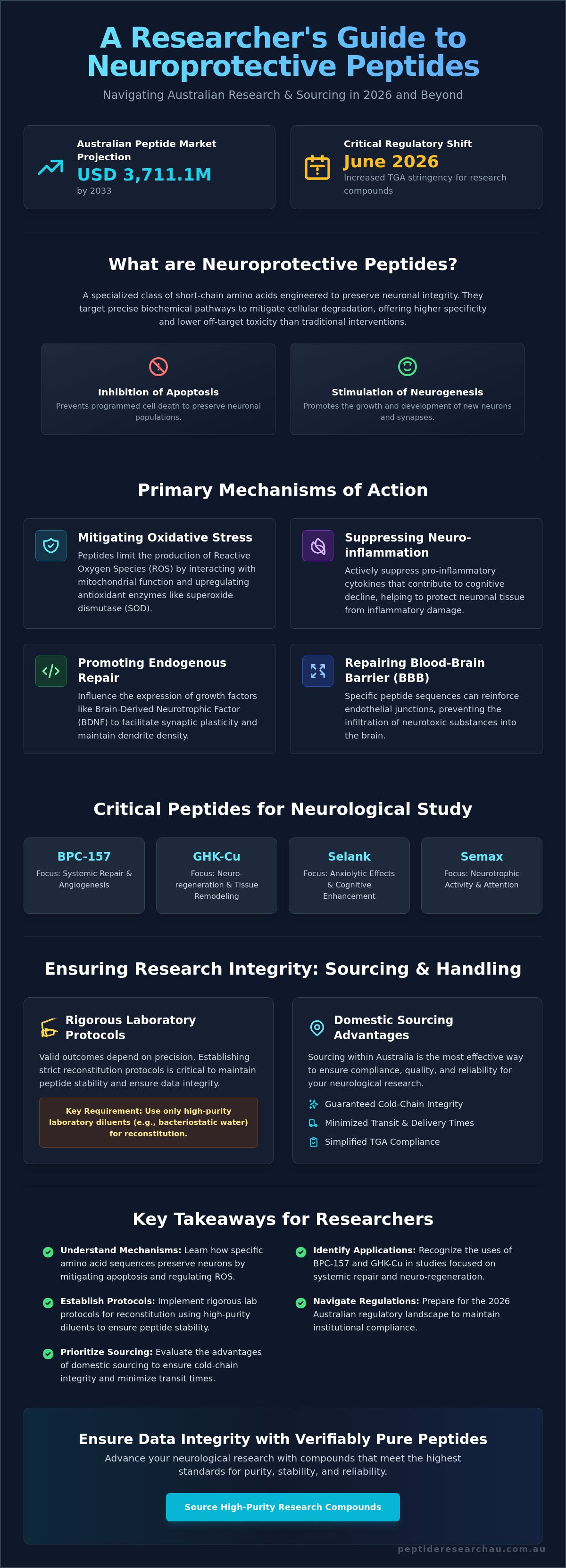
Neuroprotective peptides for research represent a specialized class of short-chain amino acids specifically engineered to preserve neuronal integrity. Unlike broad-spectrum neuro-agents, these molecules target precise biochemical pathways to mitigate cellular degradation. Neuroprotection in a laboratory setting focuses on two primary outcomes: the inhibition of programmed cell death, known as apoptosis, and the stimulation of neurogenesis. Modern investigators prioritize these compounds because they often demonstrate higher specificity and lower off-target toxicity than traditional small-molecule interventions. The shift toward peptide-based research stems from their ability to mimic endogenous signaling molecules, providing a more biological approach to neuro-regeneration studies.
It's vital to maintain a clear distinction between laboratory-grade research peptides and finished pharmaceutical products. Research compounds are synthesized for in-vitro or in-vivo modeling to observe biochemical interactions. They aren't intended for human consumption or clinical use. High manufacturing standards ensure that these molecules possess the requisite purity levels for reproducible data. In a professional laboratory environment, the focus remains on the chemical nomenclature and the specific activity of the peptide chain during controlled experiments. Reliability in sourcing these compounds is the foundation of any valid neurological study.
The Evolution of Neuro-Research Compounds
The field has transitioned from studying isolated amino acid chains to utilizing sophisticated multi-peptide complexes. As of 2026, research standards require a rigorous definition of "neuroprotective" within in-vitro contexts, focusing on measurable biomarkers of cellular health. This evolution reflects a deeper understanding of how multiple signaling pathways interact simultaneously. Investigators now place a higher emphasis on bioavailability during research model design. Ensuring the peptide reaches the target site within a biological model remains a central challenge in experimental methodology. Modern research peptides are often evaluated for their stability and resistance to enzymatic degradation within specific laboratory media.
Research Applications and Study Objectives
Current study objectives often center on neuro-inflammation. Researchers investigate how these peptides suppress pro-inflammatory cytokines that contribute to cognitive decline in disease models. Another significant area of focus is the repair of the blood-brain barrier (BBB). Laboratory models use neuroprotective peptides for research to explore how specific sequences can reinforce endothelial junctions and prevent the infiltration of neurotoxic substances. Additionally, exploring synaptic plasticity enhancement allows for a deeper understanding of how neural circuits might be preserved or restored following simulated injury. These objectives require high-purity compounds to ensure that observed effects are the result of the peptide itself rather than contaminants.
Primary Mechanisms of Action in Peptide-Based Neuroprotection
Peptide-based neuroprotection relies on the precise modulation of cellular signaling to prevent structural decay. While traditional pharmacology often targets isolated receptors, neuroprotective peptides for research operate through integrated pathways that address the root causes of neuronal death. These compounds primarily target the reduction of oxidative stress, the suppression of neuro-inflammation, and the promotion of endogenous repair factors. By influencing the expression of Brain-Derived Neurotrophic Factor (BDNF), these molecules facilitate the maintenance of hippocampal synaptic plasticity and dendrite density in various experimental models. This multi-modal activity makes them superior candidates for studying complex neurological recovery compared to narrow-spectrum small molecules.
Mitigating Oxidative Stress and ROS
Oxidative stress remains a primary driver of neuronal apoptosis. Peptides effectively intervene by interacting with mitochondrial function to limit the production of reactive oxygen species (ROS). This interaction often involves the upregulation of superoxide dismutase (SOD), an essential antioxidant enzyme that neutralizes harmful superoxide radicals. Recent studies highlight the mechanisms of GLP-1 in neuroprotection as a prime example of how peptide chains can stabilize mitochondrial membranes and reduce electron leakage. In 2026 research, the Sirt3/SOD/ROS pathway is defined as a critical mitochondrial signaling axis where Sirt3-mediated deacetylation of SOD2 directly neutralizes superoxide radicals to prevent oxidative cellular collapse. By maintaining this balance, these compounds protect the cell's metabolic engine from irreversible damage.
Synaptic Plasticity and Neuronal Repair
Structural integrity at the synapse is a key indicator of cognitive health in laboratory models. Targeted research focuses on enhancing mushroom spine density in neuron cells, as these structures are vital for stable long-term potentiation. Peptides influence these changes by modulating the ChAT/p-CaMKII/BDNF signaling pathways, which are responsible for neurotransmitter synthesis and calcium-dependent signaling. This molecular cascade doesn't just preserve existing connections; it also supports mechanisms of axonal regeneration. In models of neural injury, peptide-treated groups often show increased growth cone activity and faster re-establishment of synaptic contacts. Researchers aiming to quantify these regenerative effects can source verified research compounds to ensure experimental consistency. This rigorous approach ensures that the study of neuro-regeneration remains both precise and reproducible.
Critical Peptides for Neurological Study and Cognitive Research
Modern neuroscience increasingly relies on synthetic compounds to model complex recovery processes. While plant-derived extracts were once a primary focus, the precision of neuroprotective peptides for research allows for more targeted experimental designs. In 2026, the scientific community has moved toward highly specific sequences that can cross the blood-brain barrier and interact with neural receptors. Compounds such as BPC-157, GHK-Cu, and MOTS-c have become central to these investigations. These molecules provide a level of molecular accuracy that traditional small molecules often lack, enabling researchers to isolate specific cellular responses with greater confidence.
BPC-157 in Neurological Research
BPC-157 is widely recognized for its systemic repair capabilities, yet its neuro-regenerative potential is a growing area of study. Researchers examine its interaction with the GABAergic system to understand its role in stabilizing neural activity during periods of excitotoxicity. Current data suggests it may influence hippocampal healing following simulated traumatic injuries in laboratory models by promoting the expression of early growth response genes. This interaction provides a framework for studying the restoration of neural pathways after physical or chemical insult. For detailed protocols, consult BPC-157: A Comprehensive Guide for Scientific Research in Australia. This peptide remains a priority for those studying the intersection of systemic healing and central nervous system recovery.
Exploring GHK-Cu and Mitochondrial Peptides
GHK-Cu operates as a potent modulator of gene expression within neural tissues. It facilitates the upregulation of antioxidant enzymes and suppresses pro-inflammatory markers, making it indispensable for anti-inflammatory neural research. For more information on its specific activity, refer to the GHK-Cu Peptide: A Comprehensive Research Guide for 2026. Alongside copper-peptide complexes, mitochondrial-derived peptides like MOTS-c are gaining traction. MOTS-c research focuses on energy metabolism and its impact on age-related cognitive decline. It regulates mitochondrial proteostasis and metabolic homeostasis, which are critical for maintaining brain health in aging models. Specifically, it influences the AMPK signaling pathway, which is a major regulator of cellular energy balance.
These multi-peptide complexes are becoming standard in advanced cognitive research. By integrating multiple active sequences, investigators can simulate more complex biological interactions. The use of neuroprotective peptides for research in this format allows for the simultaneous study of synaptic plasticity and mitochondrial protection. This methodology reflects the increasing sophistication of neurological science as of June 2026. High manufacturing standards ensure these complexes maintain their intended ratios and chemical stability during laboratory handling, which is essential for achieving reproducible results in high-stakes research environments.
Methodological Considerations: Reconstitution and Laboratory Handling
The structural integrity of neuroprotective peptides for research is exceptionally sensitive to environmental variables and handling techniques. Unlike traditional small molecules that often possess robust chemical stability, peptide chains are susceptible to rapid degradation if laboratory protocols aren't strictly followed. Maintaining the primary and secondary structures of these compounds is essential for ensuring that experimental observations reflect the true biochemical activity of the molecule. Investigators must prioritize aseptic techniques and controlled environments to prevent the denaturation of these delicate amino acid sequences during preparation and study.
The Role of Bacteriostatic Water
Bacteriostatic water is the preferred diluent for multi-use research vials because it contains 0.9% benzyl alcohol as a preservative. This specific concentration effectively inhibits the growth of most potential bacterial contaminants, which is critical for long-term study viability. While sterile water is appropriate for single-use applications, it lacks the preservative properties necessary to maintain a sterile environment after the initial vial puncture. In an Australian research context, sourcing laboratory-grade diluents ensures that the chemical properties of the water don't interfere with the peptide's ionic balance. Using high-purity laboratory diluents is a fundamental requirement for maintaining the stability of the solution throughout the duration of an experiment.
To ensure the highest data integrity, researchers should follow a standardized reconstitution protocol:
Equilibrate the lyophilised peptide vial to room temperature before introduction of the diluent to prevent condensation.
Sanitize the vial stopper with 70% isopropyl alcohol and allow it to air dry completely.
Introduce the diluent slowly by aiming the needle at the side of the glass vial, allowing the liquid to drip down the wall rather than directly onto the powder.
Gently swirl the vial in a circular motion until the powder is completely dissolved; never shake the vial, as mechanical stress can lead to the formation of air bubbles and the irreversible denaturation of the peptide chain.
Storage and Long-Term Stability
Temperature control is the most significant factor in preserving peptide bond integrity. Lyophilised peptides should be stored in a specialized laboratory freezer at -20°C for long-term stability, while reconstituted solutions require immediate refrigeration at 4°C. It's critical to avoid repeated freeze-thaw cycles, as the resulting thermal stress can cause the peptide bonds to fracture, significantly reducing the compound's potency. Once reconstituted, neuroprotective peptides for research typically maintain optimal stability for 14 to 28 days when stored at 4°C, provided aseptic conditions are maintained. Light sensitivity is also a concern; vials should be kept in their original packaging or wrapped in foil to prevent UV-induced degradation during storage.
Sourcing High-Purity Neuroprotective Compounds in Australia
Securing high-purity neuroprotective peptides for research within the Australian territory requires a comprehensive understanding of both biochemical standards and local regulatory frameworks. Domestic sourcing is the most effective strategy for mitigating the logistical risks associated with international transit. Prolonged shipping durations often lead to cold-chain failures, which can denature sensitive peptide sequences before they reach the laboratory. By utilizing a local supply chain, researchers ensure that compounds remain within specified temperature ranges, preserving the molecular integrity required for valid experimental outcomes.
Regulatory Compliance for AU Researchers
Compliance with Australian regulatory standards is mandatory for all institutional and independent research. In Australia, these compounds are strictly classified under a "Research Purposes Only" designation, which exempts them from certain clinical listing requirements provided they aren't used for human consumption. Investigators must ensure their procurement processes align with the latest TGA and NICNAS guidelines for laboratory chemicals. As of June 2026, the TGA has prioritized the monitoring of peptide supply chains to prevent the diversion of research materials into the consumer market. For a detailed analysis of these legal requirements, researchers should refer to Peptides Australia: The Researcher’s Guide to Quality, Sourcing, and Standards in 2026.
Quality Assurance Standards
The validity of neuro-regeneration data depends entirely on the purity of the starting material. A purity level of 99% or higher is the industry benchmark for neuroprotective peptides for research, as even minor contaminants can induce off-target effects or inflammatory responses in cellular models. Every batch must undergo rigorous verification through High-Performance Liquid Chromatography (HPLC) and Mass Spectrometry to confirm both the identity and the concentration of the peptide. Reliable suppliers provide a Certificate of Analysis (COA) for every product, ensuring that the chemical nomenclature matches the laboratory's requirements. Investigators can source these verified materials through the Peptide Research AU catalogue, which specializes in laboratory-grade compounds for neurological study.
Effective research also requires access to technical support that understands the specific challenges of the Australian scientific community. Domestic providers offer immediate assistance with technical enquiries regarding reconstitution volumes and storage stability. This localized expertise reduces downtime and helps laboratories maintain a consistent research rhythm. Peptide Research AU supports this mission by providing high-purity research compounds and laboratory diluents that meet the stringent demands of 2026 scientific standards. Prioritizing these quality markers ensures that Australian neurological research remains competitive and reproducible on a global scale.
Advancing Neurological Research Standards
The study of neuro-regeneration in 2026 demands a rigorous commitment to both molecular specificity and methodological precision. Researchers must navigate a complex landscape where the selection of high-purity neuroprotective peptides for research is only the first step. Success in the laboratory also hinges on adhering to strict reconstitution protocols and maintaining cold-chain integrity through domestic supply channels. By focusing on established mechanisms like BDNF expression and ROS regulation, investigators can produce the reproducible data necessary for scientific advancement.
Peptide Research AU provides the essential compounds and specialized laboratory diluents required for these sophisticated studies. Every batch undergoes third-party purity testing via HPLC and Mass Spectrometry to ensure it meets the 99% benchmark. Domestic Australian shipping guarantees that your materials arrive without the degradation risks associated with international transit. We invite you to browse our range of laboratory-grade neuroprotective peptides to support your next project. Ensuring high standards isn't just a preference; it's a requirement for scientific validity. We look forward to supporting your contribution to the future of neuroscience.
Frequently Asked Questions
What are the most studied neuroprotective peptides in 2026?
BPC-157, GHK-Cu, Selank, and Semax are the most frequently investigated neuroprotective peptides for research as of June 2026. These compounds are prioritized because they've shown documented interactions with the central nervous system in various laboratory models. Researchers often select these specific sequences to model recovery from oxidative stress and neuro-inflammation in controlled environments. This focus allows for more precise data collection compared to broad-spectrum agents that lack molecular specificity.
Is BPC-157 considered neuroprotective in research models?
BPC-157 demonstrates neuroprotective properties in various in-vitro and in-vivo research models by interacting with the GABAergic and serotonergic systems. It's often studied for its ability to mitigate the effects of excitotoxicity and promote hippocampal healing after simulated injury. While primarily known for systemic repair, its influence on neural tissue stability makes it a critical subject for neuro-regeneration studies. Investigators use it to observe the restoration of neural pathways after physical or chemical insult.
How should I reconstitute peptides for a neurological study?
Reconstitution requires the slow addition of a laboratory diluent, such as bacteriostatic water, down the side of the glass vial to avoid mechanical stress. You shouldn't shake the vial; instead, allow the powder to dissolve through gentle swirling. This technique prevents the denaturation of the peptide bonds, which is vital for maintaining potency. Maintaining an aseptic environment throughout this process is essential to ensure the chemical purity of the resulting solution used in your study.
Are neuroprotective peptides legal for research use in Australia?
Neuroprotective peptides for research are legal for laboratory applications in Australia when they're designated for research purposes only. This classification requires that the compounds aren't intended for human consumption or clinical application outside of approved trials. Researchers must comply with the Therapeutic Goods Administration (TGA) and NICNAS guidelines regarding the handling and storage of laboratory chemicals. It's essential to source these materials from domestic providers that adhere to these strict regulatory standards.
Can GHK-Cu cross the blood-brain barrier in laboratory simulations?
GHK-Cu has shown the ability to influence gene expression within neural tissues, although its direct penetration of the blood-brain barrier (BBB) is often a central variable in research models. Studies frequently investigate its role in reinforcing BBB integrity and reducing the infiltration of pro-inflammatory cytokines. Its primary value in neurological research lies in its capacity to modulate the antioxidant response and suppress markers of neural inflammation. This makes it an ideal candidate for anti-inflammatory study designs.
Why is bacteriostatic water necessary for peptide research?
Bacteriostatic water is required because it contains 0.9% benzyl alcohol, which serves as a preservative to prevent bacterial proliferation. This is critical for maintaining the sterile integrity of the peptide solution over multiple extractions during an experiment. Using standard sterile water without preservatives increases the risk of contamination, which can compromise the validity of your study data. It ensures that the chemical properties of the solution don't change over time during the research period.
What is the standard storage protocol for lyophilised neuro-peptides?
Lyophilised neuro-peptides should be stored in a laboratory freezer at -20°C to ensure long-term chemical stability. This temperature prevents the degradation of the amino acid chains and maintains the compound's potency for the duration of the study. Once reconstituted, the solution must be kept at 4°C and protected from light exposure. You shouldn't allow the solution to undergo repeated freeze-thaw cycles, as this thermal stress can fracture the delicate peptide bonds.
Do neuroprotective peptides show promise for studying synaptic plasticity?
Neuroprotective peptides for research show significant utility in studying synaptic plasticity by modulating the expression of Brain-Derived Neurotrophic Factor (BDNF). Researchers use these compounds to observe changes in mushroom spine density and the re-establishment of synaptic contacts in neural models. These studies provide insights into how specific amino acid sequences might support the maintenance of cognitive function during simulated decline. This methodology allows for the precise measurement of structural changes at the synapse.


Comments