

MOTS-c Mitochondrial Research: A Guide to the Exercise-Mimetic Peptide
- peptideresearchau
- 4 hours ago
- 12 min read

The traditional view of mitochondria as static energy producers is obsolete. Recent breakthroughs, including a 2015 landmark study published in Cell Metabolism, have identified MOTS-c as a critical mitochondrial-derived peptide that communicates directly with the cell nucleus to influence systemic metabolic expression. You've likely encountered oversimplified articles that treat peptides as mere fitness shortcuts, leaving you without the technical depth needed to distinguish between consumer-grade marketing and legitimate research data. It's frustrating when academic jargon obscures the practical application of these compounds in a laboratory setting.
This analysis provides a comprehensive overview of mots-c mitochondrial research, focusing on its metabolic impacts and its emerging role as a potent exercise mimetic. You'll gain a clear understanding of how this 16-amino acid peptide regulates insulin sensitivity and fatty acid oxidation. We'll explore the specific scientific mechanisms of the mitochondrial-nuclear axis and establish clear criteria for sourcing laboratory-grade compounds for Australian research applications. This guide ensures your data remains grounded in precision and high-standard scientific inquiry.
Key Takeaways
Understand the unique biological origin of MOTS-c as a mitochondrial-encoded peptide and its critical role in the Mitochondria-Derived Peptide (MDP) revolution.
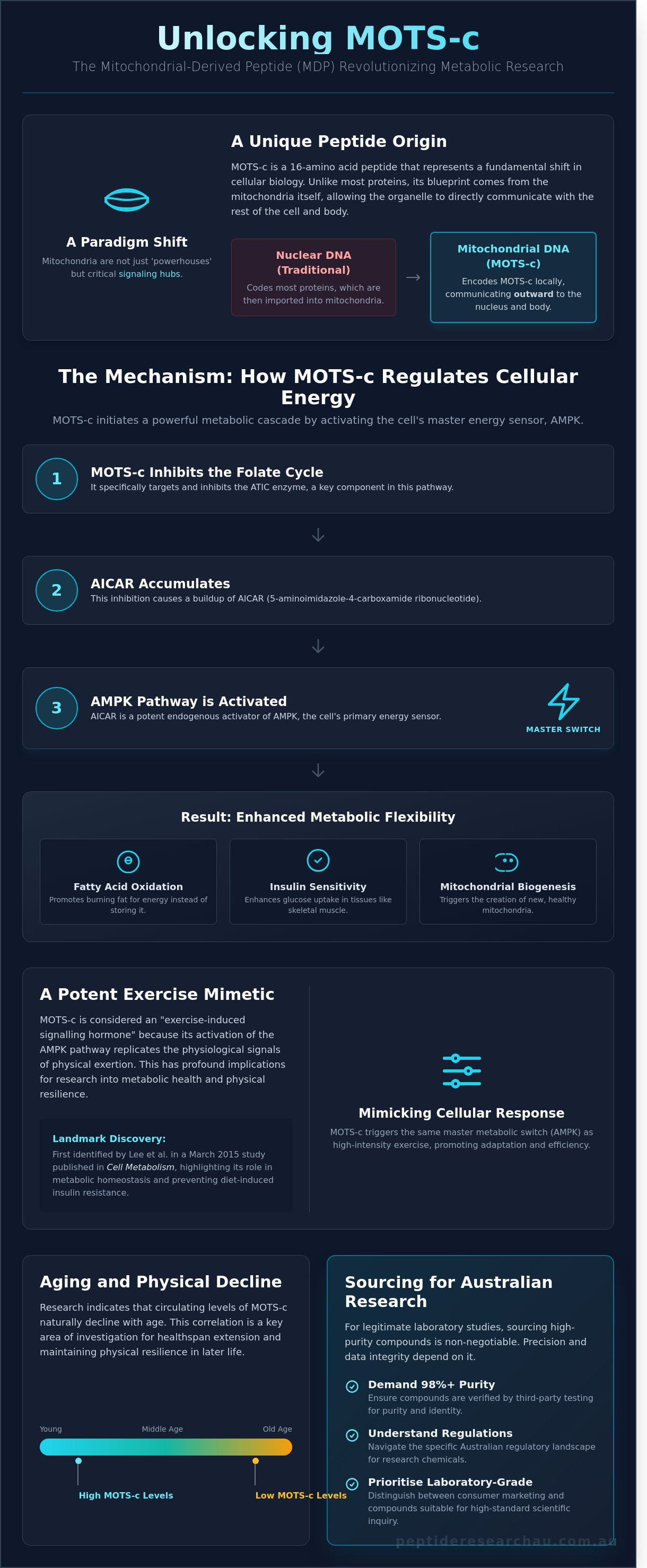
Explore the metabolic mechanisms of MOTS-c, specifically how it activates the AMPK pathway to regulate cellular energy and enzyme activity.
Examine current mots-c mitochondrial research regarding its function as an exercise-mimetic hormone that replicates the physiological signaling of physical exertion.
Investigate the relationship between declining peptide levels and biological ageing, focusing on research into healthspan extension and physical resilience.
Identify the rigorous standards for sourcing 98%+ purity research-grade compounds while navigating the specific regulatory landscape for laboratories in Australia.
Table of Contents Understanding MOTS-c: The Mitochondria-Derived Peptide (MDP) Revolution The Mechanism of Action: How MOTS-c Regulates Cellular Energy Metabolic Research: MOTS-c as an Exercise-Induced Signalling Hormone Investigating MOTS-c in Ageing and Physical Decline Sourcing Research-Grade MOTS-c for Laboratory Studies in Australia
Understanding MOTS-c: The Mitochondria-Derived Peptide (MDP) Revolution
MOTS-c, or Mitochondrial Open Reading Frame of the 12S rRNA-c, represents a fundamental shift in how scientists view cellular organelles. Traditionally, biology textbooks described mitochondria solely as the "energy plants" of the cell. Recent mots-c mitochondrial research proves they're also critical signaling hubs. The peptide is a 16-amino acid sequence encoded within the mitochondrial DNA (mtDNA) rather than the nuclear DNA. This distinction is vital for laboratory grade study. Most proteins are coded in the nucleus and sent to the mitochondria; MOTS-c is produced locally and communicates outward.
It belongs to the Mitochondria-Derived Peptide (MDP) family, which includes other bioactive molecules like Humanin and Small Humanin-Like Peptides (SHLPs). These compounds are essential for cellular protection and metabolic regulation. By acting as a signaling molecule, MOTS-c allows the mitochondria to influence systemic physiology. This paradigm shift suggests that mitochondrial health isn't just about ATP production, but about the organelle's ability to "talk" to the rest of the body.
The Discovery of MOTS-c in Modern Science
A landmark study published in March 2015 by Lee et al. in the journal Cell Metabolism first identified MOTS-c. Researchers found that this peptide plays a primary role in maintaining metabolic homeostasis. By targeting the skeletal muscle, MOTS-c influences glucose metabolism and insulin sensitivity. Its 16-amino acid sequence is remarkably short, yet it possesses the specific capacity to regulate systemic metabolic functions. This discovery transformed our understanding of how mitochondrial health dictates overall physiological performance.
Scientists now view MOTS-c as an endocrine-like factor that circulates in the blood to coordinate responses across different tissues. In laboratory settings, MOTS-c has shown the ability to prevent insulin resistance induced by high-fat diets. This specific focus on metabolic pathways makes it a cornerstone of contemporary mots-c mitochondrial research.
Mitochondrial-Nuclear Communication
The most compelling aspect of MOTS-c is its role in retrograde signaling. This process involves the mitochondria sending instructions back to the cell nucleus. When the cell experiences metabolic stress, such as exercise or nutrient deprivation, MOTS-c translocates from the mitochondria into the nucleus. Once there, it binds to specific DNA sequences to promote the expression of genes involved in antioxidant responses and metabolic adaptation. This dual-location functionality ensures the nucleus responds to the real-time energy demands of the mitochondria.
This mechanism allows the cell to adapt to environmental changes and maintain survival during periods of high physical demand. It's a sophisticated feedback loop that protects the cell from oxidative damage. By regulating nuclear gene expression, MOTS-c acts as a bridge between the energy-producing organelles and the genetic blueprint of the cell, ensuring metabolic flexibility is maintained even under stress.
The Mechanism of Action: How MOTS-c Regulates Cellular Energy
MOTS-c functions as a metabolic signaling molecule that originates directly from the mitochondrial genome. Unlike traditional hormones encoded in the nucleus, this 16-amino acid peptide acts as a localized supervisor of cellular homeostasis. Current mots-c mitochondrial research focuses on its unique ability to inhibit the folate cycle, specifically targeting the AICAR transformylase (ATIC) enzyme. This inhibition leads to a buildup of 5-aminoimidazole-4-carboxamide ribonucleotide (AICAR). This molecule is a potent, endogenous activator of AMP-activated protein kinase (AMPK), which serves as the primary energy sensor in the cell.
AMPK Activation and Metabolic Flexibility
When MOTS-c activates the AMPK pathway, it effectively mimics the cellular environment of nutrient deprivation or high-intensity exercise. This shift forces the cell to prioritise energy production over energy storage. It triggers a cascade of downstream effects, including increased fatty acid oxidation and the synthesis of new mitochondria. Research indicates that MOTS-c significantly alters the NAD+/NADH ratio. By increasing available NAD+ levels, the peptide supports sirtuin activity and maintains the mitochondrial membrane potential. Scientists utilizing laboratory grade research compounds often examine these pathways to understand how cells adapt to metabolic stress without external caloric restriction.
Glucose Metabolism and Insulin Sensitivity
One of the most critical aspects of mots-c mitochondrial research is the peptide's impact on skeletal muscle tissue. It enhances glucose clearance by promoting the translocation of Glucose Transporter Type 4 (GLUT4) to the cell surface. This mechanism is particularly notable because it doesn't rely on the standard insulin signaling pathway. In 2015, primary studies demonstrated that MOTS-c could reverse insulin resistance in mice fed a high-fat diet by bypassing defective insulin receptors. The peptide provides a secondary route for glucose entry, which is vital for studying metabolic dysfunction.
Folate Cycle Modulation: MOTS-c reduces de novo purine synthesis, redirecting cellular resources toward energy metabolism.
Fatty Acid Oxidation: It promotes the breakdown of lipids into usable ATP, reducing ectopic fat accumulation.
Insulin Independence: The peptide restores glucose uptake in insulin-resistant cells via AMPK-mediated GLUT4 expression.
Mitochondrial Biogenesis: It stimulates the creation of new mitochondria to replace damaged or inefficient organelles.
The peptide's role in de novo purine synthesis is a relatively recent discovery in the field. By restricting the folate cycle, MOTS-c limits the raw materials available for DNA replication in specific contexts, which may explain its influence on cellular longevity. This multi-targeted approach makes it a central figure in "exercise-mimetic" studies. It provides a chemical bridge between mitochondrial health and systemic metabolic performance.
Metabolic Research: MOTS-c as an Exercise-Induced Signalling Hormone
MOTS-c acts as a critical mitokine, a signalling molecule that transmits data from the mitochondria to the rest of the body to regulate metabolic homeostasis. Clinical observations indicate that physical exertion triggers an endogenous surge of this peptide. In a 2021 study published in Nature Communications, researchers found that circulating MOTS-c levels in humans increased by approximately 1.5 times during exercise and remained elevated for several hours post-workout. This mots-c mitochondrial research highlights the peptide's role as a systemic messenger rather than a localized byproduct.
The distinction between sedentary and active subjects is stark in endocrinology research. Active individuals maintain a more robust mitochondrial response, while sedentary profiles often show diminished MOTS-c expression. Because the peptide is encoded by the mitochondrial genome rather than the nuclear genome, it provides a direct snapshot of mitochondrial health. It travels from skeletal muscle through the blood circulation to target organs like the liver and adipose tissue. This systemic reach is why scientists classify it as a hormone-like peptide that mimics the physiological benefits of a workout.
Skeletal Muscle Adaptation and Homeostasis
MOTS-c promotes myoblast adaptation to metabolic stress by activating the AMPK pathway, which functions as the body's master energy switch. In laboratory settings, MOTS-c treatment helps muscle cells survive and adapt even when glucose levels are low. Research involving aged models shows that the peptide helps prevent muscle atrophy, a common issue in sarcopenia. Beyond muscle fibre retention, it influences thermogenesis by promoting the "browning" of white adipose tissue. This process increases the metabolic rate, as brown fat burns more energy to produce heat than standard white fat stores.
Physical Performance and Endurance Studies
The 2021 Nature Communications study by Reynolds et al. remains the most definitive look at physical capacity. The research demonstrated that intermittent MOTS-c treatment significantly boosted treadmill performance in mice across different age groups. Older mice didn't just move more; they showed a 20% increase in grip strength and maintained a faster gait compared to untreated controls. These results suggest that the peptide helps bridge the gap between chronological age and functional physical ability.
Grip Strength: Treated aged mice exhibited force levels comparable to much younger cohorts.
Gait Speed: Performance decline was halted, showing improved coordination and power.
Endurance: Time-to-exhaustion on treadmill tests increased by nearly 25% in treated groups.
It's vital to acknowledge the limitations of current mots-c mitochondrial research. While animal models provide a proof of concept, they don't always predict human performance outcomes with 100% accuracy. Human metabolic rates and mitochondrial densities differ from rodents, meaning clinical trials must continue to establish precise dosing and long-term safety profiles for human applications.
Investigating MOTS-c in Ageing and Physical Decline
Biological ageing is inextricably linked to the progressive decline of mitochondrial function. Recent mots-c mitochondrial research highlights a sharp reduction in endogenous levels of this peptide as organisms age. Data from a 2015 study by Lee et al. revealed that circulating MOTS-c concentrations in humans drop by nearly 50% between the ages of 20 and 70. This loss correlates with increased insulin resistance and a reduced capacity for cellular repair. Unlike many interventions that focus solely on lifespan, MOTS-c research prioritises healthspan, aiming to maintain physical function and metabolic vigour into later years.
A critical aspect of this research involves proteostatic stress. As cells age, they lose the ability to maintain protein quality control, leading to the accumulation of misfolded proteins. Research published in Nature Communications suggests that MOTS-c translocates to the nucleus during metabolic stress. Once there, it regulates the expression of genes involved in the heat shock response and protein folding. This mechanism prevents cellular dysfunction by ensuring that the proteome remains stable despite the pressures of ageing.
Stability remains a primary concern for investigators in research environments. To ensure data integrity, MOTS-c must be handled with precision. Laboratory grade MOTS-c, when stored as a lyophilised powder at -20°C, retains its biochemical integrity for up to 24 months. Once reconstituted in bacteriostatic water, the peptide's stability decreases, typically requiring use within 14 to 21 days when refrigerated at 2°C to 8°C. Adhering to these storage protocols is essential for reproducible results in long-term longitudinal studies.
Age-Related Metabolic Dysfunction
Research targets the "metabolic drift" that defines the ageing process. In older hearts, mitochondrial respiration often falters, leading to reduced cardiac output. Studies indicate that MOTS-c may modulate age-dependent chronic inflammation, often called inflammaging. By reducing pro-inflammatory cytokines like IL-6 and TNF-alpha, MOTS-c helps maintain a more youthful metabolic profile. Investigations show that MDPs can restore fatty acid beta-oxidation, providing a more efficient fuel source for ageing cardiovascular tissues.
Longevity and Healthspan Research Models
Late-life initiation of MOTS-c has yielded compelling results. In a 2021 study, mice treated with the peptide starting at 22 months, the equivalent of 65 human years, showed a 100% increase in treadmill running capacity compared to controls. This distinguishes it from interventions like Rapamycin or Metformin. While Rapamycin inhibits the mTOR pathway to extend life, mots-c mitochondrial research suggests a more direct modulation of the mitochondrial genome to enhance physical performance. This makes it a primary candidate for future mitochondrial-targeted therapies in gerontology.
Researchers seeking to advance these findings can obtain laboratory grade MOTS-c for institutional study and analysis.
Sourcing Research-Grade MOTS-c for Laboratory Studies in Australia
Precision is non-negotiable in mots-c mitochondrial research. Researchers must demand a purity level of 98% or higher to ensure experimental reproducibility. When compounds fall below this threshold, residual solvents or truncated peptide sequences can interfere with mitochondrial assays. Sourcing from domestic Australian suppliers provides a critical advantage in quality control. It minimizes the time sensitive compounds spend in transit. International shipping often exposes peptides to temperatures exceeding 30°C for several days, which can lead to premature degradation. Local procurement ensures cold-chain integrity from the laboratory to the bench.
The Australian regulatory landscape requires a clear distinction between clinical products and laboratory compounds. In Australia, MOTS-c is strictly for research purposes. It isn't for human consumption or therapeutic use. Adhering to these standards is vital for maintaining the integrity of academic and private laboratory settings. Laboratory-grade standards ensure that the peptide's primary sequence is verified and free from common contaminants like TFA (Trifluoroacetic acid) or heavy metals.
Purity Standards and HPLC Analysis
High-Performance Liquid Chromatography (HPLC) reports provide a visual map of a peptide's purity. A single, sharp peak indicates a homogenous sample. If multiple smaller peaks appear, the sample contains impurities that could compromise mots-c mitochondrial research outcomes. Mass Spectrometry (MS) complements this by verifying the exact molecular mass of the MOTS-c sequence, which is approximately 2174.6 g/mol. Laboratory Grade isn't just a label; it's a commitment to these analytical benchmarks. You shouldn't accept any peptide without a batch-specific COA (Certificate of Analysis).
Reconstitution and Handling Protocols
MOTS-c typically arrives as a lyophilised (freeze-dried) powder. This state is stable for up to 24 months when stored at -20°C in a vacuum-sealed vial. Once you begin your study, use bacteriostatic water containing 0.9% benzyl alcohol to inhibit bacterial growth. You don't want to shake the vial during this process. Mechanical stress can break the delicate peptide bonds. Instead, gently swirl the liquid until the powder fully dissolves. For a comprehensive walkthrough, refer to this guide on peptide reconstitution for detailed steps. Reconstituted MOTS-c remains stable for approximately 7 to 14 days when refrigerated at 2°C to 8°C. Proper storage protocols are the only way to ensure the peptide's biological activity remains intact for the duration of the experiment.
Advancing the Frontiers of Mitochondrial Science
The discovery of the 16-amino acid MOTS-c peptide marks a significant shift in our understanding of the mitochondrial genome and its systemic influence. This mitochondria-derived peptide functions as a critical metabolic regulator, activating the AMPK pathway to enhance glucose uptake and cellular energy production. Current mots-c mitochondrial research demonstrates its role as a potent exercise-mimetic, offering a unique mechanism to study physical decline and metabolic resilience. For Australian scientists, the focus remains on how this peptide facilitates mitochondrial-nuclear communication to preserve homeostasis under stress. Precision in the laboratory starts with the quality of the compound. We provide research-grade peptides that meet the highest technical standards for domestic studies. Every vial is HPLC and MS tested to ensure 98%+ purity, giving you the certainty required for complex data analysis. We're an Australian owned and operated supplier dedicated to empowering scientific discovery with reliable, laboratory-grade materials. Explore our Laboratory Grade MOTS-c for your next research project. We look forward to supporting your contribution to this evolving field of metabolic medicine.
Frequently Asked Questions
What is the primary function of MOTS-c in mitochondrial research?
MOTS-c functions as a signaling peptide that regulates metabolic homeostasis and insulin sensitivity by activating the AMPK pathway. In mots-c mitochondrial research, scientists observe its ability to influence nuclear gene expression in response to metabolic stress. This 16-amino acid peptide is unique because it's encoded by the mitochondrial 12S rRNA gene rather than the nuclear genome, acting as a crucial link between mitochondrial health and systemic metabolism.
Is MOTS-c considered an exercise-mimetic peptide?
MOTS-c is classified as an exercise-mimetic peptide because it replicates several physiological effects of physical activity at a cellular level. Studies conducted by the University of Southern California in 2015 demonstrated that it enhances glucose metabolism and increases fatty acid oxidation. It effectively signals the body to behave as though it's undergoing aerobic exertion, even in a sedentary state, by promoting similar metabolic pathways as vigorous exercise.
How does MOTS-c differ from other peptides like BPC-157 or TB-500?
MOTS-c differs from BPC-157 and TB-500 because it targets metabolic regulation rather than tissue repair and angiogenesis. While BPC-157 is a 15-amino acid sequence focused on gastric and musculoskeletal healing, MOTS-c acts on the mitochondria to improve energy production. TB-500 promotes cell migration for wound recovery; however, MOTS-c prioritises systemic insulin sensitivity and lipid metabolism, making its research applications distinct from regenerative compounds.
What are the common dosages used in MOTS-c laboratory research?
Laboratory researchers typically utilise dosages ranging from 5mg to 10mg per week in murine models to observe metabolic shifts. Specific protocols often involve a concentration of 0.5mg per kilogram of body weight administered three times weekly. These research grade compounds are prepared by reconstituting the lyophilised powder with bacteriostatic water to ensure precise delivery during longitudinal studies, where 98% purity levels are the standard requirement.
Can MOTS-c cross the blood-brain barrier in research models?
Research indicates that MOTS-c can cross the blood-brain barrier to exert neuroprotective effects. A 2021 study published in Molecular Psychiatry found that it helps prevent cognitive decline by reducing neuroinflammation in the hippocampus. This ability to penetrate the central nervous system makes it a primary subject for investigating age-related neurological disorders and metabolic brain health, offering a broader scope than peptides restricted to peripheral tissues.
What is the shelf life of lyophilised MOTS-c powder?
Lyophilised MOTS-c powder has a shelf life of 24 months when stored in a freezer at -20°C. If kept in a standard laboratory refrigerator at 4°C, the compound remains stable for approximately 90 to 180 days. Once reconstituted, the peptide is much more fragile and should be used within 7 to 14 days to maintain its chemical integrity. Researchers must avoid repeated freeze-thaw cycles to prevent degradation of the peptide bonds.
How do MOTS-c levels change with age in humans?
Circulating MOTS-c levels decline by approximately 50% as humans age from 20 to 70 years old. This reduction is closely linked to the gradual decrease in mitochondrial function and the onset of insulin resistance in elderly populations. Maintaining these levels is a focal point of mots-c mitochondrial research aimed at addressing age-associated metabolic dysfunction, physical frailty, and the 30% reduction in energy expenditure often observed in senior demographic groups.
Is MOTS-c research legal for laboratory use in Australia?
MOTS-c is legal for purchase and use in laboratory research settings across Australia. Under the Therapeutic Goods Administration (TGA) guidelines, peptides are generally classified as Schedule 4 substances, which means they require a prescription for clinical use. Laboratory grade compounds are strictly intended for in vitro or animal studies. They aren't approved for human consumption or athletic performance enhancement, and researchers must ensure compliance with local institutional biosafety regulations.


Comments