
How Long Do Peptides Last in the Fridge? A 2026 Storage Guide
- peptideresearchau
- 16 minutes ago
- 12 min read
A single storage error can render high-purity research compounds biologically inert before a single cycle is complete. It's frustrating to invest in quality materials only to see experimental results fluctuate due to thermal degradation. Researchers often struggle to determine exactly how long do peptides last in the fridge once they've transitioned from powder to solution. Maintaining the structural integrity of these molecules is paramount for reproducible data.
This 2026 guide provides precise, evidence-based timelines to protect your laboratory assets and ensure the integrity of your findings. You'll master the science of peptide longevity by understanding the differences between lyophilised and reconstituted storage requirements. We'll outline standardized protocols for handling common sequences like BPC-157 and TB-500. By the end of this guide, you'll have a clear framework for identifying spoiled products and managing your inventory with professional precision.
Table of Contents
The Science of Peptide Stability and Thermal Degradation
Peptides are biochemical polymers composed of short chains of amino acids linked by covalent amide bonds, commonly known as peptide bonds. These bonds define the primary structure of the molecule. While robust in a controlled biological environment, these chains are highly sensitive to external energy sources. The stability of these compounds is a prerequisite for accurate laboratory results. When the chemical bonds are compromised, the peptide loses its intended functionality, which makes precise storage protocols a necessity for any research environment.
Heat provides the kinetic energy required to accelerate chemical reactions that would otherwise occur at a negligible rate. In the presence of even trace amounts of moisture, this energy facilitates hydrolysis. This process involves water molecules attacking the peptide bonds, effectively cleaving the chain into smaller, inactive fragments. Beyond the primary sequence, the secondary structure or folding of the peptide is also at risk. Temperature fluctuations can disrupt the delicate hydrogen bonds that maintain this shape. If a peptide loses its specific three-dimensional configuration, it can't bind to target receptors. This denaturation renders the research compound biologically inert.
Why Refrigeration is Non-Negotiable for Research
Slowing molecular vibration is the primary objective of cold storage. At lower temperatures, the atoms within the peptide chain move with less velocity, which significantly reduces the probability of spontaneous bond cleavage. Maintaining a consistent environment of 2-8°C is the laboratory standard for this reason. This thermal range also serves as a critical defense against microbial proliferation. While a vial may appear clear, microscopic contaminants can multiply rapidly at room temperature. Refrigeration creates a kinetic barrier that preserves the purity of the sample. Understanding how long do peptides last in the fridge requires acknowledging that every hour spent at ambient temperature contributes to a cumulative degradation profile.
The Impact of Light and Oxidation
Photo-degradation represents a distinct threat that often mirrors the damage caused by heat. Specific amino acid residues, such as Tyrosine and Tryptophan, possess aromatic rings that absorb ultraviolet (UV) light. This absorption can lead to the formation of free radicals and subsequent chain fragmentation. Utilizing amber vials or storing compounds in complete darkness is essential to prevent this light-induced decay. Oxidation is another factor that compromises stability. When peptides are exposed to air, especially those containing sulfur-bearing residues like Cysteine, they can form unintended disulfide bridges. The Science of Peptide Stability involves mitigating these environmental variables to ensure experimental reproducibility. Researchers don't always realize that light and air are just as destructive as heat when determining how long do peptides last in the fridge. Thermal degradation in the context of amino acid chains is the heat-induced breakdown of molecular bonds that results in the loss of structural integrity and biological potency.
Lyophilised vs. Reconstituted: Two Distinct Storage Timelines
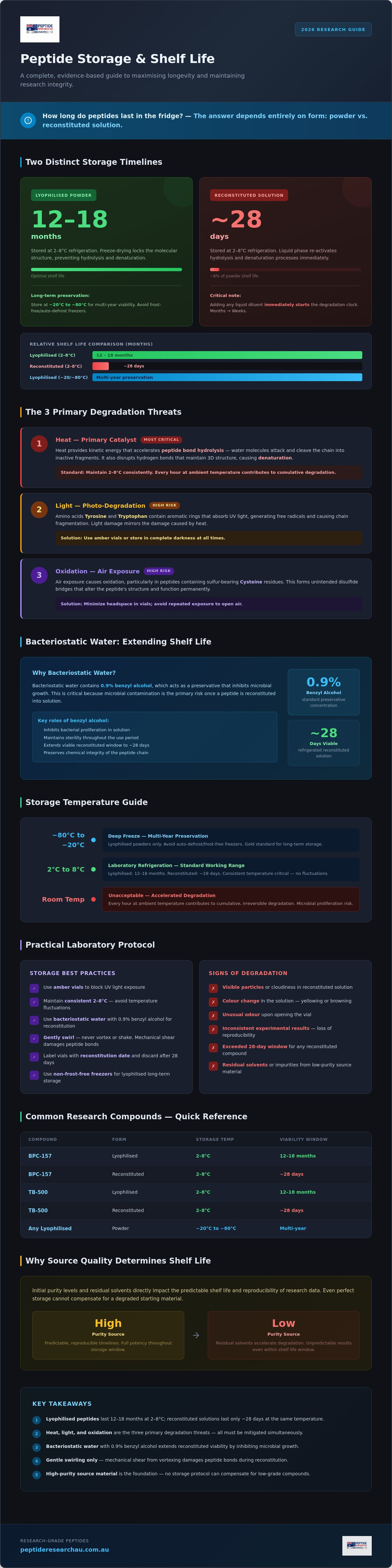
Lyophilisation, or freeze-drying, is a sophisticated stabilization process that removes solvent from a frozen peptide solution through sublimation. This technique locks the molecular structure into a stable, solid state by preventing the movement of atoms that would otherwise lead to chemical degradation. When determining how long do peptides last in the fridge, the answer depends entirely on whether the compound remains in this lyophilised form or has been mixed into a solution. In its freeze-dried state, a peptide is remarkably resilient, maintaining its integrity for 12 to 18 months when refrigerated at 2-8°C.
The introduction of a liquid diluent fundamentally changes this stability profile. Once you add bacteriostatic water or a laboratory diluent, you trigger the degradation clock. In an aqueous environment, peptides are no longer "locked" and become susceptible to the hydrolysis and denaturation processes that compromise their primary and secondary structures. Most reconstituted research compounds only maintain their full potency for approximately 28 days in the fridge. Understanding how long do peptides last in the fridge is essential for experimental budgeting, as the shift from powder to liquid reduces the viable window from months to weeks.
Storing Lyophilised Peptides for Long-Term Use
Maintaining a temperature between -20°C and -80°C is the gold standard for multi-year preservation of lyophilised powders. It's vital to avoid "auto-defrost" or "frost-free" freezers for this purpose. These units undergo regular temperature spikes to melt internal ice, which can cause subtle but cumulative damage to the peptide's delicate bonds. Proper sealing is equally critical because lyophilised cakes are hygroscopic, meaning they naturally attract moisture from the environment. Following a standardized NIBSC peptide storage protocol ensures that vials reach room temperature before opening, which prevents atmospheric moisture from condensing inside the vial and initiating premature degradation.
The Reconstitution Clock: What Happens Post-Mixing?
Reconstitution marks the transition from a stable solid to a sensitive solution. Different sequences exhibit varying levels of resilience during this phase. For instance, BPC-157 is generally noted for its stability, while TB-500 requires more meticulous handling to avoid loss of potency. Despite these variations, the 28-day rule remains the safest benchmark for researchers. Most laboratories aim to utilize the entire contents of a reconstituted vial within one month to ensure data consistency and experimental reproducibility. To ensure your study begins with the highest possible stability, it's essential to source Research Peptides from providers who utilize high-vacuum sealing and rigorous lyophilisation standards.
The Role of Bacteriostatic Water in Extending Refrigerated Shelf Life
Bacteriostatic water is a sterile, non-pyrogenic preparation of water containing 0.9% benzyl alcohol. Its primary function in a laboratory setting is to serve as a multi-dose diluent for research compounds. The benzyl alcohol inhibits the proliferation of most bacteria, ensuring the vial remains safe for repeated sampling over several weeks. Sterile water (USP) lacks this preservative and is strictly for single-use applications. Once a vial of sterile water is punctured, it must be discarded within 24 hours to prevent microbial contamination. This distinction is critical for researchers tracking how long do peptides last in the fridge, as using the wrong diluent will cause the experiment to fail within days due to bacterial overgrowth.
While bacteriostatic water is excellent for maintaining sterility, it's not a preservative for the peptide's molecular structure. The benzyl alcohol doesn't stop the hydrolysis process or the thermal degradation discussed in previous sections. Potency loss continues regardless of the diluent's sterile status. Consequently, determining how long do peptides last in the fridge involves monitoring both chemical stability and biological safety. A solution can be perfectly sterile but completely inactive if the peptide bonds have broken down.
BAC Water vs. Sterile Saline: Stability Comparison
Sterile saline or plain sterile water provides no defense against microorganisms introduced during reconstitution. Using these liquids limits the refrigerated life of a solution to a maximum of 48 hours. Benzyl alcohol provides a kinetic barrier against contamination, but it's a mild solvent that can interact with the peptide solution. Researchers should consult our guide on What are Peptides? to understand the inherent molecular fragility that necessitates such precise diluent choices. Some extremely sensitive sequences may aggregate when exposed to high concentrations of benzyl alcohol, though 0.9% is generally accepted as the standard for research stability.
Storage Limits of Reconstitution Supplies
The 28-day rule applies to the bacteriostatic water itself once the vial has been opened. Over time, the benzyl alcohol loses its efficacy as a preservative. Even if the peptide is theoretically stable for longer, the risk of microbial contamination increases significantly after four weeks. Researchers must inspect their diluents before every use. Signs of compromise include cloudiness, visible particulates, or any discoloration. To maintain the integrity of your supplies, store unused bacteriostatic water in a cool, dark environment away from direct sunlight. Proper inventory management ensures that the diluent doesn't become the weak link in your experimental timeline.
Practical Protocol: Maximising Longevity and Identifying Degradation
Maintaining the integrity of research compounds requires a disciplined laboratory protocol that begins the moment the package arrives. The first step is a visual inspection of the lyophilised cake. A high-quality product should appear as a solid, uniform mass or a fine white powder. If the cake appears collapsed, shrunken, or discoloured, it may indicate moisture ingress or thermal exposure during transit. These physical changes suggest the peptide's structural stability is already compromised before reconstitution begins.
The reconstitution process itself must be performed with precision to avoid mechanical shear stress. When introducing a diluent, aim the needle at the side of the glass vial so the liquid drips slowly onto the powder. Never shake the vial. Instead, use a gentle swirling motion until the solution is clear. Shaking can lead to the aggregation of delicate amino acid chains, rendering the compound useless. Once mixed, immediate labeling is mandatory. Clearly mark the vial with the "Date of Reconstitution" to ensure you remain within the established window of how long do peptides last in the fridge. For optimal stability, place the vials on a middle shelf. Avoid the fridge door, where temperature fluctuations are frequent, and the back wall, where the solution risk accidental freezing.
The Aliquoting Protocol for Long-Term Liquid Storage
If a study requires a large volume of solution over an extended period, aliquoting is the most effective strategy to preserve potency. This involves dividing the reconstituted solution into smaller, single-use sterile glass vials. Glass is the preferred medium because specific medical-grade plastics can occasionally absorb peptide molecules onto their surface. This method prevents the damage caused by repeated freeze-thaw cycles, which are catastrophic to molecular bonds. When you are ready to use an aliquot, allow it to thaw naturally at room temperature. Never apply heat, as the rapid transition can "heat-shock" the peptide and cause denaturation.
Signs of Peptide Degradation: When to Discard
Researchers must be vigilant in identifying signs of molecular breakdown. Visual indicators are the most common red flags. If a solution that was previously clear becomes cloudy or develops visible particulates, precipitation has occurred. This is a definitive sign of degradation. While some chemical scent changes can occur with specific sequences, they are rare. It is vital to remember that a solution can remain perfectly clear while losing its biological efficacy. If experimental results become inconsistent near the end of the 28-day refrigerated window, the peptide has likely lost its potency. To ensure your laboratory maintains the highest standards of data integrity, always source high-purity Research Compounds that arrive with verified stability profiles.
Cold Chain Management in Australian Environments
The Australian climate presents unique challenges for peptide storage, particularly during the summer months. High ambient temperatures can cause rapid degradation during the short periods a vial is removed from the fridge for sampling. In these environments, using insulated vial carriers or small laboratory ice buckets is essential for maintaining the cold chain. Furthermore, Australian researchers must account for potential power fluctuations or heatwaves that can compromise standard refrigeration units. Utilizing a dedicated laboratory fridge with a digital temperature logger provides the necessary data to confirm that your compounds have remained within the critical 2-8°C range throughout their storage life. Understanding how long do peptides last in the fridge is only useful if the internal environment of that fridge remains constant.
Sourcing Quality Peptides to Ensure Maximum Stability
The predictable shelf life of a research compound is established during the manufacturing process. High initial purity, typically 98% or greater, serves as the foundation for molecular longevity. When a peptide contains significant impurities, those residual substances often act as catalysts for chemical breakdown. Specifically, residual Trifluoroacetic acid (TFA) or various salts left over from the synthesis process can accelerate the hydrolysis of peptide bonds. These contaminants provide the chemical pathways for degradation to occur even in a temperature-controlled environment. If you are assessing how long do peptides last in the fridge, you must acknowledge that a lower-grade product will degrade significantly faster than a laboratory-standard compound.
Moisture protection is another critical variable in the sourcing phase. Quality suppliers utilize high-vacuum sealing for every vial to ensure the lyophilised cake remains in a desiccated state. Any breach in this seal allows atmospheric moisture to enter, which immediately compromises the stability of the freeze-dried powder. Furthermore, the logistics of procurement in the Australian climate require careful consideration. Domestic shipping is superior to international transit because it minimizes the time a product spends in uncontrolled thermal environments, such as shipping containers or airport tarmacs. Reducing transit time is a vital step in maintaining the cold chain before the product ever reaches your laboratory refrigerator.
The Importance of Third-Party Testing
Verifying the purity and quantity of a compound through independent analysis is a prerequisite for professional study. High-Performance Liquid Chromatography (HPLC) and Mass Spectrometry (MS) reports provide the necessary data to confirm that the lyophilised cake is free from the catalysts that drive premature decay. These reports ensure that the molecular weight matches the intended sequence and that the purity levels meet the rigorous demands of scientific research. For a detailed exploration of these requirements, researchers should consult our Peptides Australia guide on quality sourcing and standards.
Why Peptide Research AU is the Preferred Choice for Australian Researchers
We maintain a strict commitment to laboratory-grade standards and rigorous quality control for all our offerings. Our facility prioritizes fast domestic dispatch to ensure that the cold chain is preserved from our warehouse to your laboratory bench. By minimizing environmental exposure during transit, we provide researchers with compounds that possess the maximum possible shelf life. We also supply the necessary laboratory diluents, such as bacteriostatic water, to ensure your reconstitution protocol is standardized and secure. Accurate data depends on the stability of your materials. Browse our range of high-purity research peptides today.
Understanding how long do peptides last in the fridge is the final step in a comprehensive quality management strategy. By selecting high-purity compounds and following the storage protocols outlined in this guide, you ensure that your research remains consistent, reproducible, and focused on technical advancement.
Optimising Laboratory Outcomes Through Precision Storage
Precision in storage isn't just about temperature; it's about maintaining the chemical integrity established during synthesis. You've learned that the molecular state of your compound determines its viability, with lyophilised powders offering significantly more resilience than aqueous solutions. Understanding exactly how long do peptides last in the fridge allows you to plan experimental cycles without the risk of using degraded or inert materials. By implementing standardized protocols, such as using bacteriostatic water and avoiding mechanical shear stress, you protect your research assets from avoidable variability.
The success of your study begins with sourcing materials that meet rigorous laboratory-grade purity standards. We ensure every vial undergoes comprehensive third-party HPLC testing to verify its profile before it reaches your facility. Our commitment to fast domestic Australian shipping ensures your compounds remain within the necessary thermal range during transit, preserving the cold chain. Secure your high-purity research compounds at Peptide Research AU to ensure your next project is built on a foundation of excellence. Consistent methodology and quality sourcing will lead to the reliable, high-fidelity results your research demands.
Frequently Asked Questions
Can I store reconstituted peptides in the freezer?
Freezing reconstituted peptides is not recommended due to the risk of structural damage. The formation of ice crystals can shear the delicate amino acid chains, causing denaturation. This process fundamentally alters the peptide's biological activity and renders it less effective for study. To maintain integrity, keep liquid solutions at a consistent refrigerated temperature of 2-8°C. Only lyophilised powders should be considered for freezer storage at -20°C for long-term preservation.
What happens if I accidentally leave my peptides at room temperature overnight?
Accidental exposure to room temperature for a short duration accelerates the degradation process but doesn't always result in total potency loss. The impact depends on the specific sequence's thermal stability and the ambient temperature of the room. While a single night might not render the vial useless, it reduces the total duration of how long do peptides last in the fridge. Researchers should return the vial to cold storage immediately and monitor for visual changes.
How can I tell if my BPC-157 has gone bad in the fridge?
Visual changes and inconsistent research data are the primary signs of degradation in BPC-157. If the solution becomes cloudy or contains visible particulates, the peptide has likely aggregated or precipitated out of the solution. These physical changes indicate that the molecular structure is no longer intact. Since potency loss can occur without visual cues, following strict 28-day disposal protocols is the most reliable way to ensure experimental consistency.
Does the colour of the peptide vial matter for storage?
Amber or tinted glass vials provide essential protection against photo-degradation. Specific amino acids are highly sensitive to ultraviolet light, which can cause chain fragmentation and loss of potency. If your research compounds arrive in clear glass, it's vital to store them in a completely dark environment. Utilizing a light-proof secondary container within your laboratory refrigerator prevents light exposure from compromising the stability of your sensitive peptide sequences.
Is it safe to use peptides after the 4-week refrigerated window?
Using research compounds beyond the 28-day refrigerated window is not advised for accurate data collection. While the peptide might retain some activity, the preservative efficacy of bacteriostatic water begins to decline after four weeks. This increases the probability of microbial proliferation within the vial. To ensure laboratory safety and the reproducibility of your findings, always adhere to the standard one-month disposal rule for all reconstituted solutions.
Why do some peptides last longer in the fridge than others?
Molecular stability varies based on the unique amino acid sequence and the purity of the synthesis. Peptides with a higher percentage of stable bonds or those lacking sensitive residues like Cysteine naturally resist hydrolysis longer. Additionally, higher purity levels mean fewer residual solvents are present to catalyze degradation. These internal factors determine how long do peptides last in the fridge compared to more fragile sequences that require immediate use.
How should I store peptides during a move or long-distance travel?
Maintain the cold chain during transport by using insulated laboratory carriers equipped with gel ice packs. It's critical to prevent the vials from touching the ice directly, as this can cause localized freezing and subsequent structural damage. For long-distance travel, use a digital temperature logger to confirm the environment stayed between 2-8°C. Proper insulation is the only way to protect your laboratory assets from high ambient temperatures during transit.
Does bacteriostatic water expire once it is in the fridge?
Bacteriostatic water has a limited shelf life of 28 days once the vial is punctured. The 0.9% benzyl alcohol serves as a preservative to inhibit bacterial growth, but its effectiveness is not indefinite. After the one-month mark, the sterility of the diluent can no longer be guaranteed. Researchers must discard opened diluent vials according to this timeline to prevent introducing contaminants into their peptide solutions during the reconstitution process.


Comments