
High Quality TB-500 for Sale: The 2026 Australian Researcher’s Guide
- peptideresearchau
- Jun 1
- 11 min read
If your laboratory results depend on a specific molecular sequence, can you afford to trust a supplier that hides behind a generic certificate of analysis? Locating high quality tb-500 for sale in Australia requires more than a simple search; it demands a rigorous assessment of analytical data and domestic logistics. Many researchers struggle with the uncertainty of imported batches and the risk of interception; the TGA seized 847 peptide shipments in the first quarter of 2026 alone. This environment makes verifying the chemical integrity of your research peptides a critical priority for any professional study.
You likely recognize that inconsistent purity levels or untrustworthy documentation can compromise the integrity of your entire project. This guide establishes a professional standard for sourcing laboratory-grade compounds by focusing on technical verification and analytical transparency. We'll examine how to interpret HPLC and mass spectrometry reports to confirm 99% purity and discuss the advantages of maintaining a domestic chain of custody to avoid the delays associated with international shipping. By prioritizing precision and data, you ensure your research compounds meet the highest manufacturing standards available.
Key Takeaways
Learn why the specific 43-amino acid sequence of TB-500 is essential for accurate research into Thymosin Beta-4 analogues.
Understand how to interpret HPLC and Mass Spectrometry reports to verify that high quality tb-500 for sale meets the 99% purity benchmark.
Identify the critical risks of international peptide sourcing, including customs seizures and potential compound degradation during transit.
Master laboratory protocols for reconstitution and storage using sterile diluents to maintain peptide stability and research integrity.
Discover the methodology used to ensure batch-specific transparency and professional-grade quality for Australian researchers.
Table of Contents
Defining High Quality TB-500 in a Research Context
Research integrity begins with chemical precision. When identifying high quality tb-500 for sale, a researcher must distinguish between a standardized synthetic analogue and inferior industrial compounds. TB-500 is the synthetic version of the naturally occurring protein Thymosin beta-4; it's characterized by its specific 43-amino acid sequence. This molecular structure is essential for maintaining the biological activity required in controlled laboratory studies. In a professional setting, the distinction between "industrial grade" and "research grade" is not merely semantic. Industrial compounds often contain heavy metals or residual solvents that interfere with cellular assays. For any peer-reviewed or professional study, purity levels below 98% are unacceptable. Impurities act as uncontrolled variables that can lead to false positives or inconsistent data sets.
Thymosin Beta-4 vs. TB-500: Understanding the Distinction
While the terms are often used interchangeably, TB-500 specifically refers to the synthetic peptide used to replicate the effects of the full-length protein. A critical focus of modern cellular research involves the Ac-Ser-Asp-Lys-Pro sequence. This specific fragment is believed to be the primary site responsible for many of the peptide's observed effects in laboratory models. You should be cautious of vendors selling shorter, non-standardized fragments under the TB-500 label. Securing high quality tb-500 for sale ensures you are working with the correct molecular weight and amino acid chain necessary for reproducible results.
The Importance of Lyophilisation for Stability
Peptides are inherently fragile molecules. To prevent degradation, high-purity TB-500 undergoes lyophilisation, a sophisticated freeze-drying process that removes moisture while preserving the peptide's primary structure. This process is vital for long-term stability during transit and storage. Reliable laboratory compounds arrive in a vacuum-sealed state, appearing as a solid, white "cake" or plug at the bottom of the vial. If a product arrives as a loose, shifting powder, it may indicate a failure in the lyophilisation process or exposure to moisture. A well-formed cake is a visual marker of professional manufacturing and suggests the peptide's integrity hasn't been compromised by temperature fluctuations or improper sealing.
Precision is paramount. By insisting on 99%+ purity and verified lyophilisation, researchers protect their data from the complications of chemical degradation. High-quality sourcing isn't just about the compound itself; it's about the technical standards that guarantee the vial contains exactly what the label claims.
Analytical Purity: Understanding HPLC and MS Reports for TB-500
HPLC is the analytical benchmark for determining chemical purity in peptide synthesis. While many vendors claim to offer high quality tb-500 for sale, these assertions remain anecdotal without a corresponding High-Performance Liquid Chromatography (HPLC) report. This process separates the mixture into individual components, allowing researchers to quantify the exact percentage of the target peptide relative to synthesis byproducts. Current research on the function of Thymosin β4 relies on these high-purity standards to avoid biochemical interference from unwanted contaminants. Without this data, you're essentially conducting research in the dark.
How to Read an HPLC Chromatogram
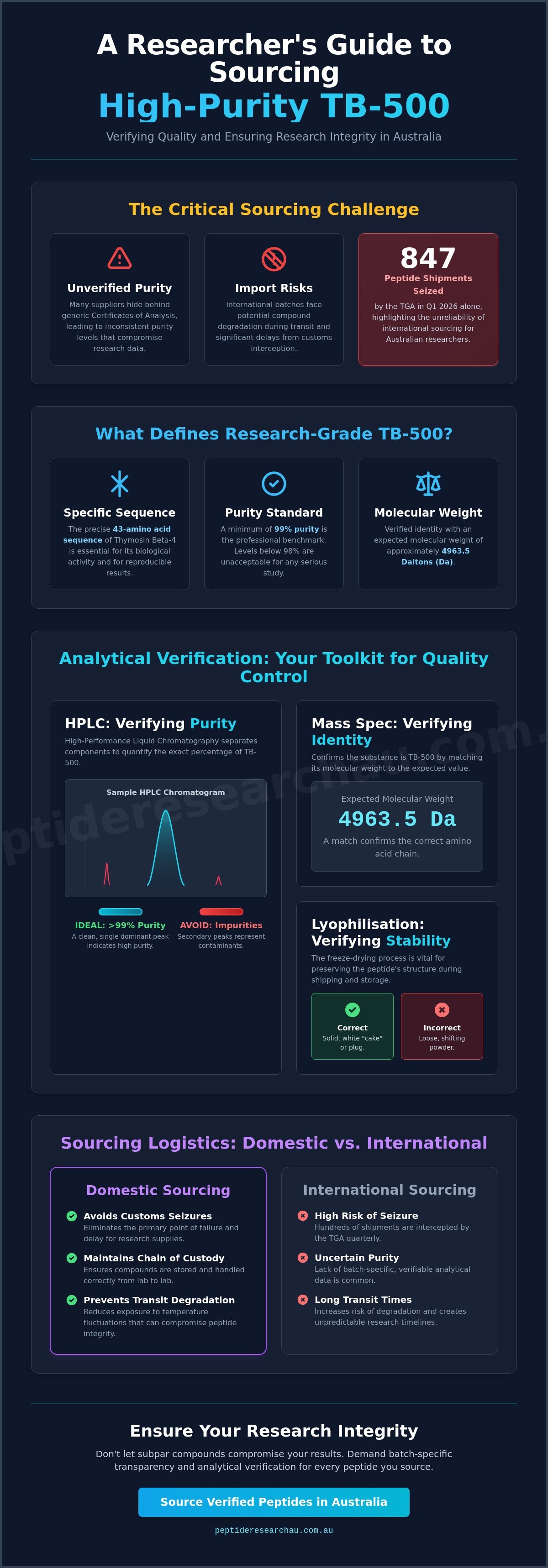
A chromatogram is a visual representation of a peptide's purity. You'll see a graph with various peaks; the tallest, most prominent peak represents the target TB-500 sequence. Analysts use the "area under the curve" (AUC) method to calculate the final purity percentage. If the main peak accounts for 99% of the total area, the peptide's purity is 99%. Any secondary peaks, often referred to as "noise" or baseline fluctuations, indicate the presence of synthesis impurities such as truncated sequences or residual reagents. A clean, single-peak profile is the hallmark of a professional-grade compound.
Verifying Molecular Weight via Mass Spectrometry
Mass Spectrometry (MS) serves a different but equally vital purpose: identity verification. While HPLC tells you how much of a substance is there, MS confirms exactly what that substance is. The expected molecular weight for TB-500 is approximately 4963.5 Daltons (Da). A variance of even a single Dalton can signal a sequence error, such as a missing amino acid or an incorrect substitution during synthesis. Mass accuracy is the only way to ensure the peptide you've purchased is actually TB-500 and not a closely related but functionally different fragment. It's the ultimate safeguard for sequence-specific research.
Low-quality syntheses often contain hidden contaminants like residual trifluoroacetic acid (TFA), acetonitrile, or heavy metals. These substances don't always appear as distinct peaks on a standard HPLC report but can significantly impact cellular viability in a laboratory setting. This is why independent, third-party testing is superior to manufacturer-provided reports. Third-party labs provide an objective, unbiased assessment that eliminates the conflict of interest inherent in in-house testing. To maintain the highest standards in your laboratory, you can source high-purity research peptides that include comprehensive, batch-specific analytical data. Securing high quality tb-500 for sale from a transparent provider ensures your research is built on a foundation of chemical excellence.
Sourcing TB-500 for Sale in Australia: Domestic vs. International
Choosing a supply chain is as critical as the chemical purity itself. While international vendors often attract attention with lower entry costs, the logistical risks in 2026 are substantial. Australian Border Force and the TGA have intensified their scrutiny, resulting in 847 peptide shipments being seized in the first quarter of 2026 alone. Beyond legal risks, international transit introduces variables like temperature fluctuations and mechanical stress that can compromise the delicate 43-amino acid structure of the peptide. Sourcing high quality tb-500 for sale within Australia mitigates these risks by ensuring a shorter, more transparent chain of custody.
Logistical Advantages of Australian Sourcing
Time is a factor in peptide stability. Domestic shipping typically takes 24 to 48 hours, whereas international orders often spend weeks in transit. During this time, vials may sit in unconditioned cargo holds or customs warehouses. Prolonged heat exposure is detrimental; it accelerates the degradation of even lyophilised compounds. By utilizing Australian Express Post, researchers ensure their laboratory supplies remain within a controlled environment for the majority of the journey. This efficiency preserves the potency of the peptide, ensuring that the analytical purity verified by FDA guidance on peptide purity standards isn't lost before the vial reaches the lab.
Navigating Customs and Compliance in 2026
The regulatory environment in Australia is strict. TB-500 is currently classified as a Schedule 4 substance, meaning unauthorized importation for personal use is a regulatory offense. The "Research Use Only" (RUO) designation remains a critical compliance factor for legitimate laboratory studies. Professional suppliers ensure that all high quality tb-500 for sale is clearly labeled for in-vitro or animal research, adhering to the necessary legal frameworks. This distinction is vital for institutional compliance and protects the researcher's standing. For a deeper analysis of these regulations, you should consult the Peptides Australia guide on quality sourcing and standards. Local suppliers who understand these nuances provide a layer of security that overseas entities cannot match, allowing you to focus on data collection rather than customs disputes.
Laboratory Protocols: Reconstitution, Storage, and Handling
Securing high quality tb-500 for sale is only the first step in maintaining research integrity. The subsequent handling of the vial determines whether the peptide retains its molecular configuration or succumbs to environmental degradation. Researchers must operate within a sterile field to prevent cross-contamination. This protocol starts with selecting the correct solvent. Bacteriostatic water is the required diluent for multi-use research vials; its 0.9% benzyl alcohol content suppresses microbial proliferation. Using standard sterile water without a preservative is unsuitable for studies extending beyond a single day, as it lacks the necessary antimicrobial properties.
Step-by-Step Reconstitution Protocol
Reconstitution requires a meticulous approach to avoid denaturing the peptide's 43-amino acid chain. Before beginning, wipe the vial's rubber stopper with 70% isopropyl alcohol to ensure a sterile entry point. When adding the diluent, aim the needle toward the inner glass wall so the liquid trickles down slowly. Rapid injection can cause significant peptide mechanical stress, which may shear the delicate sequence and render the compound useless. After adding the solvent, use a gentle swirling motion to dissolve the lyophilised cake. You shouldn't shake the vial; vigorous agitation creates foam and can lead to irreversible structural damage.
Optimal Storage Temperatures for TB-500
Peptide stability is highly dependent on thermal control. For long-term storage, keep the lyophilised powder in a specialized laboratory freezer at temperatures ranging from -20°C to -80°C. In this state, the compound maintains its integrity for approximately 24 months. Once you've reconstituted the peptide, the stability window narrows significantly. Reconstituted solutions must stay in a refrigerated environment between 2°C and 8°C to slow the inevitable rate of hydrolysis. Even under these conditions, the peptide's potency begins to decline after 10 to 14 days.
Environmental factors like UV light also pose a threat. Photodegradation can occur if vials are left exposed on laboratory benches; always store them in an opaque box or original packaging. By following these rigorous handling standards, you safeguard the analytical purity of your high quality tb-500 for sale. If you require specialized supplies to support your protocols, you can buy research compounds and laboratory diluents from a provider that prioritizes technical precision.
Securing Reliable Compounds: Why Peptide Research AU Sets the Standard
Peptide Research AU maintains a rigorous analytical standard for all research compounds. We prioritize chemical excellence by ensuring every vial meets a 99%+ purity benchmark. When you look for high quality tb-500 for sale, the primary differentiator is verifiable data. We provide batch-specific HPLC and MS reports to confirm the identity and concentration of every product. Our role is to serve as the definitive resource for TB-500 research, providing the analytical transparency required for high-level scientific inquiry. Our commitment to data-driven sourcing eliminates the guesswork often associated with unregulated research markets. We ensure that every compound adheres to the highest manufacturing standards and rigorous methodology.
The Peptide Research AU Quality Guarantee
Our methodology begins with the selection of premium laboratory-grade precursors. We don't rely solely on external manufacturer claims. Instead, we implement secondary verification protocols on all domestic stock. This involves re-testing batches using High-Performance Liquid Chromatography to identify trace impurities that standard audits might overlook. This commitment to reliability ensures you receive compounds that perform predictably in every trial. We verify the absence of residual solvents and heavy metals in every batch to maintain a clinical standard of quality. Researchers requiring specific analytical data or custom specifications are encouraged to contact our technical team for detailed data requests. We allow the technical nature of our compounds to establish their value through precision and data.
Streamlined Ordering and Support
Efficiency in the laboratory is supported by reliable logistics and technical expertise. We offer a unified platform where you can source high quality tb-500 for sale along with necessary laboratory diluents in a single transaction. Every order is shipped in professional laboratory packaging. This includes vacuum-sealed containers that protect the lyophilised cake from environmental stressors like moisture and UV light. Our Australian-based support team possesses the technical expertise to address complex queries regarding peptide stability and handling. This local presence ensures you receive timely assistance from professionals who understand the specific requirements of the Australian research community. We prioritize a logical and hierarchical communication flow to ensure you have access to the data you need when you need it.
Advancing Analytical Standards in Australian Research
Precision in scientific inquiry depends on the chemical fidelity of your starting materials. You've seen how identifying high quality tb-500 for sale requires a focus on analytical transparency and domestic logistics. By prioritizing batch-specific HPLC and MS reports, you eliminate variables that compromise study results. Domestic sourcing further protects your project by ensuring a short chain of custody and rapid delivery within Australia. These technical safeguards are essential for maintaining the integrity of the 43-amino acid sequence from synthesis to reconstitution.
Maintaining these standards ensures your laboratory data remains reliable and reproducible. We provide a 99%+ purity guarantee supported by third-party verification to meet your professional requirements. You can also rely on discreet overnight Australian shipping to maintain your project's momentum. Browse our laboratory-grade TB-500 for sale to secure the high-purity compounds your research deserves. Your commitment to precision is the foundation of meaningful scientific advancement.
Frequently Asked Questions
Is TB-500 legal for sale in Australia for research purposes?
TB-500 is classified as a Schedule 4 (Prescription Only Medicine) substance by the Therapeutic Goods Administration (TGA). While many online vendors provide it under the "research chemical" label to navigate legal loopholes, these products aren't regulated by the TGA for safety or efficacy. Researchers should ensure their institutional protocols align with current Australian law regarding the possession of scheduled substances for legitimate laboratory study and in-vitro applications.
What is the standard purity level for high-quality TB-500?
The industry benchmark for professional research peptides is 99% or higher. When evaluating high quality tb-500 for sale, anything below a 98% purity threshold is considered unacceptable for controlled scientific studies. Impurities in lower-grade batches act as uncontrolled variables. These contaminants can introduce biochemical noise into your experiments, potentially compromising the validity of your data and the reproducibility of your results.
How should I store TB-500 to prevent degradation?
Lyophilised TB-500 should be stored in a laboratory freezer at -20°C for short-term use or -80°C for long-term preservation. Once the peptide is reconstituted, it must be kept refrigerated between 2°C and 8°C. You should also protect the vials from UV light exposure and avoid frequent freeze-thaw cycles. These environmental factors accelerate the degradation of the peptide's 43-amino acid sequence and reduce its potency.
What is the difference between TB-500 and BPC-157 in a lab setting?
TB-500 is a synthetic fragment of Thymosin Beta-4, primarily studied for its role in cellular migration and actin sequestration. In contrast, BPC-157 is a pentadecapeptide derived from human gastric juice, often researched for its angiogenic and cytoprotective properties. While both are used in regenerative research, they operate through distinct biochemical pathways. They're frequently combined in multi-peptide complexes to study potential synergistic effects in laboratory models.
Can TB-500 be reconstituted with sterile water instead of bacteriostatic water?
Sterile water is suitable only for single-use applications where the entire vial is utilized immediately. For multi-use research vials, bacteriostatic water containing 0.9% benzyl alcohol is required to inhibit bacterial growth. Using a diluent without a preservative in a multi-use setting increases the risk of microbial contamination. This can degrade the peptide over time and introduce unwanted biological variables into your experimental outcomes.
How long does shipping take for TB-500 within Australia?
Domestic shipping for research compounds typically takes 24 to 48 hours when using express services. This rapid transit is critical for temperature-sensitive vials, as it minimizes the time the peptide spends in uncontrolled cargo environments. Choosing a local supplier ensures a shorter chain of custody compared to international shipping, which can take several weeks and faces a high risk of interception by authorities.
Does TB-500 require a prescription for laboratory research?
Under TGA regulations, TB-500 is a Schedule 4 substance that requires a prescription for human therapeutic use. However, when sourcing high quality tb-500 for sale as a research chemical, it's provided specifically for laboratory and in-vitro studies. Researchers must ensure they don't use these compounds for human consumption. They're not manufactured under TGA-approved clinical standards and are intended solely for professional study in a controlled environment.
How can I verify the HPLC report provided with my peptide order?
You can verify an HPLC report by examining the primary peak on the chromatogram, which should represent at least 99% of the total area under the curve. Cross-reference the batch number on the report with the label on your vial for consistency. Additionally, ensure the accompanying Mass Spectrometry data shows a molecular weight of approximately 4963.5 Da. This confirms the identity of the TB-500 sequence matches the analytical standard.


Comments