
GHRP-6 Research Peptide AU: A Comprehensive 2026 Scientific Guide
- peptideresearchau
- Jul 8
- 11 min read
Relying on international supply chains for high-fidelity biochemical research in 2026 is no longer a viable strategy for Australian laboratories. The Therapeutic Goods Administration's April 2026 safety advisory and heightened border scrutiny mean that overseas procurement frequently results in seizures or significant logistics delays. You likely understand the frustration of receiving inconsistent samples that lack verified purity or clear reconstitution data, which ultimately threatens the precision of your longitudinal data.
This guide offers a definitive technical overview of the ghrp-6 research peptide au, focusing on its molecular mechanism and professional laboratory application. We provide a rigorous analysis of the GHS-R1a receptor interaction and the specific chemical nomenclature required for stable research environments. By the end of this article, you'll be equipped to identify optimal research synergies, such as CJC-1295 combinations, and secure a reliable, domestic source for your 2026 projects. This ensures your methodology remains both compliant and precise while avoiding the risks associated with unverified international vendors.
Table of Contents
Understanding GHRP-6: A Synthetic Hexapeptide Overview
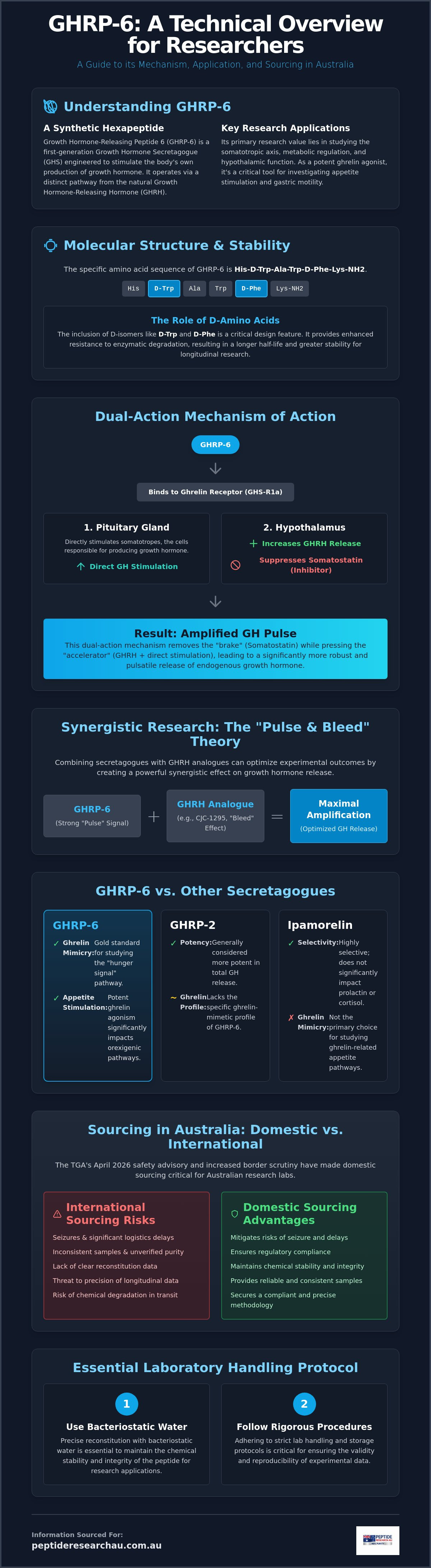
Growth hormone-releasing peptide 6 (GHRP-6) is a synthetic hexapeptide specifically engineered to stimulate the secretion of endogenous growth hormone. As a first-generation growth hormone secretagogue (GHS), it holds significant historical and functional importance in endocrine research. It was developed during a period of intense study into the somatotropic axis, serving as a foundational compound for understanding how non-GHRH pathways influence hormonal output. Unlike Growth Hormone Releasing Hormone (GHRH), which primarily acts on the pituitary gland to trigger release, GHRP-6 utilizes a distinct, complementary pathway. It engages the ghrelin receptor, signaling both the pituitary gland and the hypothalamus to initiate a pulsatile release of growth hormone. This dual-action mechanism makes the ghrp-6 research peptide au a primary subject for studies focused on metabolic regulation and hypothalamic function.
Molecular Structure and Composition
The molecular architecture of GHRP-6 is defined by a specific six amino acid sequence: His-D-Trp-Ala-Trp-D-Phe-Lys-NH2. This arrangement is not arbitrary; the inclusion of D-amino acids, such as D-Trp and D-Phe, is a critical design feature. These D-isomers provide the molecule with enhanced resistance to enzymatic degradation, ensuring a longer half-life within laboratory environments compared to purely L-amino acid chains. GHRP-6 is a met-enkephalin derivative used for endocrine research. Its structural stability allows researchers to observe prolonged biological interactions without the rapid breakdown common in naturally occurring peptides. This chemical resilience is essential for maintaining the integrity of longitudinal research data in controlled environments.
GHRP-6 vs. Other Secretagogues
When evaluating GHRP-6 within the broader context of peptides australia research frameworks, its unique properties become evident. While GHRP-2 and Ipamorelin are also widely studied secretagogues, their physiological profiles differ significantly. GHRP-2 is generally considered more potent in terms of total growth hormone release but lacks the specific ghrelin-mimetic profile of GHRP-6. Ipamorelin is often preferred for its high selectivity, as it doesn't significantly impact prolactin or cortisol levels. However, GHRP-6 remains the gold standard for investigating the "hunger signal" pathway. Because it mimics ghrelin, it's instrumental in research examining appetite stimulation and gastric motility. This specific property distinguishes the ghrp-6 research peptide au from its successors, providing a specialized tool for metabolic and nutritional studies that require a potent ghrelin agonist. Research laboratories often choose GHRP-6 when the objective involves studying the intersection of growth hormone release and orexigenic pathways.
Mechanism of Action: The Ghrelin Receptor Pathway
GHRP-6 functions as a potent agonist of the Growth Hormone Secretagogue Receptor (GHS-R1a). This receptor is primarily located in the anterior pituitary gland and the arcuate nucleus of the hypothalamus. By binding to GHS-R1a, the peptide initiates a complex signaling cascade that bypasses the traditional Growth Hormone Releasing Hormone (GHRH) pathway. This interaction is central to the ghrp-6 research peptide au profile, as it provides a direct method for stimulating endogenous growth hormone release in controlled laboratory models. The molecular mechanism ensures that the peptide remains effective even when the GHRH receptor is downregulated or inactive.
The efficacy of GHRP-6 stems from its dual-site action. In the pituitary, it directly stimulates somatotropes. In the hypothalamus, it triggers the release of GHRH while simultaneously suppressing somatostatin, the body's natural growth hormone inhibitor. This coordinated effort results in a significant amplification of the GH pulse. Researchers often refer to this as somatotrope recruitment, where a higher percentage of available cells are activated to secrete hormone. A historical appraisal of GHRPs indicates that this multi-faceted approach is what allows GHRP-6 to maintain its status as a primary research tool despite the development of newer analogues. By removing the "brake" of somatostatin, GHRP-6 allows for a more robust secretory response than GHRH alone.
GHS-R1a Agonism and Endocrine Response
GHRP-6 mimics the biological action of endogenous ghrelin, often called the "hunger hormone." Upon binding to GHS-R1a, it activates the phospholipase C (PLC) pathway, leading to an increase in intracellular calcium levels. This flux is the primary trigger for the exocytosis of growth hormone. While highly effective, researchers must account for its lack of total selectivity. In many research models, high concentrations of GHRP-6 can cause transient elevations in secondary hormones, specifically Prolactin and Cortisol. These secondary endocrine responses are critical variables in metabolic studies. For those requiring high-purity samples for such sensitive assays, sourcing from a reliable provider of research peptides ensures experimental consistency.
Impact on Gastric Motility and Appetite
The influence of GHS-R1a activation extends beyond the pituitary gland. Because these receptors are also present in the gastrointestinal tract and the central nervous system, GHRP-6 exerts notable extra-pituitary effects. It significantly enhances gastric emptying and stimulates appetite through its orexigenic properties. This makes the ghrp-6 research peptide au a valuable subject for investigating treatments for cachexia, also known as wasting syndrome, and other severe metabolic disorders. GHRP-6 modulates various non-growth hormone related pathways in laboratory subjects by directly influencing the neural circuits responsible for energy homeostasis and nutrient intake. These gastroprokinetic effects provide a broader research scope beyond simple hormonal secretion, allowing for comprehensive studies into systemic metabolic health.
Synergistic Research: GHRP-6 and GHRH Combinations
Endocrine research frequently prioritizes the potentiation of growth hormone (GH) secretion through multi-peptide administration. The most documented method involves the "Pulse and Bleed" theory. This concept describes the interaction between a Growth Hormone Releasing Hormone (GHRH) and a Growth Hormone Secretagogue (GHS). While GHRH initiates the release process, often referred to as the "bleed" or baseline signal, the GHS amplifies the magnitude of the resulting pulse. Utilizing ghrp-6 research peptide au in combination with GHRH analogues demonstrates a synergistic rather than merely additive effect. In laboratory settings, this synergy results in GH plasma levels that significantly exceed the mathematical sum of individual monotherapies, providing a more robust model for studying somatotropic signaling and metabolic flux.
GHRP-6 and CJC-1295 Synergy
The combination of GHRP-6 and CJC-1295 remains a primary focus for studies targeting maximum GH output. CJC-1295, a GHRH analogue, mimics the body's natural signal to initiate a GH pulse. However, the magnitude of this pulse is naturally constrained by somatostatin. As established in the previous analysis of the ghrelin receptor pathway, GHRP-6 inhibits somatostatin while simultaneously stimulating the pituitary somatotropes. When these two compounds are administered together, CJC-1295 provides the necessary signal to start the pulse, and GHRP-6 removes the biological "brakes." This allows for a massive surge in GH secretion that monotherapy cannot replicate. Research protocols for multi-peptide complexes typically involve simultaneous administration to capture the peak of this synergistic interaction, ensuring a high-amplitude GH spike.
Researching GHRP-6 with BPC-157
Beyond simple endocrine output, researchers are increasingly investigating the interaction between GHRP-6 and regenerative compounds like bpc 157. While GHRP-6 provides the systemic hormonal environment necessary for cellular growth and metabolism, BPC-157 acts via direct cytoprotective pathways to accelerate the repair of tendons, ligaments, and gastric mucosa. This dual-peptide approach allows for the study of GH-mediated recovery in conjunction with direct tissue healing mechanisms. Some complex research models also incorporate TB-500 to further explore actin-sequestration and cellular migration. When designing these studies, researchers must consider the specific binding affinities and metabolic half-lives of each component. The ghrp-6 research peptide au serves as a reliable baseline for these multi-variable healing studies, ensuring that the hormonal environment is optimized for the secondary regenerative compounds to function. This hierarchical structure of administration is essential for maintaining experimental control and data integrity.
Sourcing GHRP-6 Research Peptides in Australia
The regulatory landscape for 2026 in Australia is defined by rigorous enforcement and heightened border scrutiny. The Therapeutic Goods Administration (TGA) has prioritized the monitoring of unapproved peptide imports, making international procurement a significant liability for professional researchers. Beyond legal risks, international transit exposes the ghrp-6 research peptide au to extreme temperature fluctuations and prolonged customs delays, which can compromise the structural integrity of the hexapeptide. Sourcing domestically ensures that the material remains within a controlled supply chain, adhering to strict laboratory standards from synthesis to delivery. This domestic focus is essential for maintaining the chemical fidelity required for advanced endocrine studies.
Distinguishing between "Laboratory Grade" and inferior industrial grades is critical for experimental validity. Inferior samples often contain residual solvents, TFA (trifluoroacetic acid) levels that exceed safety thresholds, or truncated peptide sequences. Peptide Research AU addresses these concerns by maintaining Australian-based logistics, ensuring that every batch undergoes rigorous quality control within the domestic framework. This commitment to local distribution eliminates the uncertainty of global shipping and provides a reliable baseline for longitudinal studies. Researchers must prioritize providers who offer transparent documentation and verifiable domestic origin to avoid the pitfalls of the global grey market.
Identifying High-Purity Research Compounds
High-Performance Liquid Chromatography (HPLC) is the gold standard for determining the purity of a peptide sample. It separates the components of the mixture to ensure that the primary ghrp-6 research peptide au is isolated from any synthesis byproducts. Mass Spectrometry then confirms the exact molecular weight and identity of the hexapeptide sequence, verifying that the amino acid chain is correctly assembled. For professional research, a purity level of 99% or higher is the industry standard. Anything less introduces unknown variables that can skew data and invalidate results. Reliable sourcing requires these analytical reports for every batch to ensure consistency across different stages of a project.
The Advantages of Domestic AU Shipping
Domestic shipping within Australia offers unparalleled advantages regarding chemical stability. International air freight often subjects sensitive compounds to sub-zero temperatures followed by extreme heat on tarmac surfaces, leading to potential peptide denaturation. Local distribution through a controlled network preserves the lyophilized state of the compound, protecting it from environmental stressors. Researchers can maintain consistent study timelines by accessing research peptides online AU, ensuring that their supply chain is not interrupted by international logistics failures or border seizures. To ensure your laboratory receives verified, high-purity compounds for your 2026 projects, you can buy research peptides from a trusted domestic provider that understands the specific requirements of the Australian scientific community.
Laboratory Handling: Reconstitution and Storage Protocols
Maintaining the structural integrity of the ghrp-6 research peptide au is paramount for achieving reproducible results in endocrine studies. Peptides are inherently fragile molecules. They're susceptible to degradation from thermal, chemical, and mechanical stressors. In a laboratory setting, the transition from a lyophilized powder to a solution requires precise execution to avoid denaturation. Researchers must utilize bacteriostatic water, containing 0.9% benzyl alcohol, for reconstitution. This specific diluent inhibits the growth of potential contaminants, which is essential for preserving the purity of multi-dose research samples over time.
The reconstitution process begins with strict sanitization protocols. Both the peptide vial septum and the diluent container must be cleansed with 70% isopropyl alcohol. When introducing the bacteriostatic water, the needle should be aimed at the inner wall of the vial. This allows the liquid to trickle slowly down the glass, preventing direct high-pressure impact on the lyophilized cake. Once the diluent is added, the vial shouldn't be shaken. Instead, use a gentle swirling motion until the solution is completely clear. Mechanical agitation through shaking can break the delicate peptide bonds, leading to a loss of biological activity and skewed data.
Reconstitution Best Practices
Precise concentration calculations are vital for accurate dosing in research models. If a researcher adds 2mL of bacteriostatic water to a 5mg vial of ghrp-6 research peptide au, the resulting concentration is 2.5mg/mL. This clear metric allows for exact measurement during administration. Maintaining a stable environment post-reconstitution is equally critical. Reconstituted GHRP-6 remains stable for approximately 14 to 21 days when stored at 2-8°C. Beyond this window, the risk of peptide degradation increases significantly, potentially compromising the validity of the study.
Long-term Storage Solutions
For un-reconstituted lyophilized powder, long-term stability is best achieved through deep-freeze protocols. While the powder is stable at room temperature for short periods during transit, it should be stored at -20°C or -80°C for extended durations. This cold storage prevents the slow degradation that occurs even in a dry state. Additionally, researchers must manage light exposure meticulously. UV rays can trigger photo-degradation, altering the chemical composition of the hexapeptide. Vials should be kept in original packaging or amber containers within a dark environment. Finally, any expired or contaminated materials must be disposed of according to standard biohazard protocols, ensuring laboratory safety and environmental compliance.
Advancing Endocrine Research Standards
The evolution of growth hormone secretagogue research in 2026 emphasizes the need for chemical precision and domestic supply chain security. GHRP-6 remains a fundamental hexapeptide for investigating the complex interactions within the somatotropic axis. By understanding its dual action on the pituitary and hypothalamus, alongside its synergistic potential with GHRH analogues, researchers can better map metabolic and orexigenic pathways. Utilizing the ghrp-6 research peptide au within a controlled laboratory framework ensures that experimental data reflects the true biological potential of the compound rather than artifacts of degradation or impurity.
Maintaining high standards requires a commitment to rigorous handling protocols and verified sourcing. Domestic procurement eliminates the variables of international transit and regulatory interference, providing a stable foundation for longitudinal studies. It's essential to prioritize materials that have undergone comprehensive validation. We invite you to view our laboratory-grade GHRP-6 and research compounds to ensure your projects meet the highest scientific benchmarks. Our offerings feature 99%+ purity HPLC testing and fast domestic Australian shipping to maintain secure 2026 regulatory compliance. We look forward to supporting your scientific advancements.
Frequently Asked Questions
Is GHRP-6 legal for research purposes in Australia in 2026?
GHRP-6 is classified as a Schedule 4 (Prescription-Only) substance in Australia. While it's available as a research chemical for laboratory use, it's not approved for human or animal consumption. The Therapeutic Goods Administration (TGA) has identified unapproved peptides as a compliance priority for 2026. Researchers must ensure all procurement complies with current institutional and federal regulations regarding the handling of scheduled chemicals.
What is the standard concentration for GHRP-6 reconstitution?
The standard concentration for GHRP-6 reconstitution typically ranges from 2mg/mL to 5mg/mL. This is achieved by adding a specific volume of bacteriostatic water to the lyophilized powder. For instance, adding 2mL of diluent to a 5mg vial results in a 2.5mg/mL concentration. Maintaining a consistent concentration is essential for ensuring precise volumetric dosing during laboratory assays and longitudinal studies.
How does GHRP-6 differ from GHRP-2 in research applications?
GHRP-6 is distinguished from GHRP-2 primarily by its potent orexigenic effect and lower selectivity. While both are growth hormone secretagogues, GHRP-6 mimics ghrelin more effectively, leading to significant appetite stimulation in laboratory subjects. GHRP-2 is generally more potent regarding total growth hormone output but has a lesser impact on gastric motility. Researchers select GHRP-6 specifically when the study involves the intersection of endocrine release and metabolic hunger signaling.
Can GHRP-6 be researched alongside GHRH analogues?
Yes, researching the ghrp-6 research peptide au alongside GHRH analogues like CJC-1295 is a standard practice for observing synergistic growth hormone release. This combination utilizes the "Pulse and Bleed" theory, where the GHRH analogue initiates the pulse and the GHRP-6 amplifies its magnitude. This dual-pathway stimulation results in a significantly higher amplitude of hormone secretion than either compound could achieve as a monotherapy in a controlled environment.
What are the signs of peptide degradation in GHRP-6 samples?
Visible signs of peptide degradation often include cloudiness or the presence of particulates in a reconstituted solution. However, chemical degradation frequently occurs without visual changes, manifesting as inconsistent data or a lack of expected biological response. Exposure to light, high temperatures, or mechanical agitation can lead to deamidation or oxidation. Only laboratory analysis, such as HPLC testing, can definitively confirm the structural integrity of a sample once degradation is suspected.
Where can I find HPLC-tested GHRP-6 in Australia?
HPLC-tested GHRP-6 is available through domestic Australian providers specializing in laboratory-grade research compounds. Sourcing the ghrp-6 research peptide au from local suppliers ensures that the material has been verified for purity and identity within a controlled supply chain. These providers offer analytical reports confirming 99% or higher purity levels. This domestic focus mitigates the risks of international shipping, such as customs seizures and thermal degradation during transit.
Does GHRP-6 affect appetite in laboratory subjects?
GHRP-6 significantly increases appetite in laboratory subjects by activating the ghrelin receptor (GHS-R1a) in the hypothalamus. This orexigenic effect is one of its most prominent extra-pituitary characteristics. It triggers a physiological "hunger signal" that promotes food intake and increases gastric motility. This makes it a valuable tool for researching metabolic disorders and cachexia, where the modulation of energy homeostasis is the primary focus of the study.
How long does reconstituted GHRP-6 remain stable?
Reconstituted GHRP-6 remains chemically stable for approximately 14 to 21 days when stored under refrigeration at 2-8°C. Stability is highly dependent on the use of bacteriostatic water and the avoidance of light exposure. After this period, the peptide chain begins to undergo gradual enzymatic or chemical breakdown, which can skew research outcomes. For studies requiring long-term consistency, it's recommended to reconstitute fresh vials as needed rather than storing large volumes of solution.


Comments