
Buy Tesofensine Australia: A Technical Guide to Triple-Monoamine Research (2026)
- peptideresearchau
- Jun 2
- 12 min read
The most significant breakthroughs in metabolic research now focus on neuro-centric pathways rather than traditional hormone models. For institutions looking to buy tesofensine australia, the primary challenge remains securing high-purity compounds that can withstand the unique demands of the local climate. You likely recognize the difficulty in differentiating between these complex neuro-centric models and standard hormonal research while maintaining strict laboratory stability. It's often difficult to find reliable data on chemical integrity when domestic sourcing lacks clear purity verification.
This technical guide offers an authoritative analysis of Tesofensine’s triple-monoamine reuptake inhibition mechanism and the rigorous sourcing standards required for 2026. You'll gain a comprehensive understanding of how this compound modulates dopamine, serotonin, and noradrenaline to influence energy systems. We'll also detail precise storage protocols and handling requirements to ensure your research remains reliable and reproducible within the Australian regulatory framework. We'll conclude with a look at how to verify laboratory-grade materials to meet international excellence standards and ensure the highest methodology in your study.
Key Takeaways
Analyze the triple monoamine reuptake inhibition (TRI) mechanism and its specific modulation of serotonin, dopamine, and noradrenaline pathways in a laboratory setting.
Contrast CNS-mediated neuro-centric research models with traditional gut-hormone pathways utilized by GLP-1 and GIP incretin mimetics.
Evaluate the essential role of HPLC and LC-MS testing to verify chemical purity and potency before you buy tesofensine australia for institutional research.
Implement precise aseptic reconstitution protocols and pH-balanced storage standards to ensure the long-term stability of research compounds in Australian climates.
Navigate the 2026 Australian regulatory landscape regarding the procurement and handling of non-ARTG substances for scientific study.
Table of Contents
Understanding Tesofensine: The Neuro-Centric Approach to Metabolic Research
The Triple Agonist Mechanism: Serotonin, Dopamine, and Noradrenaline
Comparative Analysis: Tesofensine vs. GLP-1 and GIP Incretin Mimetics
Laboratory Protocols: Stability, Storage, and Reconstitution
Sourcing High-Purity Tesofensine for Australian Institutions
Understanding Tesofensine: The Neuro-Centric Approach to Metabolic Research
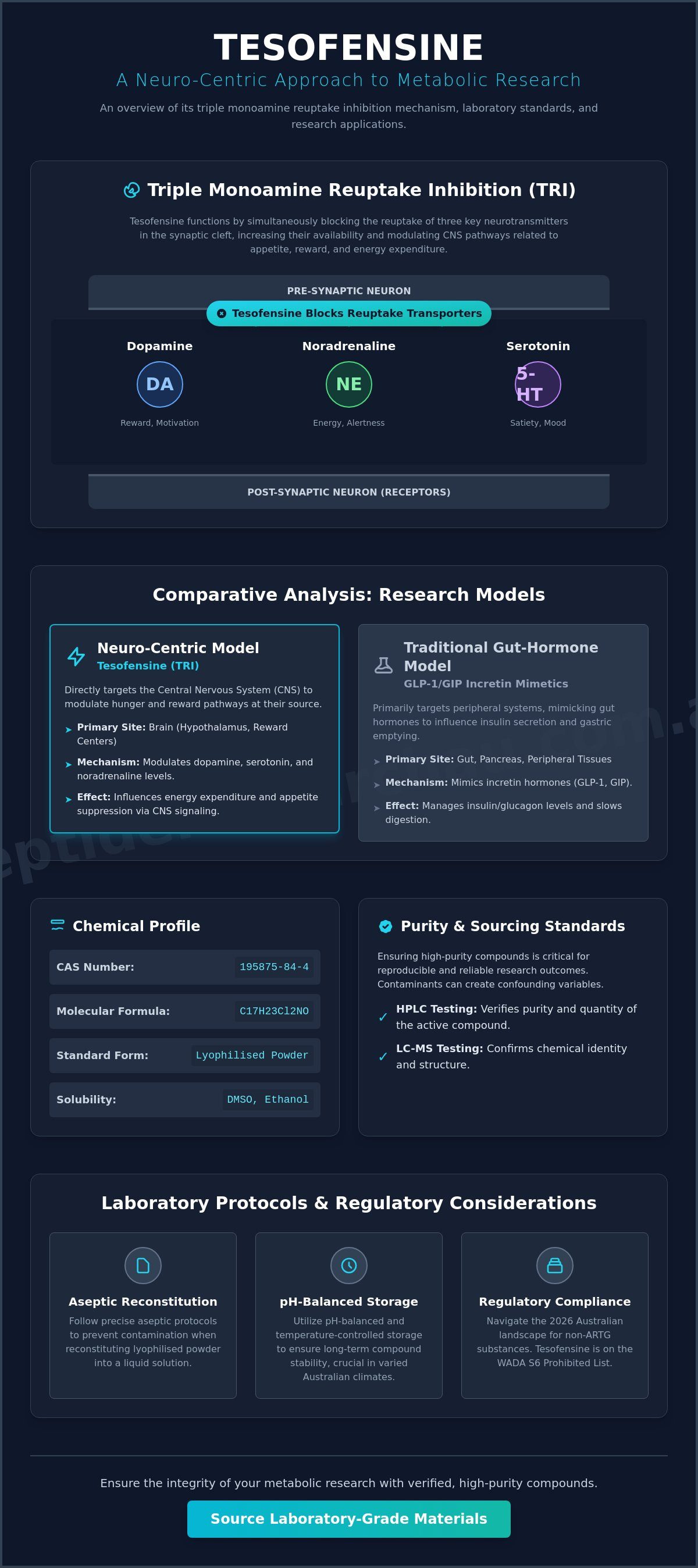
Tesofensine represents a sophisticated class of research compounds known as triple monoamine reuptake inhibitors (TRI). Unlike traditional metabolic agents that primarily target peripheral systems, this compound exerts its influence directly on the central nervous system. It functions by inhibiting the reuptake of three primary neurotransmitters: serotonin, dopamine, and noradrenaline. This multifaceted approach provides a more comprehensive model for studying metabolic regulation than single-pathway inhibitors. For institutions that intend to buy tesofensine australia for laboratory use, understanding this neuro-centric mechanism is essential for accurate experimental design. A detailed Tesofensine Overview reveals its development was not originally intended for metabolic study but for neurological preservation.
The history of Tesofensine is rooted in the search for treatments for Parkinson’s and Alzheimer’s diseases. During clinical trials for these neurodegenerative conditions, researchers observed significant, unintended shifts in metabolic homeostasis and body composition. This serendipitous discovery caused a pivot in the scientific community. By 2026, the focus has shifted toward neuro-centric models of metabolic research. These models suggest that regulating the brain's reward and satiety centers is just as critical as managing insulin or leptin levels. Researchers now prioritize compounds that can modulate the "hunger drive" at its source in the hypothalamus and reward pathways.
The Evolution of Monoamine Reuptake Research
Scientific literature has documented a clear transition from selective serotonin reuptake inhibitors (SSRIs) to the more complex triple-reuptake inhibition model. While SSRIs focus on mood regulation, the simultaneous modulation of serotonin, dopamine, and noradrenaline creates a synergistic effect on energy expenditure and appetite suppression. This evolution is closely tied to broader peptide research, which has laid the groundwork for understanding how signaling molecules interact with the blood-brain barrier. By targeting three transporters at once, Tesofensine allows for a more robust analysis of how the brain manages long-term energy stores.
Chemical Specifications for Laboratory Analysis
To maintain the integrity of a study, researchers must verify the identity of their compounds using standardized chemical nomenclature. Tesofensine is identified by the CAS number 195875-84-4 and the molecular formula C17H23Cl2NO. In its laboratory-grade form, it typically appears as a high-purity lyophilised powder. This state ensures maximum stability during transport and storage within the Australian climate. When you buy tesofensine australia, ensure the material is soluble in standard laboratory diluents such as DMSO or ethanol. High-purity sourcing is the only way to guarantee consistent research outcomes and avoid the confounding variables associated with contaminants or degraded samples.
The Triple Agonist Mechanism: Serotonin, Dopamine, and Noradrenaline
The efficacy of Tesofensine stems from its ability to modulate three distinct neurotransmitter systems simultaneously. While single or dual reuptake inhibitors target one or two pathways, this compound provides a broader pharmacological profile by inhibiting the serotonin transporter (SERT), dopamine transporter (DAT), and norepinephrine transporter (NET). This triple-action approach allows researchers to observe the combined effects of neurotransmitter elevation on energy balance. It's a significant departure from older models that only targeted serotonin or noradrenaline. Because of its potent stimulating properties, the compound is explicitly listed on the WADA Prohibited List under the S6 category. This classification underscores its physiological impact on the central nervous system. When researchers buy tesofensine australia for comparative studies, they gain a tool that bridges the gap between neurological and metabolic science.
The simultaneous inhibition of these transporters leads to a sustained increase in the synaptic concentration of monoamines. This creates a unique research environment for studying the following interactions:
Serotonin (SERT): Primarily affects satiety and reduces the urge for excessive caloric consumption.
Dopamine (DAT): Modulates the reward centers to decrease food-seeking motivation.
Noradrenaline (NET): Stimulates the sympathetic nervous system to increase resting energy expenditure.
Dopamine and Reward-Driven Metabolic Models
DAT inhibition plays a critical role in reward-pathway studies. By increasing synaptic dopamine, Tesofensine modifies the reward-seeking behavior often associated with hyper-palatable stimuli. Experimental data suggests this modulation occurs primarily in the hypothalamus and the nucleus accumbens, areas vital for regulating food-related motivation. This CNS-centric mechanism contrasts with other research models, such as those involving PT-141, which focuses on different melanocortin pathways for sexual and physiological response. When laboratory teams buy tesofensine australia, they're often investigating how these dopaminergic shifts can override habitual metabolic patterns. It's this specific focus on the brain's reward for eating that makes the compound a unique subject for studying obesity's neurological components.
Noradrenaline and Energy Expenditure
The third pillar of this mechanism is the modulation of the norepinephrine transporter (NET). Increased noradrenaline levels are directly linked to an elevated resting metabolic rate through the activation of the sympathetic nervous system. This creates a thermogenic effect, potentially increasing energy expenditure even in a sedentary state. Research has shown that this noradrenaline synergy, combined with serotonin-driven satiety, can lead to significant physiological changes. For instance, some studies have documented an average weight loss of 12.8 kg over six months in specific experimental cohorts. This dual-pronged attack, reducing caloric intake while increasing caloric burn, distinguishes triple-reuptake inhibitors from traditional metabolic agents. To maintain these precise interactions in a study, using high-quality research compounds is vital for ensuring data accuracy.
Comparative Analysis: Tesofensine vs. GLP-1 and GIP Incretin Mimetics
Researchers evaluating metabolic pathways must distinguish between peripheral hormonal signaling and central neurochemical modulation. While incretin mimetics like Semaglutide target the glucagon-like peptide-1 (GLP-1) receptors in the gut and brainstem, Tesofensine employs a "top-down" approach by regulating neurotransmitter transporters. This distinction is vital for laboratory teams that choose to buy tesofensine australia, as the compound's primary research advantage lies in its ability to bypass the digestive-hormone axis entirely. Because it functions as a potent stimulant of the central nervous system, it's explicitly classified on the WADA Prohibited List, a factor that defines its pharmacological intensity compared to standard peptides.
The efficacy profiles of triple-monoamine reuptake inhibitors differ significantly from the emerging class of triple-agonists. For example, Retatrutide targets GLP-1, GIP, and glucagon receptors to manage glucose and lipid metabolism. In contrast, Tesofensine focuses on the reward and energy expenditure pathways via serotonin, dopamine, and noradrenaline inhibition. Small molecule compounds like Tesofensine often provide different pharmacokinetic profiles than injectable peptides. This makes them a unique subject for studies where researchers want to observe the effects of sustained neurotransmitter elevation on long-term metabolic homeostasis without the variables of gastric emptying delays common in incretin research.
Hormonal vs. Neurochemical Signalling
The binding affinity of incretins is centered on G-protein coupled receptors, whereas Tesofensine targets the physical transporters of monoamines. This creates a distinct difference in half-life. Tesofensine possesses an exceptionally long half-life of approximately 190 hours, which allows for very stable plasma concentrations in research models. While triple-agonists use glucagon agonism to increase thermogenesis, Tesofensine achieves a similar metabolic elevation through noradrenaline reuptake inhibition. This neuro-centric thermogenesis provides a different data set than receptor-mediated metabolic shifts, offering a clearer view of the brain's role in energy regulation.
Research Model Suitability
Selecting the correct compound depends on the specific goals of the study. Tesofensine is the preferred choice for research involving satiety, reward-seeking behavior, and cognitive function. However, if the study involves tissue regeneration or systemic healing alongside metabolic data, researchers might prioritize BPC-157. When you buy tesofensine australia for institutional use, you're investing in a model that prioritizes the neurological drive behind metabolic dysfunction. The following table summarizes the technical differences between these research modalities:
Laboratory Protocols: Stability, Storage, and Reconstitution
Precise laboratory handling is the final determinant of research validity. Once you buy tesofensine australia, the transition from lyophilised powder to a viable solution requires strict adherence to aseptic protocols. Tesofensine is sensitive to pH fluctuations and mechanical stress. Researchers must ensure that all glassware and mixing environments are sterile to prevent cross-contamination. The chemical stability of the compound depends heavily on the choice of diluent; while DMSO is common for certain assays, aqueous solutions require specific preservation to remain viable over the course of a multi-week study.
Chemical degradation is often subtle but detrimental to data integrity. Researchers should inspect vials for signs of oxidation, which may appear as a slight yellowing of the solution or the presence of insoluble particulates. Maintaining a consistent pH level is critical, as extreme acidity or alkalinity can cause the molecule to precipitate or lose its binding affinity for monoamine transporters. If you require high-grade materials for your next study, you can procure laboratory-grade research compounds from specialized providers.
Reconstitution and Concentration Accuracy
Achieving the correct molarity is essential for dose-response studies. When reconstituting 500mcg or 10mg vials, the diluent should be introduced slowly by allowing it to trickle down the side of the glass. This prevents the formation of bubbles and protects the molecular structure from shear forces. For longitudinal studies, the use of bacteriostatic water is a standard requirement. The inclusion of 0.9% benzyl alcohol inhibits microbial growth, ensuring the sample remains uncontaminated during repeated aspirations. After the diluent is added, the vial should be gently swirled rather than shaken.
Stability in the Australian Climate
The Australian climate presents unique challenges for heat-sensitive compounds. High ambient temperatures during transit can accelerate the degradation of the lyophilised cake if not properly managed. When institutions buy tesofensine australia for high-precision studies, laboratory staff must inspect the thermal indicators immediately upon arrival to ensure the cold chain remained intact. Stability data indicates that lyophilised Tesofensine is most stable when stored at -20°C for long-term preservation.
Once reconstituted, the stability window narrows significantly. Data suggests that reconstituted solutions maintain approximately 95% potency for up to 14 days when stored at 2-8°C. At room temperature, this potency can drop more rapidly due to increased kinetic energy and potential oxidation. Researchers should avoid repeated freeze-thaw cycles, as the crystallization process can physically damage the molecular structure. It's often more effective to aliquot the solution into single-use vials immediately after reconstitution to preserve the chemical integrity of the batch.
Sourcing High-Purity Tesofensine for Australian Institutions
The procurement of research compounds in 2026 requires a deep understanding of both analytical chemistry and the local regulatory environment. For those who intend to buy tesofensine australia, the primary objective is ensuring the material is of laboratory grade and compliant with institutional standards. Tesofensine isn't currently listed on the Australian Register of Therapeutic Goods (ARTG). This means the Therapeutic Goods Administration (TGA) hasn't evaluated it for safety or efficacy in humans. Consequently, its supply is strictly limited to licensed research institutions. Legitimate sourcing involves rigorous verification to avoid the risks associated with the unregulated online market, where products are often counterfeit or contaminated.
Peptide Research AU maintains a commitment to analytical transparency. Every batch undergoes High-Performance Liquid Chromatography (HPLC) and Liquid Chromatography-Mass Spectrometry (LC-MS) to confirm identity and purity. This ensures that researchers receive a compound that matches its theoretical molecular weight and is free from the impurities that could compromise experimental data. When you buy tesofensine australia from a verified domestic source, you eliminate the ambiguity regarding chemical stability that often plagues international shipments.
Verifying Analytical Grade and Purity
Interpreting a Certificate of Analysis (CoA) is a fundamental skill for any laboratory manager. A high-quality HPLC chromatogram for Tesofensine should show a single, sharp peak representing the primary compound, with minimal baseline noise indicating the absence of residual solvents. LC-MS data provides the mass-to-charge ratio, confirming the molecular formula C17H23Cl2NO. It's also essential to verify that the material is free from heavy metals such as lead, arsenic, and mercury. This level of domestic quality control is a hallmark of Peptide Research AU sourcing standards, where institutional accountability is prioritized over low-cost, unverified alternatives.
Institutional Procurement and Logistics
Domestic sourcing offers significant advantages regarding cold-chain security. The Australian Border Force (ABF) actively screens for unapproved therapeutic goods; international shipments of research chemicals are frequently seized, leading to significant delays and loss of institutional capital. By choosing a domestic provider, institutions ensure that their compounds spend less time in transit, reducing exposure to the harsh Australian climate. Secure, discreet packaging protocols are also utilized to maintain the privacy and safety of research facilities.
Logistics are handled with an emphasis on speed and stability. Express domestic shipping ensures that temperature-sensitive lyophilised powders arrive at the laboratory in optimal condition. This localized approach minimizes the variables that can lead to chemical degradation during long-haul international transport. If your facility requires reliable, evidence-based materials, you can secure high-purity Tesofensine for your metabolic research today.
Advancing Metabolic Science through Neuro-Centric Research
The transition toward triple-monoamine reuptake inhibition represents a significant evolution in the study of metabolic homeostasis. By targeting the central reward and energy expenditure pathways, Tesofensine provides a distinct research model that diverges from traditional gut-hormone signaling. Success in these studies depends on the use of analytical-grade compounds that maintain structural integrity from the synthesis lab to the bench. Institutions that choose to buy tesofensine australia from domestic providers benefit from reduced transit times and specialized handling tailored to the local climate. This localized approach ensures that the chemical stability of your materials isn't compromised by international logistics.
Maintaining high standards for chemical purity ensures that your data remains reproducible and credible. Utilizing HPLC verified purity (>99%) and analytical grade research compounds is the only way to eliminate confounding variables in complex neurological studies. With reliable express Australian domestic shipping, your facility can maintain the strict cold-chain protocols necessary for sensitive materials. We're committed to supporting the scientific community with the precision tools required for the next generation of breakthroughs. Secure Laboratory-Grade Tesofensine for Your Research Project today and elevate the precision of your metabolic research.
Frequently Asked Questions
Is Tesofensine legal for laboratory research in Australia?
Tesofensine is legal for laboratory research in Australia when procured through authorized channels for scientific study. It isn't currently listed on the Australian Register of Therapeutic Goods (ARTG), which means it cannot be supplied as a therapeutic good for human consumption. Researchers must ensure they comply with TGA and ABF regulations regarding the acquisition of non-scheduled research compounds for institutional use.
What is the primary difference between Tesofensine and Semaglutide?
The primary difference lies in the pharmacological pathway. Tesofensine is a triple monoamine reuptake inhibitor that acts on the central nervous system to modulate serotonin, dopamine, and noradrenaline. Semaglutide is a peptide that mimics the GLP-1 hormone to regulate insulin secretion and gastric emptying. This makes Tesofensine a neuro-centric model, while Semaglutide follows a hormone-centric metabolic approach.
How should I store lyophilised Tesofensine to ensure maximum stability?
Store lyophilised Tesofensine at -20°C for long-term research integrity. This temperature minimizes kinetic energy and prevents the degradation of the chemical structure. It's essential to protect the vials from light exposure and moisture, as these factors can trigger oxidation. When you buy tesofensine australia, ensure the lyophilised cake remains intact and is stored in a dedicated laboratory freezer immediately upon arrival.
Can Tesofensine be reconstituted with sterile saline instead of bacteriostatic water?
Bacteriostatic water is the preferred diluent for Tesofensine in most multi-use research protocols. While sterile saline can be used for immediate, single-point assays, it lacks the preservative properties of benzyl alcohol. Bacteriostatic water inhibits microbial growth for up to 28 days, which is critical for maintaining sample purity during longitudinal studies. Always prioritize the diluent that matches your specific aseptic requirements.
What are the common concentration levels used in Tesofensine research models?
Research models typically utilize concentrations that allow for precise micro-dosing, often between 0.25mg and 1.0mg per milliliter. Common laboratory vials are supplied in 500mcg or 10mg formats to accommodate different study scales. Precise concentration is vital for observing dose-dependent responses in neurotransmitter modulation. Researchers should calculate their reconstitution volumes based on the specific molarity required for their experimental design.
Does Peptide Research AU provide HPLC testing results for every batch?
Yes, we provide comprehensive HPLC and LC-MS testing results for every batch to ensure analytical transparency. These reports verify that the compound meets a purity standard of at least 99% and matches the expected molecular weight. Access to this data allows institutions to buy tesofensine australia with confidence in its chemical identity. Reliable data starts with verified materials, and we prioritize high manufacturing standards.
How does Tesofensine affect the noradrenaline pathway specifically?
Tesofensine specifically inhibits the norepinephrine transporter (NET), which prevents the reuptake of noradrenaline into the presynaptic neuron. This results in higher synaptic concentrations of the neurotransmitter, leading to increased sympathetic nervous system activity. In metabolic models, this shift is associated with an elevated resting metabolic rate and enhanced thermogenesis. This noradrenergic effect is a key component of the compound's triple-action mechanism.
What is the shelf life of reconstituted Tesofensine at 4°C?
Reconstituted Tesofensine has a shelf life of approximately 14 days when stored at 4°C. After this period, the risk of chemical degradation and potency loss increases significantly. Researchers should aliquot the solution into single-use vials immediately after reconstitution to avoid repeated temperature fluctuations. For studies exceeding two weeks, it's recommended to reconstitute fresh batches to maintain the highest level of data accuracy.


Comments