
BPC-157 For Sale Australia: A Researcher’s Guide to Sourcing and Quality
- peptideresearchau
- Jun 10
- 11 min read
Updated: Jun 30
How much of your research budget is currently lost to seized international shipments or contaminated peptide batches? For Australian scientists, the search for bpc-157 for sale australia often feels like a choice between high-risk imports and opaque local suppliers. You understand that the integrity of your data depends entirely on the chemical precision of your compounds. Obtaining high-purity research materials shouldn't involve the uncertainty of customs delays or inconsistent laboratory standards.
It's frustrating when laboratory work stalls because a Certificate of Analysis (CoA) is missing or outdated. This guide provides a technical framework to secure a reliable domestic supply of BPC-157 while navigating the 2026 Australian regulatory landscape. You'll learn how to verify batch-specific purity through rigorous documentation and establish a logistics chain that avoids the pitfalls of customs intervention. We examine the essential criteria for analytical verification and domestic reliability to ensure your study remains on track. This analysis outlines the methodology required to source laboratory-grade compounds that meet the highest industry standards for professional study.
Table of Contents
Sourcing BPC-157 for Research in Australia
BPC-157, or Body Protection Compound 157, is a synthetic pentadecapeptide composed of 15 amino acids. In rigorous laboratory settings, this compound is studied for its biological activity in promoting tendon and ligament healing through the modulation of growth factor expression. When investigating bpc-157 for sale australia, researchers must categorize the substance strictly as a laboratory reagent. Its primary utility lies in its capacity to influence angiogenic pathways, making it a focal point for musculoskeletal and regenerative research in 2026.
The Australian landscape for research compounds requires a meticulous approach to sourcing. Adherence to research-only protocols is not merely a regulatory hurdle; it's a fundamental requirement for maintaining scientific integrity. Suppliers who provide these compounds for professional study must maintain clear documentation that prevents the diversion of materials into non-research applications. This ensures that the scientific community retains access to high-purity materials without compromising legal or ethical standards.
The State of Peptide Procurement in 2026
Procurement strategies have shifted toward domestic resilience. In 2026, the reliance on international manufacturers has decreased due to persistent global supply chain disruptions. Institutional and private researchers now prioritize suppliers with Australian-based warehousing. This domestic focus mitigates the risks of international shipping, such as temperature fluctuations during transit and unpredictable customs delays. By sourcing from established domestic chemical suppliers, laboratories can secure a consistent inventory of BPC-157, which is vital for maintaining the continuity of long-term experimental protocols.
Defining Laboratory-Grade Standards
Quality benchmarks for research materials are non-negotiable. There's a significant distinction between industrial-grade chemicals and the laboratory-grade standards required for peer-reviewed studies. When evaluating bpc-157 for sale australia, purity is the most critical metric. Purity levels below 98% are unacceptable for modern research because they introduce unknown contaminants into the experimental environment. These impurities can lead to inconsistent data, potentially invalidating months of laboratory work.
Analytical Verification: Every batch must undergo independent testing to confirm its chemical profile.
Synthesis Precision: High-grade peptides are produced using advanced solid-phase synthesis techniques to minimize truncation sequences.
Stability Testing: Compounds must remain stable under standard laboratory storage conditions to ensure reproducibility.
The impact of impurities on in-vitro and in-vivo studies can be profound. Residual solvents or incorrect peptide sequences can trigger unintended cellular reactions, masking the true biological effects of the compound. Selecting a supplier that provides transparent, batch-specific data is the only way to ensure that your research findings are both accurate and reproducible.
Evaluating Peptide Purity: Beyond the Label
Verification of chemical integrity is the cornerstone of reproducible science. Establishing a rigorous protocol for evaluating bpc-157 for sale australia requires an understanding of analytical chemistry. Researchers shouldn't rely on marketing claims. Instead, they must demand batch-specific Certificates of Analysis (CoA). A valid CoA provides empirical evidence of the compound's chemical composition and purity levels.
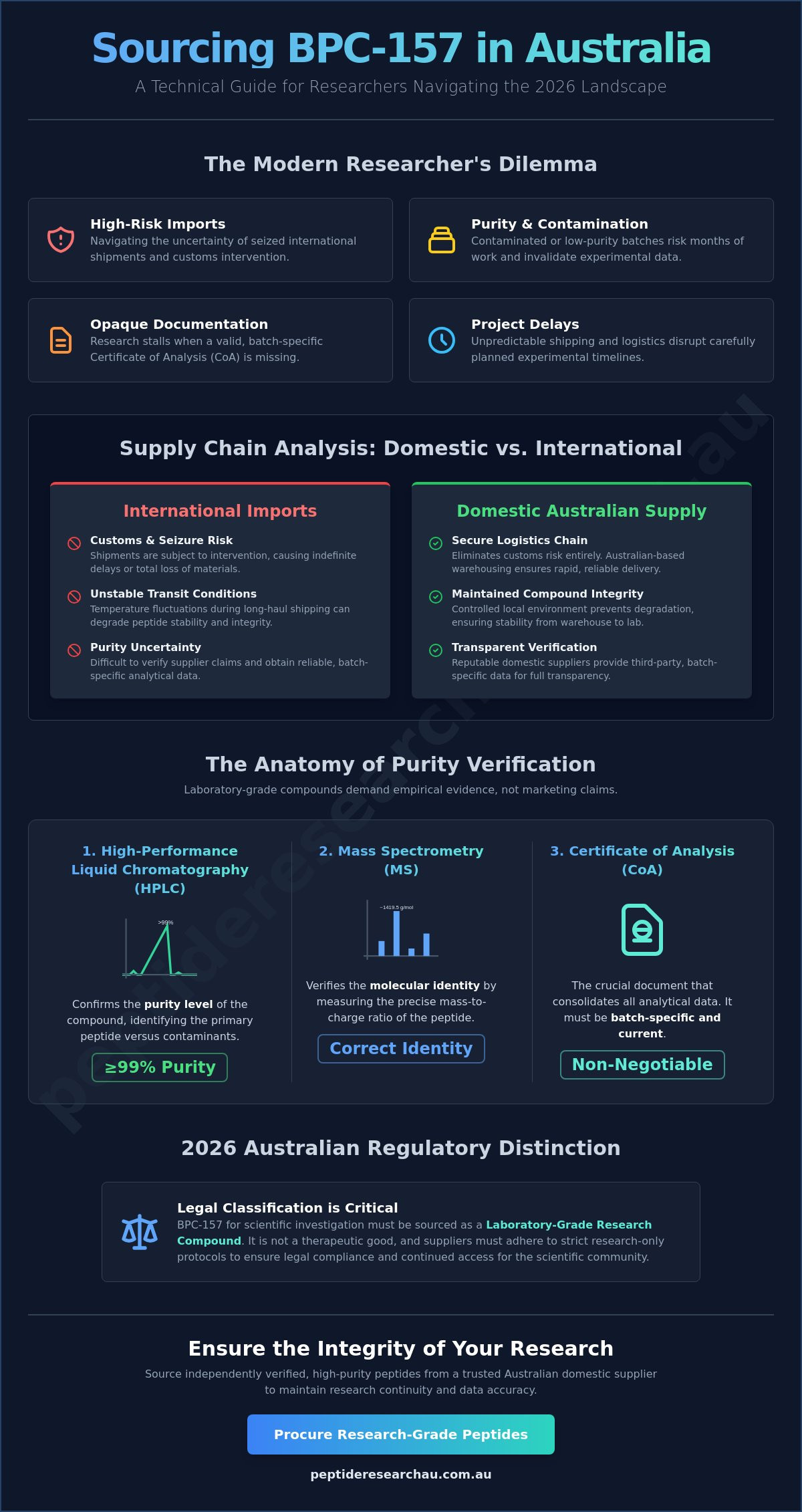
High-Performance Liquid Chromatography (HPLC) is the industry standard for determining peptide purity. It separates the components of a sample, allowing researchers to see the primary peak of the target peptide versus secondary peaks representing impurities. Complementing this, Mass Spectrometry (MS) confirms the identity of the molecule by measuring its mass-to-charge ratio. For BPC-157, the molecular weight should align with approximately 1419.5 g/mol. Discrepancies in this value indicate a different sequence or the presence of significant degradation products.
Detailed analysis of these chemical properties is essential for understanding the Scientific Review of BPC-157 and its reported biological pathways. Without verified purity, any observed experimental outcome cannot be definitively attributed to the peptide itself.
Interpreting HPLC and Mass Spec Reports
A chromatogram should show a single, sharp peak with minimal noise on the baseline. Red flags include broad peaks, multiple significant secondary peaks, or reports that lack a timestamp and batch number. Third-party testing is superior because it eliminates the inherent conflict of interest found in in-house manufacturer reports. Independent laboratories provide an unbiased verification of the synthetic output. You can review batch-specific data for research compounds to ensure your laboratory standards are maintained.
Manufacturing Standards and GMP Compliance
Quality starts at the synthesis stage. Good Manufacturing Practice (GMP) standards ensure that the laboratory environment is controlled and contamination risks are minimized. Once synthesized, the peptide undergoes sterile lyophilisation. This freeze-drying process removes moisture while preserving the peptide's structural integrity. Proper vial crimping and vacuum sealing are final, critical steps. These measures prevent the introduction of atmospheric moisture or microbes that could degrade the compound before use. High-quality synthesis ensures that the final product remains stable during storage and reconstitution.
Domestic Australian Supply vs. International Imports
Choosing between international manufacturers and domestic distributors involves more than just price comparisons. It's a calculation of risk and laboratory efficiency. For time-sensitive projects, the primary advantage of local supply is the reduction of transit variables. While international shipments often face 14 to 21-day delays, domestic logistics typically ensure 24 to 48-hour delivery. When you're searching for bpc-157 for sale australia, the geographic location of the warehouse directly impacts your ability to maintain a consistent research schedule.
International procurement introduces unpredictable oversight from the Therapeutic Goods Administration (TGA) and the Australian Border Force (ABF). Even when compounds are intended strictly for laboratory use, international parcels are frequently flagged for inspection. This process doesn't just delay the project; it exposes the compounds to non-climate-controlled environments for extended periods, potentially compromising the chemical integrity of the shipment before it reaches the bench.
Navigating Australian Customs and Border Force
Current ABF protocols are increasingly stringent regarding the importation of synthetic peptides. Researchers often face the administrative burden of reclamation if a package is seized, which requires demonstrating the research intent and ensuring all documentation aligns with regulatory requirements. Sourcing from a domestic supplier eliminates the need for individual import permits for most researchers. It shifts the regulatory responsibility to the distributor, allowing the scientist to focus on data collection rather than customs correspondence.
Stability and Handling During Transit
Peptide integrity is highly sensitive to environmental stressors. Long-haul international shipping exposes vials to extreme temperature fluctuations in cargo holds and sorting facilities. Although BPC-157 is typically provided in a stable lyophilised state, prolonged exposure to heat can initiate degradation pathways. Domestic courier services minimize these risks by reducing the total time in transit. High-quality Australian suppliers use specialized packaging designed for the local climate, ensuring that the peptide arrives with its molecular structure intact. Reliable research requires compounds that haven't been compromised by mechanical agitation or thermal stress during a three-week journey across multiple borders.
Regulatory Considerations for Australian Researchers
Regulatory clarity is essential for maintaining institutional security and laboratory standing. In Australia, the Therapeutic Goods Administration (TGA) maintains a rigorous oversight framework for all bioactive compounds. BPC-157 isn't an approved therapeutic good for human use. Consequently, researchers seeking bpc-157 for sale australia must distinguish between clinical applications and laboratory study. The legal framework permits the acquisition of these compounds exclusively for "Research Use Only" (RUO) purposes, where the intent is scientific inquiry rather than medical treatment.
Working with athletic populations introduces additional layers of complexity. Sport Integrity Australia, following World Anti-Doping Agency (WADA) guidelines, classifies BPC-157 as a prohibited substance under the S2 category of Peptides and Growth Factors. Researchers must implement strict inventory controls to prevent any diversion of materials. Meticulous record-keeping is a professional necessity. You should document every stage of procurement, storage, and disposal to ensure full transparency during institutional audits or regulatory reviews.
Research-Only Status and Compliance
Compliance begins with clear documentation and labeling. Every vial must carry a "Not for Human Consumption" warning to align with Australian consumer and chemical safety laws. If your study involves human-derived tissues or data, obtaining Human Research Ethics Committee (HREC) approval is a prerequisite. This step ensures that the research methodology adheres to the National Statement on Ethical Conduct in Human Research. Maintaining a clear separation between laboratory compounds and pharmaceutical products is the only way to safeguard your research project from legal scrutiny.
The 2026 Legal Landscape for Peptides
The Australian regulatory environment has evolved significantly leading into 2026. Recent updates to Schedule 4 of the Poisons Standard have solidified the prescription-only status for peptides intended for human use. For the research community, this means that the sale of BPC-157 for in-vitro study is permitted only when the supplier and the researcher adhere to strict non-clinical protocols. Future-proofing your laboratory involves staying informed about TGA scheduling changes and ensuring your sourcing partners are equally compliant. For verified materials that meet these rigorous compliance standards, you can buy research peptides from a trusted domestic provider.
Establishing robust internal protocols for the handling of research compounds protects the integrity of the individual scientist and the institution. Proper storage in temperature-monitored, secure environments is required by most Australian research facilities. By prioritizing these regulatory considerations, you ensure that your focus remains on the scientific outcomes rather than administrative or legal complications.
Procuring Research-Grade BPC-157 from Peptide Research AU
Securing high-purity compounds is the final step in establishing a robust experimental framework. Peptide Research AU addresses the core challenges of the Australian research sector by providing a reliable domestic supply chain. When evaluating bpc-157 for sale australia, our facility prioritizes analytical precision and logistical security. We maintain a commitment to ≥99% purity, ensuring that your data remains untainted by synthetic byproducts or environmental contaminants. Every batch undergoes independent verification, providing the empirical foundation required for professional study.
Our support infrastructure extends beyond the compound itself. We provide comprehensive technical data and batch-specific Certificates of Analysis (CoA) to facilitate institutional compliance. For large-scale studies, we offer bulk procurement protocols designed to maintain batch consistency across extended timelines. This ensures that longitudinal data isn't compromised by inter-batch variability, which is a common failure point in lower-tier supply chains. Meticulous documentation and transparency are the hallmarks of our service to the scientific community.
The Peptide Research AU Quality Guarantee
Our selection process for laboratory-grade compounds is meticulous. We only source peptides synthesized using advanced solid-phase methodologies to minimize truncation sequences. Once received, BPC-157 is stored in temperature-controlled, dark-room environments to preserve peak biological activity and prevent premature degradation. To assist with reconstitution protocols, we provide essential laboratory diluents, such as Bacteriostatic Water. Using the correct diluent is critical for maintaining peptide stability and preventing microbial growth during the study period.
Streamlined Procurement for Scientific Projects
The procurement process is designed for efficiency and security. We utilize discrete Australian packaging to ensure the privacy and integrity of your shipment. Tracking is provided for every order, allowing you to monitor the transit from our domestic facility to your laboratory door. This eliminates the uncertainty of international freight and the risk of customs intervention described in previous sections. If your project requires specialized configurations or specific technical documentation, our technical team is available to assist with your requirements. By focusing on domestic reliability, we enable researchers to maintain their focus on scientific discovery rather than supply chain management. We don't just provide compounds; we provide the reliability necessary for high-stakes research.
Optimising Experimental Integrity
Scientific progress relies on the absolute precision of your reagents. By transitioning to domestic supply chains, you eliminate the logistical instability of international transit and the risk of regulatory intervention at the border. Verification through independent HPLC and Mass Spectrometry ensures that every vial meets the rigorous standards required for peer-reviewed data. This meticulous approach to sourcing safeguards your institutional standing and experimental reproducibility. It's the only way to ensure that your laboratory findings are accurate and reliable.
Identifying reliable bpc-157 for sale australia is a critical step for researchers focusing on regenerative biological pathways in 2026. Prioritising GMP compliant manufacturing standards and independent HPLC/MS verified purity provides the foundational security your laboratory requires. These protocols aren't optional; they're essential for modern scientific methodology. Eliminating impurities at the sourcing stage prevents unintended cellular reactions during your study.
Establish a consistent procurement framework with express domestic Australian shipping to maintain your study's momentum. You can secure laboratory-grade BPC-157 for your research through our verified distribution network. We're committed to supporting the advancement of Australian scientific innovation through excellence in chemical synthesis and supply. Your work deserves the highest analytical standards.
Frequently Asked Questions
Is BPC-157 legal to buy in Australia for research purposes?
BPC-157 is legal to acquire in Australia strictly for laboratory and scientific research purposes. It isn't approved for human consumption or therapeutic use by the TGA. Researchers must ensure their procurement processes align with institutional ethics and state-based poisons regulations. This distinction ensures that the compound remains available for professional study without violating therapeutic goods legislation. It's the researcher's responsibility to maintain compliance with all local laws.
Does BPC-157 require refrigeration during transit in Australia?
BPC-157 in its lyophilized state is relatively stable during short-term transit at ambient temperatures. While refrigeration isn't strictly required for domestic shipping within Australia, the peptide should be protected from extreme heat and direct sunlight. Once the compound reaches the laboratory, it should be transferred to cold storage immediately to preserve its chemical integrity for long-term study. Reconstitution should only occur immediately before the commencement of the study.
What is the standard purity level for research-grade BPC-157?
High-quality research-grade BPC-157 should maintain a purity level of at least 99%. Purity levels below 98% are generally considered unacceptable for professional research because contaminants can lead to unpredictable experimental variables. When searching for bpc-157 for sale australia, researchers should prioritize suppliers who provide batch-specific analytical data. Confirming these purity benchmarks through independent laboratory testing is essential for maintaining the integrity of your scientific findings and ensuring data reproducibility.
How long does shipping take for BPC-157 within Australia?
Domestic shipping for research compounds typically takes one to two business days when using express courier services. This rapid delivery timeframe is a significant advantage over international imports, which can take several weeks and face customs delays. Local distribution ensures that time-sensitive research protocols aren't interrupted by logistical bottlenecks. It also minimizes the total time the peptide spends in non-climate-controlled transit environments, preserving the compound's structural stability throughout the journey.
Can I get a Certificate of Analysis for my BPC-157 order?
Reputable suppliers provide a batch-specific Certificate of Analysis (CoA) with every order. This document includes HPLC and Mass Spectrometry data to verify the peptide's identity and purity. Researchers should always request these documents to ensure the compound matches the technical specifications required for their study. A missing or outdated CoA is a primary indicator of inconsistent quality control within the supply chain. Verified documentation is the only way to confirm chemical precision.
What is the difference between BPC-157 and TB-500 in research?
BPC-157 is a 15-amino acid pentadecapeptide primarily studied for its angiogenic and cytoprotective properties. In contrast, TB-500 is a synthetic version of the active region of Thymosin Beta-4, which is studied for its role in cellular migration and actin sequestration. While both are investigated in regenerative research, they operate through different molecular pathways. Researchers often study them independently or in combination to observe synergistic effects on tissue repair and extracellular matrix modulation.
For researchers investigating these specific pathways, 157Peptides offers a specialized selection of high-purity BPC-157 and TB-500 compounds designed for laboratory study.
How should BPC-157 be stored in a laboratory setting?
Lyophilized BPC-157 should be stored in a freezer at -20°C for long-term stability, where it can remain viable for up to 24 months. For short-term use, storage at 2°C to 8°C is acceptable. Once the peptide is reconstituted with a laboratory diluent, it's significantly more fragile. Reconstituted solutions must be kept refrigerated and used within a specific timeframe to prevent degradation. Exposure to light and repeated freeze-thaw cycles should be strictly avoided.
Do I need a prescription to buy BPC-157 for research use?
A prescription isn't required for the procurement of BPC-157 when the compound is intended strictly for laboratory research. However, the purchaser must represent a legitimate research entity or demonstrate a valid scientific purpose for the acquisition. When evaluating bpc-157 for sale australia, it's vital to remember that these materials are sold under Research Use Only protocols. They aren't intended for clinical use, and any diversion from research protocols may violate local regulatory frameworks.


Comments