
Best Diluent for Peptides Research: A Guide to Reconstitution and Stability (2026)
- peptideresearchau
- Jul 1
- 12 min read
Updated: 6 days ago
A single error in reconstitution can render an expensive, high-purity compound biologically inert before the first assay begins. Identifying the best diluent for peptides research isn't merely a matter of solubility; it's a critical step in preserving the molecular architecture of the compound. Many researchers find that standard sterile water isn't sufficient for multi-use applications where bacterial contamination or thermal degradation are constant risks.
We understand that maintaining reproducible results requires absolute precision in every laboratory protocol. This guide provides the technical framework to master diluent selection and storage strategies tailored for the Australian climate to ensure maximum peptide stability. You'll gain a clear protocol for aliquoting, managing thermal cycling, and extending the shelf-life of your reconstituted compounds. We'll examine the technical specifications of bacteriostatic agents and the specific methodologies required to mitigate oxidative stress in a professional research setting.
Table of Contents
Fundamentals of Peptide Stability Post-Reconstitution
Reconstitution marks the transition of a research compound from a stable, lyophilised state into a vulnerable liquid solution. While lyophilisation effectively places a peptide in a state of chemical stasis by removing moisture, the introduction of a solvent initiates immediate chemical reactions. Identifying the best diluent for peptides research is the primary step in managing this transition and preserving the molecular integrity of the compound for laboratory study.
The core mechanism of degradation in solution is hydrolysis. This chemical process occurs when water molecules interact with the amide bonds that link amino acids together. During hydrolysis, a water molecule effectively inserts itself into the peptide bond, causing structural cleavage and breaking the chain into smaller, inactive fragments. Understanding the Fundamentals of peptides and their covalent architecture is essential for researchers aiming to minimise these interactions. The rate of this cleavage is influenced by the solution's pH, temperature, and the specific sequence of the compound.
Peptide chain length and complexity significantly influence susceptibility to degradation. Larger, more complex sequences often have intricate secondary structures that are prone to unfolding or aggregating once they're in a liquid environment. While shorter sequences might appear more resilient, they remain subject to the same laws of chemical kinetics. For those conducting peptides Australia research, maintaining stability isn't just a technical requirement; it's the cornerstone of ensuring that experimental results are both reproducible and scientifically valid.
Lyophilised vs. Reconstituted States
Lyophilisation serves as a method of molecular suspension, allowing for long-term storage by preventing the movement of molecules that leads to degradation. However, a "stability clock" begins the moment the first drop of diluent is introduced to the vial. Once reconstituted, the compound is no longer in a protected state and becomes highly sensitive to its environment. Peptide stability is the duration a compound maintains its primary sequence integrity.
Identifying Molecular Degradation
Researchers must remain vigilant for visual indicators of degradation, such as precipitation, cloudiness, or unexpected colour shifts within the vial. These signs often point to advanced aggregation or contamination. It's vital to recognise that visual clarity doesn't guarantee molecular integrity. Significant potency loss can occur in solutions that remain perfectly clear to the naked eye. Selecting the best diluent for peptides research helps mitigate these invisible risks, as degraded compounds lead to poor experimental reproducibility and compromised data accuracy.
Temperature Management and the Aliquoting Protocol
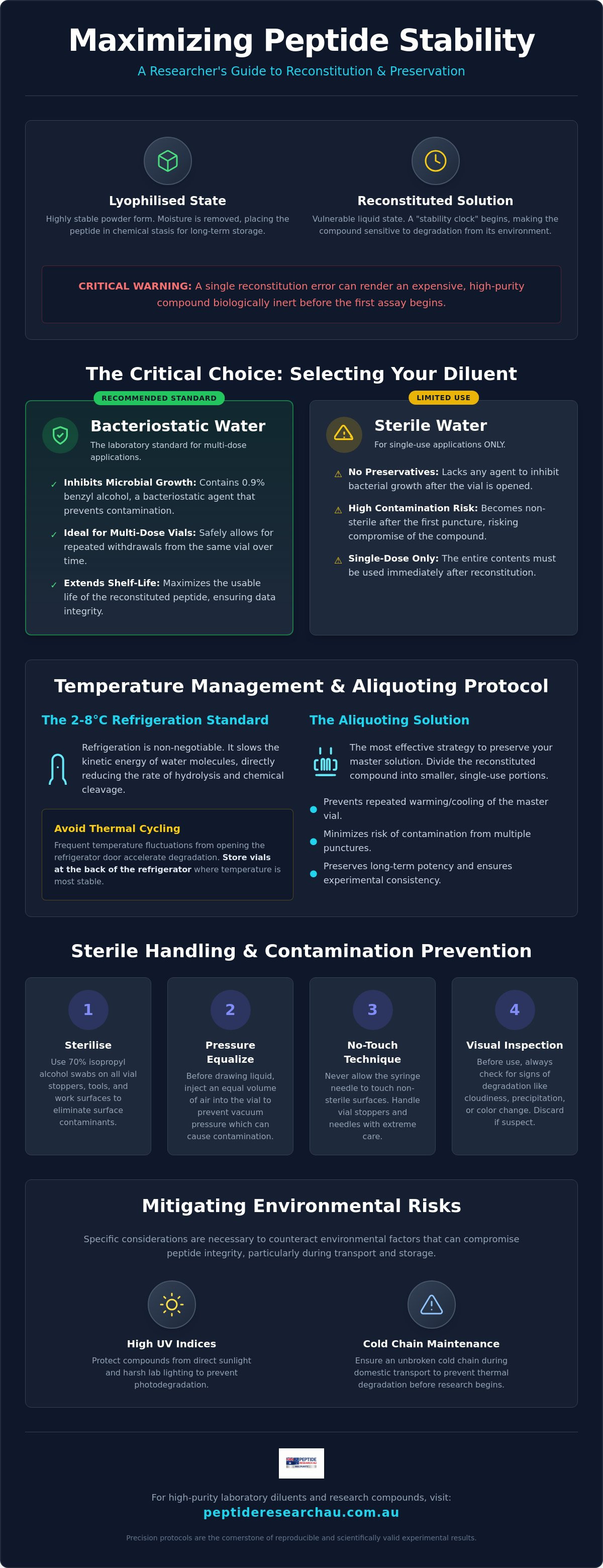
Temperature control is the primary determinant of stability once a compound has been reconstituted. While selecting the best diluent for peptides research provides the necessary chemical environment, maintaining a strict thermal range prevents accelerated degradation. The 2-8°C rule is non-negotiable for compounds in active use. Refrigeration slows the kinetic energy of water molecules, which directly reduces the rate of hydrolysis. It's the most basic defence against chemical cleavage.
Thermal cycling represents a significant risk that many laboratory protocols overlook. Every instance of fridge access causes a minor temperature fluctuation within the storage unit. These cycles, though small, provide enough energy to accelerate bond breakdown and lead to premature potency loss. To mitigate this, researchers should store vials in the back of the refrigerator, away from the door, where temperatures remain most consistent and less affected by external air exchange.
Aliquoting serves as the most effective strategy for managing large volumes of reconstituted research compounds. By dividing the solution into smaller, single-use portions, you eliminate the need to repeatedly remove the master vial from refrigeration. This practice also reduces the risk of mechanical stress from repeated needle punctures of the same stopper. For those seeking the best diluent for peptides research and high-quality laboratory diluents, adhering to a strict aliquoting schedule is essential for data integrity.
The 4-Step Aliquoting Protocol
Precision during the initial mixing phase is vital. Follow these steps to ensure sample purity and longevity:
1. Sterilise: Wipe all vial stoppers and tools using 70% isopropyl alcohol swabs to prevent cross-contamination.
2. Reconstitute: Allow the diluent to flow slowly down the glass wall. Avoid direct impact on the lyophilised powder to prevent mechanical shearing of the peptide chains.
3. Distribute: Move the solution into single-use sterile vials immediately. This avoids repeated needle punctures that can introduce contaminants.
4. Label: Mark each aliquot with the peptide name, concentration, and exact date of reconstitution.
Cryogenic Storage Considerations
Repeated freeze-thaw cycles are a primary cause of peptide failure. As water freezes, ice crystals can physically shear delicate peptide chains. You shouldn't freeze a compound more than once. For studies lasting several months, a single-time freeze at -20°C is suitable. For storage extending over a year, -80°C is necessary. Proper thawing requires a gradual transition from frozen to refrigerated states to maintain molecular stability. Don't use a heat source to accelerate the thawing process.
Bacteriostatic Water vs. Sterile Water for Stability
The choice between different solvents is the most critical decision in maintaining sample purity during a study. Bacteriostatic water is the established laboratory standard for multi-dose research vials. It consists of sterile water containing 0.9% benzyl alcohol. This additive serves a specific chemical role by inhibiting the proliferation of bacteria that might be introduced during repeated needle entries. Without this preservative, a single contamination event can compromise the entire vial.
Sterile Water (USP) lacks this protective agent. Consequently, its use is restricted to single-use, immediate applications. Once a vial of sterile water is punctured, it has no defense against environmental contaminants. This choice of diluent ultimately dictates the "discard date" of the research solution. While sterile water solutions must typically be used or discarded within 24 hours, bacteriostatic options allow for a more extended research window. Selecting the best diluent for peptides research requires balancing the intended duration of the study against the chemical requirements of the compound.
Diluent Selection Matrix
The primary advantage of bacteriostatic water is the extended window of stability it provides for multi-use vials. While sterile water solutions expire in less than a day, bacteriostatic solutions remain viable for up to 28 days when refrigerated correctly. Benzyl alcohol acts as a bacteriostat, inhibiting growth rather than acting as a broad-spectrum biocide. This means it prevents the multiplication of microbes without necessarily killing existing ones; therefore, starting with a sterile environment remains mandatory.
Solubility also influences selection. While water is the best diluent for peptides research in most cases, hydrophobic sequences may require specialized diluents like dilute acetic acid to reach full dissolution. Researchers must evaluate the amino acid profile of their compound before selecting a solvent to prevent precipitation or incomplete reconstitution. If a peptide doesn't dissolve fully in bacteriostatic water, the resulting suspension will lead to inaccurate dosing and inconsistent experimental data.
Preserving Diluent Integrity
Maintaining the quality of the solvent is as important as the peptide itself. You should store unused bacteriostatic water in a cool, dark environment to prevent the evaporation of the benzyl alcohol preservative. If the concentration of the bacteriostat drops below 0.9%, its effectiveness in inhibiting microbial growth is significantly compromised. Unmixed solvents should generally be kept at controlled room temperatures between 15°C and 30°C, away from direct light exposure.
For detailed instructions on the physical handling of these solvents, refer to the peptide reconstitution guide. Proper mixing protocols ensure that the diluent is integrated without causing mechanical stress to the compound's primary structure, preserving the integrity of the research material from the first drop.
Mitigating Environmental Degradation in Australian Climates
Australia presents unique environmental challenges for maintaining the structural integrity of research compounds. Ambient temperatures in many regions, particularly during summer months in Queensland or Western Australia, frequently exceed 40°C. These extremes make the "Cold Chain" a critical focus for domestic shipping and laboratory handling. Even when using the best diluent for peptides research, brief exposure to high ambient heat can initiate rapid molecular breakdown before the vial even reaches the refrigerator.
Humidity management is equally vital, especially in tropical northern climates. Frequent removal of vials from cold storage into humid air causes condensation to form on the exterior and potentially the interior of the stopper. This moisture ingress can introduce contaminants or alter the concentration of the solution over time. Researchers in these regions must ensure vials reach room temperature in a controlled, low-humidity environment before opening to prevent "sweating" and subsequent dilution errors.
Light Shielding and Photo-Oxidation
The high UV indices recorded across Australia pose a significant risk of photo-oxidation. Specific amino acid residues, notably tryptophan and tyrosine, are highly susceptible to UV-induced degradation. This process can alter the peptide's primary sequence and biological activity. For compounds like GHK-Cu, which are particularly sensitive to environmental factors, amber vials or opaque storage boxes are essential. If amber glass isn't available, wrapping clear vials in aluminium foil provides an effective barrier against light exposure in shared laboratory refrigerators.
Managing Heatwave Volatility
Consistency is the priority during Australian heatwaves. A dedicated laboratory refrigerator is superior to a domestic unit because it's engineered to maintain a narrow 2-8°C range despite external temperature spikes. Domestic units often have significant "cold spots" and wider temperature swings during compressor cycles. Given the frequency of grid instability during peak summer demand, backup power systems or high-quality thermal mass (such as gel packs) should be kept within the unit to protect high-value research material during outages.
Active experimentation requires strict "bench-time" limits. You shouldn't leave reconstituted vials at room temperature for longer than 15 to 30 minutes. If an assay requires extended handling, use a chilled benchtop cooler to keep the vial within its required thermal window. For researchers requiring high-standard solvents to withstand these rigorous conditions, you can buy laboratory diluents designed for professional stability. Integrating the best diluent for peptides research with these climate-specific protocols ensures that environmental volatility doesn't compromise your data accuracy.
Handling Protocols and Contamination Prevention
Physical handling is the final variable in maintaining the structural integrity of a research compound. Even when using the best diluent for peptides research, poor laboratory technique can introduce microbes or mechanical stress that renders a sample useless. A strict "No-Touch" policy for vial stoppers is mandatory. Human skin oils contain fatty acids and diverse microbial populations that can degrade the integrity of the rubber septum and contaminate the solution upon needle entry. All interactions with the vial should be mediated through sterile tools and barriers.
Pressure equalization is a technical necessity during the withdrawal of reconstituted solutions. If a researcher removes liquid without replacing it with an equivalent volume of air, a vacuum forms within the vial. This vacuum can forcefully pull unfiltered ambient air into the container once the needle is withdrawn, increasing the risk of airborne contamination. To prevent this, inject a volume of sterile air equal to the intended withdrawal amount into the vial before pulling the solution into the syringe. This maintains an equilibrium that protects the internal environment.
The transition from cold storage to active research requires a specific "tempering" procedure. Removing a vial directly from 2°C storage and opening it in a warm, humid laboratory environment triggers immediate condensation. As discussed in previous sections regarding the Australian climate, this moisture ingress is a primary vector for contamination. Allow the vial to reach room temperature within its secondary storage container before beginning the reconstitution or withdrawal process. This gradual transition prevents the "sweating" that compromises aseptic handling.
Aseptic Technique for Reconstituted Solutions
Maintaining a sterile chain requires meticulous attention to detail. Use the 15-second friction rule when preparing a vial septum; a brief wipe is insufficient to eliminate resilient microbes. Use a fresh 70% isopropyl alcohol (IPA) swab and apply firm circular pressure for at least 15 seconds before allowing it to air dry completely. Researchers must also be prepared to terminate a study if a solution's appearance changes. Any signs of particulates, persistent cloudiness, or "floaters" indicate advanced bacterial growth or irreversible peptide aggregation. Contaminated samples yield skewed data and must be discarded immediately.
The Peptide Research AU Quality Standard
Domestic Australian sourcing is a strategic advantage for maintaining baseline stability. Compounds like BPC-157 and TB-500 undergo significant stress during international transit, where temperature control is often inconsistent. Local sourcing reduces these transit-related risks. Furthermore, ensuring that compounds have HPLC-verified purity provides the necessary foundation for long-term stability in solution, a quality benchmark also prioritized by specialized European providers like Maloobchodný predaj výskumných chemikálií a peptidov.
Final Researcher Checklist:
Diluent: Confirm the use of the best diluent for peptides research (typically bacteriostatic water for multi-dose vials).
Temperature: Verify the 2-8°C storage range is maintained.
Light: Ensure amber vials or foil wraps are in place.
Aseptic: Use 70% IPA swabs and a "No-Touch" septum policy.
Mechanical: Confirm the use of sterile, single-use syringes for every entry.
Advancing Laboratory Protocol Standards
Maintaining the molecular integrity of research compounds requires a meticulous approach to reconstitution and storage. Selecting the best diluent for peptides research, typically bacteriostatic water for multi-dose vials, is only the first step in a broader stability strategy. Success depends on the rigorous application of thermal management, light shielding, and aseptic handling techniques to prevent hydrolysis and microbial contamination. These protocols ensure that your laboratory data remains reproducible and scientifically valid even under the extreme environmental stresses of the Australian climate.
Reliability in research begins with the quality of your source material. You can secure laboratory-grade research peptides and bacteriostatic water at Peptide Research AU. All our compounds meet strict HPLC-verified purity standards and are dispatched via fast domestic shipping to minimise environmental exposure during transit. We also offer specialised laboratory diluents and supplies to support your specific technical requirements. Adhering to these high standards of preparation protects your investment and ensures the accuracy of your scientific findings.
Frequently Asked Questions
Can I freeze reconstituted peptides after they have been mixed with bacteriostatic water?
You can freeze reconstituted peptides for long-term storage, but you must limit this to a single cycle. Repeated freeze-thaw cycles cause ice crystals to physically shear the delicate peptide chains, leading to a rapid loss of potency. While bacteriostatic water is often the best diluent for peptides research due to its preservative qualities, the benzyl alcohol content doesn't protect the compound from the mechanical stress of freezing.
How long does BPC-157 remain stable in the refrigerator after reconstitution?
BPC-157 typically remains stable for up to 28 days when stored in a dedicated laboratory refrigerator at 2-8°C. This duration is only achievable if you use a bacteriostatic diluent to inhibit microbial growth. If you use plain sterile water, the solution should be used or discarded within 24 hours because it lacks a preservative to prevent bacterial proliferation.
What happens if my reconstituted peptides were left at room temperature overnight?
Reconstituted peptides left at room temperature overnight are subject to accelerated hydrolysis, which breaks the amide bonds in the peptide chain. While the compound might not become instantly inert, its structural integrity is compromised and its potency will be lower than required for precise research. Using such a sample often leads to inconsistent experimental results and unreliable data sets.
Is it normal for a reconstituted peptide solution to look slightly cloudy after mixing?
A properly reconstituted peptide solution should be clear and free of any visible particulates. Cloudiness or the presence of "floaters" usually indicates that the peptide hasn't fully dissolved or that it has begun to aggregate into inactive clumps. If the solution doesn't clear after gentle swirling, it's likely that the peptide has degraded or the pH of the diluent is unsuitable for that specific sequence.
Does the Australian heat during shipping affect the stability of reconstituted peptides?
Extreme Australian summer temperatures pose a significant risk to reconstituted peptides, as heat accelerates chemical cleavage. Lyophilised powders are more resilient during transit, but liquid solutions require a strictly maintained cold chain to prevent degradation. Identifying the best diluent for peptides research is only effective if the compound arrives in a stable, non-degraded state through climate-controlled domestic shipping.
Can I store different reconstituted peptides in the same storage container?
You can store multiple different reconstituted peptides in the same refrigerator or storage box as long as each vial is hermetically sealed. There's no risk of cross-contamination through the glass walls or rubber septums of sealed vials. It's essential to label each vial clearly with the compound name, concentration, and date of reconstitution to avoid identification errors during assays.
How do I know if my peptide has degraded and lost its research potency?
Visual changes like cloudiness, precipitation, or colour shifts are definitive indicators of degradation, but significant potency loss can also occur in clear solutions. Without access to HPLC testing, the only way to ensure potency is to strictly follow storage and handling protocols. If a compound has been exposed to high heat or light for an extended period, you should assume its integrity is compromised.
Is it better to store reconstituted peptides in a syringe or the original vial?
Storing reconstituted peptides in the original glass vial is always the preferred method for maintaining stability. Plastic syringes are intended for immediate use; prolonged storage allows the peptide to adhere to the plastic walls or react with the rubber plunger. This process, known as adsorption, reduces the concentration of the peptide and can introduce impurities into the research solution.


Comments