
Avoiding Customs Seizure of Peptides in Australia: A 2026 Researcher’s Guide
- peptideresearchau
- Jun 30
- 12 min read
During a single two-week international operation in 2026, Australian authorities seized over 900,000 units of unlawfully imported therapeutic goods, with peptides representing a significant portion of these confiscated materials. As the Therapeutic Goods Administration (TGA) has designated unapproved peptides a primary compliance priority for 2026, researchers face an increasingly rigorous environment for international procurement. Understanding the specific regulatory triggers for these actions is essential for avoiding customs seizure of peptides australia and protecting your laboratory's capital.
The loss of specialized research compounds due to regulatory holds is an avoidable disruption to methodology and budget. This guide provides a technical overview of current Schedule 4 regulations and the Personal Importation Scheme requirements to help you mitigate these risks. We'll examine why packages are flagged at the border and demonstrate how domestic sourcing of research compounds ensures a secure, reliable supply chain for your professional study.
Table of Contents
Navigating Australian Peptide Regulations and Customs in 2026
The 2026 regulatory landscape for peptide compounds in Australia is characterized by heightened enforcement and sophisticated screening protocols. Most peptides are classified as Schedule 4 substances. This means they're prescription-only medicines under the current national framework. The Therapeutic Goods Administration (TGA) oversees the regulation of these substances. They ensure that all therapeutic goods meet rigorous standards of quality, safety, and efficacy. For researchers, this oversight extends to any substance that could be interpreted as having a therapeutic application, regardless of its intended laboratory use.
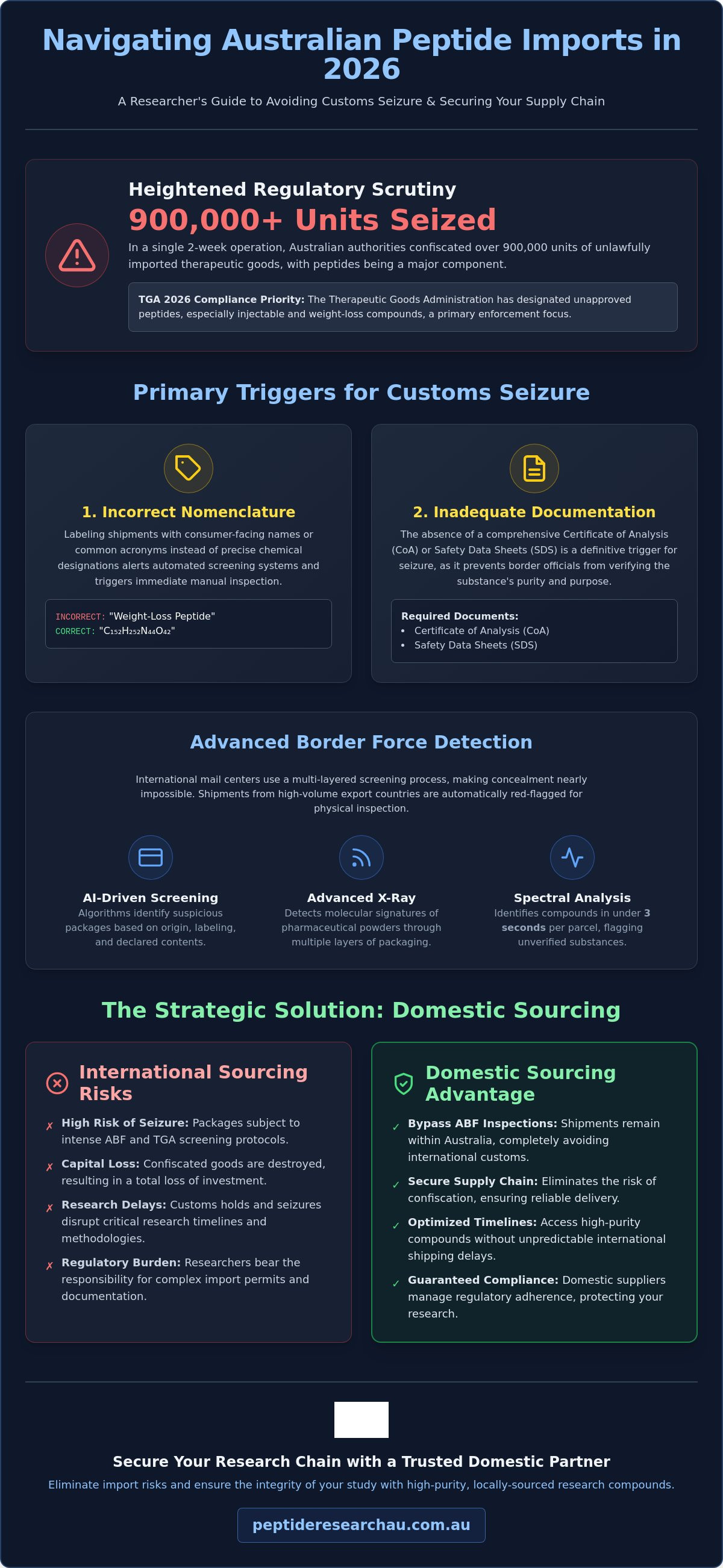
The Australian Border Force (ABF) enforces these regulations at international mail centres by applying the Biosecurity Act 2015. This legislation provides the legal basis for scrutinizing incoming shipments that may bypass standard pharmaceutical controls. In 2026, the strategy for avoiding customs seizure of peptides australia has become more complex. Legacy tactics, such as "Research Only" or "Not for Human Consumption" labelling, no longer provide a guaranteed bypass for customs inspections. ABF officials now look past these descriptors. They evaluate the specific chemical nomenclature and the presence of verified documentation to determine if a shipment complies with federal law.
The TGA Priority Focus for 2026
The TGA has officially designated unapproved peptides as a primary compliance priority for 2026. This focus specifically targets injectable peptides and weight-loss compounds that have flooded the international market. There's a clear distinction between scheduled medicines and research-grade chemicals in the eyes of the law. While a researcher may require these compounds for scientific study, the TGA treats them as potential therapeutic goods if they enter the country without a valid import permit or a recognized prescription. The 2026 regulatory updates mean individual researchers must demonstrate a legitimate scientific purpose. They must also provide a rigorous audit trail to prevent the immediate confiscation of their materials.
ABF Detection Capabilities and Methodology
Detection technology at the border has seen significant investment. International mail centres now utilize advanced X-ray systems and AI-driven screening to identify prohibited substances. These systems are programmed to recognize the molecular signatures of pharmaceutical powders even through multi-layered packaging. Origin countries with high volumes of peptide exports are "red-flagged" for mandatory physical inspection by ABF personnel. The ABF’s 2026 automated screening protocol utilizes high-resolution spectral analysis to identify pharmaceutical-like powders in under three seconds per parcel. This efficiency makes avoiding customs seizure of peptides australia through international post nearly impossible for unverified shipments. When a package is flagged, the absence of a comprehensive Certificate of Analysis (CoA) often leads to immediate destruction of the goods.
Primary Triggers for Australian Border Force (ABF) Seizures
Identifying the specific technical reasons for shipment confiscation is critical for maintaining a stable research supply. A primary trigger for intervention is the use of incorrect nomenclature on shipping labels. Labeling a shipment with consumer-facing names rather than precise chemical designations alerts automated screening systems. For example, using a common acronym instead of a full amino acid sequence or chemical formula suggests a non-professional source. This misalignment with standard laboratory procurement practices often leads to immediate manual inspection by ABF personnel. The strategy for avoiding customs seizure of peptides australia relies heavily on technical accuracy and transparency.
Inadequate documentation remains a significant vulnerability for international shipments. The TGA Compliance Priorities for 2026 highlight an intensified focus on unapproved products entering the domestic market. This increased scrutiny means that missing Safety Data Sheets (SDS) or a missing Certificate of Analysis (CoA) serves as a definitive trigger for seizure. Without these documents, the ABF cannot verify the substance's purity or intended application. Furthermore, suspicious packaging tactics, such as "stealth" wrapping or hiding vials within unrelated consumer goods, are easily identified by 2026 spectral imaging technology. These attempts to bypass the system usually result in the permanent loss of capital.
Inaccurate Customs Declarations
Mis-manifesting goods by declaring peptides as "cosmetics," "electronics," or "essential oils" is a high-risk strategy. Declaring research compounds as vague materials like "plastic beads" or "calcium powder" creates a discrepancy between the declared item and the spectral signature detected by X-ray scanners. Inconsistent value declarations also raise red flags. If the declared value is significantly lower than the market rate for high-purity laboratory chemicals, officials may suspect commercial-scale importation. Providing false information on customs documents is a federal offense in Australia, which can lead to formal investigations beyond simple product seizure.
Lack of Verified Research Credentials
Shipments addressed to residential locations are statistically more likely to be flagged for inspection in 2026. Professional research materials are expected to be delivered to recognized institutions or commercial laboratories. Researchers must maintain a documented purpose for their study to justify the possession of Schedule 4 substances. Distinguishing between personal use and laboratory-grade research materials is vital for avoiding customs seizure of peptides australia; the former is restricted under the Personal Importation Scheme, while the latter requires specific institutional oversight. To eliminate these variables, many professionals are shifting toward domestic procurement of research peptides to ensure supply chain stability.
Nomenclature: Use IUPAC names or chemical sequences instead of brand names.
Documentation: Ensure every shipment includes a batch-specific CoA and SDS.
Transparency: Avoid "stealth" packaging that suggests intent to deceive.
Compliance and Documentation Requirements for Researchers
Researchers operating within the Australian regulatory framework must prioritize administrative precision to maintain their supply chains. Relying on transparency with the Australian Border Force (ABF) is significantly more effective than attempting to obscure the nature of a shipment. When a researcher provides a complete documentation package, it demonstrates a commitment to professional standards and regulatory compliance. This proactive approach is the most reliable method for avoiding customs seizure of peptides australia when sourcing materials from international origins. It's often the lack of clarity, rather than the substance itself, that triggers a permanent hold.
A comprehensive documentation suite must include a batch-specific Safety Data Sheet (SDS). The SDS serves as a critical declaration of chemical stability, storage requirements, and handling safety. It provides customs officials with the necessary data to verify that the substance doesn't pose a biosecurity or public health risk. Without an SDS, officials often default to a precautionary seizure, as they can't confirm the safety profile of an unknown powder. Providing this paperwork upfront reduces the likelihood of manual intervention and laboratory delays.
Securing a Certificate of Analysis (CoA)
The Certificate of Analysis (CoA) is the definitive proof of a compound's identity and purity. A high-quality CoA must include High-Performance Liquid Chromatography (HPLC) and Mass Spectrometry (MS) testing data. These analytical reports confirm the peptide's amino acid sequence and ensure the absence of heavy metals or residual solvents. Verifying the authenticity of these reports is essential; researchers should cross-reference laboratory letterheads and batch numbers with the manufacturer's database. For a deeper analysis of these technical benchmarks, consult Peptides Australia: The Researcher’s Guide to Quality, Sourcing, and Standards in 2026.
HPLC Data: Confirms purity levels exceed 98% or 99%.
MS Analysis: Verifies the correct molecular mass and sequence.
Batch Number: Links the documentation directly to the physical vial.
Import Permits and Scheduling
Most research peptides are classified under the Standard for the Uniform Scheduling of Medicines and Poisons (SUSMP). Determining whether a compound falls under Schedule 4 (Prescription Only Medicine) or Schedule 7 (Dangerous Poison) dictates the specific permit requirements. For substances not currently listed on the Australian Register of Therapeutic Goods (ARTG), a TGA import permit is often mandatory for legitimate research purposes. For instance, retatrutide research in 2026 requires strict adherence to Schedule 4 importation protocols, including the provision of a valid institutional research license and a detailed study abstract. Navigating these requirements is a prerequisite for avoiding customs seizure of peptides australia and ensuring the continuity of clinical investigations.
The Strategic Advantage of Domestic Sourcing in Australia
The most effective strategy for avoiding customs seizure of peptides australia is to eliminate the international border from the logistics equation entirely. While international procurement often appears cost-effective on paper, it introduces a high-probability point of failure at the Australian Border Force (ABF) entry points. Domestic shipping operates within state and territory borders, meaning parcels don't pass through the international mail centres where advanced spectral screening and AI-driven detection protocols are most active. By utilizing a local supply chain, researchers ensure that their materials are not subject to the volatile regulatory holds that characterize 2026 international imports.
Financial security is a primary benefit of this approach. A seized international shipment represents a 100% loss of capital, as most overseas vendors don't offer insurance against government confiscation. Domestic sourcing shifts the regulatory burden to the supplier, who serves as the importer of record and handles all necessary TGA clearances before the product enters the local market. This model provides a reliable method for receiving research compounds without the risk of legal uncertainty or capital forfeiture. It also allows for immediate laboratory accountability and adherence to Australian manufacturing standards.
Bypassing the Border Force
Domestic logistics networks operate independently of the international hubs managed by the ABF. There's a significant legal difference between an individual importing a Schedule 4 substance and a researcher purchasing that same substance from a pre-verified domestic laboratory supplier. In the latter scenario, the compound has already cleared the border under appropriate commercial permits. This is why domestic sourcing is the primary recommendation for BPC-157 studies. It removes the risk of a researcher being flagged for unauthorized importation, as the transaction occurs entirely within the domestic regulatory framework.
Cost-Benefit Analysis of Local Supply
A true cost-benefit analysis must account for the "seizure tax" associated with international orders. If one in four international shipments is intercepted, the effective cost of your research materials increases by 25%. Domestic pricing reflects a guaranteed delivery model and the inclusion of local technical expertise. Additionally, local supply chains are better equipped to maintain cold-chain integrity for sensitive compounds like TB-500. Reducing transit time from three weeks to three days significantly lowers the risk of peptide degradation due to temperature fluctuations in transit. Secure your laboratory's supply chain by choosing a domestic provider of research peptides today.
Risk Mitigation: 0% chance of ABF seizure on domestic routes.
Speed: Delivery timelines reduced from weeks to 24-72 hours.
Stability: Superior handling of temperature-sensitive research compounds.
Support: Access to Australian-based technical assistance and documentation.
Securing Your Research Chain with Peptide Research AU
Peptide Research AU provides a definitive solution for researchers who prioritize supply chain integrity and regulatory compliance. As Australia’s leading provider of laboratory-grade research compounds, we specialize in high-purity materials designed for professional study. Our operational model is built on a commitment to 100% domestic shipping. This ensures that our clients never face the uncertainty of international mail centres. By maintaining all inventory within Australian borders, we offer a reliable method for avoiding customs seizure of peptides australia. This eliminates the risk of capital loss and ensures that your research timelines remain on schedule.
Quality control is central to our methodology. Every batch of peptide products undergoes rigorous analytical testing. We utilize High-Performance Liquid Chromatography (HPLC) and Mass Spectrometry (MS) to verify purity and sequence identity. This data is available to researchers to confirm that the materials meet the stringent requirements of a controlled laboratory environment. We also provide essential laboratory diluents, including bacteriostatic water, to ensure a complete and standardized research setup. This attention to detail supports the precision required for high-level scientific investigation.
Why Researchers Trust Peptide Research AU
Our "Customs-Free" guarantee is supported by localized logistics. All stock is held and dispatched from within Australia, bypassing the Australian Border Force entirely. We implement clinical-grade handling and storage protocols, maintaining lyophilized compounds in temperature-controlled environments to preserve molecular stability. Packaging is designed for professional laboratory environments. It is discreet and secure, ensuring the physical integrity of the vials during transit. This meticulous approach reflects our understanding of the high-level requirements necessary for avoiding customs seizure of peptides australia while maintaining compound efficacy.
Sourcing Your Next Research Compound
Establishing a reliable supply is critical for longitudinal studies and complex experimental designs. Our catalog includes specialized compounds such as PT-141 and GHK-Cu, which are provided with batch-specific documentation. Researchers can secure their supply for multi-phase projects without the fear of sudden inventory shortages or border delays. By choosing a domestic partner, you gain access to consistent technical standards and predictable delivery schedules. Secure your research supply with Peptide Research AU today and focus on the data, not the logistics.
Domestic Availability: All compounds are shipped from within Australia.
Verified Purity: HPLC and MS testing reports accompany every batch.
Stability: Clinical-grade storage and rapid transit times.
Comprehensive Support: Access to diluents and technical documentation.
Optimizing Your Research Supply Chain
The 2026 regulatory environment demands a meticulous approach to procurement. Successful scientific study relies on the consistent availability of high-purity compounds; international shipping can no longer guarantee this stability. By understanding the technical triggers for intervention and prioritizing domestic logistics, researchers achieve the most reliable method for avoiding customs seizure of peptides australia. Transitioning to a local supply model eliminates the risk of capital loss and ensures that every batch meets rigorous Australian laboratory standards. It's the only way to ensure your methodology isn't compromised by external logistics failures.
Peptide Research AU provides the infrastructure necessary for uninterrupted longitudinal studies. We dispatch all specialized research compounds directly from our Australian warehouses. This ensures zero exposure to international customs protocols and advanced border screening. Every batch undergoes third-party HPLC and MS purity testing to confirm it meets the technical specifications required for professional study. This approach provides the reliability and precision essential for advanced scientific investigation. We're committed to supporting the integrity of your laboratory's data through consistent supply and verified quality.
Browse laboratory-grade research peptides with 100% domestic Australian shipping and secure your research supply chain today.
Frequently Asked Questions
Is it illegal to buy peptides online in Australia for research?
It is legal to purchase research peptides from domestic suppliers for laboratory and scientific study. These substances must be handled according to the guidelines set for Schedule 4 or Schedule 7 compounds. Purchasing from international websites is high risk, as it often triggers enforcement actions from the TGA and ABF. Researchers must ensure they source from entities that comply with Australian chemical distribution laws.
What happens if my peptide shipment is seized by customs?
The Australian Border Force (ABF) issues a formal Seizure Notice to the recipient when a package is confiscated. This document details the specific grounds for seizure under the Customs Act or Biosecurity Act. The goods are typically held for 30 days. During this time, the importer can provide a valid permit; otherwise, the materials are destroyed, and the importer may face administrative fees.
Can I get a refund if my international peptide order is confiscated?
Most international suppliers do not offer refunds or reshipments for confiscated goods. The legal responsibility for compliance rests entirely with the importer of record. This loss of capital is a primary reason why researchers avoid international procurement. Domestic sourcing provides the only guaranteed protection against the financial risks associated with border intervention and product loss.
How does the ABF identify peptides in the mail?
The ABF utilizes high-resolution X-ray imaging and AI-driven screening to detect pharmaceutical signatures in mail. These systems are calibrated to recognize the specific molecular density of lyophilized powders. In 2026, these automated protocols make avoiding customs seizure of peptides australia nearly impossible for unverified parcels. If a parcel lacks a verifiable Certificate of Analysis, it is flagged for immediate manual inspection.
Do I need a prescription to buy research-grade peptides domestically?
A medical prescription is not required for the procurement of research-grade peptides from a domestic supplier. These compounds are sold strictly for laboratory use and scientific investigation rather than human consumption. However, the purchaser must be a legitimate researcher or represent a professional entity. This ensures that the substances are used within a controlled, professional environment according to safety standards.
Is BPC-157 legal to import into Australia in 2026?
Importing BPC-157 into Australia in 2026 is highly restricted because it is classified as a Schedule 4 substance. International shipments arriving without a TGA-issued import permit are frequently seized and destroyed. To ensure supply chain stability, researchers should source BPC-157 from domestic providers. These suppliers have already managed the regulatory requirements for the compound to enter the Australian market.
What is the safest way to buy peptides in Australia without customs risk?
The most reliable method for avoiding customs seizure of peptides australia is purchasing through a verified domestic supplier. This strategy removes the international border Force from the logistics chain entirely. Domestic providers like Peptide Research AU maintain local inventory and utilize standard domestic couriers. This ensures that your research compounds arrive without the delays or risks of international mail screening.
How can I tell if a peptide supplier is actually based in Australia?
Verify the supplier's physical presence by checking for a valid Australian Business Number (ABN) and a domestic dispatch location. Reputable Australian suppliers provide local contact information and ship via domestic networks like Australia Post. Avoid websites that use vague "global shipping" terms or hide their physical address. A domestic supplier will always provide batch-specific documentation that complies with Australian laboratory standards.


Comments