
Australian Peptide Company Reviews: A Researcher’s Guide to Quality & Reliability (2026)
- peptideresearchau
- May 28
- 12 min read
Updated: May 29
A subjective five star rating is a poor substitute for a high performance liquid chromatography (HPLC) report when evaluating the chemical purity of a research compound. While searching for australian peptide company reviews, many researchers mistakenly prioritize shipping testimonials over raw analytical data. This oversight is critical in a landscape where the TGA recently seized over 900,000 units of unlawfully imported therapeutic goods. Many of these products failed basic quality standards or contained entirely different substances than those listed on the label.
It's natural to feel apprehensive about receiving under-dosed materials or facing customs complications with international orders. This guide establishes a rigorous methodology for assessing Australian suppliers based on scientific transparency rather than marketing claims. You'll learn how to audit a Certificate of Analysis (COA) for authenticity and verify that your multi-peptide complexes meet strict laboratory specifications. We provide a definitive checklist to ensure your domestic sourcing remains reliable, compliant, and focused on high-purity research outcomes.
Key Takeaways
Identify the non-negotiable scientific benchmarks that separate legitimate research providers from unreliable grey-market suppliers.
Learn to scrutinize australian peptide company reviews to detect fabricated testimonials that lack the technical detail required for professional laboratory standards.
Understand how domestic Australian logistics protect research integrity by eliminating customs risks and ensuring the stability of sensitive compounds during transit.
Master the process of auditing a Certificate of Analysis (COA) to confirm that third-party testing reflects the actual batch you receive.
Gain a clear framework for evaluating the price-to-quality ratio, recognizing why rigorous testing protocols prevent bottom-dollar pricing.
Table of Contents
Navigating the Landscape of Australian Peptide Company Reviews
The Australian peptide therapeutics market reached a revenue of USD $1,906.3 million in 2025. By 2026, this sector is expanding at a compound annual growth rate of 7.8%. This rapid growth has led to a proliferation of suppliers, making objective australian peptide company reviews essential for professional researchers. Traditional e-commerce metrics like star ratings often fail to address the technical requirements of a laboratory environment. A supplier might receive praise for fast shipping while providing research peptides with unacceptable levels of trifluoroacetic acid (TFA) or residual solvents. For the discerning scientist, a review is only as valuable as the data supporting it.
True research grade status is defined by transparency. It requires a supplier to provide comprehensive data on the chemical peptide synthesis process and the resulting purity levels. Credibility in the Australian scientific community is built through the consistent provision of High-Performance Liquid Chromatography (HPLC) and Mass Spectrometry (MS) reports. Without these indicators, a review is merely an anecdote rather than a verifiable data point. Researchers must look for suppliers that publish batch-specific results rather than generic, outdated certificates.
Why Scientific Integrity Outweighs Marketing
Precision is the standard for research compounds. Lifestyle brands often prioritize marketing over methodology, which can lead to catastrophic data errors. If a multi-peptide complex contains undocumented impurities, the researcher cannot determine if observed effects are due to the primary peptide or a contaminant. Scientific integrity demands that every batch of material undergoes independent verification to ensure data reproducibility. Peer-reviewed standards should always dictate procurement choices, as the impact of purity on research outcomes remains the most critical metric of success.
While these rigorous standards are essential for the laboratory, they also provide a benchmark for the aesthetic sector; professionals seeking reliable clinical results can discover Mesoskinline Australia to explore their range of high-performance serums and advanced equipment.
Common Pitfalls in Online Peptide Sourcing
The emergence of a "grey market" in Australia presents significant risks to laboratory work. Many online retailers act as simple resellers, lacking direct oversight of the manufacturing process or quality control. These sites often use "research only" labels to bypass the Therapeutic Goods Administration (TGA) regulations regarding Schedule 4 substances. Researchers should be wary of bottom-dollar pricing. High-quality batch testing and temperature-controlled logistics represent fixed costs; prices that seem too low typically indicate that these critical quality control steps were omitted. Relying on superficial australian peptide company reviews can lead to the procurement of under-dosed or entirely incorrect compounds that compromise experimental integrity.
Scientific Criteria for Evaluating Peptide Suppliers
Subjective testimonials in australian peptide company reviews are insufficient for a laboratory setting. Empirical data must drive procurement decisions. The most critical requirement for any supplier is independent, third-party laboratory testing. This process ensures that the manufacturer's internal claims are verified by an unbiased entity. Without these reports, researchers risk introducing variables that could invalidate months of study. High-Performance Liquid Chromatography (HPLC) represents the gold standard for peptide purity verification. This technique separates the components of a mixture to identify and quantify the primary compound against any impurities.
Identity verification is equally vital. Mass Spectrometry (MS) serves this purpose by measuring the molecular weight of the peptide. It confirms that the amino acid sequence is correct and matches the intended compound. High purity is irrelevant if the substance itself is misidentified. Additionally, lyophilisation standards dictate the long-term stability of the product. Proper freeze-drying removes moisture while preserving the molecular structure. A well-formed lyophilised cake indicates a professional manufacturing process, whereas a collapsed or discoloured residue often signals moisture ingress or improper handling. These scientific indicators provide a concrete framework for assessing supplier reliability beyond simple marketing claims.
How to Read a Certificate of Analysis (COA)
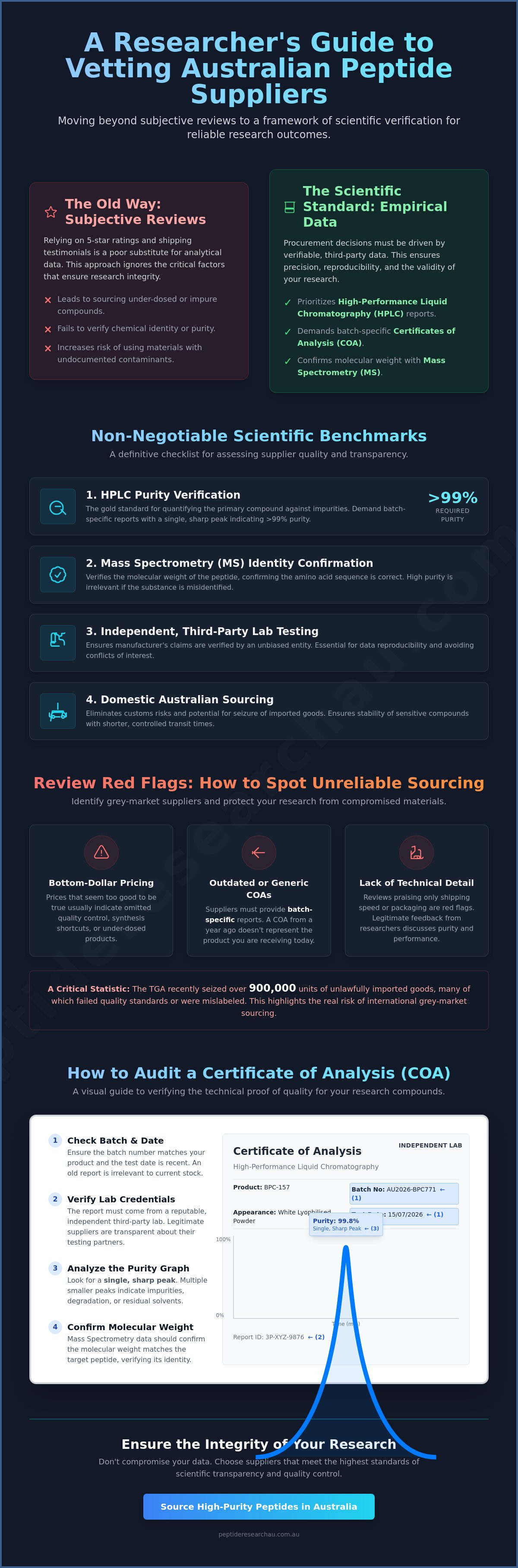
A Certificate of Analysis (COA) provides technical proof of quality. Check the batch number and test date. Freshness matters; a report from several years ago doesn't reflect current stock. Look for a single, sharp peak on the purity graph. Multiple peaks indicate impurities or degradation. Verify lab credentials by checking report IDs directly on the testing facility's website. Researchers seeking these rigorous transparency standards can explore high-purity research compounds for their studies.
Storage and Handling Protocols
Peptides are sensitive to heat and light. Professional suppliers use temperature-controlled storage, often between 2°C and 8°C. Light-resistant amber vials prevent photo-degradation, while vacuum sealing protects the lyophilised powder from oxygen. When reading australian peptide company reviews, evaluate the shipping methods. Providers using insulated packaging and rapid transit demonstrate a commitment to compound stability. These operational details are more revealing than a standard customer rating and ensure the integrity of the research material upon arrival.
Review Red Flags: How to Spot Unreliable Sourcing
Analytical scrutiny must extend beyond the laboratory and into the digital footprint of a supplier. When evaluating australian peptide company reviews, the absence of technical nomenclature is a primary indicator of non-scientific feedback. A legitimate researcher's evaluation should detail specific observations such as reconstitution times, solution clarity, or batch-to-batch consistency. Generic praise like "excellent results" or "fast shipping" provides zero insight into the chemical integrity of research compounds. If a review platform is saturated with vague, emotive language rather than technical data, the source's credibility is compromised.
Extreme price variance often signals a failure in quality control. Rigorous third-party verification, as established in previous sections, requires significant financial investment. Suppliers offering bottom-dollar pricing usually bypass these essential overheads. This "price trap" results in products that are frequently under-dosed or contaminated with residual solvents. Additionally, a lack of responsive technical support is a critical warning sign. A professional provider should be able to answer complex questions regarding lyophilisation or molar mass. If a company's communication is evasive or strictly sales-oriented, they likely lack the scientific expertise required to maintain high manufacturing standards.
Analyze the company's operational history before procurement. The peptide industry often sees "phoenix" companies that vanish after negative feedback or regulatory pressure, only to reappear under a different name. Reliable providers maintain a consistent presence and a transparent archive of their historical batch testing. Discontinuity in a brand's history is a major red flag for any researcher requiring long-term data reproducibility.
The Danger of International 'Grey Market' Suppliers
International reviews often ignore the specific challenges of Australian Border Force (ABF) protocols. In a recent 2026 crackdown, the TGA seized over 900,000 units of unlawfully imported therapeutic goods, including peptides. Sourcing from overseas entities introduces a high probability of customs intervention and permanent loss of capital. Long-haul international transit also poses a significant risk of peptide degradation. Sensitive compounds like multi-peptide complexes can lose structural integrity if exposed to fluctuating temperatures in uncontrolled cargo holds. Obtaining recourse or refunds from overseas entities is notoriously difficult, leaving researchers with no protection against sub-standard materials.
Spotting Incentivised and Fake Feedback
Suspicious patterns in australian peptide company reviews often manifest as sudden bursts of five-star ratings within a short timeframe. This usually indicates an incentivised review campaign or fabricated entries. Legitimate scientific feedback is typically staggered and detailed. Genuine providers don't just tolerate critical technical questions; they welcome them as a means of demonstrating their commitment to transparency. If a supplier actively suppresses neutral or technical critiques on their platforms, they're prioritizing marketing over scientific accuracy. Researchers should prioritize platforms where feedback includes batch numbers and references to specific laboratory diluents or equipment used during the study.
The Advantage of Domestic Australian Sourcing in 2026
Sourcing research compounds within Australia eliminates the volatility associated with international logistics. While international australian peptide company reviews might suggest lower price points, they rarely account for the high rate of customs seizures. In early 2026, the TGA seized over 900,000 units of therapeutic goods, including peptides, during a single two-week operation. Domestic sourcing ensures that materials are already within the national borders, providing researchers with total project security. This approach supports the local biotech ecosystem while ensuring that manufacturing standards align with Australian laboratory requirements. Local standards in 2026 demand rigorous adherence to purity benchmarks that often exceed those found in unregulated international markets. By choosing a domestic partner, researchers contribute to a robust scientific infrastructure that prioritizes data integrity over high-volume distribution.
Logistics and Research Continuity
Rapid transit is a scientific necessity rather than a mere convenience. Peptides are inherently unstable. They're prone to degradation when exposed to uncontrolled environmental conditions. Domestic shipping typically occurs within a 24-48 hour window. This timeframe significantly reduces the duration of thermal exposure compared to international freight which can take weeks. High-value research orders require tracking and insurance as standard protocols. Professional domestic providers use discreet, secure packaging to maintain the structural integrity of lyophilised cakes. This efficiency prevents project delays. It ensures that your data remains valid and reproducible. Reliable domestic logistics mean your research doesn't stall due to transit-related degradation or administrative hold-ups.
Compliance and Standards in Australia
Local suppliers must adhere to strict Australian laboratory safety and storage guidelines. This regulatory alignment provides a layer of accountability that overseas entities can't match. Sourcing necessary laboratory diluents, such as bacteriostatic water, from the same domestic provider ensures chemical consistency across your entire study. By consolidating procurement, researchers can verify that all compounds meet 2026 regulatory expectations. Local technical support also offers the advantage of speaking with experts who understand the specific requirements of the Australian scientific landscape. When you read australian peptide company reviews, look for mentions of domestic support responsiveness as a key performance indicator. This local expertise is invaluable when troubleshooting complex reconstitution protocols or verifying batch-specific data.
Researchers can procure high-purity research peptides from a domestic source to ensure compound stability and project continuity.
Why Peptide Research AU Sets the Benchmark for Reviews
Peptide Research AU operates on a foundation of empirical evidence. While many australian peptide company reviews focus on delivery speed, we prioritize the chemical precision of our products. Every batch of our research compounds undergoes 100% third-party testing to verify its purity and identity. This commitment to transparency ensures that researchers receive materials that meet exact laboratory specifications. Our meticulous quality control process includes advanced lyophilisation. This process creates a stable, high-purity product that maintains structural integrity during storage. We provide precision-grade compounds for discerning researchers who require data reproducibility above all else.
Scientific documentation is the cornerstone of our operations. We invite all clients to review our latest Certificates of Analysis (COA) and technical documentation before initiating a study. This level of disclosure eliminates the guesswork often associated with domestic sourcing. Our catalog includes specialized research materials such as BPC-157. These compounds are synthesized and tested to ensure they meet the rigorous demands of modern laboratory environments. We also provide the necessary laboratory diluents to ensure proper reconstitution protocols are followed, maintaining the integrity of the research compounds from receipt to application.
Evidence-Based Excellence
We prioritize raw data over marketing slogans. In an industry where vague claims are common, our role is to provide high-purity peptides in Australia for institutional and private study. We don't rely on generic testimonials. Instead, we offer direct access to our scientific support team for any technical inquiries. This ensures that your procurement process is backed by professional expertise. Our focus remains on the specific technical attributes that define a compound's utility in a research setting. By maintaining these high standards, we ensure that the australian peptide company reviews we receive reflect our commitment to scientific accuracy.
Building the Future of Australian Research
Our mission is to provide the most reliable sourcing for the AU scientific community. We're constantly expanding our range to include the latest developments in chemical synthesis, such as the triple agonist peptide retatrutide. These multi-peptide complexes represent the leading edge of contemporary research. Starting your research project with a verified domestic partner ensures you avoid the pitfalls identified earlier in this guide. We provide the laboratory diluents and high-purity compounds necessary for precise, reproducible results. Reliability is our standard. We maintain a rigorous chain of custody for all materials to ensure that every compound delivered meets the high manufacturing standards required for professional study.
Securing Data Integrity Through Verified Sourcing
The transition from anecdotal feedback to empirical verification is essential for maintaining modern laboratory standards. Relying on subjective australian peptide company reviews without auditing batch-specific HPLC and Mass Spectrometry reports introduces unacceptable variables into a study. Authentic reliability is defined by laboratory-grade purity exceeding 99% and a transparent chain of custody that international "grey market" suppliers cannot provide. Domestic logistics ensure that temperature-sensitive research compounds reach your facility without the degradation risks or customs intervention common in cross-border transit. By prioritizing technical transparency over marketing slogans, researchers protect the reproducibility of their data and the integrity of their findings.
We maintain a commitment to excellence through independent 3rd-party testing on every batch and fast domestic shipping across Australia. This methodology ensures that your focus remains on the study itself rather than the quality of the materials. You can view our laboratory-tested research peptide collection to secure high-purity materials for your next project. Establish your methodology on a foundation of precision and verified quality to achieve the most accurate research outcomes.
Frequently Asked Questions
How can I verify if an Australian peptide company's reviews are real?
Authentic reviews are verified by the presence of technical nomenclature and specific laboratory observations. Legitimate researchers often reference batch numbers, reconstitution clarity, or HPLC results in their feedback. Generic or emotive praise that lacks clinical detail is a primary indicator of fabricated australian peptide company reviews. Professional platforms should prioritize data-driven testimonials over simple star ratings.
What is the most important lab report to look for before buying peptides?
High-Performance Liquid Chromatography (HPLC) and Mass Spectrometry (MS) are the essential benchmarks for quality. HPLC quantifies the purity level of the compound, while MS confirms its molecular weight and identity. A supplier must provide both reports to ensure the material is chemically accurate and free from significant contaminants. Without these documents, the integrity of your research data is at risk.
Is it better to buy peptides from an Australian company or an overseas supplier?
Domestic sourcing is superior for maintaining research continuity and compound stability. International orders face high risks of customs intervention. In early 2026, the TGA seized over 900,000 units of unlawfully imported therapeutic goods. Domestic transit also prevents the degradation of temperature-sensitive peptides that occurs during long-haul international freight.
What are the legal requirements for buying research peptides in Australia?
Most injectable peptides are classified as Schedule 4 prescription-only medicines under the national Poisons Standard. It's illegal to possess or sell these substances without a valid doctor's prescription. While many "grey market" entities use research labels to circumvent these laws, the TGA actively monitors and enforces regulations under the Therapeutic Goods Act 1989. Researchers must ensure their procurement aligns with current Australian legal frameworks.
How do I know if a peptide has been properly tested for purity?
Proper testing is confirmed by a batch-specific Certificate of Analysis (COA) from an independent laboratory. The HPLC chromatogram should display a single sharp peak, indicating a purity level that exceeds 99%. Always verify the testing date on the report. Outdated COAs don't reflect the quality of current inventory and shouldn't be used to justify a purchase.
What happens if my peptide order is seized by Australian customs?
Seized goods are typically destroyed by the TGA or Australian Border Force, and the importer may face legal consequences. In March 2026, an individual in Victoria received an infringement notice of $3,756 for unlawful importation. International suppliers rarely offer refunds for seized materials. This makes domestic sourcing a more secure option for Australian researchers.
Why is HPLC testing so important for peptide research?
HPLC is the gold standard for purity verification because it separates and identifies every component within a mixture. It allows for the detection of trace impurities, residual solvents, or degradation products that could compromise experimental outcomes. High purity is a prerequisite for data reproducibility. Accurate HPLC data ensures that experimental results are attributed to the primary peptide rather than contaminants.
Can I request a Certificate of Analysis (COA) from Peptide Research AU?
Yes, we provide batch-specific COAs for all our research compounds and multi-peptide complexes. Transparency is fundamental to our role as a reliable provider for the AU scientific community. This documentation ensures that our materials meet the high standards established in professional australian peptide company reviews. Researchers can contact our technical support team to access the latest analytical reports for their specific batches.


Comments