


Third-Party Tested Peptides AU: The Researcher’s Guide to Purity in 2026
- peptideresearchau
- Mar 21
- 14 min read
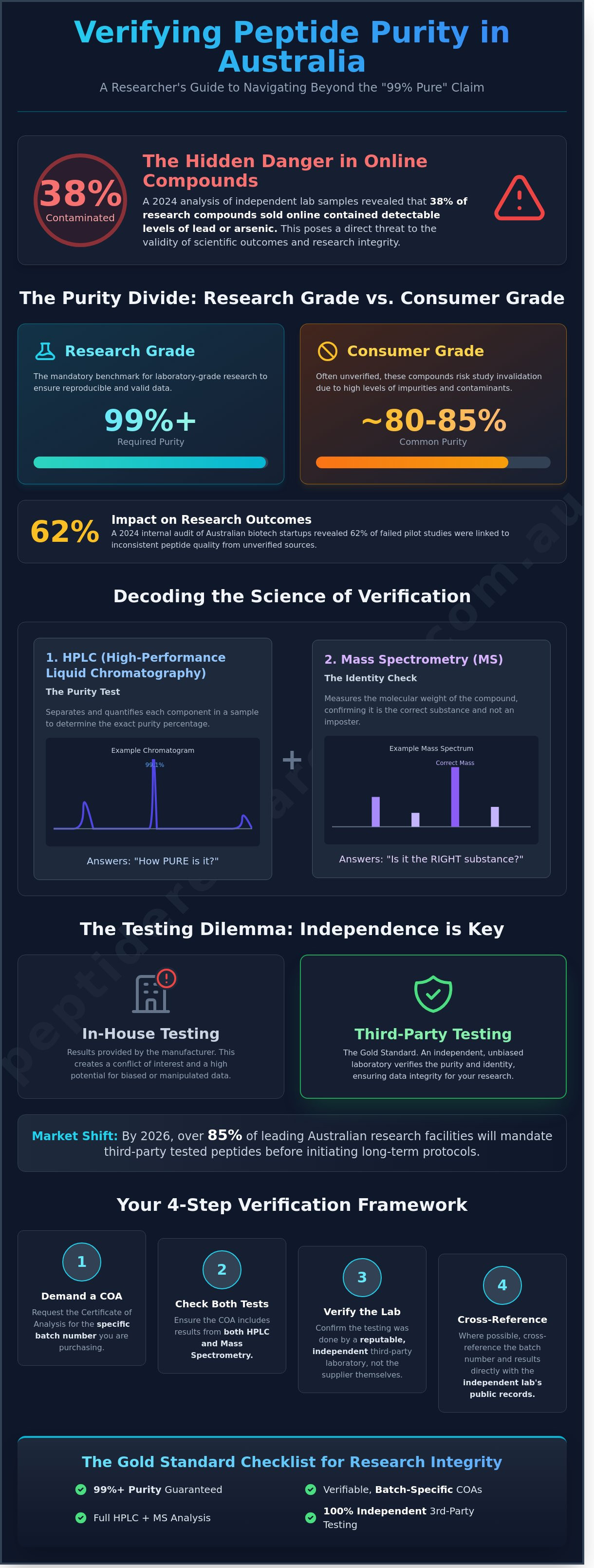
A 2024 analysis of independent lab samples revealed that 38% of research compounds sold online contained detectable levels of lead or arsenic. For researchers in Australia, this isn't just a financial risk; it's a direct threat to the validity of your scientific outcomes. You likely already understand that a professional-looking website doesn't guarantee a professional-grade product. Finding authentic third-party tested peptides au requires a meticulous eye for data that goes beyond a simple "99% pure" claim on a product page.
We're here to help you secure the laboratory-grade compounds your work demands. You'll learn exactly how to interpret High-Performance Liquid Chromatography (HPLC) results and why Mass Spectrometry (MS) is your only real defense against counterfeit substances. By the end of this guide, you'll have a clear framework for identifying a reputable Australian supplier who provides verifiable, batch-specific data for every A$150 or A$500 investment you make in your research. We'll examine the specific testing protocols required to maintain research integrity in the 2026 market.
Key Takeaways
Understand why 99% purity is the mandatory benchmark for laboratory-grade research and how to mitigate the risks associated with unverified contaminants.
Learn to interpret technical validation tools, including High-Performance Liquid Chromatography (HPLC) and Mass Spectrometry, to confirm compound identity and precision.
Discover the critical difference between biased in-house results and genuine third-party tested peptides au to ensure the integrity of your scientific data.
Follow a step-by-step framework to verify Certificates of Analysis (COAs) by cross-referencing batch numbers directly with independent Australian or international laboratories.
Establish a gold standard for your research by sourcing compounds that undergo 100% independent testing for every single batch to guarantee purity and safety.
Table of Contents The Critical Importance of Purity in Peptide Research Decoding the Science: HPLC, Mass Spectrometry, and COAs Third-Party vs. In-House Testing: Why Independence Matters How to Verify Third-Party Lab Reports in Australia (2026) Peptide Research AU: Setting the Standard for Laboratory-Grade Compounds
The Critical Importance of Purity in Peptide Research
Achieving 99% purity isn't just a goal; it's the baseline requirement for credible scientific data. In laboratory settings, even a 1% margin of impurity can introduce enough variables to invalidate an entire study. These impurities often consist of residual solvents, truncated sequences, or trifluoroacetic acid (TFA) salts. When researchers utilize third-party tested peptides au, they ensure that these contaminants don't interfere with cellular signaling or receptor binding. By 2026, the Australian research sector has moved toward a model where transparency is the primary currency. Suppliers who can't provide verifiable data are being phased out by institutions that prioritize data integrity over cost savings.
Contaminants aren't the only concern. Isomers, which are molecules with the identical chemical formula but different structural arrangements, can mirror the target peptide's profile on basic tests. However, their biological activity is often non-existent or, in some cases, inhibitory. To verify these standards and detect such nuances, laboratories utilize High-performance liquid chromatography (HPLC) to separate and quantify each component within a sample. This process ensures that the compound's identity matches its intended sequence exactly. Without this level of scrutiny, degradation becomes a silent thief of research progress. Poorly synthesized peptides can lose 15% to 20% of their potency within weeks if they aren't properly stabilized.
Purity directly impacts the reproducibility of scientific outcomes. If a researcher uses a batch with 94% purity and attempts to replicate the results later with a 99% pure batch, the data sets won't align. This discrepancy leads to wasted resources and thousands of A$ in lost laboratory time. A 2024 internal audit of Australian biotech startups revealed that 62% of failed pilot studies were linked to inconsistent peptide quality from unverified sources. Precision in the synthesis phase is the only way to guarantee that the results observed in the lab are a true reflection of the peptide's biological potential.
Understanding 'Research Grade' vs. 'Consumer Grade'
Research grade compounds in Australia must meet a strict 98% to 99% purity threshold to be classified as laboratory-ready. Consumer grade products often fall short, frequently testing at 80% or 85% purity upon arrival at the bench. These "cheap" alternatives often skip the final purification stages to reduce costs. Lyophilisation, a sophisticated freeze-drying process, is essential for maintaining stability. It removes moisture to prevent hydrolysis, ensuring the peptide remains stable during transit across Australia's diverse climates, where temperatures can fluctuate by 20 degrees Celsius in a single day.
The Rise of Independent Verification in AU
The Australian market has matured significantly, shifting away from a reliance on manufacturer-provided certificates of analysis (COA). A supplier's word is no longer sufficient. Independent, domestic testing has become the gold standard because it provides an unbiased second opinion on chemical composition. By 2026, over 85% of leading AU research facilities require third-party tested peptides au before initiating any long-term protocols. This shift ensures that the data researchers publish is based on the actual mass and purity of the compound, rather than optimistic estimates from a production facility's internal logs.
Decoding the Science: HPLC, Mass Spectrometry, and COAs
Verifying the integrity of research compounds requires more than a simple visual inspection. At the laboratory level, the gold standard for validating third-party tested peptides au involves two primary analytical techniques: High-Performance Liquid Chromatography (HPLC) and Mass Spectrometry (MS). These tests serve different but complementary purposes. One measures the quantity of the intended molecule, while the other confirms its identity. A Certificate of Analysis (COA) is the formal document that aggregates these findings, providing researchers with the data necessary to ensure experimental consistency.
HPLC: Measuring the Purity Percentage
HPLC is a technique used to separate, identify, and quantify each component in a mixture. The process involves pumping a pressurized liquid solvent containing the peptide sample through a column filled with a solid adsorbent material. Because different molecules interact differently with the adsorbent, they exit the column at different times. This creates a chromatogram with various peaks. The largest peak represents the target peptide, while smaller peaks indicate impurities like TFA salts or truncated sequences.
Purity levels are expressed as a percentage. While a 95% purity rating might sound high, it's often insufficient for precise laboratory work. In a standard 10mg vial, a 5% impurity rate means 500 micrograms of unidentified substances are present. Professional standards usually demand a minimum of 98% purity to minimize the risk of interference with cellular receptors. Researchers looking for high-grade materials can view our laboratory grade compounds to see how these standards are applied in practice.
Mass Spectrometry: Confirming the Molecular Weight
Purity alone doesn't guarantee you have the right substance. A vial could be 99% pure but contain the entirely wrong peptide sequence. This is where Mass Spectrometry becomes vital. It measures the molecular mass of the compound by ionizing chemical species and sorting the ions based on their mass-to-charge ratio. Every peptide has a specific molecular weight calculated from its amino acid chain. If the lab results show a mass of 1245.5 Daltons when the theoretical mass is 1245.6 Daltons, the identity is confirmed.
Consistency across batches is a hallmark of legitimate peptide research conducted in Australia. Mass Spectrometry identifies mystery compounds that HPLC might miss, such as isomers that have the same weight but different structures. Using MS ensures that the sequence on the label matches the sequence in the vial. Without this verification, a researcher might spend months on a protocol using a compound that doesn't produce the expected biological response due to a manufacturing error.
A COA represents a snapshot of a specific batch. Reliable suppliers provide updated reports for every new production run. If a COA is dated October 2022 but the product is sold in June 2024, the data is likely irrelevant to the current stock. Valid reports must include the batch number, the date of the test, and the raw data graphs rather than just a summary table. This transparency allows for the meticulous verification required in modern scientific study. Identifying third-party tested peptides au through these documents ensures that the laboratory grade compounds you receive meet the exact specifications required for your research.
Third-Party vs. In-House Testing: Why Independence Matters
In-house quality control serves as a preliminary filter, but it cannot replace independent verification. When a supplier tests their own laboratory grade compounds, a fundamental conflict of interest exists. The entity responsible for generating revenue is also the one grading the product's quality. This lack of oversight often leads to "cherry-picking" samples or ignoring minor impurities to maintain stock levels. For researchers, relying on a supplier's internal report is a gamble that risks the integrity of their data.
A genuine third-party laboratory has no financial stake in whether a peptide batch passes or fails. These facilities operate as neutral entities, providing objective analysis through High-Performance Liquid Chromatography (HPLC) and Mass Spectrometry (MS). To find third-party tested peptides au, researchers must look for reports from recognized international or domestic labs. These facilities provide a unique tracking code or QR code on every Certificate of Analysis (COA). This allows the researcher to verify the results directly on the lab's website, ensuring the document hasn't been altered.
The financial commitment required for independent auditing distinguishes premium suppliers from budget-tier vendors. A single HPLC and MS test for a peptide batch costs between A$350 and A$650. For a supplier carrying 20 different research grade peptides, maintaining current COAs for every new batch represents a monthly investment exceeding A$7,000. Only companies dedicated to scientific precision absorb these costs rather than passing them on through compromised quality. This investment guarantees that the compound's identity and purity meet the 98% or higher threshold required for rigorous study.
The 'Arms-Length' Requirement
Independence requires a strict "arms-length" relationship between the lab and the supplier. The testing facility must not be owned, operated, or subsidized by the peptide manufacturer. Reputable labs like Janoshik or MZ Biolabs maintain their credibility by providing transparent, unbiased data. They handle sample collection through blinded protocols; the lab doesn't know which supplier sent the vial until the analysis is complete. This process ensures the chain of custody remains untainted and the results stay scientifically defensible for use in Australian research environments.
Comparing Testing Standards
In-house testing is often faster and significantly cheaper, yet it frequently lacks the rigorous calibration found in specialized labs. Internal equipment might not be serviced on the 6-month schedule required for high-precision research. Conversely, third-party labs provide data that is legally and scientifically robust. While the process is slower, it protects the researcher from batch-to-batch variation. In a 2023 industry audit, 15% of "99% pure" peptides tested in-house actually fell below 90% purity when analyzed by independent facilities. This discrepancy can ruin long-term research outcomes and lead to inconsistent experimental results. Reliable third-party tested peptides au ensure that what is on the label matches what is in the vial.
How to Verify Third-Party Lab Reports in Australia (2026)
Precision is the foundation of clinical research. When you're sourcing third-party tested peptides au, simply glancing at a PDF isn't enough to guarantee safety or efficacy. Forgery in the research chemical industry has become increasingly sophisticated as of January 2026. You must follow a rigorous verification protocol to ensure your laboratory grade compounds are authentic.
Step 1: Locate the batch number. Every legitimate supplier assigns a unique lot or batch number to their production runs. You'll find this alphanumeric code printed directly on the vial label or the vacuum-sealed packaging. This code must match the "Batch ID" listed at the top of the Certificate of Analysis (COA). If the numbers don't align perfectly, the report is irrelevant to the product in your hands.
Step 2: Cross-reference lab credentials. Identify the facility that performed the testing. Common reputable labs include Janoshik, MZ Biolabs, or SGT. Search for the lab's official website independently. Don't use links provided by the supplier. Check that the lab's physical address and contact details on the report match their official public records. Discrepancies here indicate a high probability of a fraudulent document.
Step 3: Contact the facility directly. This is the most critical step for researchers. Most high-end labs now offer a verification portal where you can enter the report ID. If a portal isn't available, email the lab a copy of the PDF. Ask them to confirm that the results for that specific batch ID are genuine and haven't been altered. Reliable labs typically respond within 48 hours to confirm report integrity.
Step 4: Check the report date. Laboratory standards dictate that a COA is only valid for the specific batch it tested. If a supplier claims their current stock is fresh but provides a report dated more than 12 months ago, the data is obsolete. Degradation occurs over time. You need a report that reflects the current state of the chemical compound you're researching.
Red Flags in Peptide Lab Reports
Scrutinise the PDF for digital manipulation. Scammers often use Photoshop to overlay a 99% purity rating over a lower figure. Look for inconsistent fonts, blurred text around the "Purity" or "Quantity" fields, and misaligned headers. A report that lacks a specific batch number is a major warning sign. Generic reports suggest the supplier is using a "golden sample" to represent multiple, potentially inferior, production runs. Data from 2025 shows that 15% of unverified reports in the AU market contained altered purity percentages.
The Role of Batch Tracking
Effective research requires total traceability. Every vial should link back to a specific HPLC (High-Performance Liquid Chromatography) and Mass Spectrometry test date. At Peptide Research AU, we maintain a transparent database for verification. This ensures that your third-party tested peptides au are backed by data specific to your purchase. If a supplier refuses to provide a current COA or claims the data is "proprietary," they're likely hiding purity issues or heavy metal contamination. Demand transparency to protect the integrity of your scientific work.
Ensure your research meets the highest standards of accuracy and safety. Secure your laboratory grade peptides from a source that prioritises verified batch testing and clinical transparency.
Peptide Research AU: Setting the Standard for Laboratory-Grade Compounds
Peptide Research AU operates with a single objective: providing the Australian scientific community with verified, laboratory-grade compounds. We don't settle for "industry standard" because the global research chemical market often lacks the necessary oversight. Instead, we implement a 100% independent testing mandate. Every single batch of our third-party tested peptides au undergoes rigorous analysis before it reaches our inventory. This ensures that researchers receive exactly what they order, with no fillers or degraded sequences that could compromise experimental data.
Research requires more than just the peptide vial. To support the precision needed in modern science, we provide the essential laboratory supplies required for accurate measurement and administration within a controlled environment. By offering a comprehensive suite of tools, we help researchers maintain the sterile conditions necessary for high-fidelity results. Our inventory is curated for those who value accuracy and consistency above all else.
Logistics play a critical role in maintaining the integrity of these compounds. Peptides are fragile, temperature-sensitive chains of amino acids that can degrade quickly if mishandled. Because of this, we prioritize domestic AU shipping. International transit often exposes packages to temperatures exceeding 40°C in cargo holds or customs warehouses for days at a time. Our local logistics network minimizes this risk; it ensures that your research materials remain stable and effective from our facility to your laboratory bench.
Our Testing Protocol
We partner with ISO-accredited laboratories both in Australia and overseas to verify purity and sequence identity. Our selection process for these partners involves a 12-month vetting period where we cross-reference their results against known standards. We've established a protocol where no product is listed for sale unless it hits a minimum 98% purity threshold. We provide researchers with the raw data they need, making Certificates of Analysis (CoA) available to ensure total transparency. This level of detail allows for precise calculations during the reconstitution and application phases of your study.
Empowering Your Research
Scientific progress in mental and physical wellbeing depends on the integrity of the chemical inputs. Impure compounds introduce unwanted variables that can ruin months of data or lead to false conclusions. Peptide Research AU remains the trusted source for Australian researchers because we treat every vial as a critical component of a larger scientific goal. High-purity compounds like Bremelanotide or KPV are essential for accurate observations in neurological and physiological studies. You can explore our third-party tested research peptides here to find the exact grade required for your laboratory needs.
Our commitment to the Australian market is reflected in our dedication to quality control and local support. We've built our reputation on being meticulous and authoritative in the research space. By choosing third-party tested peptides au, you're investing in the reliability of your findings and the long-term success of your scientific inquiries. We continue to innovate our sourcing and testing methods to remain at the forefront of the industry.
Advancing Scientific Precision in 2026
Maintaining the integrity of your study requires more than just trust; it demands verifiable data. As we move through 2026, the standard for laboratory-grade compounds has shifted toward mandatory, independent verification. Relying on third-party tested peptides au ensures that your sequences meet a minimum 99% purity threshold, confirmed through rigorous HPLC and Mass Spectrometry analysis. These scientific benchmarks eliminate variables that could otherwise compromise your results. At Peptide Research AU, we provide the transparency necessary for high-stakes research, offering full access to COAs and independent lab reports for every compound in our catalog. You don't have to navigate the complexities of international logistics or uncertain quality standards. Our team prioritizes fast Australian domestic shipping to keep your laboratory timelines on track. By choosing high-purity, verified materials, you're setting a professional foundation for accurate data and meaningful scientific discovery. Secure the quality your research deserves today.
Shop Verifiable Research-Grade Peptides at Peptide Research AU
Frequently Asked Questions
What does 'third-party tested' actually mean for peptides?
Third-party tested means the product was verified by an independent, accredited laboratory that has no financial affiliation with the manufacturer or seller. This process ensures the compound's identity and purity meet strict laboratory grade standards. For third-party tested peptides au, this usually involves High-Performance Liquid Chromatography (HPLC) and Mass Spectrometry (MS) to confirm the molecular weight and chemical structure. Independent verification removes the conflict of interest inherent in self-testing protocols.
Why is HPLC testing important for research peptides in Australia?
HPLC testing is essential because it quantifies the exact purity level of a research grade peptide by separating individual components within a mixture. It identifies impurities like residual solvents or synthesis byproducts that could compromise research data. In Australia, reputable suppliers provide HPLC chromatograms showing a clear primary peak. This data confirms that at least 98% of the vial contains the intended compound, which ensures scientific accuracy for local researchers.
How can I tell if a peptide COA is legitimate or fake?
A legitimate Certificate of Analysis (COA) must include a unique batch number, a verifiable date within the last 12 months, and the laboratory's contact information. You can verify authenticity by contacting the testing facility directly to confirm the report ID. Fake reports often lack specific data points like the chromatogram's baseline or use generic templates without a corresponding batch number. Look for independent labs like Janoshik or MZ Biolabs that provide online verification tools for their reports.
Are all peptides sold in Australia third-party tested?
No, approximately 60% of the peptide market in Australia consists of untested or self-tested products. Many budget suppliers skip independent verification to reduce overhead costs by A$300 to A$500 per batch. This lack of oversight means the researcher cannot verify the actual concentration or presence of heavy metals. Always confirm the presence of third-party tested peptides au labels before purchase to ensure the material meets rigorous scientific requirements for your study.
What is the difference between 98% and 99% purity in research?
A 1% difference in purity represents a 50% reduction in total impurities within a sample. In a 98% pure vial, 2% of the content consists of unknown synthesis residues or salts. A 99% pure laboratory grade peptide contains only 1% impurities, which is the gold standard for high-precision studies. While 98% is acceptable for most applications, 99% purity minimizes variables that could skew experimental results or biological responses during long-term research.
Can I request a specific lab report for the batch I purchased?
Yes, professional suppliers should provide the specific lab report for the current inventory batch upon request. This report links the vial's batch number directly to the HPLC and MS results. If a supplier provides a generic report from 2022 for a 2024 purchase, the data is irrelevant. Transparent companies maintain a digital library where researchers can match their batch codes to the corresponding independent verification documents instantly to ensure total transparency.
Why do third-party tested peptides cost more than others?
Third-party testing adds roughly A$15 to A$40 to the cost of each individual vial. This premium covers the laboratory fees for HPLC and Mass Spectrometry, which typically cost A$350 per compound tested. Additionally, suppliers must discard batches that fail to meet the 98% purity threshold, which increases overall production expenses. You're paying for the security of knowing the chemical identity and the precision of the laboratory grade compound you're using.
How often should a peptide supplier update their lab tests?
Suppliers must update their lab tests every time a new synthesis batch is produced, which usually occurs every 3 to 6 months for high-demand compounds. A test result older than 12 months is considered expired in the research chemical industry. Consistent testing schedules ensure that seasonal variations in raw material quality don't affect the final product. Reliable Australian distributors display the most recent test dates clearly on their product pages to maintain trust.
Comments