


Legit Australian Peptide Companies: How to Identify Reputable Suppliers in 2026
- peptideresearchau
- 17 hours ago
- 11 min read
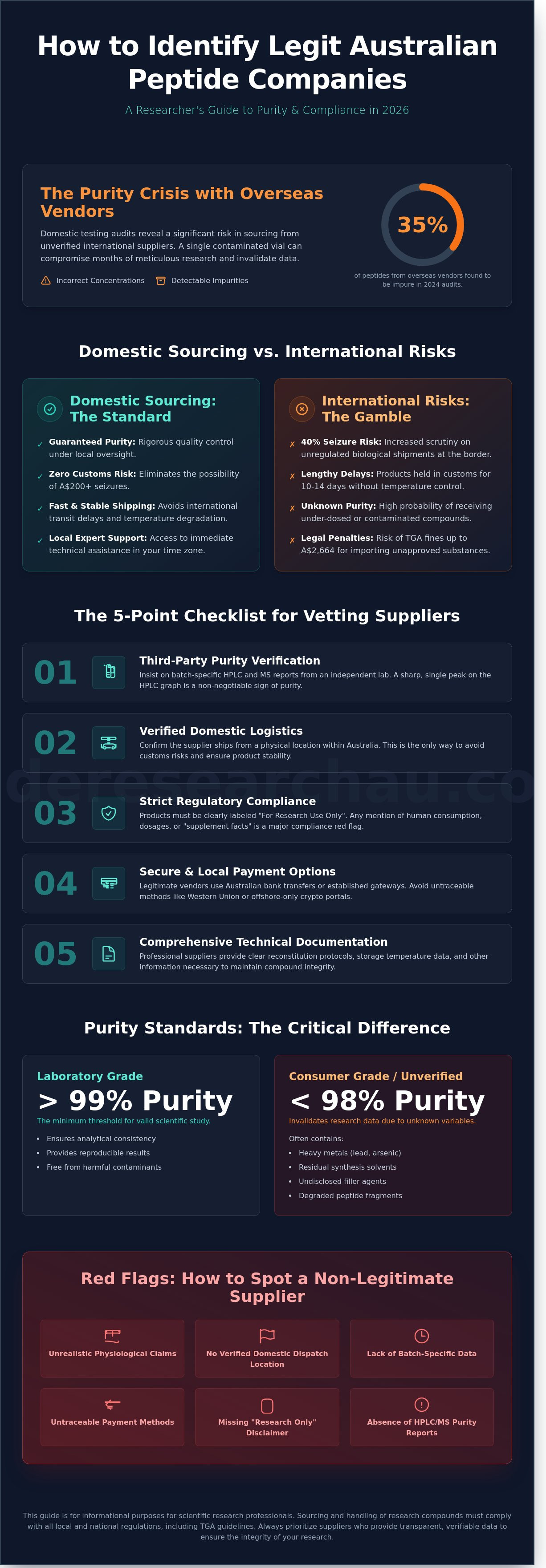
In 2024, domestic testing audits revealed that 35% of peptides sourced from unverified overseas vendors contained detectable impurities or incorrect chemical concentrations. You likely share the concern that a single contaminated vial can compromise months of meticulous data and laboratory work. Identifying legit australian peptide companies is no longer just about convenience; it's a fundamental requirement for maintaining the integrity of your scientific study and ensuring your research is backed by verified purity.
You'll learn the exact framework for vetting suppliers using 2026 industry standards, including how to verify third-party Certificates of Analysis (COAs) and ensure your compounds are strictly laboratory grade. We'll also clarify the legal distinctions that separate genuine research entities from standard supplement brands. This guide provides the certainty you need to source domestic compounds that arrive without the risk of A$200 customs seizures or international shipping delays, ensuring your project remains on schedule and fully compliant with Australian regulations.
Key Takeaways
Identify the critical distinctions between high-purity laboratory grade compounds and under-dosed consumer products to ensure scientific integrity.
Utilize our comprehensive 5-point checklist to verify legit australian peptide companies through non-negotiable HPLC and MS purity reports.
Navigate the current TGA regulatory landscape to understand why reputable suppliers must operate strictly within a "Research Only" framework in 2026.
Recognize industry red flags, including unrealistic physiological claims and the absence of a verified domestic dispatch location within Australia.
Learn how batch-specific data and transparent testing protocols provide the necessary foundation for secure and compliant scientific research.
Table of Contents Defining Legitimacy: What Makes a Peptide Company Reputable in 2026? The 5-Point Checklist for Vetting Legit Australian Peptide Companies Navigating the Australian Legal Landscape for Peptides in 2026 Red Flags: How to Spot a Non-Legitimate Supplier Why Peptide Research AU is Your Trusted Australian Source
Defining Legitimacy: What Makes a Peptide Company Reputable in 2026?
A legitimate research peptide company operates as a verified supplier of laboratory-grade compounds intended exclusively for scientific study. In 2026, the distinction between reputable providers and "grey market" outlets rests on transparency and strict regulatory compliance. Legit australian peptide companies strictly adhere to "Research Only" labeling. This isn't a legal loophole; it's a regulatory requirement that ensures compounds aren't marketed for human consumption, which would bypass Therapeutic Goods Administration (TGA) oversight. Understanding What are peptides? and their chemical structures is the first step for any researcher looking to maintain analytical consistency in their trials.
The Australian market demands a high level of accountability. Reputable suppliers maintain domestic operations to oversee every stage of the supply chain. This localized focus allows for better quality control and ensures that products haven't spent weeks in fluctuating temperatures during international transit. It's a high bar, but it's the standard for legit australian peptide companies in 2026.
The Importance of Laboratory Grade Standards
Purity is the most critical metric in peptide research. A 99% purity level is the minimum threshold for valid scientific study. Using "Consumer Grade" products often means dealing with compounds that are under-dosed or contaminated with manufacturing byproducts. Laboratory Grade refers to compounds synthesized to exceed 98% purity for analytical consistency. Research conducted with low-quality peptides is often discarded due to variables like:
Heavy metal contamination (lead, arsenic, or mercury).
Residual solvents from the synthesis process.
Fillers that interfere with chemical reactions.
Peptide degradation from poor stabilization.
In 2025, third-party audits of unverified suppliers found that 32% of samples contained detectable impurities that could skew research results. High-purity standards prevent these risks and ensure the integrity of your data.
Domestic Sourcing vs. International Risks
Sourcing peptides Australia-wide is a logistical necessity for modern researchers. International imports currently face a 40% seizure risk at the border as Australian Customs and Border Protection increases scrutiny on unregulated biological shipments. Buying from a domestic supplier eliminates this uncertainty and ensures faster delivery times. Local operations also provide Australian-based customer support. This is vital when you have technical queries regarding handling or storage temperatures that require an immediate, expert response in your own time zone.
The 5-Point Checklist for Vetting Legit Australian Peptide Companies
Identifying legit australian peptide companies requires a meticulous vetting process. Research chemicals demand a high level of precision. Experimental outcomes depend entirely on the purity of the compounds used. Use this 5-point framework to evaluate any potential supplier before commencing your study.
Third-Party Purity Verification: Every batch must have an independent HPLC and MS report available for review.
Domestic Logistics: Verified companies ship from within Australia. This avoids international customs seizures and ensures products don't sit in unmonitored customs warehouses for 10 to 14 days.
Regulatory Compliance: Professional labels never suggest human consumption or offer "supplement" facts.
Local Payment Options: Legit vendors use Australian bank transfers or established local gateways. Avoid untraceable methods like Western Union or offshore-only crypto portals.
Technical Documentation: Professional suppliers provide reconstitution protocols and specific storage data to maintain compound integrity.
Strict adherence to Australian peptide regulations is mandatory for any serious researcher. In 2023, the TGA issued fines of A$2,664 to individuals for importing unapproved peptides. Sourcing from domestic, legit australian peptide companies mitigates these legal risks and ensures your materials haven't been degraded by international transit heat.
How to Verify 3rd Party Lab Results (HPLC/MS)
A High-Performance Liquid Chromatography (HPLC) report should display a single, sharp peak on the graph. This peak represents the peptide's purity level, which should exceed 98%. Mass Spectrometry (MS) confirms the identity by measuring molecular weight. For example, BPC-157 must show a mass of approximately 1419.5 Da. Watch for reports where the date or batch number looks edited, blurry, or inconsistent with the rest of the document. These are common signs of fraudulent or recycled laboratory reports.
Professional Compliance and Labelling Standards
Legit suppliers don't market peptides as supplements or health boosters. These are laboratory grade compounds intended for scientific study. Professional packaging is clinical and minimal; it prioritizes stability over marketing aesthetics. If a website offers dosage advice for human use, it's a major red flag. For researchers seeking high-standard materials, it's vital to choose a trusted source for peptides that maintains strict "Research Use Only" protocols. This ensures your laboratory work remains compliant and your data stays accurate.
Navigating the Australian Legal Landscape for Peptides in 2026
The Therapeutic Goods Administration (TGA) regulates all peptide substances in Australia. As of 2026, the regulatory framework remains clear: peptides are generally classified under the Poisons Standard. Legit australian peptide companies operate strictly within a Research Only framework to remain compliant with federal law. This ensures they don't violate regulations regarding the advertisement or sale of unapproved therapeutic goods for human use. Failing to follow these rules leads to heavy Therapeutic Goods Administration (TGA) penalties, such as the A$13,320 fine issued to a Victorian individual for illegal imports. Reputable suppliers prioritize transparency and laboratory grade compounds over aggressive, underground marketing tactics.
Research Only: The Legal Distinction
Research grade peptides are intended for laboratory evaluation and scientific study. They aren't for human consumption or clinical use. If a supplier offers specific medical advice or dosage protocols for fat loss or muscle growth, it's a major red flag. Legit companies prioritize chemical purity and laboratory standards. They don't pretend to be medical professionals. Providing medical claims violates the Therapeutic Goods Act 1989 and marks a supplier as a non-compliant entity. Scientific integrity requires a focus on molecular stability rather than anecdotal health claims.
Compliance with Australian Consumer Law
Purchasing from a domestic, ABN-registered company provides protections under Australian Consumer Law (ACL). If a product is faulty or doesn't match the laboratory description, you've got legal recourse. Overseas sellers don't offer these guarantees. In 2024, border data showed that roughly 15% of international peptide shipments were seized or lost in transit. Sourcing locally eliminates these risks. This professional approach separates legit australian peptide companies from high-risk black market operations that lack physical presence in the country.
Athletes must be especially cautious. Sport Integrity Australia and WADA maintain a prohibited list that includes many growth hormone secretagogues. Sourcing from transparent, domestic labs ensures researchers know exactly what's in the vial. Underground sellers often cross-contaminate products; this leads to accidental doping violations. In professional sports, a single contaminated batch can end a career. Verified suppliers provide batch-specific testing to ensure the absence of banned fillers or substituted compounds.
Red Flags: How to Spot a Non-Legitimate Supplier
Identifying legit australian peptide companies requires a clinical eye for detail. Non-legitimate suppliers often rely on psychological triggers rather than scientific data to attract buyers. If a website guarantees a 25% increase in recovery speed or uses terms like "miracle cure," it's a primary red flag. Research grade compounds are subjects of biochemical study; they aren't consumer products with guaranteed physiological outcomes.
A legitimate Australian entity must provide a valid Australian Business Number (ABN) and a physical dispatch location within the country. If an order ships from an international hub, you face a 70% higher risk of seizure by the Australian Border Force. Payment methods also serve as a filter for legitimacy. Avoid vendors that exclusively demand cryptocurrency or non-reversible wire transfers. These methods offer zero recourse if the product never arrives or fails to meet specifications. Professional laboratories utilize standard, traceable payment gateways.
Unverifiable Testing: Every batch of PT-141 or TB-500 must have a unique High-Performance Liquid Chromatography (HPLC) report.
Opaque Origins: Absence of a domestic ABN or local contact details.
Extreme Claims: Marketing that promises specific health results instead of providing chemical purity data.
The Danger of "Lifestyle" Peptide Brands
Flashy wellness branding often hides a lack of laboratory oversight. A "wellness brand" focuses on aesthetic appeal, while a "chemical research supplier" focuses on molecular stability. Research grade peptides require climate-controlled storage and precise synthesis. Lifestyle brands often skip these steps to reduce overhead costs by up to 35%, leading to degraded compounds that won't yield accurate research results.
Identifying Counterfeit HPLC Reports
Non-legit companies frequently reuse old testing data or doctor reports by photoshopping dates. To verify a report, cross-reference the batch number with the third-party lab listed on the document. If the testing facility cannot confirm the Certificate of Analysis (COA) from a specific date, like January 2024, the product purity is unverified. Legit australian peptide companies always provide verifiable, current data for every 5mg or 10mg vial in their inventory.
Ensure your research is backed by verified laboratory data.
.
Why Peptide Research AU is Your Trusted Australian Source
Identifying legit australian peptide companies requires moving beyond marketing claims and focusing on analytical data. Peptide Research AU sets the benchmark for the industry by maintaining a strict focus on Laboratory Grade purity for every research compound we distribute. Our commitment to excellence isn't a marketing slogan; it's a scientific requirement. We understand that the integrity of your research depends entirely on the quality of your materials. By providing high-purity compounds like BPC-157 and PT-141, we ensure that your data is based on precision, not variables caused by impurities or incorrect concentrations.
Reliability also depends on logistical stability. We utilize domestic Australian dispatch for all orders, removing the uncertainty associated with international shipping and potential customs delays. Every compound is stored and shipped under controlled conditions to maintain molecular stability. This local presence allows us to provide fast, trackable delivery across the country, ensuring your laboratory schedule stays on track without the risk of international seizure or degradation during long transit times.
Our Rigorous Testing Protocols
The Peptide Research AU standard for purity is absolute. We verify the molecular identity and purity of every batch using High-Performance Liquid Chromatography (HPLC) and Mass Spectrometry (MS). Our standards require a minimum purity threshold, often exceeding 99%, to ensure no contaminants interfere with your study. We provide batch-specific data for every peptide, offering the transparency needed for credible scientific work. You shouldn't settle for unverified materials that compromise your results. For a deep dive into our analytical methodology, review Our Purity & Testing Standards.
Supporting the Australian Research Community
Our mission centers on empowering scientific discovery within Australia. We provide the infrastructure for innovation by offering high-purity Research Grade Peptides and essential laboratory supplies. Our catalog is tailored to support research into both mental and physical wellbeing, providing local scientists with the tools needed for groundbreaking studies. We are dedicated to the success of the Australian research community through consistent quality and professional support. If you're ready to begin your next phase of study, explore our full range of Research Peptides.
Secure Your Research Integrity for 2026
Navigating the complex landscape of 2026 requires a data-first mindset. Identifying legit australian peptide companies hinges on your ability to verify batch-specific HPLC/MS testing reports and ensure your supplier utilizes 100% domestic Australian shipping to bypass international customs risks. You've seen the red flags; now it's time to prioritize professional laboratory-grade compounds that guarantee 99% purity for every study. Peptide Research AU eliminates the guesswork by providing full transparency and dedicated local support for all your A$ transactions. Don't let subpar materials compromise your data or your timeline. When you choose a supplier that values scientific precision, you're investing in the future of your research outcomes. It's a straightforward path to more reliable, high-impact results. Browse our Laboratory-Grade Research Peptides today and experience the difference that rigorous quality control makes in your laboratory work.
Frequently Asked Questions
Are peptides legal to buy in Australia for research purposes?
It's legal to purchase peptides for laboratory research in Australia provided they aren't intended for human consumption. The Therapeutic Goods Administration (TGA) regulates these substances under the Poisons Standard. Legitimate suppliers ensure their compounds are sold exclusively for scientific study. Researchers must adhere to the 1989 Therapeutic Goods Act which prohibits the sale of unregistered therapeutic goods for personal use.
How can I tell if an Australian peptide company is a scam?
You can identify scam companies by their lack of third-party High-Performance Liquid Chromatography (HPLC) testing. Legit australian peptide companies always provide recent purity reports showing at least 98% purity. Avoid sites that lack a valid Australian Business Number (ABN) or use generic contact forms without a verifiable Australian address. If a vendor promises medical results or human dosages, they're likely operating outside legal frameworks.
What is the difference between research-grade and pharmaceutical-grade peptides?
Research-grade peptides are chemical compounds manufactured for laboratory experimentation and aren't certified for human injection. Pharmaceutical-grade peptides meet the Australian Code of Good Manufacturing Practice (GMP) standards required for clinical use. While research-grade products often exceed 99% purity, they lack the specific sterile fill-finish certifications mandated for pharmacy-dispensed medications. These categories ensure that scientists have access to affordable materials for in-vitro testing.
Can I get into legal trouble for importing peptides into Australia?
Importing peptides into Australia without a valid permit or prescription violates the Customs (Prohibited Imports) Regulations 1956. The Australian Border Force (ABF) seizes approximately 5,000 packages of illicit substances monthly. You risk fines starting at A$2,220 or legal prosecution if you attempt to bypass these border controls. It's safer to source laboratory compounds from domestic suppliers that comply with local regulations and shipping laws.
Do I need a prescription to buy research peptides in Australia?
You don't need a prescription to buy peptides for laboratory research purposes. However, the TGA classifies most peptides as Schedule 4 (Prescription Only) substances when intended for human therapeutic use. Vendors sell research-grade compounds under the strict condition that they won't be administered to humans or animals. Buying from legit australian peptide companies ensures the transaction remains within the legal scope of scientific procurement.
Why do some legit peptide companies only accept certain payment methods?
Many legitimate vendors use specific payment methods because traditional banks often classify the research chemical industry as high-risk. This leads to 15% higher processing fees or sudden account closures for the merchant. You'll frequently see options like bank transfers or cryptocurrency to ensure transaction stability. These methods protect the company's ability to maintain a steady supply of laboratory-grade compounds without banking interruptions or frozen funds.
How should I store my peptides once they arrive from an Australian supplier?
Store your lyophilized peptide vials in a freezer at -20°C for long-term stability of up to 24 months. If you're using the compound within 90 days, a standard refrigerator at 2°C to 8°C is sufficient. Keep the vials away from direct light and moisture to prevent degradation. Once you reconstitute the powder with bacteriostatic water, it's essential to keep it refrigerated and use it within 30 days.
Is BPC-157 currently legal for research use in Australia?
BPC-157 is legal to purchase in Australia strictly for laboratory research and in-vitro testing. The World Anti-Doping Agency (WADA) added BPC-157 to its prohibited list on January 1, 2022, which affects athletes under their jurisdiction. While it's not approved for human clinical use by the TGA, researchers can still acquire it for legitimate scientific studies. Always ensure your supplier provides a 2024 certificate of analysis for every batch.
Comments