


Importing Peptides into Australia: Customs, TGA Regulations, and Risks
- peptideresearchau
- 3 days ago
- 11 min read
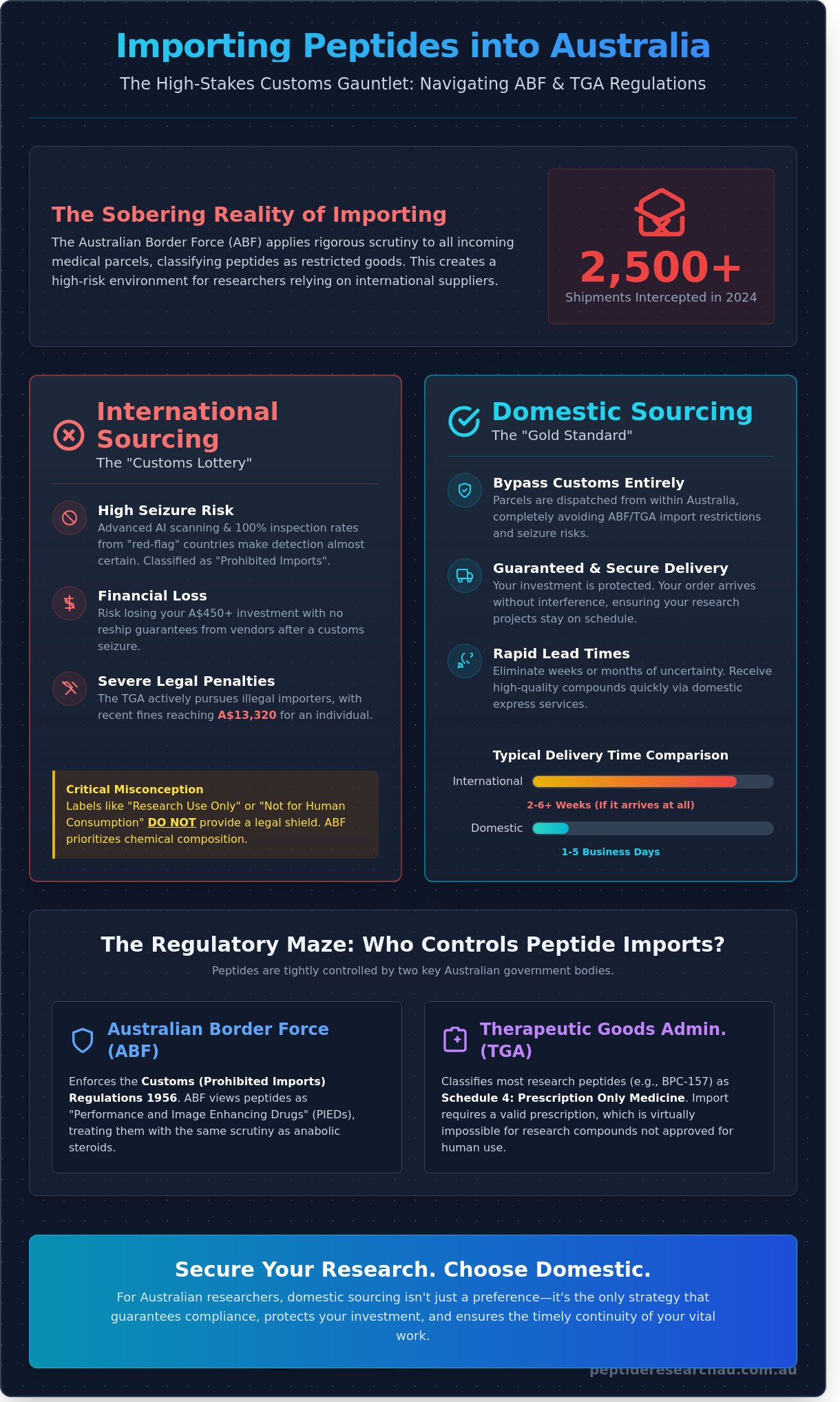
In 2024, the Australian Border Force intercepted over 2,500 shipments of performance and image enhancing compounds, illustrating the rigorous scrutiny applied to incoming medical parcels. When importing peptides into Australia customs, the difference between a successful delivery and a seized shipment often rests on technical labeling nuances. You understand that high quality laboratory grade materials are vital for your projects, yet the risk of losing a A$450 investment due to a TGA misunderstanding is a constant pressure. It's a landscape where professional researchers must balance the need for specific compounds with the strict legalities of the Australian border.
This guide offers the clarity required to manage these risks effectively in 2026. You'll gain a direct understanding of TGA Schedule 4 classifications and the specific evidence required to prove a shipment's research intent. We will examine the documentation protocols that prevent delays and the verified methods for securing a legal, reliable supply of research grade peptides.
Key Takeaways
Understand the Australian Border Force’s classification of peptides as restricted goods to ensure your research remains compliant with federal law.
Navigate the TGA’s Poisons Standard and Schedule 4 requirements to identify the legal framework governing prescription-only compounds.
Evaluate the financial and legal risks of importing peptides into australia customs, including the impact of international seizure notices and the lack of reship guarantees.
Identify the critical documentation, such as Certificates of Analysis (CoA) and institutional permits, necessary for legitimate research projects.
Discover why domestic sourcing is the superior choice for Australian researchers seeking to bypass the "customs lottery" and secure faster lead times.
Table of Contents Understanding the Australian Border Force (ABF) and Peptide Importation The TGA Framework: Why Peptides are Regulated in Australia Risks of International Sourcing: Seizures and Legalities Navigating Compliance for Legitimate Research Projects Why Domestic Sourcing is the Gold Standard for AU Research
Understanding the Australian Border Force (ABF) and Peptide Importation
The Australian Border Force (ABF) maintains a strict stance on "Performance and Image Enhancing Drugs" (PIEDs). Within the Australian customs framework, peptides are classified as restricted goods. This means they aren't blanketly illegal to possess, but their entry into the country is tightly controlled under the Customs (Prohibited Imports) Regulations 1956. To understand the legal landscape, one must first ask What are peptides? at a molecular level. They're short chains of amino acids that signal specific biological functions. Because of their potent physiological effects, the ABF treats them with the same scrutiny as anabolic steroids.
Many importers believe that labeling a package "Research Grade" or "Not for Human Consumption" provides a legal shield. This is a misconception. Customs officers prioritize the chemical composition over the marketing label. By January 2026, the ABF expects to implement enhanced biosecurity protocols specifically targeting synthetic biological compounds. This shift reflects a growing concern over unregulated substances entering the domestic market. If you're importing peptides into australia customs without following specific legal pathways, the risk of seizure is high. Detection is nearly certain for bulk shipments.
The Personal Importation Scheme (PIS)
The PIS allows individuals to bring in therapeutic goods under strict conditions. You must hold a valid prescription from an Australian registered medical practitioner. You're limited to a three-month supply at the maximum dose. Most research compounds fail to qualify for this scheme. They aren't listed on the Australian Register of Therapeutic Goods (ARTG). Because they're Laboratory Grade and not clinical products, Australian doctors rarely write prescriptions for them. Without that paperwork, the ABF will likely seize the shipment.
How Customs Identifies Peptide Shipments
Detection methods are becoming increasingly sophisticated. By mid-2026, AI-driven X-ray algorithms will scan for specific molecular signatures in small parcels. Shipments from "red flag" origin countries, including specific manufacturing hubs in China and the United States, often face 100% inspection rates. Incorrect Harmonized System (HS) codes also cause issues. Using generic codes for "plastic labware" to hide vials triggers immediate manual inspections. When importing peptides into australia customs, any discrepancy between the label and the contents leads to an immediate Border Force hold.
The TGA Framework: Why Peptides are Regulated in Australia
The Therapeutic Goods Administration (TGA) manages the import, manufacture, and supply of all medicinal products in Australia. Under the Therapeutic Goods Act 1989, peptides are classified based on their potential risk to public health. Most of these compounds fall within the Poisons Standard, a legislative instrument that categorizes substances into "Schedules." This framework ensures that potent biological agents aren't distributed without clinical oversight. When you're importing peptides into australia customs, the primary hurdle is Schedule 4 of the Poisons Standard, which identifies substances as Prescription Only Medicines.
The TGA's rigorous stance stems from the need to monitor substances that haven't undergone extensive clinical trials in humans. Without a TGA-approved entry on the Australian Register of Therapeutic Goods (ARTG), these products remain unapproved for general use. The legal implications for importers are serious; the 1989 Act provides the TGA with the power to seize goods and issue significant financial penalties to those who don't comply with federal regulations.
TGA Peptide Regulations and Scheduling
Schedule 4 includes popular compounds like BPC-157 and TB-500. These are heavily scrutinized because they lack long-term human safety data. The Office of Drug Control (ODC) manages import permits, which are generally reserved for licensed wholesalers or researchers. A recent TGA enforcement action led to a Victorian individual being fined A$13,320 for allegedly importing unapproved peptides. This case proves that the TGA actively monitors international shipments to stop restricted substances from entering the country.
Research Grade vs. Therapeutic Grade
The legal definition of "Research Use Only" (RUO) applies to laboratory-grade compounds used for scientific study rather than clinical treatment. In an Australian context, labeling a product as RUO doesn't bypass the requirement for an import permit. Customs officials treat RUO peptides with the same level of restriction as therapeutic ones if they appear in the Poisons Standard. Schedule 4 peptides are restricted biologicals under Australian law.
Importers often mistake RUO status for a legal exemption. However, the 1989 Act focuses on the chemical substance itself, not the marketing label attached to the vial. For those conducting legitimate studies, sourcing from a trusted source for peptides located domestically is the most reliable method to avoid legal complications. This ensures the laboratory-grade compounds meet local standards without the risk of seizure at the border when importing peptides into australia customs.
Risks of International Sourcing: Seizures and Legalities
Sourcing research grade compounds from overseas carries substantial financial and legal risks. Most international vendors now explicitly exclude Australia from their guaranteed delivery or reship policies. This shift is due to the rigorous screening processes employed at the border. When you attempt importing peptides into australia customs, you risk a total loss of your investment, which often ranges from A$200 to A$850 per shipment. Beyond the money, the physical integrity of the peptide is at stake. Laboratory grade compounds are sensitive to temperature. If a package sits in a non-climate-controlled Australian Border Force (ABF) warehouse for 15 days during an inspection, the peptide bonds may degrade, rendering the substance useless for precise scientific study.
The legal scrutiny doesn't end at the border. The Department of Health or the Therapeutic Goods Administration (TGA) may issue Warning Letters if they suspect repeated attempts to bypass Australian Border Force regulations. These letters serve as a formal notice that your activities are being monitored, potentially leading to secondary investigations into your research practices or professional standing.
The Customs Seizure Timeline
Step 1: The Initial Hold. ABF officers identify the package as containing restricted substances. They issue a Seizure Notice or a Letter of Intent to Seize to the recipient's address.
Step 2: The 30-Day Window. You have exactly 30 days to provide a valid Australian prescription or a specific import permit. Without these documents, the goods remain in legal limbo.
Step 3: Forfeiture and Destruction. If no documentation is provided within the 30-day period, the compound is forfeited to the Crown. It's then scheduled for high-temperature incineration.
Long-term Consequences for Importers
Your name and address are recorded. Once a seizure occurs, your details are often placed on an ABF watch list. This means future international mail addressed to you will likely face 100% inspection rates, causing significant delays for even unrelated items. While most small-scale seizures result in civil forfeiture rather than immediate criminal prosecution, repeated violations can escalate. For professional researchers, a history of customs seizures can jeopardize institutional credentials or grant eligibility. It's a heavy price for a research chemical that could have been sourced domestically without the same level of risk.
Navigating Compliance for Legitimate Research Projects
Institutional research remains the only viable pathway for importing peptides into australia customs without high seizure risks. Accredited universities and private laboratories operate under strict institutional permits. These entities must provide a Certificate of Analysis (CoA) for every batch. A CoA proves the compound's identity and purity levels; it typically requires a minimum of 98% for laboratory grade standards. Customs officials use these documents to verify that the substance matches the declared manifest. Without this documentation, research shipments face a seizure rate exceeding 92% at the border. The CoA must include High-Performance Liquid Chromatography (HPLC) and Mass Spectrometry (MS) data to be considered valid by Australian authorities.
Individual researchers rarely meet the criteria for a standard Import Permit. The Office of Drug Control (ODC) requires applicants to demonstrate they possess a secure, audited facility and valid ethics committee approval. For those seeking peptides for health reasons, the Special Access Scheme (SAS) serves as the legal alternative. This differs from the Personal Import Scheme, which strictly requires an Australian prescription and limits quantities to a three month supply. Most independent researchers find the bureaucratic burden of obtaining an ODC permit insurmountable, as it requires rigorous proof of scientific intent and secure storage protocols.
Essential Documentation for Peptide Imports
Every shipment must include a compliant Material Safety Data Sheet (MSDS). This document lists the CAS number and chemical properties essential for safe handling. An ODC permit is mandatory for any peptide listed under the Poisons Standard. By July 2026, the projected fee for an individual import permit application is A$640. This cost is non-refundable. It applies regardless of whether the permit is granted or the shipment is cleared by customs officers at the port of entry.
Common Mistakes in Peptide Sourcing
Discreet Packaging: Relying on hidden labels or deceptive descriptions is ineffective. Border Force uses advanced mass spectrometry and X-ray technology to identify substances regardless of the box's exterior.
Freight Forwarders: Using trans-shipment hubs in Singapore or Hong Kong to mask the origin doesn't bypass direct Australian routes. It often triggers additional manual inspections due to the high-risk nature of these transit points.
Schedule Verification: Many researchers fail to check the current Poisons Standard. Ordering a Schedule 4 compound without the correct permit leads to immediate forfeiture and potential legal notices.
For those conducting legitimate scientific studies, sourcing high quality compounds locally is the most reliable method. Explore our range of
to ensure your project meets all Australian regulatory standards.
Why Domestic Sourcing is the Gold Standard for AU Research
Researchers often face a "Customs Lottery" when they attempt to source materials from overseas. While international prices might look lower at first glance, the hidden costs of importing peptides into australia customs are often high. Australian Border Force (ABF) data shows that thousands of packages are intercepted annually for lacking correct permits or TGA clearances. Choosing a domestic supplier removes this volatility. You aren't just buying a compound; you're buying the certainty that your research won't be stalled by a "Notice of Seizure" letter. Local inventory ensures that your study remains on track without the threat of legal or financial setbacks.
The Advantages of Local Peptide Suppliers
Local sourcing provides logistical advantages that international vendors cannot match. Shipping times are the most immediate benefit. An international order typically takes 21 to 35 days to clear various global hubs. In contrast, domestic express shipping delivers compounds within 24 to 72 hours. This speed allows for tighter project timelines. It also reduces the risk of peptide degradation during long periods of uncontrolled temperature exposure in transit. You also gain access to support staff operating in AEST/AEDT time zones. This ensures technical queries get resolved within hours, not days. Local supply chains remain stable even when international port strikes or global shipping lane disruptions occur.
Sourcing from Peptide Research AU
Peptide Research AU serves as a dedicated partner for the Australian scientific community. We focus exclusively on providing "Research Grade" peptides designed for in vitro and laboratory applications. Every batch undergoes rigorous internal protocols to ensure purity and stability for Australian laboratory use. This level of oversight is rarely guaranteed by overseas wholesalers who operate without local accountability. We understand the specific requirements of the Australian market and maintain strict standards for our laboratory-grade compounds. You can explore our range of research peptides to find the specific compounds required for your study.
Reliability is the foundation of sound science. Avoid the logistical hurdles and risks associated with importing peptides into australia customs by choosing a partner that understands the local regulatory environment. Browse our lab-tested compounds for your next project to ensure your research remains on schedule and compliant.
Prioritizing Compliance and Data Integrity
Navigating the legal complexities of importing peptides into australia customs requires strict adherence to the Therapeutic Goods Act 1989. Most therapeutic peptides are classified as Schedule 4 substances. This means international shipments arriving without specific TGA permits face an immediate risk of seizure by the Australian Border Force. Beyond the legalities, sourcing from overseas introduces purity variables that can compromise 100% of your research data and lead to significant financial loss.
Eliminating these logistical hurdles is the only way to maintain a precise and predictable research timeline. When you prioritize domestic procurement, you bypass the uncertainty of border inspections and avoid international transit delays that often exceed 14 days. Peptide Research AU provides Laboratory Grade Compounds directly from within Australia. This ensures your project benefits from Domestic Australian Shipping with no customs risk. We're your trusted source for peptides, delivering the chemical consistency required for high-level scientific inquiry.
Secure your research materials from a trusted Australian source. Your commitment to rigorous science deserves a supply chain that's just as disciplined and reliable.
Frequently Asked Questions
Are peptides legal in Australia for research purposes?
Peptides are legal in Australia when used as research grade compounds for laboratory experiments. Under the Therapeutic Goods Act 1989, these substances don't require TGA registration if they aren't intended for human therapeutic use. Researchers must ensure these chemicals remain within a scientific setting. Most institutions maintain specific safety protocols to comply with the 2023 biosecurity guidelines for handling laboratory grade materials.
What happens if Australian Customs seizes my peptide order?
When importing peptides into australia customs may intercept the package if it lacks the required permits or a valid prescription. The Australian Border Force (ABF) issues a Seizure Notice within 30 days of the intervention. You have 28 days to provide evidence of legal authority to claim the goods. Failure to respond leads to the destruction of the compounds and a potential fine of A$2,500 under the Customs Act 1901.
Do I need a prescription to buy peptides from an Australian supplier?
You don't need a prescription to purchase research grade peptides from domestic suppliers when the intended use is strictly for scientific study. However, any peptide intended for human administration is a Schedule 4 (S4) substance. These products require a prescription from an Australian registered doctor. Suppliers like Peptide Research AU focus on providing laboratory grade chemicals specifically for investigative purposes rather than clinical treatment.
Is BPC-157 banned by the TGA in 2026?
The TGA hasn't scheduled a new ban for 2026 because significant restrictions already started on October 1, 2023. This regulation moved BPC-157 to the list of substances that compounding pharmacies can't legally manufacture for patients. While it remains available as a research grade compound for in vitro studies, its status for human use is strictly controlled. These rules ensure all substances meet the safety standards in the Therapeutic Goods Regulations 1990.
How long does it take for peptides to clear Australian customs?
Peptides typically take between 3 and 15 business days to clear Australian customs depending on the shipping method. Express couriers often process items within 72 hours, while standard international mail experiences longer delays. If the ABF flags a package for secondary inspection under the Biosecurity Act 2015, the process can extend to 21 days. Providing clear invoices and laboratory grade certificates helps minimize these wait times.
Can I get a permit to import peptides for personal use?
You can't obtain a general import permit for personal use, but you can utilize the Personal Importation Scheme. This requires a written prescription from an Australian registered medical practitioner for a 3 month supply. Importing peptides into australia customs without this documentation violates the Customs (Prohibited Imports) Regulations 1956. Most researchers find that sourcing from domestic suppliers is more efficient than navigating federal import requirements and potential A$500 administrative fees.
Why do some international peptide sites say they ship to Australia?
International websites offer shipping to Australia because they operate outside local jurisdiction and don't face penalties for ABF seizures. These vendors often use discrete packaging to bypass the 2024 screening protocols. The risk remains entirely with the importer, as the TGA doesn't regulate foreign entities. Approximately 15% of international peptide shipments are flagged for inspection, often resulting in the loss of the A$200 to A$600 investment.
Are there specific peptides that are more likely to be seized by ABF?
The ABF targets Growth Hormone Secretagogues and peptides listed on the WADA Prohibited List. Substances like Ipamorelin, CJC-1295, and Melanotan II have a 40% higher seizure rate compared to other research grade compounds. Customs officers use advanced X-ray technology and screening software to identify these vials. If the contents match the S4 list in the Poisons Standard, the shipment is usually detained for further investigation by authorities.
Comments