


Tesamorelin: A Comprehensive Guide for Scientific Research
- peptideresearchau
- Feb 25
- 10 min read
For the scientific researcher, navigating the complex landscape of peptide compounds requires access to precise and consolidated information. The synthetic growth hormone-releasing hormone (GHRH) analogue, Tesamorelin, presents a compelling subject of study, yet high-quality data often remains fragmented. This can leave investigators searching for a single, authoritative resource that covers its full spectrum of applications and the meticulous protocols required to ensure the integrity of their experimental outcomes.
This comprehensive guide is designed to address these critical gaps in knowledge. We will explore the complete scientific profile of Tesamorelin, from its fundamental mechanism of action to its established and emerging areas of investigation. Furthermore, this article provides clear, actionable protocols for the proper handling, reconstitution, and storage of this laboratory-grade compound. Our objective is to equip your research team with the definitive information required to advance scientific inquiry with confidence and precision.
Key Takeaways
Understand the core scientific function of Tesamorelin as a growth hormone-releasing hormone (GHRH) analogue that stimulates endogenous growth hormone synthesis.
Discover the foundational research that provides a clear case study of the peptide's physiological effects and mechanism of action.
Learn the correct laboratory protocols for reconstitution and handling to ensure the integrity and validity of your research outcomes.
Identify the key factors for sourcing high-purity compounds in Australia to ensure the reliability and reproducibility of your scientific data.
Table of Contents What is Tesamorelin? A Scientific Overview Established Research: HIV-Associated Lipodystrophy Emerging Areas of Tesamorelin Research Laboratory Handling and Reconstitution Protocols Sourcing Tesamorelin for Research in Australia
What is Tesamorelin? A Scientific Overview
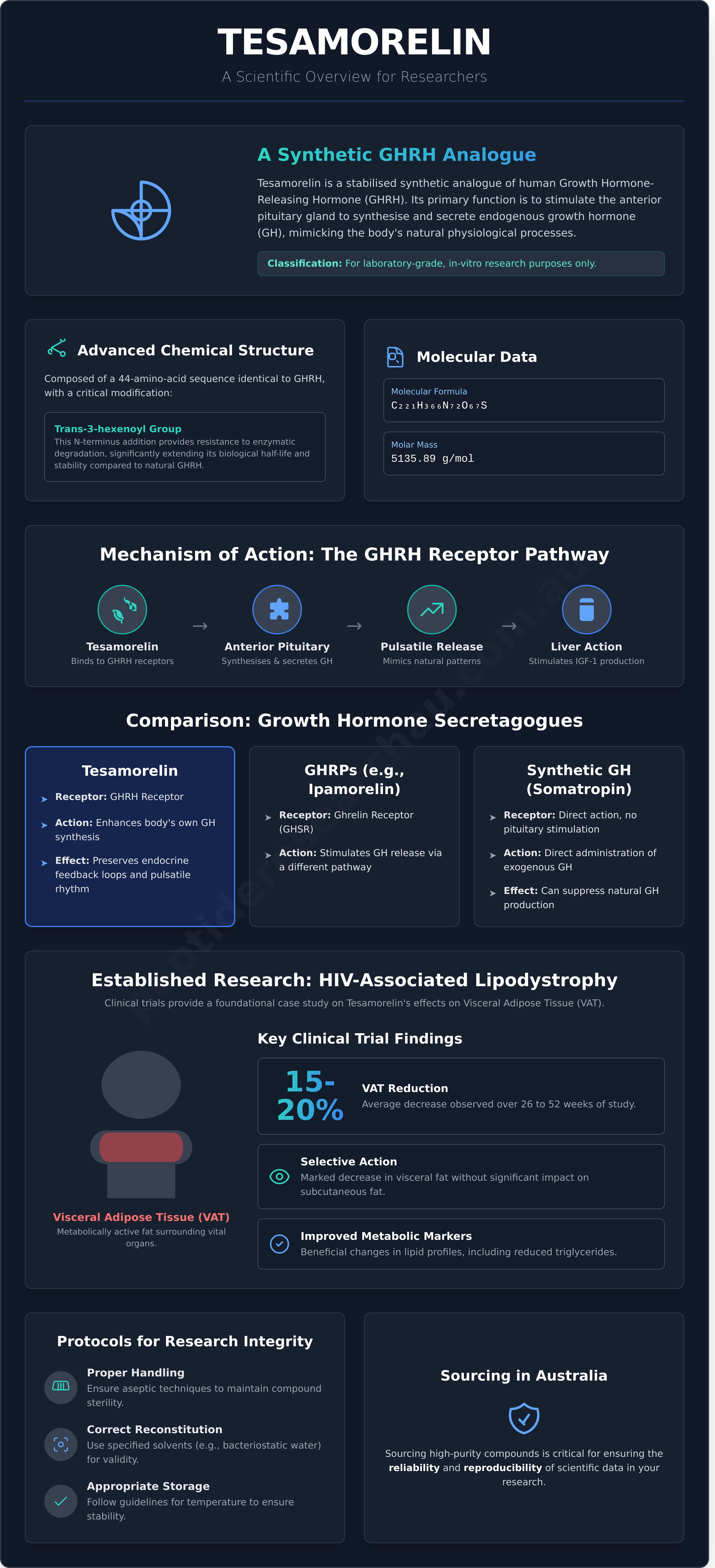
Tesamorelin is a stabilised synthetic analogue of human growth hormone-releasing hormone (GHRH). Its principal function is to stimulate the anterior pituitary gland to synthesise and secrete endogenous growth hormone (GH). Originally developed for specific clinical applications, its unique mechanism has established it as a significant compound for scientific study. For a more detailed Tesamorelin scientific overview, its Wikipedia entry offers comprehensive data. In the Australian research market, this peptide is classified as a laboratory-grade compound intended strictly for in-vitro investigation.
Chemical Profile and Structure
Structurally, this peptide is composed of a 44-amino-acid sequence identical to endogenous GHRH. The key distinction is a trans-3-hexenoyl group attached to the N-terminus. This modification provides resistance to enzymatic degradation, significantly extending the compound's biological half-life and stability compared to its natural counterpart.
Molecular Formula: C221H366N72O67S
Molar Mass: 5135.89 g/mol
Mechanism of Action: The GHRH Receptor Pathway
The compound operates by binding with high affinity to GHRH receptors on somatotroph cells within the anterior pituitary gland. This binding initiates an intracellular signalling cascade that results in the synthesis and release of GH. A critical aspect of its mechanism is that it promotes a pulsatile release of growth hormone, mimicking the body's natural physiological secretion patterns. The released GH then acts on the liver to stimulate the production of Insulin-like Growth Factor 1 (IGF-1), which mediates many of GH’s downstream effects.
Tesamorelin vs. Other Growth Hormone Secretagogues
It is important to differentiate this GHRH analogue from other classes of GH-releasing compounds:
Compared to GHRPs: Growth Hormone-Releasing Peptides (e.g., Ipamorelin, GHRP-6) stimulate GH release by acting on the ghrelin receptor (GHSR). In contrast, this compound acts exclusively on the GHRH receptor pathway.
Compared to Synthetic GH: Unlike the direct administration of exogenous GH (Somatropin), which can suppress natural production, this secretagogue enhances the body's own GH synthesis. This preserves the essential endocrine feedback loops and pulsatile release rhythm.
Its high specificity for the GHRH receptor ensures a targeted action on GH release with minimal off-target effects on other pituitary hormones like prolactin or cortisol.
Established Research: HIV-Associated Lipodystrophy
The most extensive body of research on Tesamorelin centres on its approved application for reducing excess abdominal fat in HIV-positive patients with lipodystrophy. This clinical context serves as a well-documented case study, providing a foundational understanding of the compound's mechanism of action and specific effects. By examining the data from these rigorous trials, researchers can establish a baseline for its physiological impact, particularly on visceral adipose tissue (VAT), which is crucial for exploring other potential research applications.
Understanding Visceral Adipose Tissue (VAT)
Visceral Adipose Tissue, or VAT, is the metabolically active fat stored deep within the abdominal cavity, surrounding vital organs like the liver and intestines. Lipodystrophy, a condition sometimes associated with older antiretroviral therapies for HIV, involves an abnormal distribution of body fat, often leading to a significant accumulation of VAT. This excess visceral fat is strongly linked to an increased risk of metabolic complications, including insulin resistance, dyslipidemia, and cardiovascular disease.
Key Clinical Trial Findings
Major Phase III clinical trials provided definitive evidence of the compound's efficacy in this specific context. The primary outcomes consistently demonstrated a targeted and significant reduction in visceral adipose tissue, with studies reporting an average decrease of 15-20% over 26 to 52 weeks. Key findings from this research include:
Selective VAT Reduction: A marked decrease in visceral fat was observed without a significant impact on subcutaneous fat, highlighting a specific mechanism of action.
Improved Metabolic Markers: Studies noted beneficial changes in lipid profiles, including a reduction in triglyceride levels and an improvement in the total cholesterol to HDL ratio.
Waist Circumference: The reduction in VAT correlated with a measurable decrease in waist circumference.
Hormonal Effects Observed in Studies
As a growth hormone-releasing hormone (GHRH) analogue, Tesamorelin functions by stimulating the pituitary gland to produce and release endogenous growth hormone (GH). This, in turn, leads to an increase in circulating levels of insulin-like growth factor-1 (IGF-1). While this mechanism drives the desired reduction in VAT, it also influences glucose metabolism. Some studies noted transient effects on glucose control, underscoring the necessity of careful observation. The importance of monitoring these parameters is well-documented in FDA-approved Tesamorelin protocols, which provide a critical framework for laboratory safety and handling in all research settings.
Emerging Areas of Tesamorelin Research
While primarily studied for its effects on visceral adiposity, the scientific community is actively investigating the potential of Tesamorelin in other physiological contexts. This section explores preclinical and early-stage human studies that examine the peptide's influence beyond its established metabolic role. It is crucial to note that these are areas of ongoing scientific inquiry and do not represent approved uses or established benefits. The scope of this active investigation is broad, with numerous studies catalogued in clinical trial registries that detail emerging Tesamorelin research into novel applications.
Cognitive Function in Older Adults
A promising area of neurological research involves the potential effects of Tesamorelin on cognitive health in ageing populations. Studies have investigated its impact on individuals with mild cognitive impairment (MCI). The underlying hypothesis is that declining levels of growth hormone (GH) and insulin-like growth factor 1 (IGF-1) with age may contribute to deficits in executive function. Some clinical trials have reported that administration of this peptide was associated with improvements in executive function and verbal memory in study participants, suggesting a potential avenue for further neurological investigation.
Non-alcoholic Fatty Liver Disease (NAFLD)
Given the strong correlation between excess visceral adipose tissue (VAT) and the development of non-alcoholic fatty liver disease (NAFLD), researchers are exploring whether reducing VAT can positively impact liver health. Preliminary studies have examined the peptide's effect on liver fat content, with some research indicating a significant reduction in hepatic fat fraction. Furthermore, certain investigations have noted favourable changes in markers of liver fibrosis, positioning this as a key area for future metabolic and hepatological research.
Cardiovascular Health Markers
The metabolic changes induced by this GHRH analogue may also extend to markers of cardiovascular health. Research has explored its effects on several risk factors, including:
Lipid Profiles: Studies have observed changes in lipid profiles, most notably a reduction in triglyceride levels. Effects on total cholesterol and HDL-C have also been reported.
Inflammatory Markers: Some investigations suggest a potential influence on systemic inflammation, although findings on markers such as C-reactive protein (CRP) require further study.
Vascular Health: Limited research has explored changes in carotid intima-media thickness (CIMT), a marker of subclinical atherosclerosis, though conclusive evidence is still emerging.
These findings underscore the need for continued research to clarify the peptide's role in modulating cardiovascular risk factors.
Laboratory Handling and Reconstitution Protocols
The integrity of any research study depends on the precise and careful handling of compounds. This section provides essential protocols for the laboratory reconstitution and storage of research-grade peptides. These guidelines are for informational purposes only and are intended for qualified researchers in a controlled laboratory environment. All personnel must adhere to established institutional and national safety standards.
Disclaimer: Always consult your laboratory's specific safety data sheets (SDS) and standard operating procedures (SOPs) before handling any chemical compound.
Reconstitution of Lyophilized Tesamorelin
Lyophilized Tesamorelin is supplied as a sterile, white powder that requires reconstitution with a suitable diluent before use in research applications. Proper technique is crucial to maintain the peptide's structural integrity and ensure accurate concentration.
Select Diluent: Bacteriostatic water (containing 0.9% benzyl alcohol) is the recommended diluent for reconstitution, as it helps maintain sterility over multiple uses.
Introduce Diluent: Using a sterile syringe, slowly inject the required volume of bacteriostatic water into the vial. Aim the stream against the side of the glass to avoid foaming.
Mix Gently: Do not shake or agitate the vial vigorously. Instead, gently swirl or rotate the vial between your fingers until all the powder is completely dissolved.
Typical Concentration: For research purposes, a common concentration is 1mg of peptide per 1mL of diluent, though this may be adjusted based on specific experimental design.
Proper Storage and Stability
Correct storage is critical for preserving the potency and stability of the peptide. Conditions differ significantly between the lyophilized and reconstituted forms.
Lyophilized Powder: Unmixed vials should be stored in a refrigerator at 2°C to 8°C for short-term storage. For long-term preservation, store in a freezer at -20°C.
Reconstituted Solution: Once reconstituted, the liquid solution must be stored upright in a refrigerator at 2°C to 8°C. Do not freeze the liquid solution, as repeated freeze-thaw cycles will degrade the peptide.
Stability Timeline: When stored correctly, the reconstituted solution is generally stable for several weeks. Researchers should consult specific product data for precise stability information.
Essential Laboratory Safety
Adherence to strict safety protocols is mandatory when handling any research compound to protect personnel and prevent contamination. Always work within a designated clean area.
Personal Protective Equipment (PPE): Wear appropriate PPE at all times, including nitrile gloves, a lab coat, and safety glasses.
Sterile Technique: Employ aseptic techniques throughout the reconstitution process. Use sterile syringes and ensure the vial's rubber stopper is sanitised with an alcohol wipe before piercing.
Proper Disposal: Dispose of all used syringes, needles, and vials in designated sharps containers and biohazard waste receptacles according to your facility's regulations.
Sourcing Tesamorelin for Research in Australia
Understanding the molecular mechanisms of Tesamorelin is only the first step for any researcher. The subsequent, and equally critical, phase is procuring a high-purity compound to ensure the validity and reproducibility of experimental results. For scientists in Australia, this involves navigating specific quality benchmarks and a distinct regulatory environment.
The Critical Role of Purity and Third-Party Testing
The integrity of any scientific study depends on the quality of its reagents. Low-purity compounds containing unspecified contaminants can introduce confounding variables, leading to inaccurate data and invalid conclusions. To mitigate this risk, it is essential to source peptides from suppliers who provide transparent, verifiable quality control data. Reputable suppliers utilise High-Performance Liquid Chromatography (HPLC) to confirm the identity and purity of each batch, providing a detailed Certificate of Analysis (CoA) as proof.
Navigating the Australian Regulatory Landscape
Within Australia, it is important to understand the legal framework governing peptides. For human therapeutic use, Tesamorelin is classified as a Schedule 4 (Prescription Only) medicine by the Therapeutic Goods Administration (TGA). However, the purchase of these compounds for legitimate, in-vitro scientific research and laboratory purposes is permitted. Researchers must ensure their acquisition and use of such peptides strictly adhere to TGA guidelines and are not intended for human consumption.
Why Choose a Trusted Australian Supplier?
Partnering with a domestic supplier offers significant logistical and quality assurance advantages for Australian researchers. The primary benefits include:
Reduced Shipping Times: Domestic postage avoids lengthy international transit and potential delays.
No Customs Risk: Sourcing locally eliminates the risk of consignments being inspected, delayed, or seized by the Australian Border Force.
Local Accountability: Direct access to local customer support ensures clear communication and adherence to Australian business standards.
By selecting a trusted Australian vendor, you ensure your research is built on a foundation of quality, compliance, and reliability. Source high-purity Tesamorelin for your next research project.
The Future of Tesamorelin Research in Australia
As this guide has detailed, Tesamorelin is a significant growth hormone-releasing hormone analogue with well-documented applications in managing HIV-associated lipodystrophy. Beyond its established uses, the scientific landscape is continually expanding, with emerging studies investigating its potential in other metabolic, cognitive, and age-related conditions. For researchers, a comprehensive understanding of its mechanism, precise laboratory protocols, and reliable sourcing is paramount to achieving reproducible and impactful results.
To support this critical work, Australian researchers require access to compounds of the highest integrity. When conducting studies with Tesamorelin, the quality of the peptide directly influences the validity of your data. Sourcing from a trusted Australian supplier that provides laboratory-grade, third-party purity tested compounds ensures that your research is built on a solid foundation of quality and accuracy from the outset.
For your next project, Procure Laboratory-Grade Tesamorelin for Your Research in Australia.
Your rigorous investigation is essential for advancing the future of peptide science and unlocking its full therapeutic potential. We are dedicated to providing the high-quality compounds necessary to facilitate your discoveries.
Frequently Asked Questions About Tesamorelin Research
What is the difference between Tesamorelin and Ipamorelin in a research context?
In a research context, the primary difference lies in their mechanism of action. Tesamorelin is a synthetic analogue of growth hormone-releasing hormone (GHRH), acting on GHRH receptors to stimulate GH release. Conversely, Ipamorelin is a growth hormone secretagogue and ghrelin mimetic, acting on the ghrelin receptor. While both compounds ultimately increase growth hormone secretion, they do so through distinct physiological pathways, making them valuable for studying different aspects of the endocrine system.
Does Tesamorelin research show any impact on sleep quality?
Research indicates a relationship between GHRH and the regulation of slow-wave sleep. As a GHRH analogue, Tesamorelin is observed to influence this process. Studies suggest that by promoting a more natural, pulsatile release of growth hormone, it may positively impact sleep architecture, particularly in subjects where GH secretion is dysregulated. Further investigation is ongoing to fully delineate its specific effects on sleep cycles and overall quality in controlled settings.
How does Tesamorelin's effect on IGF-1 compare to that of direct GH administration?
Tesamorelin stimulates the pituitary gland to release growth hormone (GH) in a pulsatile manner, mimicking the body's natural rhythm. This leads to a regulated increase in Insulin-like Growth Factor 1 (IGF-1) that respects physiological feedback loops. Direct GH administration, however, introduces an exogenous supply that is non-pulsatile. This can result in more sustained IGF-1 levels that may bypass the body's natural homeostatic controls, a key difference in metabolic studies.
What is the typical half-life of Tesamorelin in research models?
The terminal half-life of Tesamorelin in research models is relatively short. Following subcutaneous administration, studies consistently report a half-life of approximately 25 to 40 minutes. This pharmacokinetic property is critical for designing research protocols, as it dictates the dosing frequency required to maintain stable and effective concentrations of the compound for the duration of an experiment or observational period.
Are there any published studies on Tesamorelin's effects on muscle mass?
Yes, while the primary focus of most Tesamorelin research is its effect on visceral adipose tissue, several published studies have also documented its impact on body composition. The subsequent increase in endogenous GH and IGF-1 levels has been shown to produce a modest but statistically significant increase in lean body mass. This anabolic effect is an important secondary outcome observed in various clinical and preclinical trials.
For research purposes, how is Tesamorelin administered in lab settings?
In laboratory settings, Tesamorelin is typically supplied as a lyophilized powder requiring reconstitution. Researchers prepare the compound by dissolving it in a sterile diluent, such as bacteriostatic water. The standard method of administration for in vivo studies is subcutaneous injection. This route ensures controlled and consistent systemic absorption, allowing for precise dosing and reliable data collection throughout the research protocol.


Comments