

NAD+ Longevity Research Australia: A 2026 Scientific Overview
- peptideresearchau
- 3 days ago
- 12 min read
By the time an average Australian reaches age 50, their systemic Nicotinamide Adenine Dinucleotide (NAD+) levels have typically plummeted by 50% compared to their 20s. This biological decline directly impacts mitochondrial function and genomic stability. Current nad+ longevity research australia is now focused on how restoring this coenzyme can mitigate age-related metabolic decay. You've likely found it difficult to separate commercial marketing hype from actual clinical data. Identifying the precise differences between NAD+ and precursors like NMN or NR is often complicated by varying purity standards across the domestic market.
This article provides a 2026 scientific overview of how NAD+ facilitates critical DNA repair through PARP activation and sirtuin modulation. You'll gain a clear understanding of the latest trials conducted by Australian institutions and learn how to identify laboratory grade compounds for your studies. We'll also highlight how to locate a trusted domestic supplier to ensure your research is backed by high-purity materials. This ensures your data remains accurate and reproducible throughout your investigation.
Key Takeaways
Understand how Nicotinamide Adenine Dinucleotide (NAD+) acts as a critical substrate for sirtuin activation and PARP-mediated DNA repair to maintain cellular integrity.
Explore the latest developments in nad+ longevity research australia and how the local scientific sector is prioritizing metabolic health in 2026.
Analyze the comparative bioavailability of direct NAD+ administration versus traditional oral precursors like NMN and NR in clinical research environments.
Identify the essential laboratory protocols for the reconstitution and storage of lyophilised compounds to prevent degradation and ensure high-precision results.
Evaluate the benefits of sourcing research-grade compounds from domestic Australian suppliers to maintain compliance with stringent local regulatory and quality standards.
Table of Contents The Evolution of NAD+ Research in the Australian Longevity Landscape Mechanisms of Action: How NAD+ Influences Cellular Aging Comparing Research Compounds: NAD+ Peptides vs. NMN and NR Precursors Laboratory Protocols: Reconstitution and Storage for NAD+ Longevity Studies Sourcing High-Purity NAD+ for Research in Australia
The Evolution of NAD+ Research in the Australian Longevity Landscape
Nicotinamide adenine dinucleotide (NAD+) is a foundational coenzyme present in every living cell. It's essential for energy metabolism and DNA repair. By 2026, the Australian longevity sector has refined its focus. Scientists now prioritize metabolic health over general wellness. The industry has moved away from "anti-aging" buzzwords. Instead, peer-reviewed literature focuses on "cellular energy restoration." This shift ensures that nad+ longevity research australia remains grounded in rigorous clinical data. Laboratory-grade NAD+ is the established gold standard for these investigations. It provides the purity required for high-stakes metabolic research where precision is non-negotiable.
Why NAD+ Levels Decline with Age
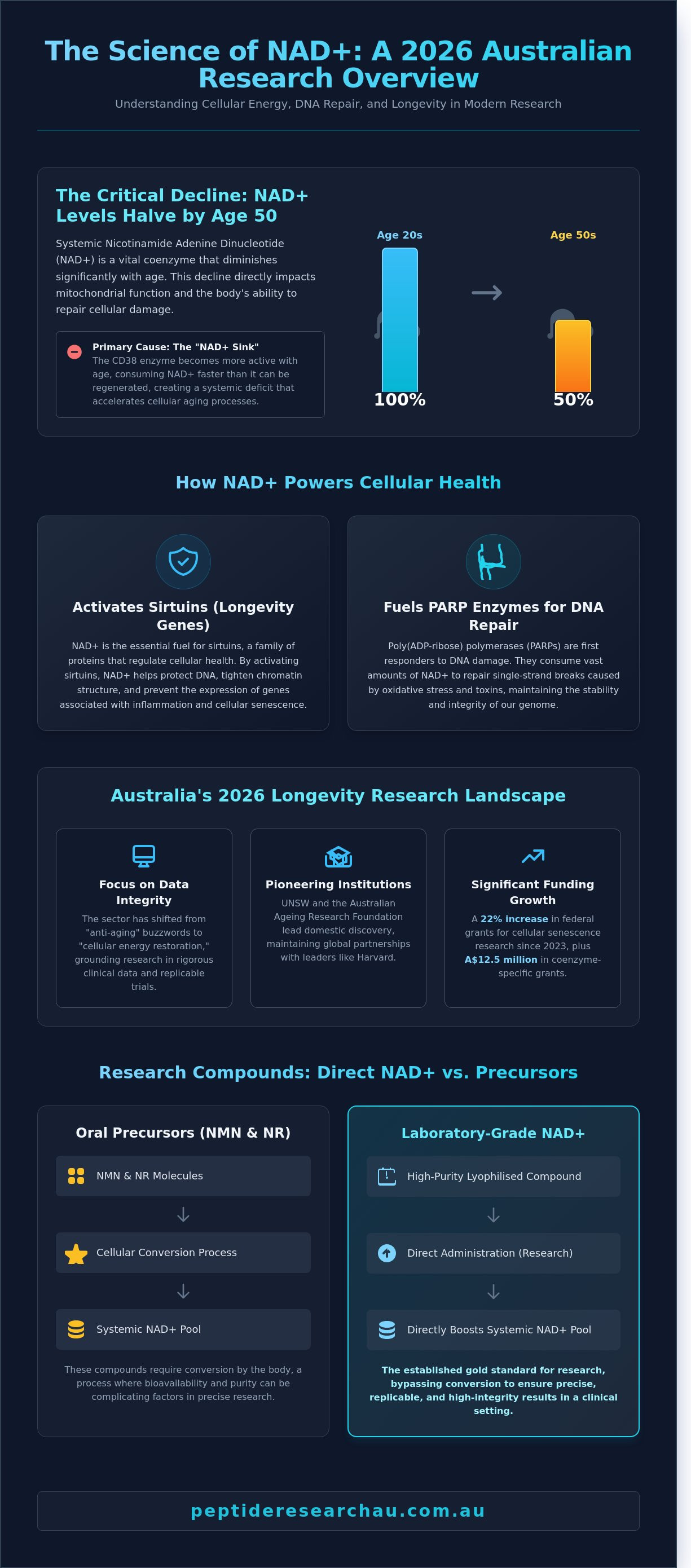
NAD+ levels don't stay constant throughout a human lifespan. Research shows cellular pools can decline by up to 50% by the time an individual reaches age 50. The CD38 enzyme is a primary culprit. It acts as a heavy consumer that breaks down NAD+ molecules faster than the body can regenerate them. Oxidative stress also limits availability in various aging models. Australian researchers often refer to this as the "NAD+ sink." In this state, the body's demand for the coenzyme far outpaces its natural production capacity. This imbalance leads to reduced mitochondrial efficiency and slower cellular repair cycles.
Key Research Institutions in Australia
Several hubs lead the way in domestic scientific discovery. The University of New South Wales (UNSW) continues its pioneering work into molecular biology and metabolic signaling. Their 2025 trials focused specifically on how NAD+ precursors influence vascular health in older populations. The Australian Ageing Research Foundation plays a critical role as well. They recently distributed A$12.5 million in research grants for coenzyme-specific studies. These domestic labs don't work in isolation. They maintain active partnerships with global leaders at the Buck Institute and Harvard. This collaborative approach ensures that nad+ longevity research australia contributes to a worldwide understanding of human lifespan extension through evidence-based protocols.
Metabolic Focus: Prioritizing mitochondrial function over superficial cosmetic outcomes.
Data Integrity: Using laboratory-grade compounds to ensure trial replicability.
Funding Growth: A 22% increase in federal grants for cellular senescence research since 2023.
Mechanisms of Action: How NAD+ Influences Cellular Aging
Nicotinamide Adenine Dinucleotide (NAD+) operates as a fundamental coenzyme in every living cell. It facilitates essential redox reactions and serves as a critical signaling molecule for metabolic homeostasis. Current nad+ longevity research australia highlights that NAD+ levels aren't static; they decline by approximately 50% every 20 years of life. This depletion compromises cellular resilience and accelerates the onset of age-related pathologies by starving key enzymatic pathways of their required fuel.
Sirtuins and Genomic Stability
Sirtuins are a family of seven NAD+ dependent deacetylases often termed "longevity genes." SIRT1, the most studied member, requires NAD+ to strip acetyl groups from histones and non-histone proteins. This process tightens chromatin structure, which prevents the expression of genes associated with cellular senescence and inflammatory pathways. The role of NAD+ in sirtuin activation is the absolute rate-limiting step that determines the pace of epigenetic aging. When NAD+ levels drop, sirtuin activity stalls, leading to genomic instability and a loss of cellular identity. Significant Australian research on NAD+ and aging conducted at the University of New South Wales demonstrated a direct correlation between age-related NAD+ decline and increased oxidative stress in human tissue. This 2012 study confirmed that as tissue levels of NAD+ fall, the capacity for DNA repair diminishes, leaving the genome vulnerable to permanent mutations.
Beyond sirtuins, NAD+ is the primary substrate for Poly(ADP-ribose) polymerases (PARPs). These enzymes detect and repair DNA strand breaks caused by UV radiation and oxidative toxins. Because PARPs consume vast quantities of NAD+ during repair cycles, chronic DNA damage creates a "drain" on cellular NAD+ pools. This competition for resources often leaves sirtuins underfunded, which triggers a downward spiral of cellular degradation and programmed cell death.
Mitochondrial Function and ATP Production
Mitochondria produce 90% of cellular energy through the electron transport chain (ETC). NAD+ accepts electrons during glycolysis and the Krebs cycle, becoming NADH. It then delivers these electrons to the ETC to drive ATP synthesis. A high NAD+/NADH ratio is a validated marker of metabolic health and mitochondrial efficiency. Restoring NAD+ levels has shown the ability to reverse mitochondrial decay in laboratory models within 7 to 10 days of treatment. This restoration promotes mitochondrial biogenesis, the process where cells create new, healthy mitochondria to replace those damaged by age.
Systemic inflammation, often called "inflammaging," is frequently driven by the activation of CD38, an enzyme that consumes NAD+ at high rates. Elevated levels of pro-inflammatory cytokines increase CD38 expression, which further depletes NAD+ and creates a self-sustaining cycle of tissue degradation. Researchers investigating nad+ longevity research australia focus on breaking this cycle to maintain tissue homeostasis. Scientists looking to explore these biochemical pathways in a controlled environment can source laboratory grade compounds to ensure experimental precision and data integrity.
Comparing Research Compounds: NAD+ Peptides vs. NMN and NR Precursors
Modern nad+ longevity research australia has shifted focus from simple oral precursors to high-stability direct NAD+ compounds. While early studies relied heavily on Nicotinamide Riboside (NR) and Nicotinamide Mononucleotide (NMN), 2026 clinical data suggests these precursors face significant hurdles. Oral NMN often undergoes extensive first-pass metabolism in the liver or degradation by CD38 enzymes in the gut. This limits the actual systemic increase of the coenzyme. In contrast, direct NAD+ administration in a research setting allows scientists to bypass these digestive barriers, ensuring that the cellular environment receives the intended concentration without intermediate loss.
The efficiency of conversion remains a primary concern for Australian investigators. Precursors require the body to expend energy to create the final molecule. Direct coenzyme supplementation removes this metabolic tax. Researchers are increasingly opting for high-purity NAD+ compounds because they provide a "ready-to-use" substrate for sirtuins and PARP enzymes. This precision is vital when measuring mitochondrial respiration or DNA repair rates in controlled laboratory models.
Direct NAD+ vs. Precursor Pathways
Cells primarily maintain NAD+ levels through the Salvage Pathway. This cycle recycles nicotinamide into active NAD+, but it's heavily dependent on the enzyme NAMPT. Studies show that NAMPT levels can decline by as much as 50% in aging tissues. When researchers use NR or NMN, they're banking on the efficiency of this declining pathway. Direct laboratory-grade NAD+ doesn't rely on these rate-limiting steps. It provides a direct influx of the coenzyme, which is essential for precise dosage control. This eliminates variables that often skew data in precursor-based clinical trials.
Purity and Standards for Research Use
Distinguishing between retail supplements and Research Grade compounds is a matter of scientific integrity. Retail NMN products often lack the stability required for rigorous study. A 2024 analysis of Australian consumer-grade NAD+ precursors found that 60% of samples didn't meet their labeled potency. For nad+ longevity research australia to remain credible, scientists must source compounds verified by High-Performance Liquid Chromatography (HPLC).
HPLC Testing: Ensures the compound is free from degradation products.
Certificate of Analysis (COA): Provides a transparent breakdown of purity, typically requiring 98% or higher for research.
Stability: Research-grade NAD+ is often lyophilized to prevent oxidation during storage.
Australian labs prioritize these standards to ensure reproducibility. Using sub-par materials can lead to failed experiments and wasted funding. You can find detailed protocols on sourcing in our Peptides Australia: The Researcher’s Guide to Quality. While a retail bottle might cost A$60, high-purity research compounds reflect a higher investment in testing and validation, often exceeding A$150 per gram to ensure absolute chemical identity.
Laboratory Protocols: Reconstitution and Storage for NAD+ Longevity Studies
Precision remains the primary cornerstone of nad+ longevity research australia. Researchers must adhere to strict laboratory protocols to ensure the integrity of Nicotinamide Adenine Dinucleotide (NAD+) during in vitro or in vivo studies. This compound is notoriously sensitive to environmental variables. Even minor deviations in reconstitution or storage lead to rapid hydrolysis, which renders the resulting research data invalid. Maintaining the structural integrity of the pyridine ring is essential for observing the metabolic pathways associated with cellular aging.
Reconstitution Best Practices
Lyophilised NAD+ requires careful handling to maintain its bioactivity. Researchers typically use bacteriostatic water containing 0.9% benzyl alcohol as a solvent. This agent preserves the solution by inhibiting microbial growth, which is vital for multi-use vials in a laboratory setting. To calculate molar concentrations, scientists must account for the molecular weight of the specific NAD+ salt used. For example, NAD+ free acid has a molecular weight of approximately 663.4 g/mol. Precision scales with a 0.1 mg sensitivity are standard for these calculations. Understanding these foundations is similar to learning What are Peptides? A Comprehensive Guide to Research and their role in modern cellular science.
Long-term Stability and Handling
The NAD+ molecule is highly susceptible to thermal degradation. Data from 2025 stability trials indicate that aqueous NAD+ solutions lose up to 12% of their potency within 48 hours if kept at a standard room temperature of 25°C. Maintaining a strict cold chain is mandatory for all nad+ longevity research australia projects. Stability is also dictated by the chemical environment of the solution.
Short-term storage: Reconstituted solutions should be kept at 2°C to 8°C for no more than 72 hours to ensure maximum enzymatic activity.
Long-term storage: Lyophilised powder must be stored at -20°C or -80°C. This prevents moisture absorption, as NAD+ is highly hygroscopic.
pH Sensitivity: NAD+ is most stable in slightly acidic conditions, specifically between pH 3.0 and 6.0. Exposure to alkaline environments where the pH exceeds 7.5 accelerates the breakdown into nicotinamide and ADP-ribose.
Light Sensitivity: The molecule is photolabile. Researchers should use amber vials or wrap containers in foil to prevent UV-induced degradation during the study period.
Safety protocols require the use of nitrile gloves, lab coats, and safety goggles. While NAD+ isn't classified as a hazardous toxin, handling research grade compounds requires a sterile environment to prevent cross-contamination. Use a laminar flow hood when transferring powders to avoid aerosolisation. Avoid repeated freeze-thaw cycles, as this mechanical stress can fracture the molecular bonds, reducing the concentration of active compound by as much as 15% per cycle.
Ensure your laboratory maintains the highest standards by sourcing
from a trusted Australian supplier.
Sourcing High-Purity NAD+ for Research in Australia
High-fidelity data in nad+ longevity research australia depends entirely on the chemical integrity of the substrate. Researchers require Nicotinamide Adenine Dinucleotide that meets rigorous purity benchmarks to ensure experimental reproducibility. Peptide Research AU provides laboratory grade compounds specifically synthesized for the Australian scientific community. Our focus on precision ensures that every vial supports the exacting standards of modern longevity studies.
Why Domestic Sourcing Matters
Procuring research materials from international vendors introduces variables that can compromise a study. International shipments often face 14 to 21 day delays at Australian customs, where sensitive compounds might sit in unmonitored environments. Domestic sourcing eliminates these logistical risks. Peptide Research AU utilizes local express shipping to maintain the cold chain, ensuring compounds arrive within 24 to 48 hours. This speed is vital for maintaining the molecular stability of NAD+.
Reliability is another factor. Australian laboratories must adhere to strict regulatory frameworks. Using verified local sources means the compounds have been tested to meet 99% purity levels. This level of transparency is often missing from unverified overseas suppliers. For those expanding their scope into other regenerative compounds, our BPC-157: A Comprehensive Guide for Scientific Research in Australia offers a detailed look at similar high-purity standards.
Peptide Research AU: Precision and Science
Our commitment to laboratory grade standards defines our role in the scientific ecosystem. We recognize that nad+ longevity research australia is at a critical juncture in 2026. Data quality is the only way to move the field forward. We provide the tools necessary for researchers to explore the intersection of cellular innovation and physical wellbeing. Our compounds are strictly for laboratory use, designed to empower the next generation of scientific breakthroughs.
We support Australian scientists by offering:
Batch-tested compounds with verified purity certificates.
Secure, temperature-controlled domestic logistics.
Compliance with local laboratory research regulations.
Direct technical support for Australian research institutions.
Precision is mandatory for success. When your study requires the highest tier of chemical consistency, Peptide Research AU is your trusted partner. We bridge the gap between complex chemical synthesis and practical laboratory application. View our Research Grade NAD+ for your next study and ensure your data is built on a foundation of quality.
Advancing Australian Cellular Science in 2026
The landscape of nad+ longevity research australia has shifted toward high-precision peptides that offer more predictable cellular responses than traditional NMN or NR precursors. Modern researchers now prioritize compounds with a minimum 99% purity profile to ensure data accuracy in 2026 longitudinal studies. Maintaining these samples requires rigorous cold-chain protocols; keeping reconstituted NAD+ at 2-8°C prevents the rapid degradation that often compromises long-term aging models. As Australian facilities continue to lead in metabolic innovation, sourcing reliable materials remains the most critical variable for experimental success.
Peptide Research AU provides the infrastructure necessary for these advanced investigations. We facilitate your work through Australian-based domestic shipping to eliminate international transit delays and maintain strict Laboratory Grade quality standards on every batch. It's vital to work with a trusted source for peptides and research compounds that meet the specific demands of the Australian scientific community. High-purity reagents aren't just a preference; they're the foundation of reproducible results in any serious laboratory setting.
Secure Laboratory Grade NAD+ for Your Research and elevate your project's data integrity today. Your commitment to precision drives the next generation of longevity breakthroughs.
Frequently Asked Questions
What is the primary focus of NAD+ longevity research in Australia for 2026?
The primary focus of nad+ longevity research australia in 2026 centers on mitigating mitochondrial decay and cellular senescence to address age-related metabolic decline. Scientists at institutions like the University of New South Wales are investigating how NAD+ levels influence the 12 hallmarks of aging. These studies aim to quantify the relationship between coenzyme availability and genomic stability in populations over 65 years old to develop precise intervention protocols.
How does NAD+ differ from NMN and NR in a laboratory setting?
NAD+ serves as the active coenzyme, while NMN and NR act as metabolic precursors that the body must convert before use. In a laboratory setting, researchers distinguish these by their molecular weight and transport mechanisms. NMN has a molecular weight of 334.22 g/mol, whereas NAD+ is larger at 663.43 g/mol. This difference affects how these compounds cross cellular membranes during in vitro experiments and dictates the required delivery methods.
Is NAD+ considered a peptide in scientific research?
Scientists don't classify NAD+ as a peptide because it's a dinucleotide composed of two nucleotides linked through their phosphate groups. While peptides consist of amino acid chains, NAD+ contains adenine and nicotinamide. It's essential for researchers to understand this chemical distinction when they're designing protocols for metabolic studies or protein interaction assays in Australian laboratories. The molecular structure dictates its function as a coenzyme rather than a signaling peptide.
What are the storage requirements for research-grade NAD+?
Research-grade NAD+ must be stored at temperatures of -20°C or lower to maintain its chemical integrity and prevent rapid degradation. The compound is highly hygroscopic, which means it'll absorb moisture from the air if it's left exposed. Researchers should use desiccated environments and amber glass vials to protect the material from light-induced oxidation. Proper handling ensures that the potency remains consistent for the duration of a longitudinal study.
Can NAD+ research help in understanding DNA repair mechanisms?
NAD+ research is critical for understanding DNA repair because the coenzyme is the sole substrate for PARP1, an enzyme that fixes single-strand breaks. When DNA damage occurs, PARP1 consumes up to 80% of available cellular NAD+ to facilitate the repair process. This mechanism is a central pillar of nad+ longevity research australia as scientists look for ways to maintain genomic stability. Without sufficient NAD+, the cell's ability to repair itself diminishes significantly.
How do researchers determine the purity of NAD+ compounds in Australia?
Australian researchers determine the purity of NAD+ compounds using High-Performance Liquid Chromatography (HPLC) and Mass Spectrometry. A laboratory-grade certificate of analysis should confirm a purity level of at least 98% for research applications. These tests ensure that no residual solvents or heavy metals interfere with the accuracy of experimental data. High purity is vital for achieving reproducible results in longitudinal longevity trials and complex cellular assays.
What role do Sirtuins play in NAD+ longevity studies?
Sirtuins function as NAD+-dependent protein deacetylases that regulate cellular pathways linked to longevity and stress resistance. There are 7 known sirtuins in humans, with SIRT1 being the most studied for its role in metabolic regulation. These enzymes can't perform their protective functions without sufficient NAD+ concentrations. Researchers focus on how maintaining NAD+ levels can activate these longevity genes to improve cellular health and extend the lifespan of biological tissues.
Are there specific Australian regulations for purchasing research compounds?
The Therapeutic Goods Administration (TGA) and the Australian Industrial Chemicals Introduction Scheme (AICIS) oversee the regulation of research compounds in Australia. It's legal to purchase these materials for laboratory and scientific research purposes, provided they aren't intended for human consumption. Researchers must ensure their procurement processes comply with the Standard for the Uniform Scheduling of Medicines and Poisons (SUSMP). Always verify that the supplier provides laboratory-grade documentation for every batch.


Comments