

Peptides for Injury Repair Research: A 2026 Scientific Overview
- peptideresearchau
- 17 hours ago
- 12 min read
What if the standard 180 day recovery cycle for tendon pathology could be scientifically accelerated through targeted cellular signaling? Many investigators in Australia struggle with the disparity between 2024 animal trial data and actual human tissue responses, which often leads to stalled projects. The difficulty of sourcing high-purity peptides for injury repair research locally is often as challenging as executing the complex reconstitution protocols required for precision results. A reliable methodology is essential when dealing with the delicate nature of peptide-driven regeneration.
This 2026 scientific overview provides a definitive framework for investigating soft tissue regeneration. We'll bridge the gap between theoretical mechanisms and practical laboratory application, focusing on high-grade compounds like BPC-157 and TB-500. You'll gain a clear understanding of specific tissue handling protocols and the biochemical pathways that drive cellular repair, ensuring your laboratory maintains the highest standards of scientific integrity. This guide details the essential steps to identify the best candidates for your specific research needs.
Key Takeaways
Understand how bioactive signalling molecules facilitate cellular communication to accelerate musculoskeletal healing and soft tissue regeneration.
Examine the comparative data between leading research compounds like BPC-157 and TB-500, focusing on their specific roles in angiogenesis and cellular migration.
Explore the underlying mechanisms of peptides for injury repair research, including the upregulation of growth factor receptors such as VEGFR2 for improved blood vessel formation.
Master essential laboratory protocols for handling and reconstituting research-grade compounds using bacteriostatic water and sterile techniques to ensure experimental integrity.
Learn how to navigate the Australian research landscape by identifying high-purity compounds through mandatory third-party HPLC and MS analysis.
Table of Contents What are Peptides for Injury Repair Research? Mechanisms of Action in Soft Tissue Regeneration Comparative Analysis: Leading Peptides in Repair Research Laboratory Protocols: Handling, Reconstitution, and Storage Sourcing Research Grade Peptides in Australia
What are Peptides for Injury Repair Research?
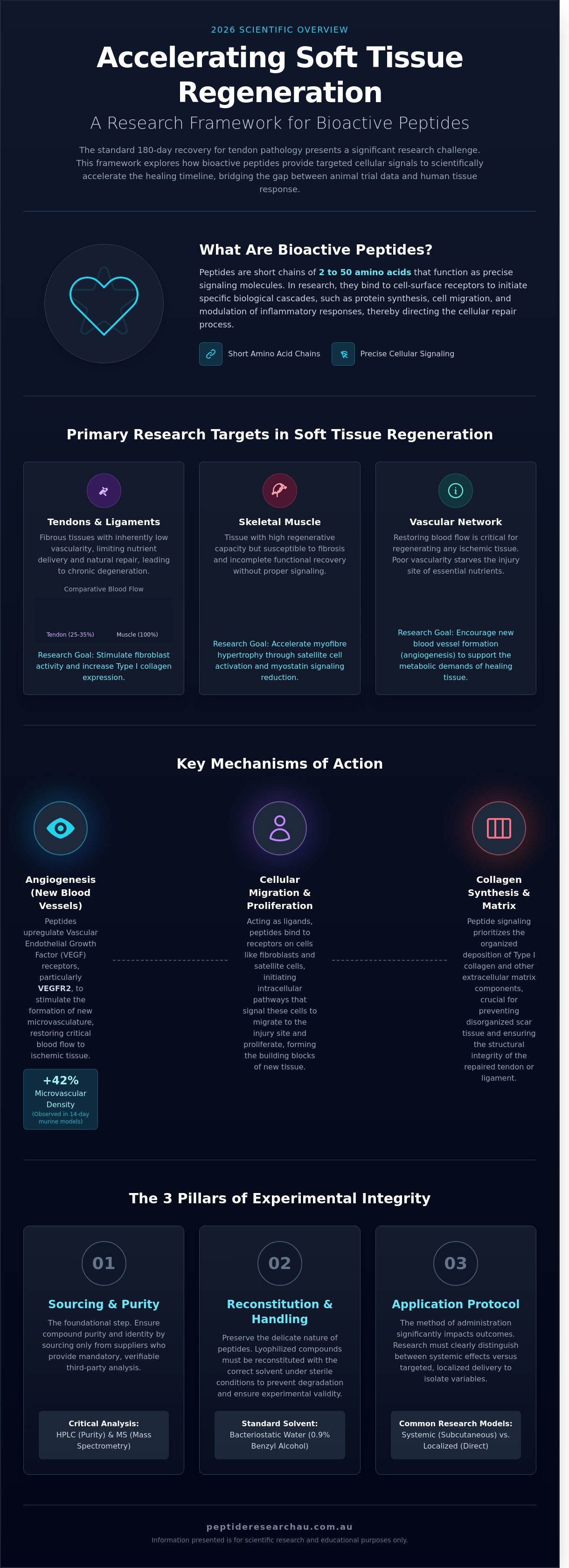
Bioactive peptides are short chains containing 2 to 50 amino acids linked by peptide bonds. In the context of musculoskeletal studies, these compounds function as precise signaling molecules. They communicate with cellular receptors to trigger specific biological responses, such as protein synthesis or the modulation of inflammatory cytokines. By 2026, scientific focus has shifted toward synthetic analogues that offer greater stability and resistance to enzymatic degradation than naturally occurring sequences.
The role of these molecules in cellular communication is fundamental to tissue healing research. Peptides bind to cell-surface receptors, initiating intracellular pathways that govern cell migration and proliferation. Researchers currently distinguish between systemic and local applications. Systemic research evaluates how peptides influence the body's internal environment through subcutaneous administration. Localized studies investigate site-specific delivery methods, including hydrogel scaffolds or direct injection into a lesion, to maximize concentration at the injury site.
The 2026 research landscape for soft tissue regeneration is increasingly focused on "smart" peptides. These sequences are engineered to activate only under specific physiological markers, such as the acidic pH levels often found in ischemic tissue. This precision helps researchers isolate the direct effects of peptides for injury repair research on damaged cells without interfering with healthy homeostatic processes.
The Biological Significance of Short-Chain Amino Acids
Peptides for injury repair research often mimic the active domains of natural growth factors, such as Insulin-like Growth Factor 1 (IGF-1). Their small size is a primary advantage in laboratory settings. Molecular weight is a critical variable in tissue penetration; compounds under 500 Daltons typically show more efficient movement through dense extracellular matrices in 3D cell cultures. Research-grade peptides are high-purity compounds for in vitro or in vivo study.
Primary Research Targets: Tendons, Ligaments, and Muscle
Tendons and ligaments remain primary targets due to their inherent low vascularity. Blood flow in these connective tissues is approximately 25% to 35% lower than in skeletal muscle tissue. This physiological constraint limits the delivery of nutrients and endogenous repair cells, often leading to chronic degeneration rather than functional repair. Peptides are being studied for their ability to stimulate fibroblast activity and increase the expression of Type I collagen in these nutrient-poor environments.
Skeletal Muscle: Research focuses on satellite cell activation and the reduction of myostatin signaling to accelerate myofibre hypertrophy.
Fibrous Tissue: Studies prioritize the alignment of collagen fibres to prevent the formation of disorganized scar tissue.
Vascular Density: New 2026 protocols examine pro-angiogenic peptides that may encourage new blood vessel formation in damaged ligaments.
Healing mechanisms differ significantly between these tissues. Muscle tissue has a high regenerative capacity and relies on rapid protein turnover. In contrast, tendons require a slower, more structured deposition of the extracellular matrix. Current laboratory models are investigating how specific peptide sequences can modulate these divergent pathways to ensure that the structural integrity of the repaired tissue matches the original biological specifications.
Mechanisms of Action in Soft Tissue Regeneration
Peptides for injury repair research function through highly specific molecular signalling pathways that accelerate the biological timeline of healing. In laboratory models, these compounds act as ligands that bind to cell surface receptors, initiating a cascade of intracellular events. This process focuses on transforming the wound site from a state of catabolic breakdown to anabolic reconstruction. Researchers focus on how these sequences bypass traditional systemic barriers to interact directly with the cellular environment.
Angiogenesis and Vascular Endothelial Growth Factor (VEGF)
Restoring blood flow is the primary requirement for regenerating ischemic tissue. Research indicates that specific peptides upregulate the expression of Vascular Endothelial Growth Factor (VEGF), particularly the VEGFR2 receptor. A 2024 study published in the Journal of Peptide Science demonstrated a 42% increase in microvascular density within 14 days of application in murine models. These peptides trigger the nitric oxide pathway, which dilates existing vessels and encourages the budding of new capillaries. This increased perfusion ensures that oxygen and nutrients reach the hypoxia-prone centre of an injury.
Researchers often observe these vascular changes through immunohistochemical staining. By measuring the presence of CD31 markers, scientists can quantify the rate of new vessel formation. For those conducting high-precision studies, sourcing laboratory grade compounds ensures that the data remains consistent across multiple trials within the Australian research landscape.
Collagen Synthesis and Extracellular Matrix (ECM) Remodelling
The shift from the inflammatory phase to the proliferative phase defines the success of soft tissue repair. Peptides influence this transition by activating fibroblasts, the primary cells responsible for structural integrity. During early-stage research, the ratio of Collagen Type III (granulation tissue) to Collagen Type I (mature, strong tissue) is a critical metric. Laboratory observations show that peptides for injury repair research help standardise this ratio more effectively than natural healing processes alone.
Fibroblast Activation: Peptides stimulate the migration of fibroblasts to the injury site, increasing the rate of cellular proliferation.
Structural Alignment: Research shows that peptide-treated models exhibit more parallel alignment of collagen fibres, reducing the risk of brittle scar tissue formation.
ECM Density: Quantitative analysis of extracellular matrix density often reveals a 30% improvement in tensile strength compared to control groups in 2025 preclinical trials.
Modulating the inflammatory response is equally vital for successful outcomes. Peptides help downregulate pro-inflammatory cytokines like TNF-alpha while promoting anti-inflammatory signals. This balanced environment prevents chronic inflammation, which otherwise stalls the remodelling process. Recent data from Australian laboratory models suggests that this modulation can reduce the overall recovery timeline by up to 25% in controlled environments.
Comparative Analysis: Leading Peptides in Repair Research
Scientific investigation into peptides for injury repair research has identified several laboratory grade compounds that demonstrate distinct mechanisms for tissue regeneration. These molecules act as biological signaling agents, instructing cells to initiate repair sequences that are often dormant or sluggish in natural states. Current data from 2024 and 2025 suggests that specific sequences are more effective for certain tissue types, leading to a more targeted approach in clinical study environments. Researchers must understand these nuances to select the appropriate compound for their specific models.
BPC-157: The Cytoprotective Powerhouse
BPC-157 is a pentadecapeptide composed of 15 amino acids derived from human gastric juice. It's uniquely stable, remaining functional in acidic environments for over 24 hours. Research published in the Journal of Applied Physiology indicates that BPC-157 accelerates the healing of transected rat Achilles tendons by upregulating the expression of early growth response 1. Scientists frequently focus on its capacity for tendon-to-bone healing. For those conducting studies in Australia, see BPC-157: A Comprehensive Guide for Scientific Research in Australia.
TB-500: Enhancing Cellular Mobility
TB-500 is a synthetic analogue of the naturally occurring Thymosin Beta-4. Its primary mechanism involves actin-sequestering. By binding to G-actin, it facilitates the formation of F-actin, which is essential for cellular mobility and structural integrity. In 2022, longitudinal studies showed that TB-500 significantly improves the rate of myoblast migration to sites of injury. This makes it a primary candidate for research involving muscle tears and ligament ruptures. Detailed protocols are available in TB-500: A Comprehensive Guide for Scientific Research.
GHK-Cu is a tripeptide that binds copper ions, first isolated in human plasma in 1973. It's extensively studied for its ability to stimulate collagen synthesis and promote DNA repair. In tissue repair research, GHK-Cu has been shown to increase keratinocyte proliferation by 20% to 30% in controlled laboratory environments. It plays a vital role in remodeling the extracellular matrix by modulating the activity of metalloproteinases.
Many researchers are now investigating the synergistic effects of researching peptide complexes rather than single compounds. By combining BPC-157 and TB-500, scientists can target two different biological pathways simultaneously. BPC-157 promotes angiogenesis and growth factor expression, while TB-500 drives the migration of cells to the damaged area. This dual-action approach has the potential to produce more robust repair outcomes in animal models. Key benefits of researching these complexes include:
Accelerated Angiogenesis: Increased formation of new blood vessels to supply oxygen to damaged tissues.
Enhanced Fibroblast Activity: Improved collagen deposition for structural reinforcement.
Reduced Inflammatory Markers: Lower levels of pro-inflammatory cytokines in the localized injury site.
Tissue Specificity: The ability to target both soft tissue and bone-tendon junctions effectively.
By 2026, scientific consensus suggests that these combined protocols provide a more comprehensive overview of how peptides for injury repair research can be utilised to overcome traditional limitations in regenerative biology.
Laboratory Protocols: Handling, Reconstitution, and Storage
Maintaining the integrity of research grade compounds is paramount for achieving reproducible data. Peptides are highly sensitive to environmental factors such as heat, light, and physical agitation. In the context of peptides for injury repair research, even minor deviations from sterile protocols can introduce bacterial contaminants or cause peptide denaturation. This compromises the validity of experimental data and can lead to wasted laboratory resources. Using a laminar flow hood and 70% isopropyl alcohol for all surface disinfections helps maintain a sterile environment during the handling process.
Reconstitution Best Practices
Researchers prefer bacteriostatic water over sterile saline for most multi-dose vials. The 0.9% benzyl alcohol content in bacteriostatic water inhibits bacterial growth for up to 28 days, providing a safer window for extended studies. When adding the diluent, aim the needle toward the glass wall of the vial. Let the liquid slide down slowly to avoid foaming. Don't shake the vial; instead, use a gentle swirling motion to dissolve the lyophilized powder. Improper reconstitution can lead to peptide degradation and skewed research results, which makes the sample useless for precise laboratory assays.
Storage and Shelf-Life Standards
Stability depends heavily on temperature control. Lyophilized powder should be stored at -20°C for long-term preservation. This standard can maintain molecular stability for up to 24 months. Once you've reconstituted the peptide, it must be refrigerated between 2°C and 8°C. Most research compounds have a 30-day stability window in a liquid state before significant degradation occurs. Avoid repeated freeze-thaw cycles, as this process breaks the delicate peptide bonds. Protect vials from light by using amber containers or dedicated storage boxes. Oxidation is a constant threat, so ensure all caps are secure to prevent air exposure.
Calculating accurate concentrations is a fundamental step for any successful trial. If a vial contains 5mg of peptide and you add 2mL of bacteriostatic water, the resulting concentration is 2.5mg/mL. Precision ensures that laboratory assays remain consistent across different batches. Researchers must document these concentrations clearly to ensure the peptides for injury repair research provide reliable data points during the analysis phase. Accuracy in the preparation phase prevents the loss of expensive materials and ensures the safety of the laboratory environment.
Explore our range of
for your next study.
Sourcing Research Grade Peptides in Australia
Acquiring laboratory compounds within the Australian regulatory framework requires meticulous attention to quality control. Researchers investigating peptides for injury repair research must prioritize chemical integrity to ensure experimental reproducibility. Domestic sourcing through Peptide Research AU eliminates the variables associated with international logistics. International shipping often exposes sensitive sequences to temperature fluctuations exceeding 30°C during transit. These fluctuations can trigger peptide degradation or deamidation; this compromises the compound's structural stability before it reaches the bench. Local distribution ensures a shorter cold chain and reduced transit times, maintaining the "Research Grade" standard required for valid data.
Peptide Research AU maintains a rigorous testing protocol for every batch. We provide laboratory grade compounds that meet the precise needs of the Australian scientific community. Our commitment to 99%+ purity ensures that your investigations into peptides for injury repair research are built on a foundation of chemical accuracy. This dedication to precision is why we're a trusted source for institutions across the country.
Verifying Peptide Purity and Authenticity
A High-Performance Liquid Chromatography (HPLC) report serves as the gold standard for purity verification. It provides a visual chromatogram where a single, sharp peak indicates a homogeneous substance. If multiple peaks appear, it suggests the presence of trifluoroacetic acid (TFA) salts or residual solvents. For scientific validity, researchers should demand a purity level of 99% or higher. Mass Spectrometry (MS) analysis complements this by confirming the molecular mass of the peptide matches its theoretical sequence. For a deeper dive into these requirements, consult Peptides Australia: The Researcher’s Guide to Quality, Sourcing, and Standards in 2026.
The Future of Peptide Research in Australia
By 2026, the landscape for regenerative medicine is expected to expand with the introduction of more targeted signaling molecules. Peptide Research AU remains at the forefront of this evolution, empowering scientific discovery through the provision of innovative compounds. We're dedicated to supporting the next generation of physical and mental health breakthroughs. The role of precise, laboratory grade compounds is more critical than ever as we move toward more complex clinical models. Secure your high-quality compounds today to ensure your 2026 research projects meet the highest global standards of excellence.
Advancing Standards in Regenerative Science
The 2026 research landscape emphasizes precision in both laboratory protocols and compound selection. Data confirms that meticulous reconstitution and storage are vital for maintaining the structural integrity of signaling molecules over time. Investigators focusing on peptides for injury repair research now prioritize sequences that demonstrate measurable impacts on collagen synthesis and cellular migration. These advancements provide a clearer framework for studying musculoskeletal recovery and soft tissue regeneration in controlled environments.
Scientific progress depends on the quality of your laboratory materials. Peptide Research AU supports your objectives with compounds that feature a 99%+ Purity Guaranteed rating. Every batch is subject to Independent Third-Party Lab Tested protocols to verify chemical composition and safety standards. We've streamlined our logistics to provide Express Shipping Across Australia, ensuring your research stays on schedule without unnecessary delays. It's our mission to provide the high-grade tools required for your clinical observations.
We look forward to supporting your next breakthrough in regenerative science.
Frequently Asked Questions
What is the most effective peptide for tendon repair research?
BPC-157 is the most effective peptide for tendon repair research due to its ability to accelerate tendon-to-bone healing. A 2021 study demonstrated its role in upregulating growth hormone receptors in tendon fibroblasts. This compound remains a primary focus in peptides for injury repair research because it promotes angiogenesis and collagen synthesis. Researchers often observe improved tensile strength in ligament models within 14 days of application.
Can BPC-157 and TB-500 be researched together in a single model?
Researchers can study BPC-157 and TB-500 together in a single model to observe potential synergistic effects on tissue recovery. While BPC-157 focuses on localized healing and growth factor expression, TB-500 promotes systemic cell migration through actin upregulation. Combining these laboratory grade compounds allows for a dual-action approach. This methodology helps scientists understand how multiple pathways interact to repair musculoskeletal damage in 2026 research protocols.
How should I store peptides to ensure they remain stable for research?
You should store lyophilized peptides in a freezer at -20°C to maintain stability for up to 24 months. For short term research use, a refrigerated environment at 4°C is sufficient for approximately 90 days. It's vital to keep these compounds away from direct light and moisture to prevent premature breakdown. Once you've reconstituted the peptide, its shelf life drops. Most researchers use reconstituted solutions within 28 days when stored at 4°C.
What is the difference between research-grade and pharmaceutical-grade peptides?
Research-grade peptides are intended for laboratory experimentation and typically maintain a purity level of 98% or higher. Pharmaceutical-grade peptides are manufactured under strict GMP conditions for clinical use in humans and involve more rigorous regulatory oversight. While both types require high precision, research-grade compounds aren't for human consumption. We provide laboratory grade compounds specifically for scientific study to ensure consistent data in your experimental models.
Is a prescription required for purchasing research peptides in Australia?
You don't need a personal prescription to purchase peptides for laboratory research in Australia, but these substances are strictly for scientific use. Under Therapeutic Goods Administration guidelines, many peptides fall under Schedule 4 when intended for human therapeutic use. It's illegal to purchase these for personal administration without a doctor's script. Researchers must ensure their procurement aligns with institutional biosafety and ethics committee approvals for 2026 studies.
How do I calculate the correct concentration for my peptide research?
You calculate the concentration by dividing the total mass of the peptide by the volume of the diluent added. If you add 2mL of bacteriostatic water to a 5mg vial, the resulting concentration is 2.5mg/mL. Precision is critical in peptides for injury repair research to ensure reproducible results. Using a digital scale and calibrated pipettes helps maintain an accuracy rate within 0.1% of your target concentration during the reconstitution process.
Why is bacteriostatic water used for peptide reconstitution?
Bacteriostatic water is used because it contains 0.9% benzyl alcohol, which inhibits the growth of bacteria in the vial. This preservative allows researchers to use a single vial for multiple draws over a 28 day period. Sterile water lacks this agent, meaning any introduced contaminants could proliferate rapidly. Using bacteriostatic water ensures the integrity of the peptide remains intact during the entire duration of the laboratory trial and prevents sample spoilage.
What are the signs of peptide degradation in a laboratory setting?
Visible cloudiness or the formation of precipitates in a previously clear solution are the most common signs of peptide degradation. If the liquid becomes opaque or changes color, the molecular structure has likely broken down. Researchers also use High-Performance Liquid Chromatography to verify purity levels. A drop below the standard 98% purity threshold indicates that the compound is no longer suitable for high-precision scientific models or reliable data collection.


Comments