

TB-500 Research Protocols Australia: A Laboratory Guide for 2026
- peptideresearchau
- May 9
- 12 min read
Could a single error in solvent choice or a minor temperature fluctuation during storage invalidate months of laboratory findings? You understand that maintaining the molecular integrity of research compounds is the foundation of any successful study. Many researchers struggle with inconsistent data caused by improper handling or confusion regarding the strict tb-500 research protocols australia requires for high-level accuracy. With the TGA intensifying its focus on unapproved peptides in 2026, there's no room for technical errors that compromise either your data or your laboratory's standing.
This guide provides a professional framework for the reconstitution, handling, and storage of laboratory grade compounds to ensure they remain stable and effective. You'll learn exactly how to manage these processes to achieve reproducible results and maintain full compliance with Australian standards. We'll examine the specific requirements for diluent selection, thermal stability, and the precise handling methods required for research chemicals that often start at $99.95 per vial. This overview ensures your research remains precise, safe, and scientifically sound.
Key Takeaways
Understand the molecular role of TB-500 as a primary G-actin sequestering molecule to ensure your study objectives align with its biological mechanism.
Implement standardized tb-500 research protocols australia for reconstitution, focusing on temperature equilibration and sterile handling to prevent peptide degradation.
Maintain long-term integrity by storing lyophilised powder at -20°C and limiting reconstituted stability to 30 days under strict refrigeration.
Navigate the Australian regulatory landscape by adhering to Research Use Only (RUO) designations and TGA guidelines for non-clinical environments.
Guarantee reproducible data by utilizing research-grade compounds with verified 99%+ purity and stringent batch consistency testing.
Table of Contents
Understanding TB-500: The Molecular Mechanism of Thymosin Beta-4
TB-500 is a synthetic version of the 43-amino acid peptide Thymosin Beta-4. It's recognized in the scientific community as the primary G-actin sequestering molecule in eukaryotic cells. This specific function allows it to regulate the availability of actin monomers, which are essential for building the cellular cytoskeleton. TB-500 is a laboratory-grade research compound meant for studying tissue remodeling pathways. Unlike other proteins, its low molecular weight allows it to migrate through tissues with high efficiency, making it a focal point for studies involving cellular migration, angiogenesis, and cytoskeletal regulation.
The molecular structure of this peptide allows it to bind to G-actin in a 1:1 ratio. This prevents the actin from polymerizing into F-actin, effectively maintaining a reservoir of building blocks for rapid cellular movement. When establishing tb-500 research protocols australia, researchers must focus on these biochemical interactions to understand how the compound influences structural changes at the cellular level. This mechanism is the reason TB-500 is frequently utilized in preclinical models exploring vascular development and recovery processes.
Biological Pathways in Preclinical Research
In laboratory environments, the upregulation of actin is a central metric for measuring cellular motility. TB-500 plays a documented role in influencing vascular endothelial growth factor (VEGF), a signal protein that stimulates the formation of blood vessels in experimental models. The significance of the 17-23 amino acid sequence, specifically the LKKTETQ motif, can't be overstated. This sequence is the active site responsible for the peptide's ability to promote cell migration and collagen deposition. Data from 2026 laboratory studies indicate that targeting this specific sequence is vital for achieving reproducible results in tissue regeneration research.
TB-500 vs. Thymosin Beta-4: Distinguishing Research Grades
Standard nomenclature often creates confusion, but 'TB-500' is the preferred term within the research chemical industry to distinguish synthetic fragments from the naturally occurring protein. High purity levels are mandatory for generating reliable in vitro data. Standard tb-500 research protocols australia require that all compounds undergo High-Performance Liquid Chromatography (HPLC) and Mass Spectrometry (MS) verification. These analytical methods ensure the compound meets strict laboratory standards:
Purity verification: Compounds must show 99% purity or higher to avoid interference from truncated peptide sequences.
Molecular Identity: MS testing confirms the exact molecular weight of the 43-amino acid structure.
Stability: HPLC testing ensures that the peptide remains stable under varying laboratory conditions before reconstitution.
Using verified laboratory grade compounds prevents the introduction of contaminants that could skew kinetic data. Meticulous documentation of these purity markers is a hallmark of professional Australian research environments.
Standardised TB-500 Reconstitution Protocol
Precision in the laboratory starts with the physical handling of the lyophilised compound. When implementing tb-500 research protocols australia, the reconstitution phase is where most peptide degradation occurs due to mechanical stress or thermal shock. To maintain the structural integrity of the 43-amino acid chain, researchers must follow a rigorous, step-by-step process that prioritises molecular stability over speed.
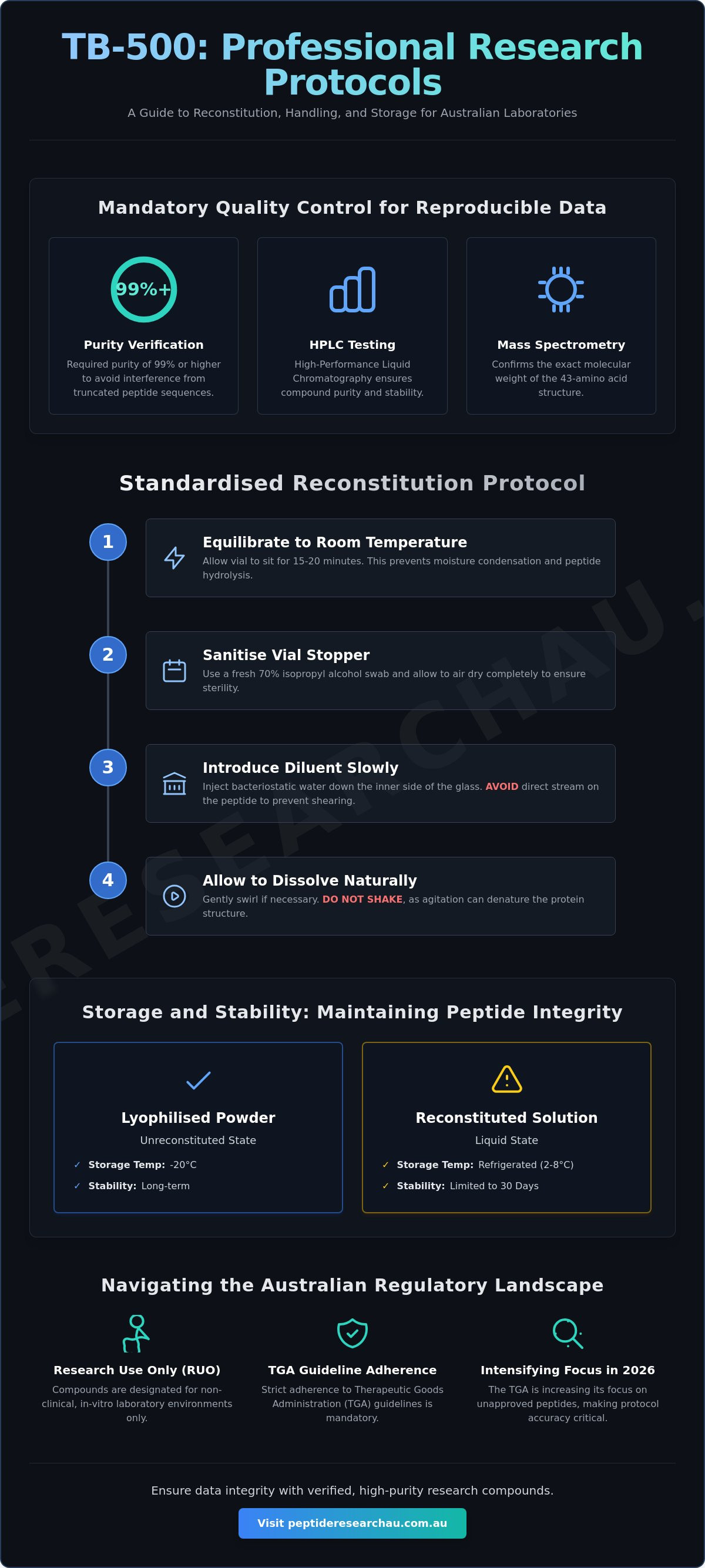
Step 1: Equilibrate the lyophilised TB-500 vial to room temperature for approximately 15 to 20 minutes. This prevents moisture from condensing inside the vial, which can lead to premature peptide hydrolysis.
Step 2: Sanitise the vial stopper using a fresh swab of 70% isopropyl alcohol. Allow the surface to air dry completely to ensure no residual alcohol enters the vial during needle insertion.
Step 3: Introduce the diluent slowly. When injecting the bacteriostatic water, angle the needle so the liquid flows down the inner side of the glass. Avoid direct contact between the liquid stream and the peptide cake, as the force can cause peptide shearing.
Step 4: Allow the peptide to dissolve naturally. You shouldn't shake the vial, as agitation introduces bubbles and can denature the protein. If the powder doesn't dissolve immediately, gently rotate the vial between your palms.
Step 5: Perform a visual inspection under a high-intensity light source. The solution must be clear and free of particulate matter. Any persistent cloudiness suggests the tb-500 research protocols australia for sterile handling or temperature control were compromised.
Selecting the Correct Diluent
Bacteriostatic water is the preferred diluent for multi-use research vials because it contains 0.9% benzyl alcohol. This additive is essential for inhibiting bacterial growth, which is a significant risk in studies lasting up to 30 days. While sterile saline is sometimes used in single-use scenarios, it lacks the preservative qualities required for extended laboratory observation. For a detailed breakdown of laboratory standards, you can refer to our guide to bacteriostatic water.
Calculating Research Concentrations
Determining the correct mg/mL ratio is critical for micro-pipetting accuracy. For a standard 5mg vial, adding 2mL of diluent creates a concentration of 2.5mg/mL. This allows for precise measurement in 0.1mL increments. Many laboratories use a peptide dosage calculator to eliminate manual errors when preparing complex multi-peptide stacks. Sourcing laboratory grade compounds with verified purity ensures that these calculations remain consistent across different batches and trials.
Storage and Stability: Maintaining Peptide Integrity
Maintaining the molecular stability of TB-500 is as critical as the reconstitution process itself. In Australian research environments, where ambient temperatures can fluctuate significantly, adhering to precise thermal parameters is the only way to ensure the reproducibility of your data. Tb-500 research protocols australia dictate that lyophilised powder remains most stable when stored at -20°C. Under these conditions, the peptide maintains its structural integrity for up to 24 months. For short-term laboratory use, storing the powder at 4°C is acceptable for approximately 90 days, but any duration exceeding this requires deep-freeze conditions to prevent gradual degradation of the amino acid chain.
Once you've reconstituted the compound, the window for optimal stability narrows considerably. The solution must be kept between 2°C and 8°C at all times. Even under these refrigerated conditions, the peptide's shelf life is limited to a maximum of 30 days. Beyond this period, the risk of peptide hydrolysis increases, which can lead to inactive fragments that skew kinetic observations. Australian domestic shipping for research compounds requires a strictly managed 'cold chain' to prevent thermal degradation during transit across varying climates. This ensures that the product arrives at the laboratory with its biological activity fully intact.
Preventing Degradation and Shearing
The 43-amino acid structure of TB-500 is notably fragile. Mechanical agitation, such as vigorous shaking, causes molecular shearing that permanently breaks the delicate peptide bonds. This physical stress renders the compound useless for precise cellular migration studies. You should also avoid multiple freeze-thaw cycles once the peptide is in solution. Each cycle creates ice crystals that can physically puncture or disrupt the peptide's tertiary structure. To protect the compound from UV-induced degradation, laboratories should use amber vials or light-protective storage containers, as prolonged exposure to high-intensity light can catalyze the breakdown of the molecular sequence.
Signs of Peptide Compromise
Vigilance during visual inspection is a core component of professional tb-500 research protocols australia. If you identify any particulates, cloudiness, or "floaters" post-reconstitution, the batch is likely compromised and should be discarded. These visual cues often indicate bacterial contamination or advanced denaturation. Additionally, shifts in the pH of the diluent can significantly shorten the peptide's longevity. If a solution shows any change in color or clarity, it no longer meets the standards for high-precision research. All expired or compromised materials must be disposed of according to standard Australian laboratory biohazard protocols to maintain a controlled and safe research environment.
The Australian Regulatory Landscape for Research Peptides
Operating within the Australian scientific sector requires a clear understanding of the "Research Use Only" (RUO) designation. This classification is a technical boundary that separates laboratory compounds from therapeutic goods. In Australia, the Therapeutic Goods Administration (TGA) monitors unapproved peptides closely. As of May 2026, TB-500 remains an unapproved substance and isn't included in the Australian Register of Therapeutic Goods (ARTG). For researchers, this means that tb-500 research protocols australia must be strictly confined to in vitro or preclinical settings. Adhering to these boundaries ensures that your work remains outside the clinical regulatory framework intended for human medications.
Sourcing peptides Australia domestically is the most reliable method for maintaining a consistent supply chain. International imports face high risks in 2026. The Australian Border Force actively screens for undeclared peptide sequences, and the TGA has issued warnings about the lack of sterility in unregulated imports. By sourcing within the country, laboratories reduce the risk of customs seizures and ensure the compounds have been handled according to domestic cold chain requirements. Ethical laboratory practice also demands that researchers maintain precise documentation to prove the non-clinical intent of their studies.
Sourcing Laboratory-Grade TB-500 in Australia
Quality assurance is the foundation of research validity. When you verify an Australian supplier, you should demand third-party testing results for every batch. High-Performance Liquid Chromatography (HPLC) and Mass Spectrometry (MS) are non-negotiable standards. These tests confirm that the peptide has a purity level of 99% or higher and matches the correct molecular weight for Thymosin Beta-4. You can find more details on these quality benchmarks in our TB-500 comprehensive guide. Reliable data depends on the absence of truncated sequences or residual solvents in your samples.
Legal Frameworks for 2026
Current TGA regulations for 2026 classify TB-500 as a Schedule 4 (Prescription Only) substance for human use. Possession without a valid prescription can lead to fines reaching $220,000. However, the RUO framework allows institutional research projects to proceed when proper safety measures are in place. Every laboratory must maintain updated Safety Data Sheets (SDS) for all research chemicals. These documents provide essential information on chemical properties, health hazards, and emergency procedures. Maintaining these records is a core part of tb-500 research protocols australia and institutional compliance. To ensure your laboratory is equipped with the highest quality compounds, you can buy research peptides from our verified catalog.
Optimising Research Outcomes with Peptide Research AU
Achieving reproducible data in tissue remodeling studies requires more than just following tb-500 research protocols australia; it requires compounds that meet the highest analytical standards. Peptide Research AU provides a foundation for scientific excellence by ensuring every vial reaches a minimum of 99% purity. We understand that laboratory grade compounds are the cornerstone of valid research. Our stringent testing protocols focus on batch-to-batch consistency, which eliminates variables that often plague long-term preclinical trials. By sourcing your materials domestically, you gain access to local expertise and a supply chain optimized for the Australian climate.
Beyond the peptides themselves, we supply the essential tools required for a controlled laboratory environment. This includes high-quality laboratory diluents like bacteriostatic water, which is the gold standard for multi-use research vials. Our commitment to the Australian scientific community is built on providing the precision instruments and compounds necessary to advance research into cellular pathways. By maintaining a domestic inventory, we ensure that the cold chain integrity discussed in our storage protocols is never compromised during long-distance international transit.
Why Purity Matters in Cellular Studies
Contaminants in a peptide sample can drastically skew data, especially in sensitive tissue remodeling research. Even a small 2% variance in purity can introduce truncated sequences that compete for binding sites on G-actin, leading to inaccurate kinetic measurements. Peptide Research AU utilizes a multi-stage verification process for every vial. We use High-Performance Liquid Chromatography (HPLC) to confirm that 99% or more of the sample consists of the intended 43-amino acid sequence. This meticulous approach ensures that your results are reproducible across multiple study phases, providing the reliability required for professional laboratory standards.
Getting Started with Your Protocol
Setting up a dedicated peptide research station is the final step in ensuring laboratory success. Before beginning your next trial, ensure your facility meets these criteria:
Environmental Control: A dedicated refrigeration unit capable of maintaining a stable 2°C to 8°C environment for reconstituted vials.
Sterilization Supplies: Adequate stocks of 70% isopropyl alcohol and sterile micro-pipetting tools.
Documentation: Current Safety Data Sheets (SDS) for all active compounds and diluents to meet Australian safety standards.
Verified Compounds: Sourcing high-purity TB-500 that has undergone domestic quality control as of May 2026.
Your research deserves the highest level of precision and chemical integrity. You can explore our Laboratory-Grade TB-500 for Research to secure the compounds necessary for your next institutional project.
Advancing Precision in Australian Peptide Research
Standardizing your laboratory procedures is the only path to achieving consistent, high-fidelity data in preclinical studies. By mastering the delicate balance of reconstitution and maintaining the cold chain at -20°C, you ensure the 43-amino acid sequence remains biologically active. Adhering to the tb-500 research protocols australia established for 2026 protects your laboratory's integrity and aligns your work with the latest TGA research frameworks. Precision in the handling phase directly correlates to the accuracy of your cellular migration and angiogenesis data.
Your research outcomes depend entirely on the quality of your starting materials. Peptide Research AU provides the scientific community with compounds that are third-party HPLC and MS verified to guarantee 99%+ purity. Our domestic Australian shipping ensures your samples arrive without the degradation risks associated with international transit. It's time to elevate your laboratory standards with compounds you can trust. Ready to begin your next phase of study? Order Laboratory-Grade TB-500 for Australian Research and proceed with the confidence that your data is built on a foundation of chemical excellence.
Frequently Asked Questions
What is the best diluent for TB-500 research in Australia?
Bacteriostatic water is the optimal diluent for TB-500 research in Australia due to its antimicrobial properties. The 0.9% benzyl alcohol inhibits bacterial growth for up to 30 days of laboratory use. While sterile saline is an alternative, it lacks preservatives and is only suitable for immediate, single-use applications. Maintaining sterile tb-500 research protocols australia requires using high-quality diluents to prevent sample contamination.
How long does reconstituted TB-500 remain stable in a lab fridge?
Reconstituted TB-500 remains stable for a maximum of 30 days when stored in a laboratory refrigerator between 2°C and 8°C. Beyond this 30-day window, the peptide bonds undergo hydrolysis, which results in a loss of molecular integrity. Researchers should label vials with the reconstitution date to ensure that only viable compounds are used in active study phases.
Can I freeze TB-500 after it has been mixed with bacteriostatic water?
You shouldn't freeze TB-500 once it's been mixed with bacteriostatic water. The formation of ice crystals during the freezing process can physically shear the delicate 43-amino acid peptide chain. This mechanical damage permanently denatures the compound. To preserve stability, keep the solution refrigerated at 2°C to 8°C and avoid any temperature fluctuations that could lead to accidental freezing.
Why is my TB-500 solution cloudy after reconstitution?
Cloudiness post-reconstitution typically indicates peptide denaturation or the presence of contaminants. This often occurs if the diluent was injected too forcefully or if the vial was shaken rather than rotated. If the solution doesn't clear within 10 minutes, the batch is likely compromised. Such samples no longer meet the standards required for tb-500 research protocols australia and must be discarded.
Is TB-500 legal for laboratory research in Australia in 2026?
TB-500 is legal for laboratory research purposes in Australia under the "Research Use Only" (RUO) designation as of May 2026. It is classified as a Schedule 4 substance by the TGA, meaning it requires a prescription for human consumption. Laboratories must ensure all compounds are used strictly for non-clinical, in vitro, or preclinical studies to remain compliant with federal regulations.
What temperature should lyophilised TB-500 be stored at for long-term use?
Lyophilised TB-500 should be stored at -20°C for long-term preservation of up to 24 months. At this temperature, the peptide remains in a stable, crystalline state that resists degradation. For shorter durations of 90 days or less, storage at 4°C is acceptable. Always ensure the freezer is a non-frost-free model to avoid the heat cycles that occur during automatic defrosting.
How do I calculate the concentration of a 10mg TB-500 vial?
To calculate the concentration of a 10mg vial, divide the total peptide mass by the volume of diluent added. For example, adding 2mL of bacteriostatic water results in a concentration of 5mg/mL. If you add 5mL, the concentration becomes 2mg/mL. Using standardized volumes simplifies micro-pipetting and reduces the risk of measurement errors during complex laboratory trials.
Does TB-500 require light-sensitive storage during research?
TB-500 requires protection from light during storage and active research. Prolonged exposure to UV or high-intensity laboratory lighting can catalyze the breakdown of peptide bonds, leading to molecular degradation. Researchers should use amber vials or store clear vials in opaque containers. This precaution is vital for maintaining the 99% purity levels required for high-precision tissue remodeling studies.


Comments