

Peptide Concentration Calculation for Research: A Professional Laboratory Guide
- peptideresearchau
- 2 days ago
- 12 min read
What if a single decimal point error in your laboratory calculations effectively nullified weeks of research and depleted high-value lyophilised material? In the rigorous field of Australian peptide research, the margin for error is non-existent. You understand that the confusion between milligrams and micrograms is not just a mathematical oversight; it is a risk that compromises the integrity of your data. With the TGA seizing over 900,000 units of unlawfully imported therapeutic goods in May 2026, the necessity for precise, documented laboratory protocols has never been more apparent. This peptide reconstitution guide australia provides the technical protocols required to master concentration calculations and ensure your research remains accurate.
You'll learn the essential formulas for volume determination, the critical role of net peptide purity in your final data, and the systematic verification steps needed to protect your research compounds from degradation. We acknowledge the complexity of transitioning from theoretical mathematics to practical laboratory application, especially when handling expensive research peptides. This guide provides the mathematical framework to ensure your research outcomes are both reliable and reproducible, allowing for precise concentration data and confidence in your manual calculation verification.
Key Takeaways
Learn the systematic two-step protocol for verifying total milligram counts and calculating target concentrations for precise laboratory logging.
Understand the critical distinction between gross weight and net peptide content to account for counter-ions and residual moisture in your calculations.
Master the mapping of liquid concentrations to syringe graduations using this peptide reconstitution guide australia to ensure accurate delivery.
Identify how sourcing from verified Australian suppliers and monitoring shipping conditions prevents the degradation of high-purity research compounds.
Establish a clear distinction between solute mass in milligrams and final research dosage in micrograms to prevent common mathematical errors.
Table of Contents
Fundamentals of Peptide Concentration in Laboratory Settings
Precision in laboratory research begins with a clear understanding of peptide concentration, defined as the mass of solute per unit volume of solvent. In this context, the solute is the active research compound, while the solvent is typically a laboratory diluent like bacteriostatic water. This peptide reconstitution guide australia emphasizes the necessity of distinguishing between concentration and research dosage. While concentration refers to the density of the solution, expressed in mg/mL, dosage refers to the specific mass intended for study, expressed in mcg. Misunderstanding this relationship is a primary cause of mathematical errors that can compromise data integrity. Accurate calculations ensure that Peptides remain viable for the duration of the study.
Lyophilisation, or freeze-drying, is the industry standard for maintaining the structural stability of research peptides. This process removes moisture through sublimation, which prevents hydrolysis and enzymatic degradation. Once a researcher introduces a diluent, the compound transitions from a stable solid to a more volatile aqueous state. Accurate measurement requires familiarity with common Australian research units; specifically milligrams (mg) for total mass, micrograms (mcg) for precise dosing, and millilitres (mL) for volume. International Units (IU) may also be used when referencing biological activity rather than mass.
Solute vs. Solvent: Establishing the Ratio
Successful reconstitution depends on identifying the exact mass of the lyophilised cake within the vial. This mass is not always visually apparent. A 2mg cake may appear identical in size to a 5mg cake due to the presence of bulking agents like mannitol. Researchers must select a diluent volume that creates a concentration density suitable for accurate measurement via syringe graduations. A standard reconstitution ratio for a 5mg vial often utilizes 2mL of bacteriostatic water to achieve a concentration of 2.5mg/mL. This ratio allows for manageable volume measurements while maintaining compound stability.
Stability Factors in Concentration Maintenance
The integrity of a reconstituted solution is highly sensitive to environmental variables. Temperature is the most critical factor. Reconstituted compounds should be maintained at 2-8°C to slow the rate of molecular degradation. The pH of the solvent also plays a vital role in solubility. Most research compounds require a slightly acidic or neutral environment to remain in solution without precipitating. Higher concentrations can sometimes lead to aggregation, while excessively dilute solutions may lose mass through adsorption to the glass walls of the vial. Maintaining a consistent concentration is essential for reproducible research data and long-term stability.
The Mathematics of Peptide Reconstitution: A Step-by-Step Protocol
Manual verification of mathematical models is essential for laboratory precision. While automated calculators offer convenience, they often obscure the underlying mechanics of concentration density, leaving researchers vulnerable to software errors. This peptide reconstitution guide australia prioritizes a rigorous manual protocol to ensure research accuracy and compound integrity. A systematic approach prevents the waste of expensive lyophilised materials and ensures that every micro-gram is accounted for in the final solution.
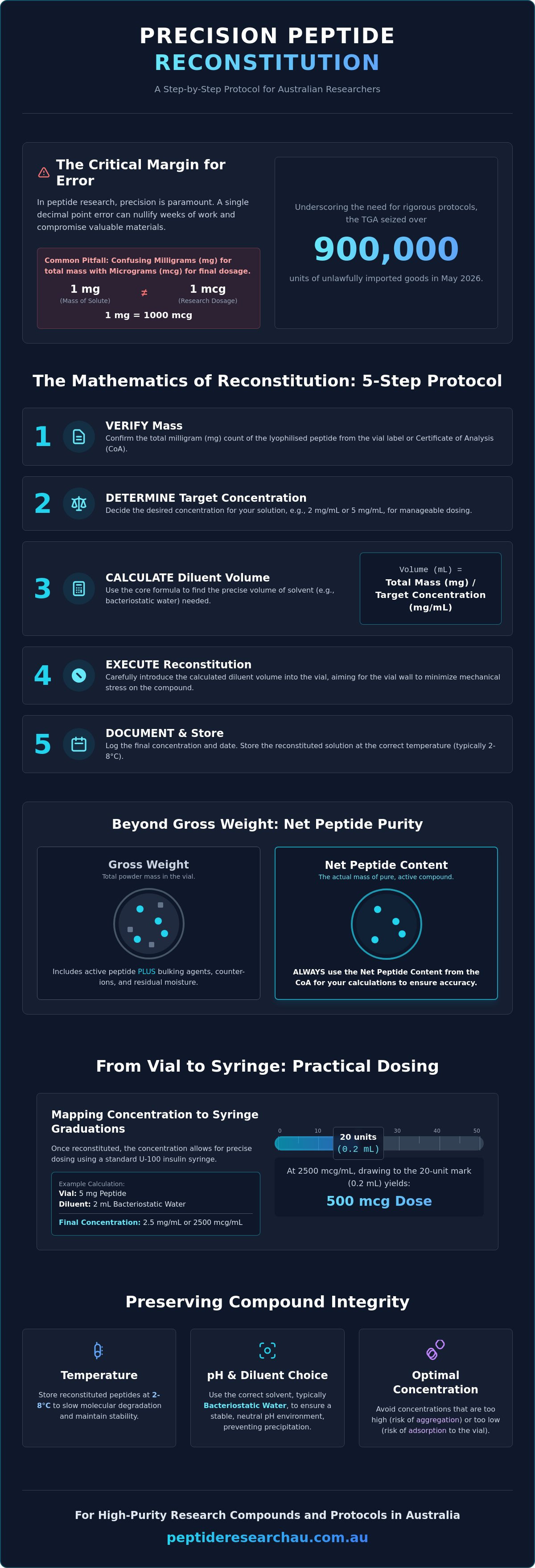
Step 1: Verify the total milligram (mg) count of the research compound as stated on the certificate of analysis or vial label.
Step 2: Determine the target concentration required for the study, such as 2mg per 1mL or 5mg per 1mL.
Step 3: Calculate the required volume of bacteriostatic water or other laboratory diluents using the formula: Volume = Mass / Concentration.
Step 4: Execute the physical reconstitution using precision instruments, ensuring the diluent is introduced via the vial wall to minimize mechanical stress.
Step 5: Document the final concentration and date of reconstitution for longitudinal study accuracy.
The Core Formula: Mass, Volume, and Density
The C1V1 = C2V2 equation facilitates precise dilutions when stock solutions are prepared for varied study parameters. However, the initial reconstitution relies on a direct mass-to-volume ratio. Converting milligrams to micrograms is a fundamental requirement for micro-dosage accuracy. Since 1mg equals 1000mcg, a 10mg vial reconstituted with 2mL of diluent results in a 5mg/mL concentration. This equates to 500mcg per 0.1mL. Adhering to established Handling and Storage Guidelines for Peptides ensures the compound remains stable during this transition from solid to liquid state.
Common Calculation Pitfalls to Avoid
Researchers must account for the displacement volume of the lyophilised powder. While often negligible in small quantities, it can slightly alter the final volume in high-concentration solutions. A "Zero-Error" rule should be applied, requiring a secondary verification of all decimal placements during mcg conversions. Miscalculating a single decimal place can lead to a tenfold error in dosing, potentially compromising the entire research project. Using an insufficient volume of diluent may also result in peptide precipitation, where the solute fails to remain in a homogenous state. For optimal results, ensure you are using high-quality laboratory diluents designed for professional research applications.
Beyond Gross Weight: Factoring Purity and Net Peptide Content
Achieving laboratory precision requires a transition from gross weight calculations to net peptide analysis. Gross weight refers to the total mass of the lyophilised powder within a vial, which includes the peptide, counter-ions, and residual moisture. Net peptide content represents the actual percentage of peptide by weight. In a professional peptide reconstitution guide australia, accounting for these variables is mandatory for accurate micro-dosing. If you assume the gross weight equals the active mass, your resulting concentration will be consistently lower than intended, compromising research reproducibility.
Most lyophilised research compounds are not 100% peptide. During the final stage of solid-phase synthesis, peptides are often purified using HPLC and then lyophilised. This process leaves behind essential counter-ions and water molecules that are bound to the peptide structure. Depending on the sequence and lyophilisation parameters, these non-peptide components can account for 10% to 30% of the total mass. Using high-purity peptides australia ensures that these variables are documented, allowing for the adjustment of reconstitution volumes to maintain exact concentration density.
Interpreting the Certificate of Analysis (CoA)
A Certificate of Analysis provides two distinct metrics: purity and peptide content. Purity measures the percentage of the target peptide sequence relative to sequence-related impurities. Peptide content indicates the actual weight percentage of the peptide in the total powder. To determine the actual mass, apply the formula: Actual Mass = Gross Mass x (Purity % x Peptide Content %). A purity rating of 98% indicates the absence of sequence errors or truncated chains, but it doesn't account for the weight of essential counter-ions or residual water. Therefore, a 5mg vial with 98% purity and 80% peptide content actually contains only 3.92mg of active compound.
The Impact of Salt Content on Research Accuracy
Peptides are synthesized as salts to enhance solubility and stability. Trifluoroacetic acid (TFA) is the standard counter-ion used in synthesis, yet it can be cytotoxic in specific cell cultures. Acetate salts are often utilized as an alternative for biological studies where TFA interference must be avoided. These residual salts influence the osmotic pressure of the final solution, which may alter the results of sensitive cellular assays. Researchers must select the appropriate salt form based on their specific study parameters. Minimising salt interference involves choosing compounds with a high peptide-to-salt ratio and verifying the salt type on the CoA before finalizing the peptide reconstitution guide australia protocols for your laboratory.
Syringe Volume and Practical Concentration Management
Precise delivery of reconstituted compounds requires a meticulous mapping of liquid concentration to syringe graduations. In Australian research laboratories, the standard instrument is the U-100 syringe, which is calibrated based on a 100-unit-per-millilitre scale. It's essential to understand that one unit on this scale is equivalent to exactly 10 microlitres (µL). This peptide reconstitution guide australia emphasizes selecting the correct syringe size, such as 0.3mL, 0.5mL, or 1.0mL, to match the intended study volume. Smaller syringes offer superior resolution for micro-dosing because the tick marks are spaced further apart, which significantly reduces the risk of parallax error during the draw process. Using a 1.0mL syringe for a 5-unit draw is statistically less accurate than using a 0.3mL syringe for the same volume.
Dead space loss is a critical variable in high-concentration research protocols. This term refers to the residual fluid remaining in the needle and hub after the plunger is fully depressed. While low-dead-space syringes minimize this effect, researchers must account for potential mass loss when working with limited quantities of expensive research compounds. Consistent measurement depends on utilizing the same syringe brand throughout a longitudinal study, as manufacturing tolerances for graduation placement can vary slightly between different providers. For high-precision studies, you can purchase research peptides and laboratory diluents that meet rigorous quality standards for consistent performance across all study phases.
Calculating Dose per Tick Mark
Determining the amount of compound per graduation requires a simple yet vital formula: (Total mcg / Total Units). For example, if a 5mg (5000mcg) vial is reconstituted with 1mL (100 units) of diluent, each unit on the syringe represents 50mcg of the compound. Visualising the draw is easier on a 30-unit (0.3mL) syringe where each individual tick mark typically represents 0.5 or 1 unit. When study parameters require a 250mcg dose, the researcher would draw to the 5-unit mark. Accuracy at this level is paramount; a deviation of just two units in this scenario results in a 20% dosage error, which can lead to skewed data and unreliable results in a professional laboratory setting.
Handling High-Concentration Solutions
Highly concentrated peptide solutions often exhibit increased viscosity, which can complicate the draw and lead to air bubble formation. These bubbles displace the active solution, resulting in an under-dose if not properly cleared before application. Measuring sub-5 unit volumes is notoriously difficult due to the physical limits of syringe plunger precision and the surface tension of the liquid. In cases where ultra-low dose research is required, a secondary dilution step is recommended. By adding more laboratory diluent to a small aliquot of the stock solution, the researcher increases the manageable volume. This allows for more accurate measurement across a larger number of syringe units without altering the total mass of the research compound delivered to the study subject.
Optimising Research Outcomes with High-Purity Compounds
The validity of research data hinges on the chemical integrity of the starting material. Sourcing research peptides from verified Australian suppliers mitigates the risks associated with international transit and regulatory instability. In May 2026, the TGA reported significant seizures of unapproved products, highlighting the volatility of the external supply chain. Domestic sourcing ensures that compounds are handled according to Australian laboratory standards, preserving the effective concentration before it reaches your facility. Improper handling during shipping, such as exposure to extreme thermal fluctuations, can lead to peptide denaturation, rendering even the most precise mathematical calculations irrelevant.
Integrating this peptide reconstitution guide australia into your laboratory's Standard Operating Procedure (SOP) ensures consistency across multiple researchers and study phases. Stability isn't a static attribute; it's a variable managed through rigorous storage protocols. Lyophilised vials must be kept in a temperature-controlled environment, ideally at -20°C for long-term storage, while reconstituted solutions require immediate refrigeration at 2-8°C. Preventing potency loss requires a controlled environment that minimizes light exposure and mechanical agitation, both of which can disrupt sensitive peptide bonds.
Sourcing and Diluent Quality
Selecting the correct laboratory diluent is as critical as the peptide itself. For multi-use vials, bacteriostatic water is superior to sterile water because it contains 0.9% benzyl alcohol, which inhibits bacterial growth. Sterile water lacks this preservative, making it suitable only for single-use applications where the vial is discarded immediately. Researchers must verify the grade of all research compounds and diluents before initiating concentration math. Australian standards for laboratory-grade storage dictate that all solvents must be free from contaminants that could alter the pH or osmotic pressure of the final solution.
Final Protocols for Data Integrity
Data integrity is maintained through redundant verification systems. Implementing a "double-blind" math check, where two researchers calculate the reconstitution volumes independently, eliminates individual calculation errors. Once the solution is prepared, document the reconstitution date, the batch number, and the calculated concentration directly on the vial label. This practice ensures that longitudinal studies remain accurate even as the solution approaches its stability threshold. For researchers demanding the highest standards of reliability, you can secure high-purity peptides for your next research project through verified domestic channels.
Advancing Laboratory Precision through Standardised Protocols
Mastery of peptide concentration requires more than basic arithmetic; it demands a rigorous commitment to chemical accuracy. You've learned to account for the critical distinction between net peptide content and gross weight, ensuring that counter-ions and residual moisture don't skew your final data. Precise syringe mapping and the selection of appropriate laboratory diluents further protect the integrity of your study. Implementing this peptide reconstitution guide australia establishes a standard operating procedure that minimizes mathematical error and maximizes compound stability. These protocols are essential for any researcher aiming for reproducible, high-quality results in a professional laboratory setting.
Reliability in research starts with the quality of your starting materials. Our research peptides undergo independent 3rd-party purity testing to verify exact specifications and chemical nomenclature. We provide domestic Australian shipping to maintain maximum stability throughout the supply chain and offer clinical-grade laboratory diluents designed for technical study. By aligning your manual calculation verification with superior research compounds, you ensure your data remains beyond reproach. Browse Laboratory-Grade Research Peptides in Australia to secure the high-purity materials required for your next project. Your dedication to precision is what drives scientific innovation forward.
Frequently Asked Questions
How do I calculate peptide concentration if I do not have a calculator?
You can calculate concentration by manually dividing the total mass of the peptide by the volume of the diluent. If a vial contains 5mg of a research compound and you add 2.5mL of bacteriostatic water, the resulting concentration is 2mg/mL. Performing these calculations on paper helps ensure decimal accuracy and supports the "Zero-Error" rule. This peptide reconstitution guide australia recommends a secondary manual check to verify all mathematical results before proceeding with laboratory work.
What is the difference between 1mg and 1000mcg in peptide research?
There is no mathematical difference because 1mg is exactly equal to 1000mcg. Laboratories typically use micrograms (mcg) for research dosing to avoid the risks associated with leading zeros and decimal points in milligram expressions. Standardising your data logging to mcg prevents confusion when measuring micro-volumes in U-100 syringes. Consistency in these units is a fundamental requirement for ensuring reproducible research outcomes and precise data entry.
Can I use sterile water instead of bacteriostatic water for reconstitution?
Sterile water is suitable only for single-use applications because it does not contain a preservative agent. Bacteriostatic water contains 0.9% benzyl alcohol, which effectively inhibits bacterial growth for up to 28 days in multi-use vials. For longitudinal studies that require multiple draws from the same vial over several days, bacteriostatic water is the mandatory laboratory standard. Using sterile water in multi-use scenarios increases the risk of contamination and compound degradation.
How does peptide purity affect my concentration calculations?
Peptide purity determines the actual mass of the target sequence relative to sequence-related impurities and counter-ions. A purity rating of 98% indicates that 2% of the mass consists of truncated chains or other synthesis byproducts. You must adjust your reconstitution volume based on the Net Peptide Content found in the Certificate of Analysis to achieve the exact concentration density required. Ignoring purity levels results in a solution that is consistently less concentrated than your theoretical calculations suggest.
What happens if I add too much water to my peptide vial?
Adding excessive diluent results in a lower concentration, which requires a larger liquid volume to achieve the target dose. This can exceed the capacity of smaller 0.3mL syringes or lead to measurement inaccuracies on the graduation scale. If the solution becomes too dilute, it may also increase the rate of peptide adsorption to the glass walls of the vial. This process reduces the available mass of the research compound, potentially compromising the integrity of your study results.
How many units on a syringe equals 250mcg of a 5mg/2mL solution?
Exactly 10 units on a U-100 syringe will deliver a 250mcg dose of this solution. In a 5mg/2mL preparation, the concentration is 2.5mg/mL, which equates to 25mcg per individual unit (0.01mL). This calculation is vital for maintaining micro-dosage accuracy during laboratory procedures. Always verify the syringe graduation scale before the draw to ensure the units correspond correctly to the intended microlitre volume of the reconstituted compound.
Why is my peptide not dissolving completely at high concentrations?
Peptides may reach a saturation point where the solvent cannot accommodate more solute, leading to visible precipitation. This is often influenced by the compound's specific hydrophobicity and the pH of the laboratory diluent. If the peptide remains undissolved, you may need to increase the volume of the diluent or gently adjust the solution's pH. Avoid mechanical vortexing, as the resulting shear stress can permanently degrade sensitive peptide bonds and alter the compound's effectiveness.
How long does a peptide remain stable once it has been reconstituted?
Most reconstituted research compounds remain stable for 14 to 28 days when stored correctly at 2-8°C. Stability varies based on the amino acid sequence and the specific type of diluent used in the process. To maintain data integrity, always document the reconstitution date clearly on the vial label. Monitor the solution for physical changes, such as cloudiness or precipitation, as these are primary indicators of molecular degradation and loss of potency.


Comments