

Lyophilized Peptide Stability: A Comprehensive Guide for Laboratory Research
- peptideresearchau
- 12 minutes ago
- 12 min read
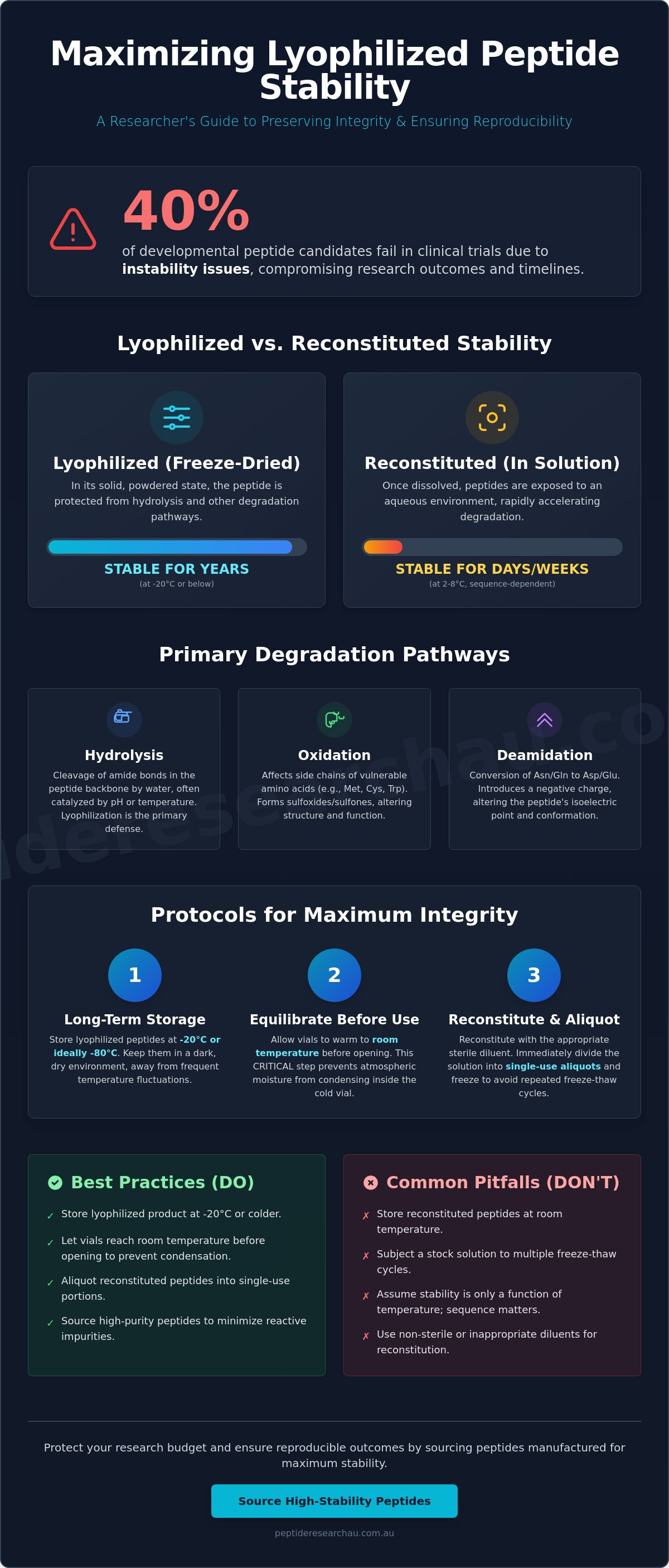
Forty percent of developmental peptide candidates fail during clinical trials specifically because of instability issues. This data point highlights the precarious nature of laboratory research, where environmental factors and chemical composition dictate the success of an entire study. Maintaining lyophilized peptide stability is not merely a matter of refrigeration; it's a complex requirement for ensuring the integrity of your experimental data. You've likely experienced the frustration of seeing expensive research materials degrade or witnessing inconsistent results that compromise your project's timeline.
It's difficult to determine exactly how long samples will maintain potency without a technical understanding of their chemical vulnerabilities. This guide provides a definitive framework for managing peptide preservation to protect your research budget and ensure reproducible outcomes. You'll gain a clear protocol for long-term storage and an understanding of residue-specific vulnerabilities that lead to lost potency. We'll examine why stability is a function of sequence chemistry rather than temperature alone, providing the technical clarity needed for the rigorous handling of research compounds and laboratory diluents according to ICH Q1A(R2) standards.
Key Takeaways
Understand how the lyophilization process arrests hydrolysis to maintain the biological activity and chemical integrity of research peptides.
Identify the primary degradation pathways, including oxidation and hydrolysis, that compromise the integrity of specific amino acid residues.
Implement standardized storage protocols to maximize lyophilized peptide stability and ensure the reproducibility of laboratory data.
Execute precise handling techniques, such as vial equilibration and aliquoting, to prevent moisture contamination and preserve potency.
Evaluate the role of manufacturing purity and TFA removal in extending the functional shelf life of research compounds.
Table of Contents
What is Lyophilized Peptide Stability?
Peptide stability refers to the capacity of a molecular sequence to maintain its specific chemical integrity and biological activity over time. For researchers, lyophilized peptide stability represents the gold standard for preserving these fragile compounds. Without proper stabilization, peptides are highly susceptible to chemical modifications that render them biologically inert. Stability in the solid state is often categorized by thermodynamic and kinetic parameters. While thermodynamic stability relates to the lowest energy state of the molecule, kinetic stability describes the rate at which degradation occurs. Lyophilization effectively traps the peptide in a high-energy kinetic state, preventing the molecular movement required for chemical reactions.
The physical result of this process is a porous cake or powder. This structure provides a high surface area that allows for rapid, uniform reconstitution. A well-formed cake indicates that the peptide was processed correctly, ensuring that the internal structure remains accessible to diluents while minimizing the risk of collapse during storage. A collapsed cake often signals moisture ingress, which compromises lyophilized peptide stability and leads to inconsistent experimental results.
The Science of Freeze-Drying
The process of lyophilization involves removing water through sublimation, which transitions ice directly into vapor. By eliminating the liquid phase, manufacturers prevent the formation of reactive aqueous environments where hydrolysis thrives. A critical factor in this process is the glass transition temperature (Tg). If a peptide cake is stored above its Tg, it may transition from a rigid glassy solid to a rubbery state. This transition increases the vibrational energy of the peptide backbone, significantly accelerating degradation. Maintaining the product below this temperature is essential for long-term storage.
Lyophilized vs. Reconstituted Peptides
There is a profound difference between the shelf life of a solid-state peptide and one that has been solubilized. Once a diluent is introduced, the peptide's half-life begins to decline rapidly. In the lyophilized state, a peptide might remain stable for years at -20°C. Once reconstituted, that same sequence may only remain viable for days or weeks, depending on its specific amino acid composition. Solid-state peptides are the industry standard for shipping and long-term archiving because they resist the environmental stressors encountered during transit. Researchers typically utilize bacteriostatic water during the reconstitution phase to inhibit microbial growth, but this does not prevent the chemical degradation that naturally follows solubilization.
Chemical and Physical Degradation Pathways
Peptides are inherently unstable molecules. Even in a solid state, they remain susceptible to various chemical and physical degradation pathways. These processes can alter the primary sequence or the three-dimensional conformation, leading to a loss of biological activity. Understanding these mechanisms is essential for maintaining lyophilized peptide stability throughout the duration of a study. While the freeze-dried state significantly slows these reactions, it doesn't stop them entirely.
Hydrolysis represents the most significant threat to the peptide backbone. Although lyophilization removes the bulk of the solvent, trace moisture can still facilitate the cleavage of amide bonds. This reaction is often catalyzed by extreme pH levels or high temperatures, resulting in shorter, non-functional fragments. The rate of hydrolysis is sequence-dependent, meaning some research compounds are naturally more fragile than others.
Oxidation typically affects specific side chains rather than the backbone itself. Sulfur-containing amino acids are particularly vulnerable. When these residues interact with oxygen, they can form sulfoxides or sulfones, which may prevent the peptide from binding to its intended target. Researchers sourcing high-quality research peptides should prioritize batches with verified purity to minimize the presence of reactive impurities that accelerate these oxidative processes.
Deamidation involves the conversion of asparagine or glutamine residues into aspartic or glutamic acid. This modification introduces a negative charge to the molecule. Such a shift in the isoelectric point can drastically alter the peptide's solubility and binding affinity. Physical aggregation is another concern, where peptides undergo irreversible self-association. This creates insoluble clumps that cannot be effectively reconstituted, rendering the sample useless for laboratory study.
Residue-Specific Vulnerabilities
Certain amino acids act as weak links in a sequence. Cysteine and methionine are highly prone to oxidative transformation, often requiring nitrogen or argon purging during vial sealing to ensure long-term integrity. Tryptophan is sensitive to photolysis, meaning light exposure can trigger degradation even in a dry cake. Asparagine and glutamine residues are susceptible to deamidation, a process that is highly dependent on the local pH and the identity of the adjacent amino acid residues in the sequence.
The Role of Residual Moisture
No lyophilization process is absolute. Most commercial peptide cakes contain between 1% and 3% residual water. While this level is generally acceptable, it provides enough molecular mobility for chemical reactions to proceed slowly over time. Hygroscopic peptides naturally attract more moisture from the environment if exposed. If the vial seal is compromised, this ingress can degrade the vacuum integrity and cause the cake to collapse, severely impacting lyophilized peptide stability.
Optimising Storage Conditions: Temperature and Environment
Temperature control is the primary defense against the degradation pathways discussed in previous sections. While lyophilization significantly reduces molecular mobility, thermal energy still drives the chemical reactions that compromise lyophilized peptide stability. Establishing a rigorous storage protocol based on the intended duration of the study is essential for maintaining sample integrity and ensuring reproducible data. Kinetic reactions, though slowed in a solid state, are never completely halted without extreme thermal suppression.
Standard laboratory practice dictates that peptides should be stored at -20°C for most medium-term applications. This temperature sufficiently slows down the kinetic energy within the peptide cake to prevent significant degradation for several months. For long-term archiving, which may span several years, researchers must utilize ultra-low temperature freezers set to -80°C. These conditions provide the highest level of protection against deamidation and hydrolysis by nearly eliminating the vibrational energy of the peptide backbone.
One of the most overlooked risks in laboratory environments is the use of 'frost-free' freezers. These units utilize periodic heating cycles to prevent ice buildup, causing internal temperatures to fluctuate by several degrees. Such cycles promote the movement of residual moisture within the vial, which can lead to cake collapse and irreversible chemical damage. Consistent, non-cycling temperatures are required to preserve the quality of research compounds and multi-peptide complexes.
Temperature Matrix for Research Peptides
According to Bachem's peptide handling and storage guidelines, the following temperature thresholds apply to most sequences:
Room Temperature (20-25°C): Suitable only for short-term shipping or immediate use within 48 to 72 hours.
Refrigerated (4°C): Provides adequate stability for 1 to 3 months for most sequences, provided they are kept away from light.
Deep Freeze (-20°C to -80°C): The industry standard for long-term storage, ensuring integrity for 12 to 48 months.
Environmental Factors in Australia
The Australian climate presents unique challenges for maintaining lyophilized peptide stability. High ambient humidity, particularly during the summer months in northern regions, increases the risk of moisture ingress if vial seals aren't meticulously maintained. Additionally, extreme UV exposure in laboratory settings can trigger photolysis in sensitive residues like tryptophan.
Shipping logistics also require careful consideration. High-quality peptides in Australia must be transported in temperature-controlled packaging to avoid the degradation associated with heat spikes during domestic transit. Researchers should always verify that their laboratory diluents and samples are shielded from direct sunlight during benchtop handling to prevent light-induced chemical shifts.
Handling Protocols to Maximize Peptide Integrity
Precise handling is the final safeguard for maintaining lyophilized peptide stability during active laboratory use. Most degradation events occur during the transition from storage to the benchtop. Atmospheric moisture is the primary catalyst for hydrolysis in this context. When a cold vial is opened in a warmer environment, ambient humidity condenses on the surface of the peptide cake. This ingress of water provides the necessary molecular mobility for chemical reactivity, even if the vial is immediately returned to the freezer.
Preventing cross-contamination is equally vital in shared laboratory environments. Aerosolized particles or contaminated pipette tips can introduce proteolytic enzymes or microbes that rapidly degrade research compounds. Researchers should utilize dedicated workspace areas and sterile equipment for all peptide manipulations. To further ensure long-term integrity, vials should be sealed with Parafilm and, when possible, purged with an inert gas blanket such as Argon or Nitrogen before storage. This displaces oxygen and moisture, creating a stable internal environment for multi-peptide complexes.
Step-by-Step Equilibration Protocol
To prevent condensation, researchers must follow a strict equilibration protocol before opening any lyophilized sample:
Remove the vial from the -20°C or -80°C freezer.
Place the sealed vial inside a desiccator at room temperature.
Wait 30 to 60 minutes to allow the vial to reach ambient temperature (20-25°C).
Perform a visual inspection of the cake; it should appear as a solid, porous mass without signs of shrinkage or discoloration.
Only after these steps are complete should the cap be removed for reconstitution or aliquoting.
Aliquoting Strategy for Multiple Experiments
The 'freeze-thaw' trap is a significant risk to the peptide backbone. Repeatedly opening a single vial and returning it to the freezer causes thermal fluctuations that degrade the sequence over time. Standardizing lab protocols involves calculating the total mass needed for each research phase and dividing the bulk sample into single-use portions. This strategy is essential for sensitive sequences like TB-500, where maintaining high potency is critical for experimental reproducibility. By aliquoting the dry powder into multiple vials, you ensure that each sample only undergoes a single warming cycle.
To ensure your laboratory work is supported by the highest standards of manufacturing, you can order high-purity research peptides specifically designed for long-term stability.
Sourcing High-Stability Peptides in Australia
The foundation of lyophilized peptide stability is established long before a vial reaches the laboratory freezer. While storage and handling protocols are vital, they cannot compensate for poor manufacturing standards. Chemical impurities remaining from the synthesis process often act as catalysts for the degradation pathways discussed in previous sections. High-purity research peptides ensure that the experimental results are a reflection of the peptide's biological activity rather than the influence of residual contaminants.
Trifluoroacetic acid (TFA) removal is a critical factor in enhancing the functional shelf life of these compounds. TFA is commonly used as an ion-pairing agent during HPLC purification. If it's not effectively removed, the residual acid can lower the local pH within the peptide cake. This acidic environment significantly accelerates hydrolysis and deamidation over time. Professional sourcing involves ensuring that TFA levels are minimized, providing a more stable environment for the peptide backbone during long-term archiving.
Domestic shipping within Australia requires a provider that understands the necessity of cold-chain integrity. Given the extreme thermal peaks encountered during transit, research compounds must be dispatched in validated, temperature-controlled packaging. This ensures that the kinetic energy of the molecules remains suppressed from the moment of manufacture until the point of laboratory delivery.
Quality Indicators for Researchers
Meticulous researchers should always demand comprehensive documentation to verify the integrity of their materials. High-Performance Liquid Chromatography (HPLC) and Mass Spectrometry (MS) reports are essential for confirming both purity levels and molecular identity. A purity threshold of 99% is the industry standard for reliable research data. Anything less introduces unknown variables that can compromise the reproducibility of a study. Additionally, the physical state of the vial provides immediate clues to its quality. Professional vacuum sealing and the use of high-grade borosilicate glass prevent moisture ingress and light-induced degradation, further securing lyophilized peptide stability.
The Peptide Research AU Standard
Peptide Research AU provides laboratory-grade compounds specifically synthesized for rigorous scientific study. Our commitment to excellence involves strict adherence to purity standards and the use of professional-grade packaging to protect the chemical integrity of every sample. We provide technical support for researchers managing complex PT-141 or GHK-Cu protocols, ensuring that your handling techniques align with the specific requirements of each sequence. By prioritizing manufacturing excellence and logistical reliability, we help you maximize your research budget through extended product shelf life.
To secure high-quality materials for your next study, browse our range of high-purity research peptides and laboratory diluents.
Advancing Research Through Technical Precision
Maintaining the integrity of your research requires a meticulous approach to every stage of the study. By implementing standardized equilibration protocols and utilizing deep-freeze storage, you directly mitigate the chemical and physical degradation pathways that compromise molecular activity. Mastery of lyophilized peptide stability ensures that your data remains reproducible and your laboratory resources are maximized. Don't let avoidable degradation compromise your findings; success in the lab begins with a commitment to these technical standards, from the moment of sourcing to the final reconstitution.
Peptide Research AU supports your objectives by providing materials that meet laboratory-grade purity standards. Every batch undergoes independent HPLC/MS testing to confirm identity and sequence integrity. We facilitate your project timelines with discreet domestic Australian shipping, ensuring that your research compounds and multi-peptide complexes arrive in optimal condition. Shop Laboratory-Grade Research Peptides in Australia to ensure your next study is built on a foundation of chemical excellence.
Precision in handling leads to excellence in discovery.
Frequently Asked Questions
How long do lyophilized peptides last at room temperature?
Lyophilized peptides typically remain stable at room temperature for a period of one to four weeks. This window is sufficient for standard shipping and immediate laboratory preparation. However, extended exposure to ambient temperatures facilitates kinetic energy transfer, which gradually increases the rate of chemical degradation. For any duration exceeding 30 days, researchers should transition the samples to a refrigerated or frozen environment to maintain molecular integrity.
Can I store my research peptides in a standard kitchen freezer?
Standard kitchen freezers are unsuitable for research storage because they utilize frost-free cycles. These cycles cause internal temperatures to fluctuate significantly to prevent ice accumulation. Such variations promote the movement of residual moisture within the vial, which can lead to cake collapse. A dedicated laboratory freezer with a manual defrost setting is required to ensure consistent thermal conditions and preserve the peptide's primary structure.
Why did my peptide cake collapse or turn into a gel?
A collapsed or gel-like appearance usually indicates moisture ingress or exposure to temperatures exceeding the glass transition point. When the peptide cake absorbs water from the atmosphere, it loses its porous structure and undergoes physical transition. This change often signals that lyophilized peptide stability has been compromised. Once a cake has collapsed, the peptide becomes difficult to reconstitute and its biological activity is likely reduced.
Is it necessary to use an inert gas like Argon for sealing vials?
Sealing vials with an inert gas like Argon or Nitrogen is highly recommended for sequences containing sulfur-bearing residues. These gases displace atmospheric oxygen and moisture, which are the primary drivers of oxidation and hydrolysis. While it's a standard practice for all high-grade research compounds, it's particularly critical for peptides containing cysteine or methionine. This method provides an additional layer of protection against environmental stressors during long-term storage.
How many freeze-thaw cycles can a lyophilized peptide survive?
Research peptides should ideally undergo zero freeze-thaw cycles after the initial storage. Each transition from frozen to ambient temperature introduces the risk of condensation and increases the vibrational energy of the peptide backbone. To avoid this, researchers should aliquot the dry powder into single-use portions. This strategy ensures that each sample is only warmed once, effectively bypassing the cumulative damage associated with repeated thermal cycling.
What are the signs that a peptide has degraded?
Physical indicators of degradation include discoloration, shrinkage of the cake, or the presence of insoluble particulates upon reconstitution. However, chemical degradation isn't always visible to the naked eye. Significant shifts in potency or biological activity are often only detectable through analytical methods such as HPLC or Mass Spectrometry. If a sample fails to dissolve completely or shows unexpected yellowing, its chemical integrity is likely compromised.
Does light exposure affect lyophilized peptide stability?
Light exposure can trigger photolysis, particularly in peptides containing aromatic residues like tryptophan. This process occurs even in the lyophilized state if the vials are exposed to high-intensity UV or fluorescent lighting. To prevent light-induced chemical modifications, researchers should store vials in amber glass or opaque containers. Maintaining a dark environment is a fundamental requirement for ensuring lyophilized peptide stability over multi-year archiving periods.
Should I reconstitute the entire vial at once?
Reconstituting an entire vial is only recommended if the total volume will be consumed within the peptide's specific solution-state stability window. Most peptides degrade much faster once a diluent is introduced compared to their solid-state form. If your study requires multiple dosing phases over several weeks, it's more efficient to aliquot the lyophilized powder. This approach preserves the majority of the sample in its most stable form until it's needed.


Comments