

Research Peptides: The Definitive Laboratory Guide for 2026
- peptideresearchau
- May 15
- 12 min read
Within a laboratory landscape where molecular integrity defines the success of every study, a 0.5% variance in purity can compromise months of data. Achieving reproducible results requires absolute certainty in the chemical composition of your reaserch peptides. You likely recognize the frustration of deciphering ambiguous COA reports or waiting weeks for international shipments that arrive with degraded stability. These variables introduce unacceptable noise into sensitive biochemical assays and hinder the progression of meticulous scientific study.
This guide provides the technical framework necessary to master the handling and verification of high-purity compounds within the Australian regulatory environment. You'll gain a clear understanding of HPLC-verified purity standards, precise reconstitution protocols, and the logistical advantages of a domestic supply chain. We'll examine the methodologies required to ensure your laboratory maintains the highest level of scientific rigor while managing the complexities of modern peptide synthesis and laboratory handling.
Key Takeaways
Define the biochemical role of peptides as signaling sequences and understand the legal necessity of the "Research Only" designation within a laboratory context.
Identify the technical roles of HPLC and Mass Spectrometry in verifying the exact molecular weight and purity of reaserch peptides.
Assess the logistical advantages of domestic Australian sourcing to ensure compound stability and avoid the degradation risks inherent in international transit.
Execute advanced reconstitution protocols using bacteriostatic water and gentle handling techniques to preserve the structural integrity of delicate amino acid chains.
Adopt a multi-stage verification framework that utilizes third-party testing to guarantee the highest standards of laboratory-grade excellence for all research compounds.
Table of Contents
Defining Research Peptides in the 2026 Scientific Landscape
Peptides represent a fundamental class of signaling molecules composed of short-chain amino acid sequences. These molecules are linked by covalent amide bonds, typically ranging from two to fifty amino acids in length. In a controlled laboratory environment, reaserch peptides serve as high-precision tools for investigating complex cellular communication and biological pathways. Their primary function involves binding to specific cell surface receptors to trigger targeted intracellular responses. This specificity allows scientists to isolate and study individual physiological processes with extreme accuracy.
Every compound discussed within this framework carries a strict "Research Only" designation. This classification is vital for maintaining the integrity of scientific data. These chemicals are not finished consumer products and are not for human consumption or therapeutic use. The designation ensures that the substances remain within the domain of in vitro testing and animal model studies. By 2026, regulatory oversight has intensified, making it essential for laboratories to document the intended scientific application of every compound in their inventory. Using these substances outside of a professional research context compromises both safety and the validity of the resulting data.
The field of chemical peptide synthesis has evolved rapidly, leading to the high-purity standards available in 2026. Modern solid-phase peptide synthesis (SPPS) now utilizes advanced automation and real-time monitoring to minimize sequence errors. These technological leaps allow for the production of highly stable compounds that facilitate the study of metabolic regulation and tissue regeneration. Researchers use these molecules to map the intricate signaling involved in wound healing, muscle protein synthesis, and neuroprotection.
The Molecular Architecture of Peptides
The structural stability of a peptide depends on its molecular architecture. The peptide bond itself is a rigid, planar linkage that determines how the molecule folds and interacts with its target. Sequence length is a primary factor in synthesis complexity. As the chain grows, the risk of "deletion sequences" increases, requiring more rigorous purification. Researchers often choose between linear and cyclic variants depending on the study's requirements. Cyclic peptides, which feature a closed-loop structure, offer superior resistance to proteolytic degradation. This structural modification is often necessary when studying long-term biological interactions where a linear sequence would break down too quickly.
Current Trends in Global Peptide Research
Scientific interest in 2026 is increasingly focused on multi-peptide complexes and synergistic formulations. Rather than studying a single isolated molecule, researchers are examining how combinations of reaserch peptides mimic natural biological environments. Triple agonist peptides are a significant area of focus. These compounds target three distinct receptor pathways simultaneously to study complex metabolic disorders. For those requiring a baseline definition of these molecules, our resource on what are peptides provides a foundational overview. Additionally, mitochondrial-targeted peptides have emerged as essential tools for investigating cellular energy production and aging at the organelle level.
Evaluating Peptide Purity: HPLC and Mass Spectrometry Explained
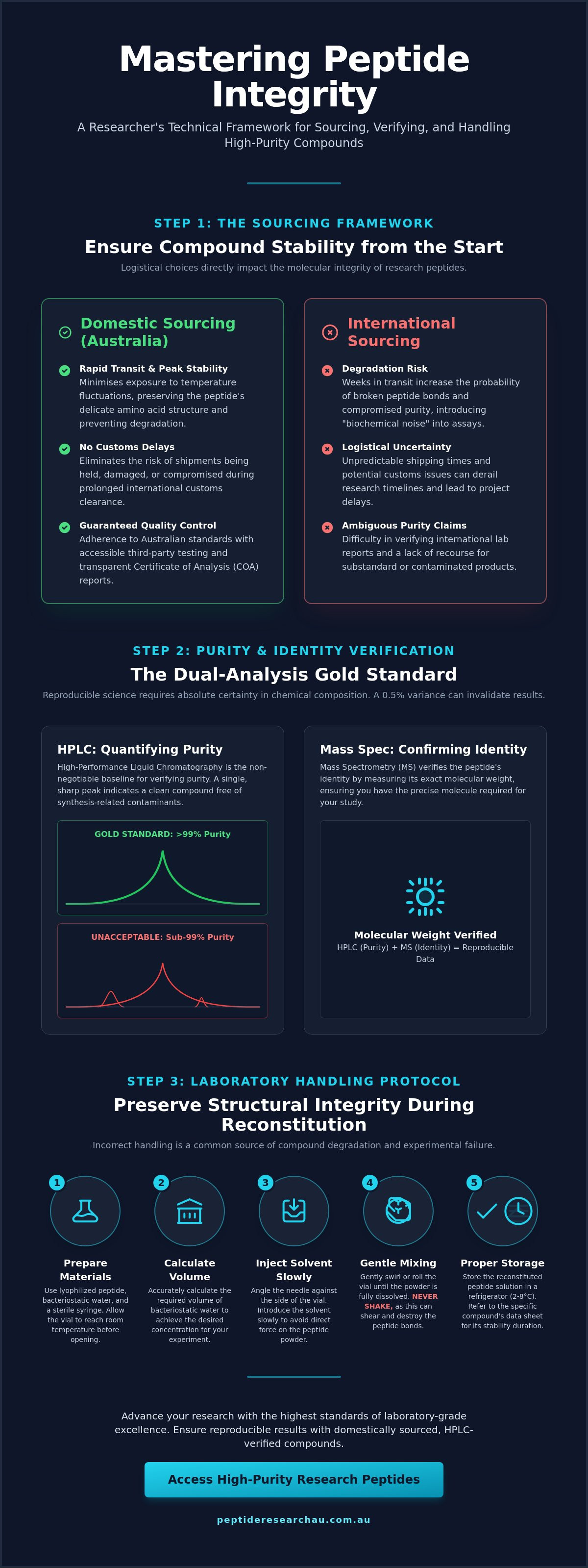
High-performance liquid chromatography (HPLC) serves as the primary analytical tool for assessing the chemical excellence of reaserch peptides. This method ensures that the synthesized sequence matches the intended design without significant contamination. HPLC is the process of separating components in a mixture to verify purity levels. While many providers claim high quality, a 99% purity rating is the non-negotiable baseline for generating reproducible scientific data. Anything less introduces biochemical noise that can invalidate months of laboratory work.
While HPLC measures purity, Mass Spectrometry (MS) confirms identity. It calculates the mass-to-charge ratio of ionized particles to determine the exact molecular weight of the compound. This dual-verification approach, often referred to as Peptide Purity Analysis via HPLC and Mass Spectrometry, ensures that the vial contains the correct sequence rather than a structurally similar byproduct. Without MS data, a researcher cannot be certain the reaserch peptides in the vial match the specific sequence ordered.
Low-grade synthesis often leaves behind residual substances that interfere with sensitive biological assays. These contaminants are not merely inert fillers; they are active chemical agents. Common impurities include:
Trifluoroacetic acid (TFA): A counter-ion used during synthesis that can be cytotoxic in high concentrations, potentially killing the very cells under study.
Residual solvents: Acetonitrile or other reagents that haven't been fully removed through lyophilization.
Atmospheric moisture: Excess water weight that skews dosage calculations and accelerates peptide degradation.
Truncated sequences: Incomplete peptide chains that may bind to receptors and produce incorrect or inhibitory signals.
How to Interpret a Certificate of Analysis (COA)
A legitimate COA must display a clear, high-resolution HPLC chromatogram. Scientists should identify the primary peak; the area under this curve represents the total purity percentage. Compare the theoretical mass, which is the calculated weight based on the amino acid sequence, against the actual mass found via MS. Discrepancies larger than 1 Dalton suggest synthesis errors. Red flags in these reports include redacted laboratory names, missing testing dates, or blurry graphs that appear to be photocopied. These inconsistencies suggest the data may not belong to the specific batch in question.
The Impact of Impurities on Research Integrity
Impurities frequently cause off-target effects, leading to false positives or unexpected toxicity in laboratory models. This is particularly damaging in longitudinal studies where batch-to-batch consistency is vital. If the impurity profile changes between orders, the experimental results will fluctuate, making it impossible to draw valid conclusions. For researchers demanding absolute precision, sourcing HPLC-verified research compounds is the only way to ensure the integrity of the experimental environment.
Sourcing Research Peptides in Australia: A Supplier Framework
Procuring reaserch peptides within the Australian territory requires a meticulous evaluation of supplier logistics and regulatory compliance. The primary challenge for laboratory managers involves balancing the need for high-purity compounds with the physical stability of the molecules during transit. Lyophilized peptides are inherently sensitive to thermal fluctuations; prolonged exposure to ambient temperatures during shipping can trigger premature degradation. Utilizing a domestic supplier framework mitigates these risks by shortening the logistics chain and ensuring that compounds remain within controlled environments from synthesis to delivery.
As of March 2026, the Australian regulatory landscape has become increasingly complex. Most injectable peptides are classified as Schedule 4 substances under the Poisons Standard. The Therapeutic Goods Administration (TGA) issued updated warnings in May 2026 regarding the safety risks of unapproved peptides. These regulations emphasize that possession or supply without valid authorization carries significant legal penalties. In New South Wales, for instance, illegal possession can result in a $2,200 fine or six months imprisonment. In the Australian Capital Territory, penalties reach up to $66,000 or two years imprisonment. Researchers must ensure their procurement processes align with these stringent legal requirements to maintain laboratory standing.
Domestic vs. International Procurement
The choice between domestic and international sourcing directly impacts research timelines and specimen viability. International procurement typically involves transit times of 14 to 21 days. During this window, packages often sit in unconditioned customs facilities, exposing reaserch peptides to heat that compromises their molecular structure. Furthermore, the Australian Border Force (ABF) continues to seize unapproved products imported via the Personal Importation Scheme. In contrast, domestic sourcing reduces transit to 2 or 3 days. This rapid turnaround ensures the "cold chain" remains intact. For a deeper analysis of these requirements, consult our guide on peptides australia to understand the necessary sourcing standards for 2026.
Verification Checklist for Australian Suppliers
Reliable suppliers must demonstrate a commitment to clinical precision and data transparency. A robust verification process includes the following criteria:
Third-Party Validation: Every batch must be accompanied by independent HPLC and Mass Spectrometry reports to confirm the 99% purity standard discussed in previous sections.
Laboratory Diluents: Suppliers should provide access to sterile laboratory diluents, such as bacteriostatic water, to ensure proper reconstitution.
Specialized Packaging: Sensitive compounds require "temperature-safe" vacuum-sealed packaging and insulated shipping containers.
Direct Support: A domestic presence allows for technical consultation regarding batch-specific data or logistical inquiries.
Maintaining these standards prevents the introduction of experimental variables that could skew sensitive data. By prioritizing domestic logistics and rigorous verification, researchers can focus on the scientific objectives of their study rather than the uncertainties of the supply chain.
Laboratory Protocols: Reconstitution, Storage, and Handling
Adhering to rigorous laboratory protocols is essential for maintaining the molecular integrity of reaserch peptides. These compounds are highly susceptible to physical and thermal stress. In the Australian context, environmental factors like ambient heat and UV exposure represent significant risks to specimen stability. Protecting vials from direct light and maintaining a strict temperature-controlled environment is mandatory to prevent peptide bond cleavage before research begins. Every step of the handling process must prioritize the preservation of the compound's primary structure.
The "Australian Heat Factor" is a critical consideration for local laboratories. Ambient temperatures in many Australian regions often exceed the stability threshold for lyophilized powders. Even short periods of exposure during laboratory preparation can trigger degradation. Researchers should work in climate-controlled environments and ensure that vials are returned to cold storage immediately after use. This meticulous attention to detail prevents the introduction of experimental noise caused by degraded or inactive molecules.
The Reconstitution Process
Reconstitution is the process of returning a lyophilised peptide to its liquid state for research use. This procedure requires sterile conditions and precise execution. Begin by sanitising the vial stopper and the diluent container with 70% isopropyl alcohol. Use bacteriostatic water as the primary diluent to inhibit bacterial growth during the study period. When introducing the liquid, manage the vacuum effect by allowing the diluent to flow slowly down the internal wall of the vial. You should never drop the liquid directly onto the lyophilised powder cake. Once the diluent is added, use the "Gentle Swirl" method to facilitate dissolution. Vigorous shaking is prohibited. The mechanical force of shaking can destroy delicate peptide bonds and render the reaserch peptides biologically inactive.
Long-term Stability and Degradation
Optimal storage temperatures are critical for long-term specimen viability. Lyophilised powders should be stored at -20°C to ensure stability for extended periods. Once reconstituted, the solution must be kept at 4°C and used within a specific timeframe, typically 14 to 28 days depending on the specific sequence. You must avoid multiple freeze-thaw cycles. Repeated temperature shifts cause ice crystal formation that physically shears the peptide chains. Use desiccant packs in storage containers to prevent moisture-induced degradation, as humidity can compromise the vacuum seal over time. Specific handling protocols vary by molecule; for instance, the structural requirements for TB-500 necessitate precise temperature management to maintain biological signaling potency.
For researchers requiring high-purity compounds and laboratory diluents, maintaining these strict handling protocols ensures the highest level of data accuracy and experimental reproducibility.
Advancing Science with Peptide Research AU
Peptide Research AU maintains a rigorous commitment to laboratory-grade excellence for the 2026 scientific community. Our operational framework centers on the "Triple-Check" purity protocol. This methodology involves three distinct layers of verification: initial synthesis validation, internal quality control (QC), and final third-party analysis. By implementing this hierarchical structure, we ensure that every vial of reaserch peptides meets the 99% purity standard required for valid biochemical study. This level of oversight eliminates the ambiguity often associated with international grey-market suppliers and provides researchers with the data certainty they require.
Reliability extends beyond chemical composition to the physical delivery of compounds. We utilize discrete, temperature-optimised shipping protocols tailored specifically for the Australian climate. Every order is packaged to resist thermal degradation, ensuring that lyophilised powders arrive with their molecular stability intact. This logistical precision allows researchers to initiate studies immediately upon receipt, without concerns regarding transit-induced structural damage. Our domestic supply chain effectively removes the risks of customs seizures and prolonged exposure to unconditioned environments.
Our Testing Rigour
Precision is not an elective attribute in laboratory research; it's a fundamental requirement. We only partner with synthesis facilities that adhere to ISO 9001 manufacturing standards. This international certification guarantees that every step of the production process follows documented, repeatable protocols. Transparency is a core value of our operations. Every batch is accompanied by a downloadable HPLC and Mass Spectrometry report. These documents provide the raw data necessary for researchers to verify batch numbers and synthesis dates independently. By providing this level of detail, we empower scientists to maintain full control over their experimental variables and uphold the highest standards of research integrity.
A Partner in Australian Scientific Innovation
We provide the foundational compounds necessary for next-generation metabolic and regenerative research. Our extensive inventory includes high-purity reaserch peptides such as BPC-157, TB-500, and PT-141. These compounds are specifically synthesized for professional laboratory use and are not for human consumption. We support the Australian research community by offering technical guides and high-grade laboratory supplies that facilitate accurate data collection. This commitment to the AU scientific sector ensures that local researchers have a dependable domestic partner for their procurement needs. By sourcing through a verified domestic channel, laboratories can ensure their focus remains on scientific discovery rather than logistical troubleshooting.
Explore our full range of research-grade peptides to secure HPLC-verified compounds for your next laboratory study.
Advancing Laboratory Standards in 2026
Achieving valid scientific outcomes requires a synthesis of molecular purity and meticulous handling. You've seen how HPLC and Mass Spectrometry data provide the necessary certainty for complex assays. Sourcing these reaserch peptides through a domestic Australian framework eliminates the variables of international transit and ensures compliance with 2026 regulatory standards. Maintaining these high standards is the only way to produce data that stands up to peer review and advances our collective understanding of biological signaling.
Peptide Research AU remains committed to providing the foundational tools for scientific innovation. We offer HPLC and Mass Spec verified batches to guarantee the integrity of your laboratory study. Our logistics network provides fast domestic Australian shipping to protect specimens from thermal degradation. All transactions are protected by a secure 256-bit encrypted checkout to ensure operational security. Your commitment to scientific rigor deserves a partner that values precision as much as you do. We're here to support the next generation of Australian scientific breakthroughs.
Procure High-Purity Research Peptides from Peptide Research AU
Frequently Asked Questions
Are research peptides legal to buy in Australia for laboratory use?
Research peptides are legal for purchase in Australia exclusively for laboratory and scientific study. Under the Poisons Standard, many of these compounds are classified as Schedule 4 substances, meaning they require specific authorization for possession. They are strictly not for human consumption or therapeutic use. Researchers must ensure their procurement aligns with current TGA regulations to maintain legal compliance within a professional institutional or laboratory setting.
How should I store my peptides to ensure maximum shelf life?
Optimal storage requires maintaining lyophilized reaserch peptides at -20°C for long-term stability. This temperature prevents the degradation of the amino acid chains and preserves the compound's integrity for up to 24 months. For short-term use or once reconstituted, the vials should be kept at 4°C. Always store vials in a dark environment to prevent UV-induced bond cleavage and use desiccant packs to minimize moisture exposure.
What is the difference between lyophilized powder and reconstituted peptides?
Lyophilized powder is the freeze-dried, stable state of the compound intended for long-term storage. Reconstituted peptides are those that have been returned to a liquid state using a sterile diluent for active laboratory application. While the powder form is resistant to thermal stress, the liquid form is highly sensitive and begins to degrade within weeks. Reconstitution should only occur immediately prior to the start of a research protocol.
How can I verify the purity of a peptide batch from Peptide Research AU?
You can verify the purity of every batch by downloading the specific HPLC and Mass Spectrometry reports available on our platform. These documents provide a transparent analysis of the molecular weight and purity percentage of our reaserch peptides. By matching the batch number on your vial to the corresponding laboratory report, you can confirm that the compound meets the 99% purity threshold required for reproducible scientific data.
Does Peptide Research AU provide international shipping or only domestic?
Peptide Research AU focuses exclusively on domestic Australian shipping to ensure the highest level of compound stability. International transit introduces unacceptable risks, including prolonged exposure to ambient heat and potential seizure by the Australian Border Force. By maintaining a domestic supply chain, we provide a 2 to 3 day delivery window. This rapid transit ensures that temperature-sensitive compounds remain within stable parameters from our facility to your laboratory.
What is the recommended diluent for reconstituting research peptides?
Bacteriostatic water is the standard recommended diluent for most research applications. This solution contains 0.9% benzyl alcohol, which acts as a preservative to inhibit the growth of bacteria within the vial. Using sterile water without a bacteriostatic agent increases the risk of contamination, which can compromise the results of in vitro or in vivo studies. Always ensure the diluent is at room temperature before introduction to the vial.
Can I use a standard refrigerator for peptide storage, or is a lab freezer required?
A standard refrigerator is suitable for storing reconstituted peptides at 4°C, but a laboratory-grade freezer is required for long-term storage at -20°C. Standard domestic freezers often undergo auto-defrost cycles that cause temperature fluctuations. These freeze-thaw cycles can physically damage the peptide structure. For maximum shelf life and data consistency, we recommend a dedicated laboratory freezer that maintains a constant, monitored temperature without cyclical warming.


Comments