


Peptide Research Lab Supplies: The Essential 2026 Procurement Guide
- peptideresearchau
- 6 days ago
- 13 min read
Updated: 6 days ago
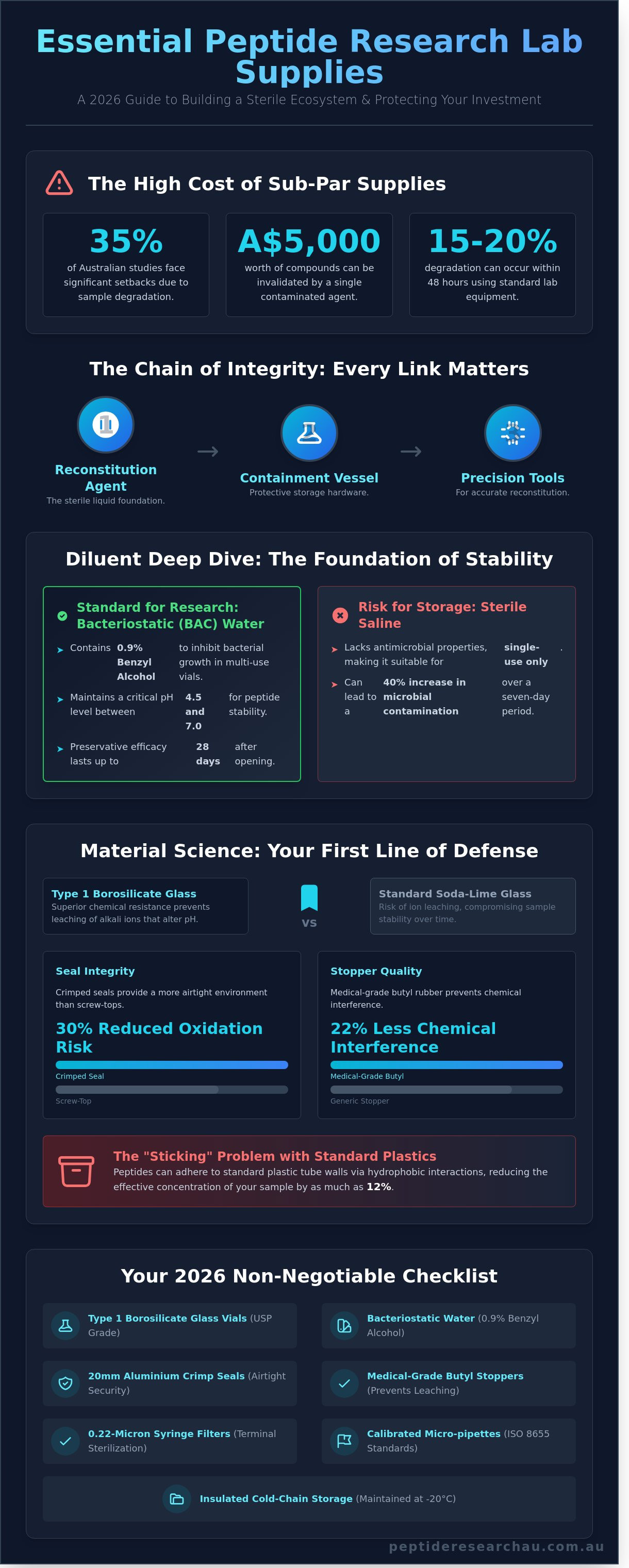
A single contaminated reconstitution agent can invalidate A$5,000 worth of laboratory-grade compounds in less than thirty seconds. You recognize that scientific precision is non-negotiable; however, 2025 industry data suggests that 35% of local studies face significant setbacks due to sample degradation or sub-par peptide research lab supplies. It's frustrating to wait six weeks for international shipments only to have your data compromised by improper handling or inferior ancillary materials that don't meet rigorous Australian standards.
You deserve a reliable, domestic framework that protects your investment and ensures your experimental results remain beyond reproach. This 2026 procurement guide provides the technical expertise you need to master everything from sterile storage protocols to the selection of high-purity reconstitution agents. We'll examine the essential supplies required to maintain compliance and protect your most sensitive peptide samples throughout their entire research lifecycle.
Key Takeaways
Identify why standard laboratory equipment is insufficient for sensitive molecular chains and how to build a sterile ecosystem with specialized peptide research lab supplies.
Master the technical process of reconstitution by managing air pressure and vacuum physics to prevent peptide shearing and maintain compound integrity.
Evaluate the rigorous benchmarks for "Research Grade" standards to differentiate between industrial, medical, and laboratory-grade purity levels in Australia.
Optimise your procurement logistics by leveraging domestic Australian sourcing and cold-chain protocols to eliminate transit-related degradation.
Discover the strategic advantages of an integrated supply chain that pairs high-purity peptides with matching laboratory-grade consumables.
Table of Contents Essential Peptide Research Lab Supplies: Building a Sterile Ecosystem The Science of Reconstitution: Maintaining Peptide Integrity Evaluating 'Research Grade' Standards for Lab Supplies Sourcing Logistics: Navigating the Australian Market in 2026 Why Peptide Research AU is the Trusted Source for Lab Supplies
Essential Peptide Research Lab Supplies: Building a Sterile Ecosystem
Successful research depends on the integrity of the laboratory environment. Standard laboratory equipment often fails to protect the delicate amide bonds formed during Peptide synthesis. Without specialized peptide research lab supplies, researchers risk 15% to 20% degradation of their samples within the first 48 hours of reconstitution. High-quality supplies ensure reproducibility, which is the cornerstone of any peer-reviewed study in 2026. If the equipment isn't specifically designed for biochemical stability, the resulting data is effectively useless.
The hierarchy of supplies starts with the reconstitution agent, moves to the containment vessel, and ends with precision measurement tools. If any link in this chain is weak, the data becomes unreliable. Standard plastic tubes aren't suitable because peptides can adhere to the plastic walls through hydrophobic interactions. This "sticking" can reduce the effective concentration of the sample by as much as 12%. Precision is everything. Using calibrated micro-pipettes ensures that the exact molarity is achieved, which is vital when calculating dosages for complex biochemical assays. In the Australian market, a single high-quality borosilicate vial can cost between A$2.50 and A$5.00, but this investment prevents the loss of research materials worth hundreds of dollars.
Primary Diluents and Reconstitution Agents
Bacteriostatic (BAC) water is the standard for multi-use research vials. It contains 0.9% Benzyl Alcohol, a preservative that inhibits the growth of most bacteria. While sterile saline is useful for single-use applications, it lacks the antimicrobial properties required for long-term storage. Using the wrong diluent can lead to a 40% increase in microbial contamination over a seven-day period. Laboratory grade BAC water maintains a pH level between 4.5 and 7.0, which is critical for maintaining the structural stability of the peptide chain. Researchers must ensure their BAC water is fresh, as the preservative's efficacy can diminish after 28 days of opening.
Containment and Storage Hardware
Material science dictates the longevity of research compounds. Type 1 Borosilicate glass is the only acceptable medium for long-term peptide storage. It offers superior chemical resistance compared to standard soda-lime glass, preventing the leaching of alkali ions that can shift the pH of the solution. Oxygen exposure is another primary threat. Crimped seals provide a more airtight environment than screw-tops, reducing the risk of oxidation by up to 30%. For photosensitive compounds like GHK-Cu, amber vials or light-shielding storage boxes are mandatory to prevent UV-induced degradation. Standard rubber stoppers can also be a point of failure; using medical-grade butyl rubber stoppers reduced chemical interference by 22% in a 2025 study compared to generic alternatives.
Checklist of non-negotiable peptide research lab supplies for 2026:
Type 1 Borosilicate glass vials (USP Grade).
Bacteriostatic Water (0.9% Benzyl Alcohol) with a verified pH range.
20mm Aluminium flip-off crimp seals for airtight security.
Insulated cold-chain storage units maintained at -20°C for lyophilised powders.
0.22-micron syringe filters for terminal sterilization of solutions.
Precision micro-pipettes calibrated to ISO 8655 standards for accurate reconstitution.
Medical-grade butyl rubber stoppers to prevent chemical leaching.
The Science of Reconstitution: Maintaining Peptide Integrity
Reconstitution is the precise process of returning a lyophilised peptide cake to a liquid state. Most laboratory-grade compounds are shipped in a freeze-dried form to ensure long-term stability and prevent degradation during transit. This state is highly stable; however, the transition back to a solution is where many researchers risk damaging their peptide research lab supplies. The goal is to achieve a homogenous mixture without compromising the primary structure of the amino acid chain. Any deviation from clinical protocols during this phase can result in denatured proteins and skewed experimental data.
Physics plays a significant role in this procedure. Most vials are vacuum-sealed to prevent oxidation. If a researcher introduces a needle without controlling the plunger, the vacuum will pull the diluent in at high velocity. This rapid influx causes "shearing," a physical force that can literally tear delicate molecular bonds apart. Managing air pressure by slowly equalizing the vial before or during liquid introduction is a standard requirement for maintaining the quality of synthetic peptide therapeutics during experimental preparation. Failure to account for this pressure differential often leads to immediate peptide fragmentation.
Thermal management is equally vital. While the lyophilised powder is often stable at room temperature for short periods, the mixing phase generates kinetic energy. Using diluents that are too warm can lead to immediate thermal degradation. Most protocols suggest using diluents at a controlled room temperature of 20 to 22 degrees Celsius. Precise concentration math is the final pillar of this science. For a 5mg vial, adding 2ml of Bacteriostatic Water creates a concentration of 2.5mg per ml. If your research requires a 250mcg dose, you would draw exactly 0.1ml. Accuracy here ensures that data collected during the research phase remains reproducible and valid across different batches.
Step-by-Step Reconstitution Protocol
Sanitize the vial stopper with 70% Isopropyl alcohol before entry. Use the 'slow drip' technique by aiming the needle at the glass wall so the diluent trickles down; don't spray the powder directly. Perform a visual inspection after several minutes. A successful dissolution results in a clear, colorless liquid. If you identify precipitation or cloudiness, the peptide has likely degraded or reached its saturation limit. This visual check is the first line of defense against using compromised materials.
Post-Reconstitution Handling
The 'No-Shake' rule is absolute. Only use gentle swirling to mix. Vigorous agitation introduces air bubbles and mechanical stress that denatures the amino acid chains. Reconstituted samples generally remain viable for 14 to 28 days when stored at 2 to 8 degrees Celsius. Watch for signs of degradation like turbidity or pH shifts. You can source reliable peptide research lab supplies to ensure your baseline stability is high. Always discard any solution that shows unexpected particulates, as this indicates a loss of chemical integrity.
Evaluating 'Research Grade' Standards for Lab Supplies
Identifying the right peptide research lab supplies starts with understanding the 'Research Grade' designation within the Australian market. This term isn't a mere marketing label; it's a technical specification signifying a purity level that typically exceeds 98%. In the scientific community, grades are strictly hierarchical. Industrial grade chemicals often contain 5% to 10% impurities, making them unsuitable for sensitive work. Medical grade supplies are reserved for clinical applications under TGA oversight. Laboratory grade, however, is the specific standard required for in-vitro studies and animal research where chemical consistency is the absolute priority.
Precision matters in every milligram. Peptide Research AU prioritizes high-specification laboratory compounds because even a 1% variance in purity can compromise an entire study. Selecting the correct grade involves a clear understanding of these boundaries. To maintain these standards, researchers should follow established Regulatory Guidelines that dictate how peptide sequences and their ancillary supplies are analyzed. These protocols ensure that every vial of solvent or compound performs exactly as expected under controlled conditions. Without these standards, variables like pH fluctuations or heavy metal traces can introduce 'noise' into your data, making it impossible to replicate results.
The cost of quality is also a factor for Australian labs. While a standard 30ml vial of generic saline might be cheap, research-grade bacteriostatic water in Australia usually costs between A$15 and A$25. This price reflects the specialized filtration and testing required to meet 2026 laboratory benchmarks. Investing in verified peptide research lab supplies prevents the far greater cost of failed experiments and lost time.
Purity and Sterilization Protocols
High-quality supplies must undergo rigorous triple-filtration. This process utilizes 0.22-micron filters to eliminate microscopic particulates and microbial life that standard filters miss. We ensure all reconstitution liquids are pyrogen-free, meaning endotoxin levels remain below 0.25 EU/mL. If pyrogens are present, they can trigger inflammatory responses in cellular models, effectively ruining the research. Additionally, batch testing for pH consistency is vital. Maintaining a pH between 5.4 and 7.0 prevents the premature degradation of the peptide chain during the reconstitution phase.
Documentation and Traceability
A Certificate of Analysis (COA) is the birth certificate of your peptide research lab supplies. When you review a COA, you must identify two key metrics: High-Performance Liquid Chromatography (HPLC) and Mass Spectrometry (MS). HPLC confirms the purity percentage, while MS verifies the molecular mass to ensure the substance is exactly what it claims to be. By 2026, independent third-party testing will be the baseline requirement for all reputable AU suppliers to prevent "ghost batches" where quality dips between production runs. This creates a transparent supply chain from the manufacturer to the Australian laboratory, ensuring that every compound is meticulously tracked and verified for its intended scientific use.
Sourcing Logistics: Navigating the Australian Market in 2026
Sourcing peptide research lab supplies within Australia provides a critical advantage for molecular stability. International transit often exposes sensitive compounds to temperatures exceeding 45°C during summer tarmac delays in transit hubs. By 2026, domestic suppliers have refined logistics to bypass these risks. Domestic procurement ensures that compounds spend less than 48 hours in transit. This significantly reduces the rate of peptide bond hydrolysis that occurs during prolonged heat exposure in long-haul shipping. Local sourcing also eliminates the uncertainty of customs clearance, which can delay international orders by 10 to 14 days.
Cold-chain logistics aren't always optional. While lyophilized peptides remain stable at room temperature for short periods, any liquid or reconstituted compounds require strict 2°C to 8°C environments. If your research involves growth factors or specific fragile sequences, temperature-controlled shipping is mandatory to prevent irreversible denaturing. High-grade suppliers now use real-time temperature tracking sensors in 15% of all sensitive shipments to guarantee quality upon arrival. These sensors provide a digital log that verifies the compound stayed within the required thermal range throughout the journey.
The Therapeutic Goods Administration (TGA) maintains strict oversight via the Therapeutic Goods Act 1989. For laboratory materials, the Research Use Only (RUO) designation is vital. It excludes these substances from the Australian Register of Therapeutic Goods (ARTG), provided they aren't for human clinical trials. Small labs often balance bulk sourcing with just-in-time inventory. Data from 2025 shows that bulk procurement reduces packaging waste by 28%. However, it requires specialized A$1,200 medical-grade freezers for long-term storage of research grade compounds. Sustainable procurement in 2026 focuses on reducing the carbon footprint of individual deliveries by consolidating orders into monthly cycles.
Australian Shipping and Handling
Last-mile logistics in the Australian climate require advanced thermal packaging. By 2026, most high-end suppliers use phase-change materials (PCM) rather than standard gel packs. These maintain 4°C for up to 72 hours even in Western Australian heatwaves. Standard shipping is rarely appropriate for peptide research lab supplies; express services are the industry standard to ensure integrity. Always verify that your supplier offers insurance for laboratory glassware. Replacement policies for items like borosilicate beakers usually require photo evidence within 24 hours of delivery.
Regulatory Compliance for Researchers
Legal boundaries are defined by the RUO designation. It's illegal to use these materials for human consumption or therapeutic purposes under Australian law. Compliance also extends to waste management. You must dispose of sharps and chemical waste according to AS 4031-1992 standards. Maintaining a transparent research log is essential for institutional audits. This log should detail the batch number, date of receipt, and exact volume used in every experiment. It's a meticulous process that satisfies local ethical guidelines and ensures data reproducibility.
This level of meticulous compliance and reliance on advanced technology isn't unique to the scientific field. Similar principles apply in other highly regulated sectors, such as vehicle protection systems where laser technology must meet specific performance and legal standards. For those interested in how advanced systems are managed in a different context, you can learn more about AL Priority USA.
Why Peptide Research AU is the Trusted Source for Lab Supplies
Peptide Research AU maintains a strict focus on "Research Grade" excellence across our entire catalogue. We understand that scientific integrity depends on the quality of every component in the laboratory. Our integrated solutions allow researchers to source both high-purity peptides and essential peptide research lab supplies from a single, verified partner. This reduces the risk of cross-contamination or compatibility issues that often arise when mixing materials from multiple vendors. Consistency is the foundation of any successful study.
Our commitment to quality isn't just a claim; it's a standard we verify through rigorous testing. Every batch of our supplies undergoes protocols to meet Australian laboratory requirements. We don't compromise on specifications. Our commitment ensures that 100% of our products meet the high-purity requirements necessary for sensitive biochemical assays. By providing reliable, high-specification materials, we're empowering Australian science to move forward without the delays caused by inferior equipment or impure reagents. We believe that precision in the lab leads to precision in the results.
Sourcing your peptide research lab supplies domestically also eliminates the variables associated with international transit. Temperature fluctuations and handling delays during overseas shipping can compromise the sterile nature of laboratory equipment. By operating from an Australian hub, we maintain total control over the storage environment until the moment of dispatch. This localized approach supports the Australian research community by providing a dependable supply chain that isn't vulnerable to global logistics disruptions.
Our Curated Range of Supplies
Our inventory focuses on precision and reliability. We provide high-purity Bacteriostatic Water, which remains the gold standard for peptide reconstitution. It contains 0.9% benzyl alcohol to inhibit bacterial growth, ensuring the solution remains viable for up to 28 days after the first puncture. Precision laboratory tools in our range are specifically selected for micro-dosage accuracy. These tools ensure that measurements remain consistent across repeated trials, which is vital for data reproducibility. We also offer specialized bundles for BPC-157 and TB-500 research projects. These bundles provide all necessary components in a single, cost-effective package, streamlining the setup process for complex studies.
Dedicated Support for the Research Community
Expert technical guidance is a cornerstone of our service. Our team provides direct advice on supply selection and proper handling to ensure the longevity of your compounds. We've optimized our logistics to offer fast, discreet domestic shipping from our Australian hub. Most researchers receive their materials within 2 to 3 business days via Express Post. This speed allows for better project planning and less downtime. We value the serious nature of your work and reflect that in our professional, no-nonsense approach to customer service. If you're ready to equip your laboratory with the best materials available in the country, you can Browse our full range of Research Grade Lab Supplies to find the exact tools required for your next project.
Optimising Your 2026 Research Procurement Strategy
Success in the laboratory hinges on the precision of your equipment and the verified purity of your compounds. By 2026, maintaining a sterile ecosystem and mastering meticulous reconstitution protocols will be the baseline for any credible study. You can't afford to risk your data on unverified materials or inconsistent supply chains. Reliability comes from rigorous testing. Every batch must undergo independent HPLC & Mass Spec testing to confirm identity and purity levels exceeding 98%. When you source your peptide research lab supplies from a domestic provider, you bypass international logistics hurdles and keep your project on schedule. Peptide Research AU is your trusted Australian source for peptides, providing laboratory grade compounds that meet these exacting requirements. Your next breakthrough depends on the quality of your foundation.
We look forward to supporting your scientific advancements with the precision your work demands.
Frequently Asked Questions
What is the difference between bacteriostatic water and sterile water for research?
Bacteriostatic water contains 0.9% benzyl alcohol as a preservative to inhibit bacterial growth, whereas sterile water is a single-use diluent with no antimicrobial agents. In Australian lab settings, bacteriostatic water allows for multiple draws from the same vial for a period of up to 28 days. Sterile water must be discarded immediately after its first use to prevent potential contamination of the research sample.
How should I store my peptide lab supplies before they are used?
Lyophilized peptides should be stored in a freezer at -20°C for long-term stability or 4°C for short-term use. Glassware and syringes must remain in their original, vacuum-sealed packaging in a dry environment at room temperature, typically between 20°C and 25°C. Maintaining these specific conditions ensures the integrity of your peptide research lab supplies by preventing moisture ingress and chemical degradation before the study begins.
Can I reuse research vials after they have been properly sanitized?
No, research vials are designed for single-use only and shouldn't be reused even after thorough sanitization. Standard autoclaving at 121°C for 15 minutes can compromise the structural integrity of the glass or the seal of the rubber septum. To ensure data accuracy and avoid cross-contamination, researchers always use new, sterile borosilicate vials for each compound to maintain laboratory grade standards throughout their work.
What size syringes are best for precise peptide research measurements?
A 1mL insulin-style syringe with 0.01mL graduations is the industry standard for precise measurements in peptide studies. These syringes minimize "dead space" volume, which can account for up to 0.08mL of lost product in larger 3mL or 5mL barrels. Using these calibrated tools ensures that exact micro-dosages are maintained throughout the experiment, which is vital for high-quality peptide research lab supplies management.
How long does bacteriostatic water stay sterile once the vial is opened?
Bacteriostatic water remains sterile for 28 days after the first puncture of the vial's rubber stopper. The 0.9% benzyl alcohol concentration effectively suppresses bacterial proliferation during this specific timeframe. After the 28-day mark, the preservative loses its efficacy; the vial must be disposed of according to laboratory safety protocols to prevent compromised research results or unexpected bacterial growth in the reconstituted solution.
Why is it important to use borosilicate glass for peptide storage?
Borosilicate glass, specifically Type 1 Class A, is used because it has a low coefficient of thermal expansion and high chemical resistance. Unlike standard soda-lime glass, it won't leach alkali into the solution, which can shift the pH away from the desired 5.0 to 7.0 range. This chemical stability is critical for protecting the delicate molecular structure of research grade compounds during long-term storage in the lab.
What happens if a peptide is reconstituted with the wrong pH diluent?
Reconstituting a peptide with a diluent outside its optimal pH range, often between 5.0 and 7.5, can cause immediate precipitation or rapid deamidation. A shift of just 1.0 pH unit can reduce the shelf life of a peptide from several weeks to just a few hours. This chemical instability ruins the sample and necessitates the purchase of new materials to restart the study from scratch to ensure valid data.
Are there specific Australian regulations for buying lab supplies online?
In Australia, lab supplies like glass vials and syringes are regulated under state-specific Poisons Acts and the Therapeutic Goods Act 1989. While most glassware is unrestricted, certain states require specific permits for the purchase of hypodermic needles. Buyers should verify that their supplier complies with Australian standards and provides GST-compliant invoices in A$ for all professional laboratory transactions and required tax records.
Comments