

Peptide Mixing Guide: The Professional Reconstitution Protocol for 2026
- peptideresearchau
- Apr 18
- 12 min read
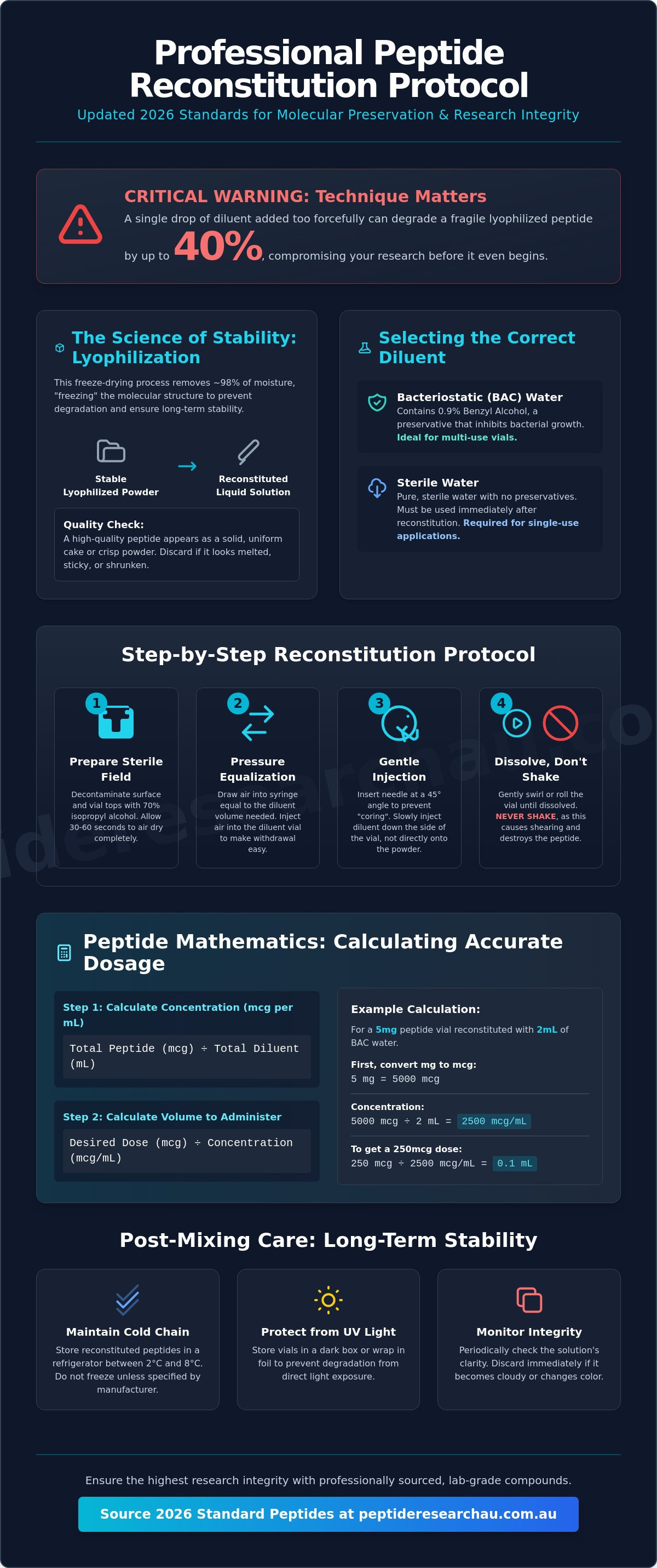
A single drop of bacteriostatic water added too forcefully can degrade a fragile lyophilized peptide sequence by up to 40% before your experiment even begins. You've likely felt the pressure of handling expensive laboratory grade compounds while following a peptide mixing guide that lacks technical depth. A minor calculation error or a lapse in sterile technique can compromise months of data. It's a common frustration for researchers who demand absolute precision but find themselves second guessing the complex math behind mg to mcg conversions.
By following this professional protocol, you'll master the exact reconstitution steps required to ensure your research grade peptides remain stable. We've updated these standards for 2026 to reflect current best practices in molecular preservation. You'll learn the precise volumetric calculations for accurate dosing and the meticulous handling techniques necessary to preserve the integrity of your sequences. This guide provides the scientific foundation you need to move from uncertainty to total experimental confidence.
Key Takeaways
Understand the scientific role of lyophilisation in maintaining compound stability and the precise requirements for restoring research-grade powders to a liquid state.
Follow this comprehensive peptide mixing guide to implement professional sterile field preparation and the essential "pressure equalisation" technique to protect vial integrity.
Distinguish between Bacteriostatic and Sterile Water to ensure the longevity and safety of multi-use laboratory vials during extended research periods.
Master the universal formula for precise concentration calculations, enabling accurate conversion from milligrams to micrograms for experimental consistency.
Identify the specific "cold chain" and UV protection protocols necessary to prevent peptide degradation and ensure long-term compound stability.
Table of Contents Understanding Peptide Reconstitution: The Science of Solubility The Step-by-Step Peptide Mixing Protocol Selecting the Correct Diluent: BAC Water vs. Sterile Water Peptide Mathematics: Calculating Concentration and Dosage Post-Mixing Care: Storage and Stability in Australia
Understanding Peptide Reconstitution: The Science of Solubility
Peptide reconstitution is the precise process of restoring a lyophilised (freeze-dried) powder to a liquid state for laboratory analysis. This step is the foundation of any professional peptide mixing guide, as the structural integrity of the compound depends entirely on how it's transitioned back into solution. Most Research Grade peptides arrive in a dehydrated state to ensure long-term stability and prevent the breakdown of delicate molecular structures.
The process of creating these compounds involves complex chemical strategies to link amino acids in specific sequences. Gaining a deeper perspective on The Science of Solubility helps researchers understand why these molecules are exceptionally sensitive to their environment. Lyophilisation removes approximately 98% of moisture, which "freezes" the molecular structure. This prevents chemical hydrolysis and bacterial proliferation while the vial is stored at temperatures between -20°C and 4°C.
Lyophilisation and Compound Stability
Removing water is essential because moisture acts as a primary catalyst for peptide degradation. By eliminating the aqueous environment, manufacturers stop the biological and chemical reactions that would otherwise destroy the peptide bond within days. A stable, high-quality lyophilised cake should appear as a solid, uniform plug or a crisp, crystalline powder. If the powder looks melted, sticky, or shrunken, it often indicates a breach in the vacuum seal or exposure to moisture. To ensure your laboratory results remain consistent, it's vital to procure materials from a trusted source for peptides that maintains strict 2026 quality standards.
The Risks of Improper Mixing
Peptides are notoriously fragile. Aggressive agitation or vigorous shaking causes "shearing," a process where mechanical force physically breaks the delicate peptide chains. This destruction renders the compound biologically inactive for research purposes. Temperature shocks also pose a significant risk; adding a room-temperature solvent to a vial taken directly from deep-freeze storage can cause immediate precipitation of the solute.
Precision in this peptide mixing guide also requires attention to the solvent's chemistry. Research Grade compounds require specific diluents, such as bacteriostatic water, to maintain a stable pH balance. Using low-quality solvents or standard tap water can lead to rapid degradation or "salting out," where the peptide fails to dissolve and instead forms visible particulates. Maintaining a physiological pH between 7.0 and 7.4 is often necessary to prevent the compound from unfolding or precipitating out of the solution.
The Step-by-Step Peptide Mixing Protocol
Precision is the foundation of laboratory research. When you follow this peptide mixing guide, you ensure the integrity of the compound and the safety of the environment. Establishing a sterile field is the first requirement. Use 70% isopropyl alcohol to decontaminate your work surface and the top of every vial. This concentration is the industry standard because it evaporates slowly enough to penetrate cell walls and destroy pathogens. Wait 30 to 60 seconds for the alcohol to dry completely before proceeding. If the surface is wet, the sterilization process isn't finished.
Aseptic Technique and Preparation
A meticulous preparation phase prevents contamination. You'll need specific lab supplies: 1ml or 3ml sterile syringes, 21-gauge to 27-gauge needles, alcohol swabs, and a diluent like bacteriostatic water. Swab the rubber stopper of both the diluent and the peptide vial in a single, firm direction. Don't use a circular motion, as this can reintroduce contaminants to the center. Let the stoppers air dry for a full 30 seconds. This step is critical; puncturing a wet stopper can drag alcohol or bacteria into the vial, which might degrade your research grade peptides.
Executing the Reconstitution
Executing the reconstitution requires a steady hand and specific mechanical techniques. Start with "Pressure Equalization." Draw a volume of air into your syringe that matches the amount of liquid you intend to use. Inject this air into the diluent vial to make the liquid easier to withdraw. When you're ready to transfer the solvent to the peptide vial, insert the needle at a 45-degree angle. This angle prevents "coring," a common error where the needle shears off a small piece of the rubber stopper and drops it into the solution.
Once the needle is inside the peptide vial, use the "Side-Wall Drip" method. Don't spray the liquid directly onto the lyophilized powder. Instead, aim the needle at the glass wall and let the solvent trickle down slowly. This gentle introduction protects the fragile molecular bonds of the compound. For accurate measurements during this process, refer to Peptide Mathematics: Calculating Concentration to determine the exact ratio of solvent to solute required for your study.
Agitation is the final step. You must use a "Gentle Swirl" rather than shaking the vial. Shaking creates air bubbles and kinetic energy that can denature the peptide, rendering it useless for research. Swirl the vial in a slow, circular motion for 60 seconds. If the solution isn't clear, let it sit in a refrigerator for 5 to 10 minutes. A successful reconstitution results in a perfectly clear liquid. If persistent particulates or cloudiness remain after 15 minutes, the compound may be compromised. For researchers seeking laboratory grade compounds, adhering to these meticulous steps is the only way to ensure valid experimental results.
Selecting the Correct Diluent: BAC Water vs. Sterile Water
Successful reconstitution depends entirely on the choice of diluent. Bacteriostatic (BAC) water is the industry standard for multi-use research vials. It consists of sterile water containing 0.9% benzyl alcohol. This preservative is critical. Without it, a reconstituted peptide becomes a breeding ground for bacteria within 24 hours of the first needle entry.
When using this peptide mixing guide, researchers must understand the shelf-life disparity. Peptides mixed with sterile saline or plain sterile water have a 24-hour expiration window once the vial seal is broken. In contrast, BAC water maintains the stability of most research-grade compounds for up to 28 days when refrigerated at 2°C to 8°C. This preservative action allows for longitudinal studies without the risk of microbial contamination. However, benzyl alcohol is toxic to certain sensitive research models, such as neonatal subjects or specific neurological tissues. In these niche cases, sterile water is used, and the compound is discarded immediately after a single use.
The Role of Benzyl Alcohol
The 0.9% benzyl alcohol concentration acts as a bacteriostatic agent by inhibiting the growth of gram-positive bacteria. It doesn't kill bacteria outright but stops them from reproducing. This allows for multiple draws from a single vial over several weeks. It's vital to follow the 28-day rule; once a vial of bacteriostatic water is opened, the preservative begins to lose its efficacy. Researchers in Australia should prioritize laboratory-grade diluents to ensure the chemical purity and safety of their samples throughout the duration of the study.
Alternative Solvents for Difficult Peptides
Some compounds are hydrophobic, meaning they won't dissolve in BAC water alone. In these instances, researchers use small amounts of Acetic Acid (0.6% to 1.0%) or DMSO (Dimethyl Sulfoxide). The "dilution after dissolution" rule is vital here. You must first dissolve the peptide in the specialized solvent before adding BAC water to reach the final concentration. This prevents the peptide from "crashing" or precipitating out of the solution. For example, specific requirements for BPC-157 research often dictate precise pH balancing to maintain the molecule's structural integrity during the peptide mixing guide protocol.
BAC Water: 0.9% Benzyl Alcohol, 28-day shelf life post-reconstitution.
Sterile Saline: No preservative, 24-hour shelf life post-reconstitution.
Acetic Acid: Used for peptides with an isoelectric point that makes them insoluble in water.
Peptide Mathematics: Calculating Concentration and Dosage
Precision is the cornerstone of laboratory research. When you follow a peptide mixing guide, the primary objective is to transform a lyophilized powder into a measurable liquid solution with absolute accuracy. The universal formula for this process is straightforward: Total Milligrams (mg) / Milliliters (mL) of Bacteriostatic Water = Milligrams per Milliliter. Because most research protocols require microgram (mcg) increments, you must convert your results by multiplying the mg value by 1,000. For example, a 5mg vial contains exactly 5,000mcg of the compound.
The Concentration Grid
Accurate measurements prevent data skewing in scientific settings. Using a higher volume of diluent, such as 2mL or 3mL, provides a larger margin for error when drawing small doses. This is particularly useful for high-potency research grade peptides where a single unit can represent a significant shift in concentration. You can streamline these variables and verify your manual math by using a peptide dosage calculator before starting the reconstitution process.
Common Reconstitution Ratios:
2mg Vial: Reconstituted with 1mL BAC water results in 200mcg per 10 units.
5mg Vial: Reconstituted with 2mL BAC water results in 250mcg per 10 units.
10mg Vial: Reconstituted with 2mL BAC water results in 500mcg per 10 units.
Syringe Anatomy and Unit Conversion
Standard U-100 insulin syringes are the industry benchmark for peptide research. These typically come in 0.3mL, 0.5mL, and 1.0mL capacities. It's a common misconception that "10 units" represents a fixed dose of the peptide itself. In reality, 10 units is simply 0.1mL of volume. If your concentration is 5mg/mL, 10 units equals 500mcg; if your concentration is 2.5mg/mL, those same 10 units equal 250mcg. This distinction is vital for maintaining the integrity of your peptide mixing guide protocols.
Reading the lines on a U-100 syringe requires attention to the barrel size. On a 1.0mL syringe, each small line typically represents 2 units (0.02mL). On a 0.3mL or 0.5mL syringe, each line usually represents 1 unit (0.01mL). This increased resolution makes the 0.3mL syringe the preferred choice for high-precision micro-dosing in laboratory environments. Always verify the graduation marks on your specific syringe before drawing the solution.
Secure your laboratory grade peptides from a trusted source to ensure consistency in your research calculations.
Post-Mixing Care: Storage and Stability in Australia
Once the reconstitution process is finished, the peptide's molecular structure becomes significantly more vulnerable to environmental stressors. Maintaining the "cold chain" is mandatory for research integrity. In a laboratory setting, reconstituted peptides typically begin to degrade within 48 to 72 hours if left at room temperature (20°C to 25°C). Following this peptide mixing guide ensures your research compounds remain viable for the duration of your study.
Ultraviolet light acts as a catalyst for peptide bond cleavage. Research indicates that even brief exposure to direct sunlight can initiate photo-oxidation, particularly in sensitive sequences. You should store vials in opaque containers or their original packaging to mitigate this risk. It's also vital to monitor for physical changes. A compromised compound often displays visible markers such as persistent cloudiness, the presence of "floaters," or sudden changes in colour. If any of these occur, the sample's purity is no longer guaranteed.
Australian summers present a unique challenge, with ambient temperatures often exceeding 38°C in most states. During transport between facilities, researchers must use insulated containers with medical-grade gel packs to prevent thermal degradation. In the lab, fluctuations in power grids during heatwaves can compromise refrigerated storage. High-precision backup power systems are a standard requirement for 2026 protocols to ensure a steady environment.
Optimising the Cold Chain
Peptides require a consistent temperature range between 2°C and 8°C for short-term research use. Storing vials in the door of a refrigerator is a common error because the constant opening causes temperature spikes of up to 5°C. The back of the fridge provides a stable thermal environment that protects against these shifts. Compounds like TB-500 are particularly sensitive to thermal fluctuations. You must follow this peptide mixing guide strictly to prevent the deactivation of the peptide sequence during storage.
Safety and Lab Disposal
Professional research environments must adhere to strict biohazard protocols. All sharps, including needles and glass vials, require disposal in yellow Australian Standard (AS 4031) puncture-resistant containers. Don't dispose of these materials in standard waste streams. Every reconstituted vial needs a clear label stating the date of mixing, the concentration (e.g., 2mg/mL), and the specific compound name. This documentation prevents cross-contamination and ensures data accuracy across your research timeline.
Explore our laboratory-grade research peptides to ensure your next study utilizes the highest quality compounds available in the Australian market.
Advancing Your Laboratory Reconstitution Standards
Precision in reconstitution defines the success of any research study. Adhering to this peptide mixing guide ensures that delicate compounds maintain their structural integrity throughout the 2026 protocol. Selecting Bacteriostatic water over sterile alternatives provides the 0.9% benzyl alcohol necessary for multi-dose stability. Accurate mathematical calculations prevent dosage errors that could compromise your data. Maintaining cold chain storage at 2 to 8 degrees Celsius is essential for preserving peptide longevity in the Australian climate. It's a meticulous process that requires absolute attention to detail.
Peptide Research AU provides the infrastructure for high-level scientific inquiry. Every compound is third-party purity tested to exceed 99% standards. We ensure all orders are dispatched from Australia within 24 hours to maintain strict research timelines. Our laboratory-grade quality guaranteed compounds are designed for researchers who refuse to compromise on accuracy.
Professional standards in the lab lead to breakthroughs in the field. Your dedication to meticulous protocol ensures the highest level of research excellence.
Frequently Asked Questions
Can I use tap water or bottled water to mix my peptides?
You shouldn't use tap or bottled water for reconstitution because they lack the necessary sterility and pH balance for laboratory research. Research grade peptides require Bacteriostatic Water containing 0.9% benzyl alcohol to prevent bacterial growth for up to 28 days. Tap water contains minerals like calcium and pathogens that will degrade the compound immediately. Always use sterile, laboratory grade diluents to maintain the 100% integrity of your research material.
What should I do if my peptide solution is cloudy after mixing?
A cloudy solution often indicates that the lyophilised powder hasn't fully dissolved or that the peptide has denatured. If you see cloudiness, let the vial sit in the refrigerator for 15 to 20 minutes to allow for natural dissolution. This peptide mixing guide recommends gentle swirling rather than agitation. If the solution remains opaque after 30 minutes, it suggests the compound's structural integrity is compromised and it shouldn't be used.
How long does a peptide remain stable after it has been reconstituted?
Reconstituted peptides typically remain stable for 4 to 8 weeks when stored at temperatures between 2°C and 8°C. Scientific studies on specific compounds show that stability decreases by 10% to 15% after 30 days if left at room temperature. For optimal results in your study, use the solution within 30 days of mixing. Always keep the vial away from direct light to prevent UV-induced degradation of the amino acid chains.
Is it possible to "over-dilute" a peptide with too much bacteriostatic water?
You can't chemically over-dilute a peptide, but adding excessive bacteriostatic water makes accurate dosing difficult. Most researchers use 1ml to 3ml of diluent per vial. If you add 10ml of water to a 5mg vial, the volume required for a 250mcg dose becomes too large for standard 1ml syringes. Stick to the ratios provided in this peptide mixing guide to ensure your measurements remain precise and manageable for your research.
Why did my peptide vial hiss or suck in the water very fast?
The hissing or rapid suction occurs because manufacturers create a vacuum seal inside the vial during the lyophilisation process. This vacuum ensures the powder remains sterile and moisture-free during transit. When you insert the needle, the pressure difference pulls the water in forcefully. You should angle the needle against the glass wall and hold the plunger to slow the flow, preventing the water from hitting the powder directly and causing damage.
Can I pre-fill syringes and store them for later research?
You shouldn't pre-fill syringes for long-term storage because the peptide can adhere to the plastic walls or the rubber stopper. Medical grade syringes are designed for immediate use, not for storage beyond 24 hours. Research indicates that certain compounds lose 20% of their potency when left in plastic syringes for more than 48 hours. It's best to draw your dose directly from the glass vial before each application to ensure compound stability.
What happens if I accidentally shake the vial instead of swirling it?
Shaking the vial creates air bubbles and shear stress that can break the delicate molecular bonds of the peptide. Unlike robust chemicals, peptides are fragile chains of amino acids. Shaking can lead to permanent denaturation, rendering the compound 100% ineffective for research purposes. If you've accidentally shaken a vial, check for persistent foam or cloudiness, as these are clear signs the structural integrity of the compound has been compromised during the process.
Do I need to keep the lyophilised powder in the fridge before mixing?
You must keep lyophilised powder in a temperature-controlled environment to prevent degradation. While the powder is stable at room temperature for 3 to 4 weeks during shipping, long-term storage requires a refrigerator at 2°C to 8°C or a freezer at -20°C. Storing the powder in a freezer can extend its shelf life to 24 months. Always allow the vial to reach room temperature for 5 minutes before beginning the professional reconstitution process.


Comments