
P21 Peptide Research in Australia: A Comprehensive Scientific Guide (2026)
- peptideresearchau
- Jun 3
- 12 min read
What if the primary obstacle in neurogenesis research isn't biological complexity, but the chemical instability of the molecules used to study it? You're likely aware of the difficulties in utilizing Ciliary Neurotrophic Factor (CNTF) derivatives that degrade before providing meaningful laboratory data. Advancing p21 peptide research australia involves balancing these technical requirements with the TGA's strict 2026 regulatory environment. It's vital to secure research compounds that meet exact purity specifications to ensure experimental reproducibility and scientific integrity.
This comprehensive guide explores the biochemical mechanisms of the P21 peptide and its potential as a potent, stable neurogenic agent. We'll examine the specific protocols for utilizing laboratory diluents in reconstitution and provide a detailed analysis of the current Australian regulatory framework. You'll gain a standardized methodology for handling these peptides and a clear path toward sourcing high-purity research materials. This analysis ensures your laboratory remains compliant while pursuing excellence in neurotrophic study.
Key Takeaways
Analyze the molecular pathways through which P21 functions as a synthetic tetrapeptide to promote targeted neurogenic activity.
Compare the efficacy of P21 against broader porcine extracts like Cerebrolysin to determine the most effective compound for neurotrophic study.
Master precise reconstitution methods using laboratory diluents to maintain the chemical stability and potency of research compounds.
Identify the critical compliance requirements for conducting p21 peptide research australia within the 2026 TGA regulatory framework.
Establish rigorous quality control benchmarks, including HPLC and Mass Spec verification, to ensure the purity of all laboratory materials.
Table of Contents
What is P21? The Biochemistry of a CNTF Mimetic
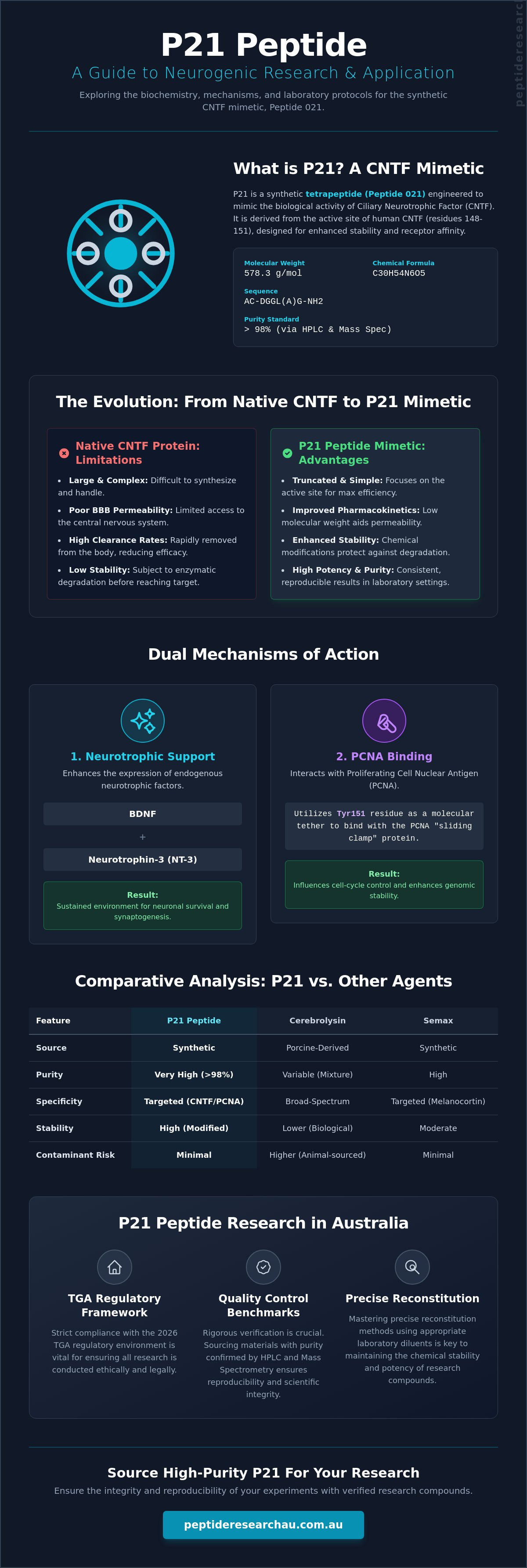
P21 is a synthetic neurogenic compound specifically engineered to mimic the biological activity of ciliary neurotrophic factor (CNTF). It is classified as a tetrapeptide, frequently identified in scientific literature as Peptide 021 (P021). For investigators engaged in p21 peptide research australia, the molecular architecture of this compound is a foundational element of experimental design. P21 is derived from residues 148 to 151 of the human CNTF molecule. This specific truncation represents the biologically active site responsible for promoting neuronal differentiation and survival. Its primary sequence, AC-DGGL(A)G-NH2, reflects a design intended to maximize receptor affinity while minimizing enzymatic degradation.
The Evolution from CNTF to P21
The transition from using full-length CNTF proteins to synthetic mimetics was driven by several physiological barriers. Native CNTF proteins are large, complex, and possess poor blood-brain barrier permeability. They're also subject to high clearance rates, which limits their utility in long-term neurogenesis studies. P21 overcomes these challenges through its truncated molecular structure. By focusing solely on the active residues, researchers can bypass the limitations of the full-length protein. This mimetic approach allows for the stimulation of neurotrophic pathways with much greater efficiency. It's a more stable alternative that maintains high potency even in complex laboratory environments.
Chemical Properties and Stability
The technical specifications of P21 provide a clear rationale for its use in professional study. It possesses a molecular weight of 578.3 g/mol and is defined by the chemical formula C30H54N6O5. This relatively low molecular weight is a primary reason for its improved pharmacological profile. The synthetic nature of P21 is a significant advantage for p21 peptide research australia. Unlike porcine-derived extracts, synthetic P21 allows for meticulous quality control and consistent purity levels. High-grade synthesis ensures the compound remains free from the biological contaminants often found in animal-sourced neurotrophic factors.
Molecular Weight: 578.3 g/mol
Chemical Formula: C30H54N6O5
Sequence: AC-DGGL(A)G-NH2
Purity Standards: Typically exceeds 98% via HPLC and Mass Spec verification
The stability profile of P21 is enhanced by its specific chemical modifications, including C-terminal amidation and N-terminal acetylation. These structural adjustments protect the peptide from rapid proteolysis. This ensures that the compound remains viable for the duration of the experimental protocol. It provides a reliable foundation for data collection that larger, more fragile proteins cannot match. In a controlled laboratory setting, this stability translates to reproducible results and a clearer understanding of neurogenic mechanisms.
Mechanisms of Action: Neurogenesis and PCNA Binding
P21 operates through a dual-action pathway that distinguishes it from traditional neurogenic agents. It doesn't simply mimic Ciliary Neurotrophic Factor (CNTF); it actively enhances the expression of endogenous Neurotrophic Factors, specifically Brain-Derived Neurotrophic Factor (BDNF) and Neurotrophin-3 (NT-3). This upregulation is critical for the differentiation of neural stem cells into mature, functional neurons. For those conducting p21 peptide research australia, understanding this modulation is vital for designing experiments that target hippocampal regeneration and cognitive restoration.
The peptide's primary mechanism involves the inhibition of neutralizing antibodies and the stabilization of the CNTF signaling pathway. By preventing the degradation of these vital growth factors, P21 ensures a sustained environment for neuronal survival. This biochemical environment is essential for synaptogenesis, the formation of new synapses between neurons, which is frequently compromised in models of cognitive decline. Laboratory investigators often use P21 to observe how increased neurotrophic support can reverse synaptic loss in pre-clinical settings.
PCNA Binding and DNA Repair Models
A defining characteristic of P21 is its high-affinity interaction with Proliferating Cell Nuclear Antigen (PCNA). Scientific data indicates that P21 utilizes the Tyr151 residue as a molecular tether to bind with the PCNA molecule. PCNA acts as a "sliding clamp" that is essential for DNA polymerase activity during replication and repair. By binding to this protein, P21 may influence cell-cycle control and genomic stability within neural progenitor cells. This interaction is a primary focus in neurodegeneration studies because PCNA is a critical marker for cellular health and proliferative capacity. Researchers analyze this "tether" mechanism to understand how P21 supports the structural integrity of DNA during rapid cell division in the brain.
Increasing Neuroplasticity and Synaptic Density
The impact of P21 on neuroplasticity is most evident in the dentate gyrus of the hippocampus. Experimental models consistently show that P21 administration correlates with a measurable increase in dendritic spine density. These spines are the primary sites of excitatory synaptic input; their proliferation directly enhances the brain's capacity for learning and memory retention. When sourcing research peptides for these studies, it's necessary to ensure the compound maintains the structural fidelity required for such precise molecular interactions.
Synaptogenesis: Increases the number of functional synaptic connections in the hippocampus.
Dendritic Spines: Promotes the growth and maturation of mushroom-shaped spines associated with long-term potentiation.
Cognitive Models: Improves performance in Morris Water Maze and Object Recognition tasks in laboratory subjects.
BDNF Expression: Provides a significant boost to endogenous neuroprotective proteins.
By targeting both the birth of new neurons and the strengthening of existing connections, P21 offers a comprehensive approach to neuroplasticity research. It provides a stable, potent alternative to broader extracts, allowing for a more granular analysis of how specific neurotrophic pathways influence cognitive outcomes. This level of specificity is what makes p21 peptide research australia a high-priority area for 2026 laboratory protocols.
Comparative Analysis: P21 vs. Cerebrolysin and Semax
The Australian neurogenic research landscape requires high-precision compounds to meet rigorous 2026 laboratory standards. While several peptides are utilized for cognitive and neuroprotective studies, P21 offers a unique mechanism compared to established alternatives like Cerebrolysin and Semax. For investigators focused on p21 peptide research australia, the primary distinction lies in molecular specificity. Cerebrolysin is a broad-spectrum porcine-derived peptide mixture. It contains a heterogeneous blend of neurotrophic factors and amino acids. In contrast, P21 is a highly targeted synthetic tetrapeptide. This specificity allows researchers to isolate the effects of CNTF mimetic activity without the variability inherent in animal-sourced extracts.
Semax operates primarily through the melanocortin system and the modulation of dopamine and serotonin levels. It serves as a potent neuroprotective agent in ischemia models. However, P21 is often preferred for studies specifically targeting de novo neurogenesis in the dentate gyrus. While Semax provides rapid cognitive support, P21 focuses on the structural regeneration of neural pathways through PCNA binding and BDNF upregulation. These distinct pathways allow for comparative control groups within Australian laboratory protocols. Using a synthetic compound ensures that experimental data isn't skewed by the unknown biological components found in multi-peptide complexes.
Stability and Bioavailability Factors
Maintaining the integrity of research compounds is essential for longitudinal data accuracy. P21 demonstrates superior stability compared to full-length neurotrophic proteins. It's typically supplied as a lyophilised powder, which remains stable at room temperature for short periods but requires storage at -20°C for long-term preservation. Once reconstituted with laboratory diluents, the peptide's half-life is significantly shorter than its lyophilised state. Researchers should consult the peptides Australia guide for detailed quality sourcing standards. Reliable sourcing ensures that the peptide's bioavailability remains consistent across multiple experimental cohorts.
Targeted Research Applications
P21 is a high-priority compound for Alzheimer’s and dementia research models due to its ability to cross the blood-brain barrier effectively. It provides a more stable alternative to native CNTF for investigating the reversal of cognitive deficits. In some complex studies, P21 is evaluated alongside other compounds like BPC-157 to study the interaction between systemic healing and central nervous system regeneration. While P21 targets the neural progenitor cells, comparative agents like Semax are often used to measure immediate neuroprotective responses. This multi-peptide approach allows for a comprehensive analysis of neuroplasticity within a controlled environment. Selecting the correct mimetic depends entirely on whether the study goal is acute protection or long-term structural neurogenesis.
Laboratory Protocols: Reconstitution and Storage
Precision in laboratory handling is non-negotiable for p21 peptide research australia. Achieving reproducible results requires a meticulous approach to reconstitution. Even minor deviations in protocol can lead to peptide degradation or inconsistent concentrations. Researchers must establish a sterile workspace, ideally within a laminar flow hood, to maintain an aseptic field. This prevents microbial contamination that could compromise the integrity of the synthetic tetrapeptide. Maintaining a controlled environment is the only way to ensure the biochemical fidelity of the compound throughout the study duration.
Essential equipment includes insulin-grade syringes for precise measurement, alcohol swabs for vial disinfection, and high-quality laboratory diluents. Standardizing the concentration is the first step in any experimental design. For instance, a 2mg vial of P21 reconstituted with 2ml of diluent yields a concentration of 1mg/ml, or 1000mcg/ml. Accurate microgram calculations are vital for ensuring that the dosage administered to research subjects aligns with the study's parameters. Small errors at this stage can lead to significant data skewing in neurogenesis models.
Step-by-Step Reconstitution Protocol
Selecting the appropriate diluent is the foundation of stability. Bacteriostatic water is often preferred for multi-use vials due to its antimicrobial properties, while sterile saline is suitable for single-use applications. When introducing the liquid into the vial, use the slow-drip method. Aim the needle at the glass wall of the vial rather than directly onto the lyophilized powder. This prevents mechanical stress on the peptide bonds. Once the liquid is added, don't shake the vial. Shaking causes foaming and denaturation. Instead, use a gentle swirling motion until the solution is completely clear and no particulates remain.
Storage and Shelf-Life Standards
The stability profile of P21 varies significantly based on its physical state and environment. Lyophilized P21 is quite robust. It can remain stable at room temperature for several weeks, though long-term storage at -20°C is recommended to preserve its biochemical potency for up to two years. Once reconstituted, the peptide becomes much more fragile. It's essential to monitor storage temperatures daily to prevent accidental degradation.
Reconstituted solutions must be refrigerated at 2°C to 8°C and should be used within a 30-day window. Light exposure is another critical factor. UV rays can catalyze the breakdown of amino acid chains, rendering the compound inert. Vials should be stored in their original packaging or wrapped in foil to ensure light-tight conditions. For multi-use vials, minimize the time the vial spends outside of refrigeration during handling. Consistent temperature management is the only way to ensure the data collected in p21 peptide research australia remains valid and rigorous.
Sourcing P21 Peptide Research Materials in Australia
The regulatory environment for p21 peptide research australia in 2026 is defined by strict Therapeutic Goods Administration (TGA) oversight. Under the Therapeutic Goods Act 1989, most peptides are classified as Schedule 4 (Prescription Only) medicines. Labeling a compound "for research use only" doesn't exempt it from these regulations if it possesses therapeutic potential. The TGA has significantly increased enforcement; it requested the removal of over 13,700 online advertisements in the 2024-2025 financial year alone. Legitimate scientific investigators must navigate these legal pathways carefully, often utilizing specific TGA-sanctioned schemes to supply unapproved goods for institutional study. This complexity makes the choice of a supply partner a critical factor in laboratory compliance and data integrity.
Quality Assurance and Purity Testing
Verifying the chemical identity of a compound is paramount. A Certificate of Analysis (COA) provides the necessary empirical data to confirm that a batch meets the required specifications. High-purity research compounds should consistently demonstrate 99%+ purity levels. This is verified through High-Performance Liquid Chromatography (HPLC) and Mass Spectrometry (MS). HPLC measures the purity of the peptide by separating its components. Mass Spec confirms the molecular weight matches the theoretical value of 578.3 g/mol. Third-party testing within the Australian market adds a necessary layer of transparency. It ensures that the materials used in p21 peptide research australia are free from trifluoroacetic acid (TFA) salts or residual solvents that could interfere with cellular assays.
Why Sourcing Domestically Matters
International procurement often introduces variables that can compromise sensitive molecules. Customs delays are a primary concern; they often lead to extended periods of ambient temperature exposure. For a peptide like P21, which requires strict thermal management once it leaves its lyophilized state, these fluctuations are detrimental. Sourcing research peptides from a domestic provider mitigates these risks. Domestic supply chains offer expedited transit times and more reliable climate-controlled shipping options. This ensures the peptide arrives in its optimal state, ready for immediate laboratory use.
Reduced Transit Risk: Minimizes exposure to extreme temperatures during international customs holds.
Verified Purity: Access to HPLC and Mass Spec data for every batch of research compounds.
Local Expertise: Technical support from specialists who understand the Australian regulatory landscape.
Supply Stability: Reliable access to laboratory diluents and multi-peptide complexes.
Peptide Research AU serves as a specialized partner for the Australian scientific community. By providing HPLC-verified research compounds and high-grade laboratory diluents, we enable researchers to focus on methodology rather than material degradation. Access to local technical support ensures that specific questions regarding reconstitution or storage are addressed by experts familiar with the Australian laboratory landscape. Choosing a domestic provider isn't just a matter of convenience; it's a strategic decision to maintain the highest standards of scientific rigor in neurogenesis studies.
Advancing Neurogenic Research Standards
P21 represents a significant evolution in neurotrophic study. It offers a stable and targeted alternative to traditional porcine extracts. Its high-affinity interaction with PCNA and modulation of BDNF levels provide researchers with a precise tool for investigating hippocampal neurogenesis. Maintaining the integrity of these findings depends on rigorous adherence to aseptic reconstitution protocols and temperature-controlled storage. As the regulatory environment for p21 peptide research australia continues to evolve in 2026, securing high-purity materials from a reliable domestic source is essential for both compliance and experimental reproducibility.
Browse our laboratory-grade P21 and other research peptides at Peptide Research AU. Our compounds are HPLC and Mass Spec verified for purity and delivered via domestic Australian express shipping. We offer dedicated laboratory support to ensure your study doesn't face unnecessary delays. Achieving breakthrough results in neuroplasticity requires precision at every stage of the scientific process.
Frequently Asked Questions
Is P21 peptide legal for research in Australia?
In Australia, peptides are regulated as therapeutic goods by the TGA under the Therapeutic Goods Act 1989. Most of these compounds are classified as Schedule 4 (Prescription Only) medicines. Labeling a product for research use only doesn't exempt it from these regulations. Legitimate scientists must follow specific legal pathways, such as clinical trial approvals or TGA-sanctioned schemes, to import and utilize these materials for professional study.
What is the primary difference between P21 and Cerebrolysin?
P21 is a synthetic tetrapeptide designed specifically to mimic the active site of ciliary neurotrophic factor. Cerebrolysin is a broad-spectrum porcine-derived extract containing a complex mixture of peptides and amino acids. P21 offers researchers greater molecular specificity and batch-to-batch consistency. This precision is vital for p21 peptide research australia where isolating specific neurogenic pathways is the primary objective of the laboratory protocol.
How should P21 be stored to maintain maximum stability?
Lyophilized P21 should be stored at -20°C for long-term preservation, which maintains biochemical integrity for up to 24 months. For short-term use, it can remain at room temperature for several weeks if kept in a dark environment. Once the compound is reconstituted, it must be refrigerated at 2°C to 8°C. Light exposure should be strictly minimized as UV radiation can catalyze the degradation of the peptide bonds.
What diluent is best for reconstituting P21 for laboratory use?
Bacteriostatic water is the preferred laboratory diluent for multi-use vials because its 0.9% benzyl alcohol content inhibits microbial growth. Sterile saline is an alternative for single-use applications where antimicrobial preservation isn't required. Use the slow-drip method during reconstitution to prevent mechanical stress on the molecule. Swirling the vial gently is superior to shaking, which can cause denaturation and foaming of the research compounds.
Can P21 be used in combination with other peptides like PT-141?
Research models often utilize multi-peptide complexes to study synergistic effects on cellular pathways. While P21 targets neurogenesis, other research peptides like PT-141 target different physiological systems. Scientists must meticulously document these interactions within a controlled experimental framework. It's necessary to ensure that each compound meets the same high purity standards to avoid cross-contamination or skewed data during the observation of complex biological interactions.
What are the reported research outcomes of P21 on hippocampal neurogenesis?
Pre-clinical data indicates that P21 significantly increases dendritic spine density in the dentate gyrus. It promotes the differentiation of neural progenitor cells into mature neurons, which is a key marker for cognitive recovery. Studies using memory models, such as the Morris Water Maze, show improved performance following administration. These outcomes suggest that P21 provides a stable environment for long-term structural neuroplasticity within the hippocampus.
How does P21 interact with PCNA in DNA repair models?
P21 binds to Proliferating Cell Nuclear Antigen (PCNA) using its Tyr151 residue as a molecular tether. PCNA is a critical protein for DNA replication and repair mechanisms. This interaction allows P21 to influence cell-cycle control and maintain genomic stability in neural cells. Researchers utilize this mechanism to study how neurotrophic mimetics can support cellular health and potentially mitigate the structural damage associated with neurodegenerative models.
Where can I find HPLC-tested P21 in Australia?
High-purity P21 is available through domestic providers like Peptide Research AU, which specializes in professional-grade research materials. Every batch should be accompanied by a Certificate of Analysis confirming 99%+ purity via HPLC and Mass Spectrometry. Sourcing p21 peptide research australia from local suppliers ensures that the compounds are shipped using express methods to minimize temperature fluctuations. This domestic supply chain supports the rigorous quality control standards required for institutional study.


Comments