

Oral BPC-157 vs Injectable for Lab Use: A 2026 Research Comparison
- peptideresearchau
- May 9
- 12 min read
The injectable route might be the inferior choice for specific gastrointestinal research targets. While the standard acetate form offers a meager 3% bioavailability, the emergence of stable arginate salts has pushed oral absorption rates as high as 90% in specific laboratory models. This shift forces a re-evaluation of oral bpc-157 vs injectable for lab use, as the choice now depends more on the tissue target than the delivery method itself.
You've likely struggled with the complexity of reconstituting lyophilized powders or the uncertainty of whether an oral compound can survive the harsh environment of the gut. This article provides a definitive scientific comparison of BPC-157 delivery methods to help you optimize bioavailability and experimental outcomes in your facility. We'll examine the 14% to 51% systemic reach of injectables, provide a framework for selecting the right form based on your research target, and identify reliable Australian sourcing for 2026. By understanding how these compounds interact with the metabolic environment of your research model, you can ensure more precise and reproducible data.
Key Takeaways
Understand why the unique 15-amino acid sequence of BPC-157 provides superior chemical resilience against hydrochloric acid compared to larger peptide structures.
Evaluate the systemic reach of injectable compounds and their capacity to bypass metabolic barriers for rapid transport to musculoskeletal research sites.
Establish a clear framework for selecting oral bpc-157 vs injectable for lab use based on the specific tissue targets and metabolic environment of your research model.
Analyze the comparative half-life and cost-efficiency of each administration route to optimize the resource allocation of long-term laboratory studies.
Identify the critical laboratory-grade certifications and 2026 Australian regulatory standards required to ensure the reproducibility of your experimental data.
Table of Contents
Understanding BPC-157: The Rationale for Comparing Administration Routes
BPC-157, or Body Protection Compound 157, is a synthetic pentadecapeptide composed of 15 amino acids in a specific sequence: Gly-Glu-Pro-Pro-Pro-Gly-Lys-Pro-Ala-Asp-Asp-Ala-Gly-Leu-Val. It's a sequence derived from a larger protein found in human gastric juice. Its primary role in biological models is promoting cytoprotection. In 2026, the primary debate in laboratory settings centers on delivery methods. Researchers are increasingly scrutinizing the choice of oral bpc-157 vs injectable for lab use to determine which protocol yields the most reproducible data across different physiological systems. The core of this discussion lies in the "Systemic vs. Local" effect hypothesis, which posits that the route of administration dictates the concentration of the peptide at the specific research site.
The Gastric Pentadecapeptide Origin
Isolation of this compound from gastric secretions occurred in the early 1990s. This origin explains its inherent resistance to enzymatic degradation. Most peptides break down within minutes when exposed to hydrochloric acid (HCl); however, this compound remains stable in gastric juice for over 24 hours. This chemical resilience is a cornerstone for researchers investigating the role of bpc 157 in cytoprotection and tissue repair. With a molecular weight of approximately 1419.5 Daltons, the peptide possesses high cell permeability, which facilitates its interaction with both localized and systemic receptors during laboratory experiments.
Why Researchers Pivot Between Oral and Injectable
The shift in administration protocols reflects the diversity of modern research targets. Early studies, such as those conducted in rodent models in 1991, focused heavily on gastrointestinal repair. By 2026, research has expanded into complex musculoskeletal and neurological domains. Each target demands a different pharmacokinetic profile to achieve optimal results.
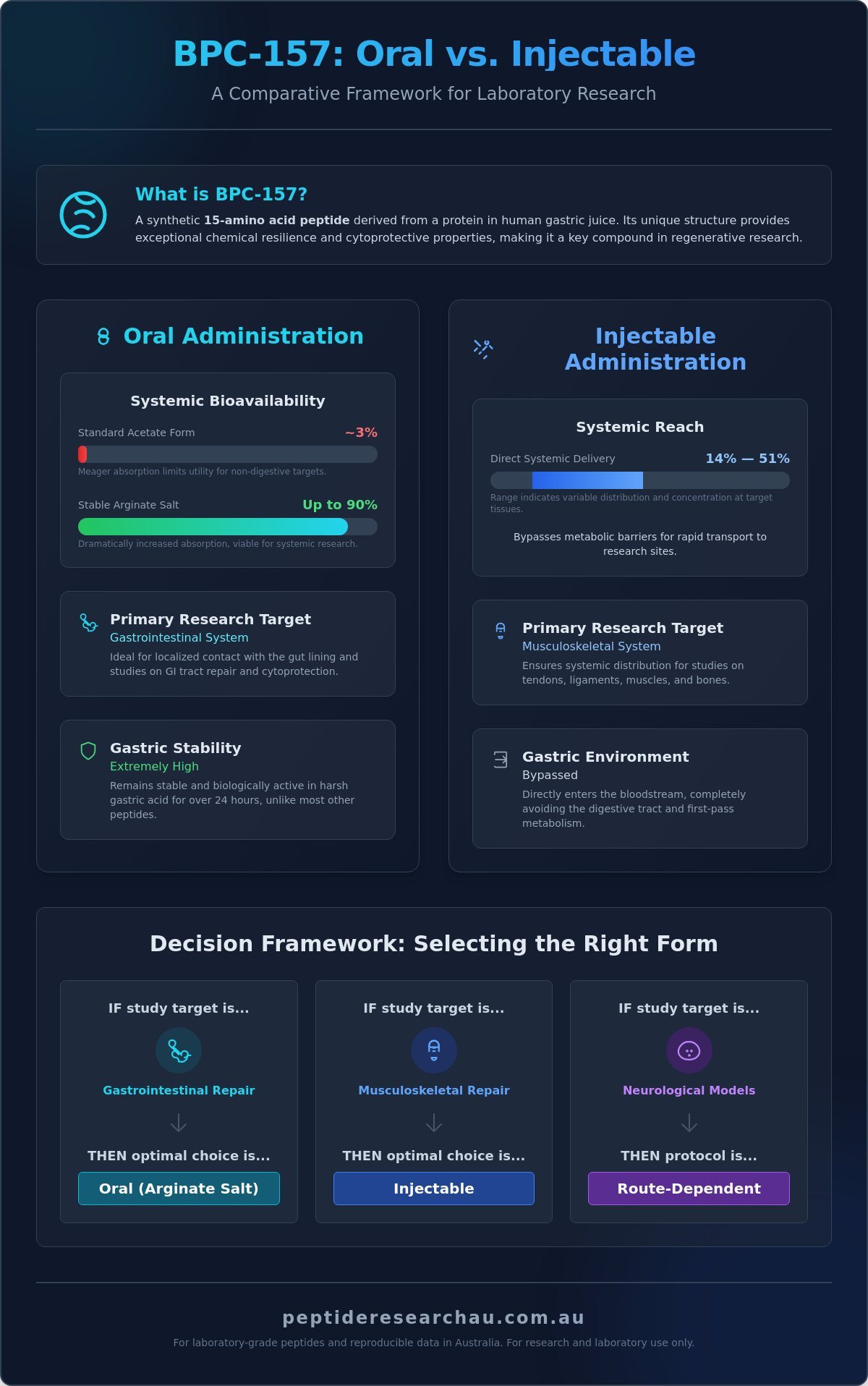
Gastrointestinal studies often favor oral administration to maximize localized contact with the gut lining.
Musculoskeletal research, targeting tendons or ligaments, typically utilizes injectable forms to ensure systemic distribution.
Neurological models investigate the peptide's capacity to cross the blood-brain barrier via different routes.
Establishing standardized protocols for oral bpc-157 vs injectable for lab use in Australian laboratories is vital for data integrity. Without precise administration data, comparing results across different 2026 studies becomes nearly impossible. Researchers must decide whether the metabolic environment of the gut will enhance or hinder the specific outcomes they seek to measure. This decision is no longer just about convenience; it's about the metabolic environment of the research model.
Oral BPC-157 in Research: Bioavailability and Gastric Stability
The resilience of BPC-157 in acidic environments sets it apart from almost all other regenerative peptides. While most signaling proteins degrade within minutes when exposed to human gastric juice, this pentadecapeptide remains fully intact for over 24 hours. This extraordinary stability is the primary reason researchers investigate the oral route. However, the choice of oral bpc-157 vs injectable for lab use hinges on the specific chemical form used. Standard acetate forms of the peptide exhibit a low systemic bioavailability of approximately 3%, which often limits their utility for extra-digestive research. In contrast, the arginate salt (Arg-BPC-157) has demonstrated oral absorption rates reaching 90% in specific laboratory models. This salt form also enhances shelf-stability at room temperature, making it a preferred candidate for long-term 2026 research protocols.
Resistance to Gastric Degradation
The 15-amino acid chain of BPC-157 is uniquely structured to resist proteolysis. In comparative laboratory analyses, common growth factors like Epidermal Growth Factor (EGF) and Fibroblast Growth Factor (FGF) show rapid denaturation in low pH environments. BPC-157 doesn't share this vulnerability. Its resistance to hydrochloric acid (HCl) allows it to maintain biological activity throughout the entire digestive tract. This makes it an ideal tool for in vivo studies focusing on the mucosal lining. For those establishing new protocols, selecting laboratory grade compounds with verified salt forms is essential for data consistency.
Localized Gut Research vs. Systemic Absorption
Oral delivery is the gold standard for investigating localized gastrointestinal healing. Laboratory models focusing on gastric ulcers, inflammatory bowel disease, and "leaky gut" phenotypes benefit from the direct contact of the peptide with the damaged epithelium. While the "first-pass effect" in the liver can reduce the concentration of acetate-based BPC-157 in peripheral tissues, the localized concentration in the gut remains high. Researchers prioritizing the gut-brain axis or digestive tract integrity often find oral administration superior to systemic injections for these specific endpoints.
Current ongoing clinical trials and preclinical studies continue to explore how oral delivery influences systemic markers despite the first-pass metabolism. Data suggests that even with lower systemic bioavailability, oral administration can trigger protective cascades that reach beyond the stomach. When evaluating oral bpc-157 vs injectable for lab use, you must determine if your study requires high plasma concentrations or if localized receptor binding in the GI tract is sufficient to meet your experimental objectives. The higher absorption of the arginate salt form is rapidly closing the gap between oral and injectable systemic reach in modern 2026 laboratory settings.
Injectable BPC-157: Systemic Reach and Tissue Regeneration
Injectable administration remains the definitive method for achieving maximum systemic saturation in laboratory models. While oral stability is a unique feature of this compound, the injectable route bypasses the digestive tract and hepatic first-pass metabolism entirely. This results in near 100% bioavailability, ensuring the full concentration of the peptide reaches the circulatory system. In a comprehensive review of BPC-157's mechanisms, researchers noted that systemic delivery is essential for investigating the compound's effect on extra-abdominal tissues. When weighing oral bpc-157 vs injectable for lab use, the decision is often predicated on whether the research goal involves non-localized healing or complex vascular signaling.
Subcutaneous vs. Intramuscular in Lab Models
Laboratory protocols generally distinguish between subcutaneous (SQ) and intramuscular (IM) injections based on the desired absorption rate. SQ administration is the gold standard for most peptides australia research due to the steady release into the bloodstream. IM injections may offer faster peak concentrations but are often more invasive for the research model. Maintaining the integrity of the 15-amino acid chain requires strict handling; research-grade peptides must be reconstituted using sterile laboratory diluents to prevent degradation or contamination. Precise preparation ensures that the experimental variables remain controlled throughout the study duration.
Angiogenesis and Tendon Repair Efficacy
One of the most significant advantages of injectable BPC-157 is its capacity to stimulate angiogenesis via the upregulation of Vascular Endothelial Growth Factor (VEGF). This process is critical for tissue repair in areas with poor blood supply, such as tendons and ligaments. The peptide modulates nitric oxide (NO) pathways and recruits fibroblasts to the injury site, facilitating a more robust regenerative response than localized oral delivery can typically provide.
Research focusing on skeletal muscle trauma or ligamentous tears relies on this systemic reach. By 2026, data from 52 distinct animal studies suggests that systemic administration significantly accelerates the recovery of tensile strength in Achilles tendon models compared to control groups. For studies involving systemic trauma or multi-site injuries, the choice of oral bpc-157 vs injectable for lab use is clear. The injectable route provides the necessary concentration of the peptide at distant sites of injury that the oral route might not reach efficiently due to metabolic barriers.
Oral vs. Injectable: A Comparative Framework for Laboratory Outcomes
Selecting between oral bpc-157 vs injectable for lab use requires a rigorous analysis of the metabolic environment and the specific tissue targets. While previous sections established the stability of the peptide in gastric environments, the choice often comes down to the required speed of action and the precision of the concentration at the site of interest. Injectable administration offers a rapid T-max, typically reaching peak plasma concentration within 30 to 60 minutes. Oral delivery, while slower, allows for a prolonged presence of the peptide within the gastrointestinal tract, which is essential for studying mucosal defense mechanisms. Researchers must weigh the ease of oral administration against the 100% bioavailability provided by systemic injections.
Pharmacokinetics Comparison
The pharmacokinetic profile of BPC-157 varies significantly between delivery routes. In injectable models, the peptide enters the bloodstream immediately, leading to a sharp peak in concentration. Oral models, conversely, rely on the stability of the 15-amino acid chain to survive the stomach before absorption occurs in the small intestine. Maintaining a steady-state concentration with oral dosing often requires a twice-daily protocol to compensate for the lower systemic absorption of the acetate form. Oral research models typically require a dosage variance of 10 to 50 times the concentration of injectable models to achieve comparable systemic markers in serum analysis. This variance is a critical factor when designing large-scale longitudinal studies where cost and compound volume are primary constraints.
Popular science discussions, such as those from the Huberman Lab, often claim that injection is superior even for localized gut research. However, laboratory data from 2024 and 2025 suggests that oral delivery provides a higher localized concentration at the gastric mucosal surface. This direct interaction is vital for investigating immediate cytoprotective responses that systemic injections might bypass. For researchers requiring high-purity compounds for these comparative studies, sourcing Research Grade Peptides ensures that experimental variables remain consistent across all administration routes.
Selecting the Route Based on Research Objectives
A structured decision matrix helps researchers align their administration route with their experimental endpoints. When the objective is neuroprotection or the study of the gut-brain axis, oral administration is often prioritized due to its influence on the vagus nerve and enteric nervous system. Conversely, injectable BPC-157 is mandatory for research involving bone-to-tendon repair or systemic healing of skeletal muscle, where high plasma concentrations are necessary to stimulate angiogenesis at distant sites.
An emerging 2026 trend in peptide research involves dual-route administration. This protocol utilizes a baseline oral dose to maintain gastric integrity while employing supplemental injections to target specific musculoskeletal injuries. This multi-system approach allows for a more comprehensive analysis of the peptide’s pleiotropic effects. By understanding the pharmacokinetics of oral bpc-157 vs injectable for lab use, laboratories can optimize their protocols to ensure the highest degree of data reproducibility and scientific validity.
Sourcing Research-Grade BPC-157 in Australia for 2026
The validity of any comparative study between oral bpc-157 vs injectable for lab use rests entirely on the quality of the starting material. Since the implementation of the Australian Poisons Standard update on June 1, 2024, which classified BPC-157 as a Schedule 4 substance, the landscape for acquiring research compounds has tightened. Researchers must ensure they're sourcing "Laboratory Grade" chemicals specifically intended for in vitro or animal models. Domestic sourcing through Peptide Research AU minimizes the risks associated with international transit, such as prolonged heat exposure that can lead to peptide denaturation. By maintaining high standards for purity and shipping, we provide the foundation for reproducible science in the Australian research community.
Purity Standards and Lab Verification
Reliable research requires a purity threshold of at least 98%. Verification of these standards is achieved through High-Performance Liquid Chromatography (HPLC) and Mass Spectrometry (MS). These reports confirm the peptide's identity and ensure the absence of heavy metals or residual solvents. Grey market sourcing often lacks this level of transparency, leading to inconsistent experimental outcomes or toxic artifacts in the data. Peptide Research AU provides access to these verification reports, ensuring that every vial meets the rigorous demands of 2026 laboratory standards. This level of meticulousness is essential when comparing oral bpc-157 vs injectable for lab use, as even minor impurities can skew bioavailability data.
Integrating Quality into Research Protocols
Proper handling is as critical as the sourcing itself. Peptides are fragile chains of amino acids that can easily degrade if exposed to light or temperature fluctuations. Best practices include storing lyophilized powder at -20°C for long-term stability. For injectable research, the use of sterile laboratory diluents like bacteriostatic water is mandatory to maintain sterility and prevent the growth of microorganisms during the study.
Our mission is to support the advancement of science by providing the tools necessary for groundbreaking discoveries. By prioritizing quality and precision, we help researchers connect their findings to broader goals of empowering mental and physical wellbeing through empirical evidence. If you're ready to advance your study, you can explore our laboratory-grade BPC-157 for your next research project. Ensuring your protocols utilize the highest grade of Research Compounds is the final step in achieving definitive laboratory outcomes.
Optimising BPC-157 Protocols for 2026 Laboratory Standards
The debate regarding oral bpc-157 vs injectable for lab use isn't a question of simple efficacy. Researchers must instead focus on the pharmacokinetic requirements of their specific model. Data from 2024 and 2025 confirms that while oral arginate salts achieve up to 90% bioavailability for localized gastric studies, injectable administration remains the gold standard for systemic reach in musculoskeletal repair. By aligning the delivery method with the target tissue, you ensure the integrity of your experimental data and the reproducibility of your findings.
Precision in research starts with the quality of your compounds. Peptide Research AU provides verified Laboratory Grade Compounds with HPLC and Mass Spectrometry verification to ensure reproducible results. As a trusted Australian source for research peptides, we offer express domestic shipping to maintain the chemical stability of your materials during transit. Shop Laboratory-Grade BPC-157 at Peptide Research AU to secure high-purity materials for your next study. We're dedicated to helping you advance scientific understanding through rigorous research standards.
Frequently Asked Questions
Is oral BPC-157 as effective as injectable for systemic healing?
Injectable administration is generally more effective for systemic healing because it provides near 100% bioavailability by bypassing the liver's first-pass metabolism. While oral delivery is highly effective for localized gastrointestinal research, the systemic reach is often lower. When comparing oral bpc-157 vs injectable for lab use, researchers find that injectables ensure a higher plasma concentration reaches distant musculoskeletal or neurological sites.
Can BPC-157 be used orally for tendon repair research?
Oral administration is possible for tendon research, but it typically requires significantly higher dosages to match the efficacy of systemic injections. Most laboratory models for Achilles tendon or ligament repair utilize subcutaneous injections to ensure the peptide reaches the poorly vascularised connective tissues. Systemic delivery via injection remains the gold standard for studies focusing on tensile strength recovery and fibroblast recruitment in non-gastric tissues.
What is the half-life of BPC-157 in a laboratory model?
The biological half-life of BPC-157 is approximately 4 to 6 hours in most rodent and canine models. This relatively short duration requires a twice-daily administration schedule to maintain steady-state concentrations during longitudinal studies. Researchers must account for this rapid clearance when designing protocols for oral bpc-157 vs injectable for lab use to ensure consistent receptor activation over a 24-hour period.
Does oral BPC-157 require a specific salt form for stability?
The arginate salt form is required for optimal stability and enhanced absorption in oral research models. While the standard acetate form is stable in gastric juice for 24 hours, it only offers about 3% systemic bioavailability. Arginate salts increase this absorption rate to approximately 90% and protect the peptide from degradation at room temperature, making it more resilient for long-term laboratory storage.
What are the most common research doses for BPC-157 in Australia?
Standard laboratory protocols in Australia typically utilize dosages ranging from 10mcg to 50mcg per kilogram of body weight. These values are derived from successful animal studies conducted between 1991 and 2025. Dosage adjustments are frequently necessary when switching between administration routes; oral protocols often require higher concentrations than injectable ones to achieve similar systemic markers in serum analysis.
How should injectable BPC-157 be reconstituted for lab use?
Reconstitute the lyophilized powder using bacteriostatic water or sterile saline for all laboratory applications. It's essential to aim the diluent at the side of the glass vial and swirl gently rather than shaking the container. Shaking can denature the fragile 15-amino acid chain. Once reconstituted, the solution should be stored at 2 to 8 degrees Celsius and used within 30 days to ensure maximum biological activity.
Is BPC-157 legal for research purposes in Australia in 2026?
BPC-157 remains legal for legitimate laboratory research and in vitro scientific investigation in 2026. Although the TGA reclassified the compound as a Schedule 4 substance on June 1, 2024, these regulations primarily govern human clinical use and prescription requirements. Researchers can still acquire high-purity peptides for study provided they're used strictly within a controlled laboratory environment and not for human consumption.
What happens if BPC-157 is exposed to high temperatures during shipping?
Exposure to temperatures exceeding 40 degrees Celsius for more than 48 hours can lead to peptide denaturation and a loss of experimental validity. While lyophilized powder is stable at room temperature for short durations, prolonged heat breaks the molecular bonds of the pentadecapeptide. Domestic sourcing from Australian suppliers reduces transit times, ensuring the compound arrives with its structural integrity and biological potency fully intact.


Comments