


NAD+ Research Guide 2026: Cellular Energetics and Australian Regulatory Landscape
- peptideresearchau
- Mar 15
- 13 min read
Will your current research protocols remain compliant when the TGA’s January 2026 regulatory updates reclassify key cellular energetics compounds? You likely recognize that NAD+ is the fundamental coenzyme for mitochondrial function and DNA repair; however, the growing gap between retail-grade supplements and true laboratory grade compounds creates significant risk for clinical accuracy. It's frustrating to invest in cellular studies only to find your materials don't meet the rigorous purity standards required for reproducible data.
This guide provides a definitive scientific analysis of Nicotinamide Adenine Dinucleotide (NAD+) mechanisms while clarifying exactly how the 2026 Australian landscape affects your procurement. We'll examine the biochemical pathways of direct NAD+ versus precursors and identify the specific quality markers that distinguish a trusted research-grade supplier from a generic wellness brand. You'll gain a clear understanding of mitochondrial energetics and the regulatory compliance necessary for high-standard research in Australia.
Key Takeaways
Understand the fundamental role of NAD+ as a critical co-factor in mitochondrial ATP production and the Electron Transport Chain.
Explore the scientific link between cellular NAD+ levels and the activation of longevity-associated sirtuins and DNA-repairing PARP enzymes.
Gain clarity on the 2026 Australian regulatory environment, specifically regarding the TGA’s distinction between NAD+ listed medicines and research-grade compounds.
Learn the essential criteria for sourcing high-purity, laboratory-grade NAD+ to ensure consistent and reliable NAD+ outcomes in scientific research.
Table of Contents What is NAD+? Defining Nicotinamide Adenine Dinucleotide The Mechanism of Action: How NAD+ Powers Research Primary Research Areas: Sirtuins, DNA Repair, and Longevity The 2026 Australian Regulatory Landscape for NAD+ Research Sourcing High-Purity NAD+ for Laboratory Research
What is NAD+? Defining Nicotinamide Adenine Dinucleotide
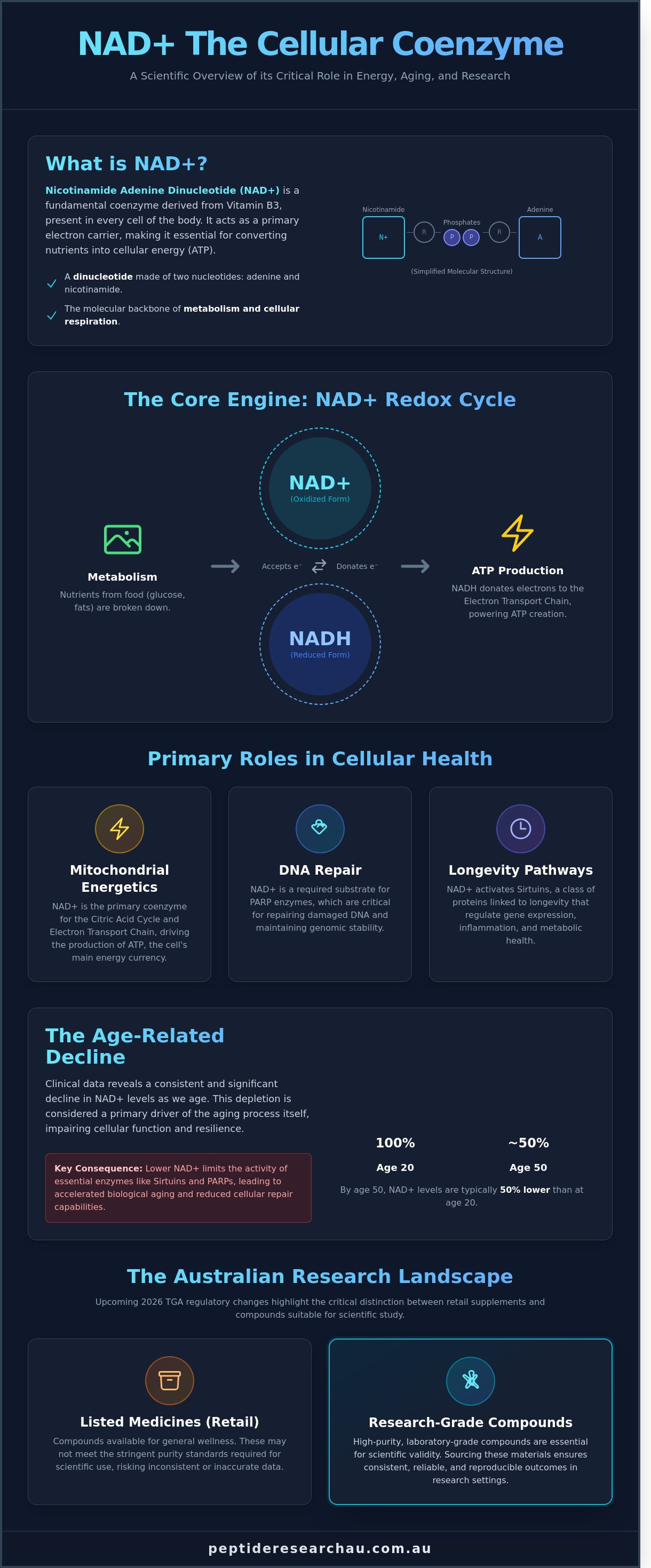
Every living cell requires Nicotinamide adenine dinucleotide to maintain basic biological functions. It's a fundamental coenzyme derived from Vitamin B3 that exists in every tissue of the human body. Scientists classify it as a dinucleotide because it's composed of two nucleotides joined through their phosphate groups. This compound doesn't just sit idly in the cytoplasm; it acts as a primary electron carrier in the process of cellular respiration. Without sufficient levels of this molecule, cells cannot convert nutrients into the chemical energy needed to survive. It's the molecular backbone of metabolism.
The primary role of NAD+ involves "Redox" reactions, which are shorthand for reduction-oxidation processes. These reactions are chemical transfers where one molecule loses electrons and another gains them. During the breakdown of glucose and fats, the oxidized form of the molecule (NAD+) accepts electrons and a proton from metabolic intermediates. This transformation turns it into its reduced form, NADH. This continuous cycling is essential for mitochondrial function. If this cycle breaks, the production of adenosine triphosphate (ATP) halts, leading to immediate cellular dysfunction. Research grade compounds are often used in laboratory settings to study how these cycles impact overall metabolic health.
Human NAD+ levels are not permanent. Clinical data shows a consistent decline in systemic concentrations as individuals age. By the time a person reaches age 50, their levels are typically 50% lower than they were at age 20. This equates to a steady 1% to 2% annual decrease in available coenzyme. This decline isn't merely a byproduct of ageing; it's a primary driver of the ageing process itself. Lower levels limit the activity of sirtuins, which are longevity-linked enzymes that depend on this coenzyme to repair damaged DNA and regulate gene expression. Australian researchers are currently investigating how maintaining these levels might influence biological markers of senescence.
The Molecular Structure of NAD+
The architecture of this compound is precise and functional. It consists of two nitrogenous bases: adenine, which is also found in DNA, and nicotinamide. These are linked by a pair of bridging phosphate groups and two ribose sugar rings. The nicotinamide ring is the active site of the molecule. It possesses the unique ability to accept and donate electrons without breaking its own structural integrity. This chemical flexibility allows it to shuttle high-energy electrons between different metabolic pathways like glycolysis and the electron transport chain. NAD+ is the central metabolic coenzyme required for energy transfer.
NAD+ vs. NADH: The Redox Couple
The relationship between the oxidized (NAD+) and reduced (NADH) forms is known as a redox couple. The ratio between these two states serves as a critical sensor for the cell's metabolic state. In a healthy, aerobic environment, the NAD+/NADH ratio in the cytoplasm stays near 700:1. This high ratio is necessary to drive the oxidation of nutrients. When this ratio becomes imbalanced, usually due to overnutrition or lack of physical activity, the cell's ability to manage oxidative stress diminishes. An accumulation of NADH relative to the oxidized form signals that the mitochondria are overwhelmed. This imbalance triggers the production of reactive oxygen species (ROS), which can damage laboratory grade cell cultures and living tissue alike. Maintaining a high ratio is a primary focus of current metabolic research.
The Mechanism of Action: How NAD+ Powers Research
Nicotinamide Adenine Dinucleotide acts as the primary electron carrier in cellular respiration. It functions by transitioning between its oxidized (NAD+) and reduced (NADH) states to drive the Electron Transport Chain (ETC) located in the inner mitochondrial membrane. This process creates a proton gradient that allows ATP synthase to produce chemical energy. Without a sufficient supply of this coenzyme, the production of ATP drops, leading to cellular dysfunction. Research indicates that a 50 percent reduction in these levels is often observed by age 50, which directly impacts the efficiency of the ETC. This decline compromises the cell's ability to maintain its membrane potential and respond to oxidative stress.
Metabolic efficiency depends on the constant availability of these molecules to facilitate redox reactions. When a cell experiences energy deficits, it's often a direct result of depleted co-factor pools. Scientific studies show that restoring these levels can improve mitochondrial respiration and increase the metabolic rate in various tissues. Researchers requiring high-purity materials for these studies can source laboratory grade compounds to ensure experimental consistency. Maintaining high metabolic flux is critical for cellular health; therefore, investigating the triggers of depletion remains a priority in modern biochemistry.
Mitochondrial Function and Energy Transfer
The Citric Acid Cycle, also known as the Krebs Cycle, requires specific co-factors to accept electrons during the breakdown of acetyl-CoA. This cycle is the engine of the cell, converting nutrients like glucose and fatty acids into usable fuel. If the co-factor supply is low, the cycle slows down, leading to a buildup of metabolic intermediates and reduced ATP output. This mechanism has significant implications for metabolic syndrome, where mitochondrial dysfunction is a hallmark. Current research into energy-related disorders focuses on how these biochemical pathways can be optimized to treat conditions characterized by chronic fatigue and insulin resistance. Data from 2021 clinical models suggests that increasing co-factor availability can boost ATP production by up to 20 percent in stressed cells.
Non-Redox Roles: NAD+ as a Signaling Molecule
Beyond its role in energy production, the molecule serves as a vital substrate for signaling enzymes like Sirtuins and Poly(ADP-ribose) polymerases (PARPs). Sirtuins (SIRT1-7) regulate gene expression and aging processes, while PARPs are essential for repairing damaged DNA. Unlike redox reactions where the molecule is recycled, these enzymes consume it entirely during the reaction. This creates an internal competition for resources between energy production and genomic stability. For instance, when PARP1 is heavily activated by DNA damage, it can cause an 80 percent depletion of the cellular pool within 15 to 30 minutes. This rapid loss often leads to cell death because the mitochondria can no longer produce ATP. Understanding NAD+ biosynthesis and therapeutic targets is necessary to decipher how cells balance these competing demands during periods of high physiological stress or environmental damage.
Primary Research Areas: Sirtuins, DNA Repair, and Longevity
Current molecular biology focuses heavily on how NAD+ dictates cellular lifespan through its interaction with sirtuins. These are a family of seven NAD+ dependent deacetylases that act as metabolic sensors. SIRT1, the most studied member, functions by linking nutrient availability to gene expression. When NAD+ levels are high, SIRT1 initiates pathways that mimic caloric restriction. Research published in 2013 by David Sinclair demonstrated that increasing these levels could reverse mitochondrial decay in mice. The study showed that 22 month old tissue could resemble 6 month old tissue after just seven days of treatment.
Sirtuins and Epigenetic Regulation
Sirtuins regulate the epigenetic landscape by removing acetyl groups from histones. This process is critical for maintaining genomic stability and silencing genes that cause cellular dysfunction. Scientific interest in NAD+ and sirtuins in aging highlights how SIRT1 promotes mitochondrial biogenesis via the activation of PGC-1α. Laboratory grade precursors are currently being evaluated in clinical trials for their ability to sustain these pathways. Data from 2021 trials indicate that 250 mg daily dosages can improve insulin sensitivity in specific demographic groups.
DNA Integrity and PARP Activation
The cell's ability to repair itself relies on Poly (ADP-ribose) polymerases, specifically PARP-1. This enzyme detects single strand DNA breaks and uses NAD+ to build polymer chains that recruit repair proteins. However, persistent genomic stress creates a biological conflict. High PARP-1 activity can consume up to 80 percent of a cell's NAD+ pool. This exhaustion leaves other vital enzymes, like sirtuins, without the fuel they need to function. Researchers in oncology are investigating how modulating this relationship might sensitise cancer cells to treatment while protecting healthy tissue from age-related instability.
Cellular senescence represents another major frontier in longevity science. As cells age, they enter a state of permanent growth arrest. These senescent cells develop a Senescence-Associated Secretory Phenotype (SASP), which involves the release of pro-inflammatory cytokines. Studies from the Mayo Clinic in 2018 suggest that maintaining NAD+ levels can mitigate the systemic inflammation caused by SASP. This is vital for managing chronic conditions that arise from "inflammaging," a term used to describe age-related chronic inflammation.
Neuroprotection remains a primary goal for research grade compounds in the Australian market. The brain's high metabolic demand makes it sensitive to NAD+ depletion. Evidence suggests that SIRT3, located in the mitochondria, protects against oxidative stress in neurons. By supporting mitochondrial health, researchers aim to address the mechanisms behind cognitive decline. Current Australian laboratory standards ensure that these compounds meet the 99 percent purity required for rigorous neurological study. High quality research materials allow scientists to observe how NAD+ restoration affects synaptic plasticity and microglial activation in various neurodegenerative models. The focus is on whether consistent levels can prevent the protein misfolding associated with cognitive impairment.
The 2026 Australian Regulatory Landscape for NAD+ Research
The Therapeutic Goods Administration (TGA) maintains a rigorous stance on the sale and distribution of cellular health compounds. As of January 2026, the regulatory framework remains complex for those seeking to study nicotinamide adenine dinucleotide. While international markets often permit these substances as dietary supplements, the Australian framework classifies them differently to ensure public safety and product efficacy. This creates a distinct separation between consumer-ready supplements and the high-purity materials required for laboratory settings.
Regulatory oversight focuses on the Australian Register of Therapeutic Goods (ARTG). For a compound to be sold as a "Listed Medicine" (AUST L), it must appear on the Permissible Ingredients list. Currently, the biological role of NAD+ continues to drive scientific interest, yet it hasn't secured a spot on this list for general oral supplementation. This exclusion is largely due to the TGA's requirement for extensive safety data and evidence of stable bioavailability in humans before broad public access is granted.
TGA 2026 Updates: NAD+, NADH, and NMN
Under the Therapeutic Goods (Permissible Ingredients) Determination No. 4 of 2025, the TGA has clarified the status of various precursors. Nicotinamide Mononucleotide (NMN) is a focal point of this update. Specifically, the TGA has acknowledged the SyncoZymes (Shanghai) Co. Ltd sponsorship, which provides a protected period for their specific NMN data until December 2027. This means other sponsors cannot rely on that data to list their own NMN products until the deadline passes.
Sponsors who bypass these rules face significant legal risks. Making NAD+ claims on labels for products not registered on the ARTG can result in fines exceeding A$13,000 for individuals and A$66,000 for corporations per infringement. The TGA monitors digital marketing and labelling strictly; it ensures that no therapeutic claims regarding "anti-ageing" or "cellular repair" are made without rigorous clinical backing and formal registration.
Sourcing for Research vs. Therapeutic Use
Research institutions and independent laboratories operate under a different set of guidelines. The legal pathway for acquiring these compounds involves sourcing "Research Grade" materials. These are chemicals intended solely for in vitro or animal-based studies. They aren't intended for human consumption and don't require an ARTG listing, provided they aren't marketed as medicines or supplements to the general public.
Compliance hinges on the "Not for Human Consumption" designation. When importing research chemicals into Australia, documentation must clearly state the intended laboratory use. Customs and Border Protection (CBP) and the TGA coordinate to ensure that bulk imports of research compounds aren't diverted into the illicit supplement market. Researchers must maintain clear records of their protocols to demonstrate that the substances are used within a controlled, scientific environment. This distinction protects the integrity of the research sector while upholding Australia's high standards for therapeutic safety.
To ensure your laboratory work meets these stringent standards, it's essential to source from providers who understand the Australian regulatory environment. You can access high-purity research compounds through our verified catalogue.
Sourcing High-Purity NAD+ for Laboratory Research
Achieving reproducible results in cellular biology depends entirely on the chemical integrity of the reagents used. For investigators studying metabolic pathways, sourcing 'Laboratory Grade' NAD+ is not a luxury; it's a fundamental requirement. Low-purity compounds often contain residual solvents, heavy metals, or degradation byproducts that interfere with enzymatic assays. These contaminants lead to skewed data and wasted resources. At Peptide Research AU, we recognize that the precision of your data is only as good as the purity of your starting material. We serve as a trusted partner for Australian researchers by providing compounds that meet rigorous analytical standards, ensuring that experimental variables remain controlled and outcomes remain valid.
Purity Standards and Quality Control
Research Grade NAD+ must meet a minimum threshold of 98% purity to ensure experimental validity. We verify these standards through High-Performance Liquid Chromatography (HPLC) and Mass Spectrometry (MS). These analytical methods confirm the molecular weight and identity of the compound while identifying trace impurities. Even a 2% variance in purity can introduce uncontrolled variables into a study. Contaminants in lower-grade products can inhibit sirtuin activation or alter redox ratios, which effectively masks the actual biological effects of the compound. By insisting on 98% or higher purity, researchers eliminate these risks and maintain the integrity of their scientific inquiries.
Handling and Reconstitution Protocols
NAD+ is highly sensitive to environmental stressors like light, heat, and moisture. It degrades rapidly when exposed to temperatures above 25°C or high humidity levels. In a professional laboratory setting, researchers should store lyophilized powders at -20°C for long-term stability. For short-term use, maintaining the compound at 2-8°C is acceptable. When it's time to prepare the solution, use laboratory-grade diluents such as bacteriostatic water. This prevents microbial growth and maintains the compound’s structural integrity during the study period. Always reconstitute gently; vigorous agitation can lead to mechanical degradation of the molecular structure. Proper cold-chain management from the supplier to the benchtop is essential for maintaining the compound's bioactivity.
Australian researchers face unique challenges regarding international logistics. Ordering from overseas often results in long transit times where temperature control is frequently compromised. Peptide Research AU solves this by providing domestic Australian shipping from our local facilities. This ensures that the compound arrives quickly, usually within 2 to 5 business days, minimizing environmental exposure. By choosing a local supplier, labs avoid the complexities of Australian Border Force inspections and the associated delays that can stall a project for weeks. Our streamlined domestic supply chain allows your team to maintain strict research timelines without the uncertainty of international freight.
Reliability in sourcing is the backbone of successful scientific exploration. We focus on providing meticulous quality control and efficient delivery to support the Australian scientific community. Whether you are conducting small-scale pilot studies or large-scale longitudinal trials, the quality of your reagents determines the credibility of your findings.
Advancing Australian Cellular Research in 2026
The trajectory of cellular energetics research into 2026 emphasizes the critical role of sirtuin activation and DNA repair mechanisms. Scientists across Australia are navigating a refined regulatory landscape that prioritizes the use of verified, high-purity compounds to ensure data integrity. Achieving reproducible results in longevity studies requires a consistent supply of NAD+ that meets 2026 laboratory standards. Peptide Research AU bridges this gap by providing purity-verified compounds with 100% domestic Australian shipping. We're specialists in research-grade materials, helping you avoid the 14-day delays often associated with international customs. By sourcing your materials from an Australian-based provider, you ensure your 2026 projects remain on schedule and compliant with local guidelines. It's essential to maintain these high standards to contribute meaningful data to the global scientific community. We look forward to supporting your next breakthrough in metabolic science.
Frequently Asked Questions
Is NAD+ legal to buy in Australia for research purposes in 2026?
Yes, NAD+ is legal to purchase for laboratory research purposes in Australia in 2026. These compounds fall under specific TGA exemptions when they aren't intended for human therapeutic use. Researchers must ensure they source from reputable suppliers to maintain compliance with the Therapeutic Goods Act 1989. This classification allows scientific institutions to conduct in vitro and in vivo studies without the clinical trial requirements of Schedule 4 substances.
What is the difference between NAD+ and NMN in research?
NAD+ is the final coenzyme used by cells, while Nicotinamide Mononucleotide (NMN) acts as a direct precursor. In a 2023 comparative study, researchers observed that NMN often requires conversion by the Slc12a8 transporter before entering certain cell types. NAD+ research focuses on direct cellular availability and mitochondrial function. Many investigators choose this compound for studies requiring immediate coenzyme presence in extracellular environments or specific enzymatic assays.
Can NAD+ be used in listed medicines in Australia?
NAD+ isn't currently permitted as an active ingredient in listed medicines on the Australian Register of Therapeutic Goods (ARTG). The TGA's Permissible Ingredients Determination 2024 excludes it from self-listed complementary medicines. Manufacturers instead use precursors like Nicotinamide or Nicotinic Acid. This distinction makes high-purity NAD+ compounds essential for laboratory settings where researchers require the specific coenzyme rather than its vitamin B3 derivatives.
How should NAD+ research compounds be stored to prevent degradation?
NAD+ research compounds require storage at -20°C or -80°C to maintain a purity level above 98%. Exposure to temperatures above 25°C for more than 48 hours leads to significant hydrolytic degradation. Researchers should use airtight, light-protected containers to prevent oxidation. Lyophilized powders are more stable than liquid solutions; however, once reconstituted in sterile water, the compound should be used within 24 hours or aliquoted and frozen immediately.
What are sirtuins and why do they require NAD+?
Sirtuins are a family of seven signaling proteins (SIRT1-7) that regulate cellular health and longevity. They function as NAD+-dependent deacetylases, which means they require the NAD+ molecule as a co-substrate to remove acetyl groups from proteins. Without sufficient coenzyme levels, sirtuin activity drops by as much as 50% in aging tissues. This dependency makes the compound a critical focus for research into metabolic regulation and DNA repair mechanisms.
Why is the NAD+/NADH ratio important in metabolic studies?
The NAD+/NADH ratio serves as a primary indicator of a cell's redox state and metabolic efficiency. A healthy ratio in mammalian cells typically sits around 700:1, favoring the oxidized form. When this balance shifts, it signals disruptions in the electron transport chain or glycolysis. Measuring this specific ratio allows scientists to quantify the impact of metabolic stressors or potential interventions on mitochondrial performance during controlled laboratory experiments.
What does 'Research Grade' mean for NAD+ compounds?
Research Grade signifies that a compound has reached a minimum purity threshold of 98% as verified by High-Performance Liquid Chromatography (HPLC). This standard ensures that experimental results aren't skewed by contaminants or manufacturing byproducts. These chemicals are strictly for laboratory use and aren't manufactured under Good Manufacturing Practice (GMP) standards required for human consumption. Peptide Research AU provides these laboratory grade compounds to ensure data accuracy and experimental reproducibility.
Does the TGA regulate research-only peptides and compounds?
The TGA doesn't regulate chemicals that aren't intended for therapeutic use, though they monitor the boundary between research and clinical applications. Under the Therapeutic Goods Act 1989, substances sold exclusively for scientific research are exempt from ARTG registration. However, suppliers must clearly label these products "For Research Purposes Only." This legal framework ensures that Australian laboratories can access necessary compounds like NAD+ while maintaining strict separation from the consumer supplement market.
Comments