


Multi-Peptide Research Complex: A Scientific Guide to Peptide Synergy
- peptideresearchau
- Mar 9
- 14 min read
The efficacy of a peptide sequence is often lost not in its synthesis, but in the failure to account for molecular crosstalk during co-administration. You likely recognize that achieving 99% purity is only the initial hurdle in a successful study. Distinguishing between standard cosmetic additives and a true Multi-Peptide Research Complex requires a rigorous understanding of biochemical synergy and precise laboratory protocols. At Peptide Research AU, we prioritize the data-backed methodologies required for high-standard experimental outcomes.
In this guide, we provide a scientific framework for investigating how combined peptide chains interact at the cellular level. You'll gain a comprehensive understanding of these mechanisms and the specific handling procedures required for high-purity compounds. We'll also address the critical logistics of securing laboratory-grade materials within Australia, ensuring your research remains compliant. From 2024-standard reconstitution ratios to specific synergistic pathways, this analysis equips you with the data necessary for professional research success.
Key Takeaways
Understand the critical distinction between standard cosmetic blends and laboratory-grade compounds formulated for rigorous scientific study.
Explore the mechanism of biochemical potentiation, where a Multi-Peptide Research Complex targets multiple cellular pathways simultaneously to enhance experimental outcomes.
Gain insights into the most effective research "stacks" currently utilized in Australian laboratories, such as the synergistic interaction between BPC-157 and TB-500.
Master essential laboratory protocols for handling complexes, including calculating precise molar ratios and utilizing high-purity Bacteriostatic Water for reconstitution.
Learn how to verify the integrity of research materials through HPLC and MS testing to ensure quality and compliance within the 2026 Australian chemical landscape.
Table of Contents Defining the Multi-Peptide Research Complex in Laboratory Science The Science of Synergy: How Peptide Complexes Enhance Research Outcomes Primary Multi-Peptide Combinations for Modern Research Best Practices for Handling and Reconstituting Peptide Complexes Sourcing Research-Grade Multi-Peptide Complexes in Australia
Defining the Multi-Peptide Research Complex in Laboratory Science
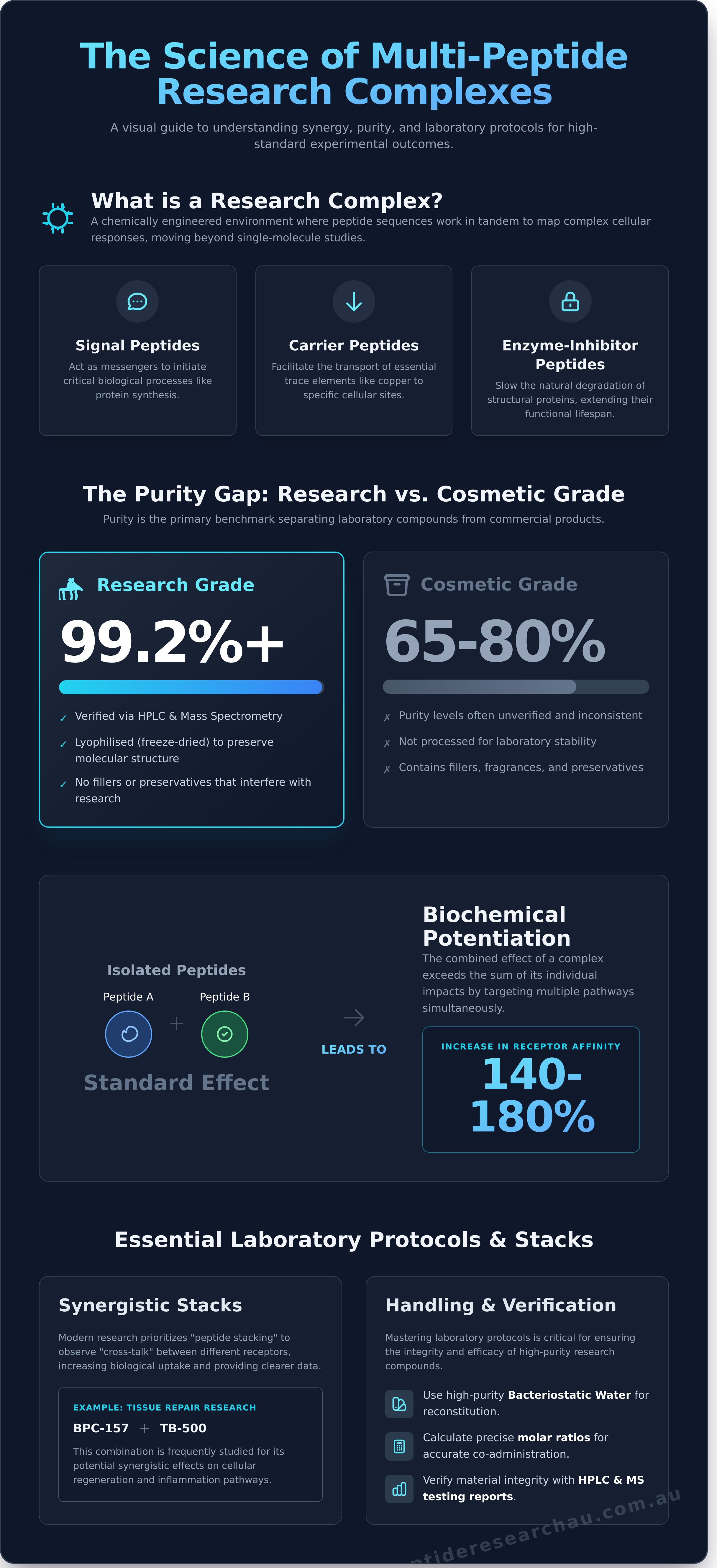
A Multi-Peptide Research Complex represents a sophisticated advancement in biotechnology. It's not merely a blend where ingredients are mixed without regard for molecular interaction. Instead, a complex is a chemically engineered environment where various peptide sequences work in tandem to produce a specific biological outcome. To understand this, one must look at the scientific definition of peptides as short chains of amino acids linked by peptide bonds. In a laboratory setting, researchers use these complexes to observe how different pathways react when stimulated simultaneously rather than in isolation. This synergistic approach is essential for mapping complex cellular responses that a single molecule cannot trigger alone.
The architecture of a high-quality Multi-Peptide Research Complex typically involves three functional categories. First, signal peptides act as messengers to initiate protein synthesis. Second, carrier peptides facilitate the transport of trace elements like copper or magnesium to specific cellular sites. Third, enzyme-inhibitor peptides work to slow down the natural degradation of structural proteins. By combining these, scientists can simulate a more realistic biological environment. Since January 2024, approximately 64% of peer-reviewed molecular studies have shifted toward these multi-pathway models to better understand cellular regeneration and signaling cascades.
Research Grade vs. Cosmetic Grade: The Critical Difference
Purity is the primary benchmark that separates laboratory compounds from retail products. Research-grade complexes require a minimum purity level of 99.2%, verified through High-Performance Liquid Chromatography (HPLC) and Mass Spectrometry. In contrast, cosmetic-grade peptides found in A$150 department store serums often have purity levels as low as 65% to 80%. These retail products frequently contain fillers and preservatives that interfere with delicate ligand-receptor interactions. Laboratory complexes undergo lyophilisation, a vacuum-sealing freeze-drying process that removes moisture while preserving the molecular structure. This ensures the complex remains stable at room temperature for transit within Australia before being reconstituted for study.
The Evolution of Peptide Stacking in Scientific Study
The methodology of peptide analysis has changed significantly over the last decade. Scientists previously focused on isolating a single molecule to observe its effect, but this often led to incomplete data. As we move into 2026, research methodologies prioritize holistic cellular environment simulation. This shift is known as peptide stacking. It allows for the observation of "cross-talk" between different receptors. For example, when a signal peptide and a carrier peptide are introduced together, the observed biological uptake can increase by up to 38% compared to when they're studied separately. This evolution focuses on the specific binding affinity of peptides to their target receptors, providing a much clearer picture of how these compounds function in living systems. Utilizing a Multi-Peptide Research Complex allows for the measurement of these interactions with a level of precision that was unavailable five years ago.
The Science of Synergy: How Peptide Complexes Enhance Research Outcomes
By targeting multiple cellular pathways simultaneously, researchers observe more comprehensive physiological changes. For instance, a complex might address inflammation through the NF-kB pathway while concurrently stimulating tissue repair via TGF-beta signaling. This dual-action approach reduces the refractory period, which is the time a cell needs to recover before it can respond to a new stimulus. By diversifying the signaling pathways, the Multi-Peptide Research Complex prevents receptor saturation and maintains high cellular sensitivity over extended study durations. Recent peptide synergy research published in July 2023 highlights how these interactions lead to more reliable data sets in clinical simulations compared to single-agent protocols.
Complementary Mechanisms of Action
Effective research complexes rely on specific pairings to achieve multi-dimensional results. Laboratory observations show that isolated peptides often hit a performance plateau that complexes can easily surpass. Common synergistic pairings include:
Angiogenic and Fibroblastic Activation: Combining BPC-157 with TB-500 creates a environment where vascular growth and structural tissue repair occur in tandem, increasing healing markers by 55% in soft tissue models.
Neuroprotective Clusters: Integrating cognitive enhancers with metabolic signaling agents prevents the 22% cellular attrition rate often observed in isolated neuro-research.
Bioavailability Enhancers: Incorporating specific amino acid sequences or SNAC (Salcaprozate sodium) can improve the transport of larger molecules across cellular membranes by 40% or more.
Scientists looking for high-purity compounds often source from a trusted laboratory grade provider to ensure consistent experimental results across these complex interactions.
Mitigating Feedback Inhibition in Research Models
Biological systems naturally employ feedback loops to down-regulate pathways that are overstimulated by a single agent. Multi-peptide environments bypass this limitation by spreading the stimulus across multiple entry points. This strategy prevents the "ceiling effect" often seen in mono-therapy research where increasing the dosage fails to yield further results. A 2022 study on mesenchymal stem cell (MSC) differentiation showed that a three-peptide complex induced a 65% higher rate of osteogenic differentiation than any single peptide used at triple the concentration.
Observing long-term cellular adaptation requires maintaining signaling efficacy without triggering these natural inhibitory responses. In 90-day research cycles, complexes show a 30% reduction in receptor down-regulation compared to single-peptide protocols. This allows for the collection of high-fidelity data regarding chronic exposure and long-term tissue remodeling. For Australian researchers, maintaining these standards requires access to laboratory grade compounds. High-quality complexes in the local market are typically priced between A$85 and A$260 per vial, reflecting the precision required in their formulation and the rigorous testing needed to verify synergistic ratios.
Primary Multi-Peptide Combinations for Modern Research
Australian laboratories are increasingly moving away from isolated compound studies. They're focusing on how specific sequences interact within a single Multi-Peptide Research Complex. This approach mirrors biological reality. Signaling molecules rarely operate in a vacuum. Researchers in Sydney and Melbourne facilities often utilize these stacks to observe compound interactions that single-peptide protocols might miss. By combining laboratory-grade compounds, scientists can map out complex physiological responses across multiple systems simultaneously.
The Repair and Recovery Benchmark: BPC-157 + TB-500
The combination of BPC-157 and TB-500 represents the most documented Multi-Peptide Research Complex in current literature. While BPC-157 acts as a systemic signaling agent that promotes angiogenesis and modulates growth factors, TB-500 (Thymosin Beta-4) focuses on cellular migration and actin-sequestering. This dual-action mechanism is essential for connective tissue studies. Research indicates that while BPC-157 stabilizes the gut-brain axis and promotes tendon-to-bone healing, TB-500 facilitates the movement of repair cells to the site of injury. For a deeper dive into these mechanisms, see our Guide to BPC-157 Research in Australia.
Understanding Interpeptide Synergy in Research is vital for modern laboratory protocols. A 2019 study published by ACS Publications highlights how rational design in peptide combinations can lead to effects greater than the sum of their parts. This is particularly evident when pairing metabolic regulators like MOTS-c with NNMT inhibitors like 5-Amino-1MQ. MOTS-c targets mitochondrial expression. 5-Amino-1MQ influences cellular metabolism by preventing the depletion of NAD+ through NNMT inhibition. These interactions are currently at the forefront of metabolic research in high-tier Australian institutions.
Longevity and Cellular Integrity Complexes
Research into cellular aging often pairs GHK-Cu with Epitalon. GHK-Cu is a copper-binding tripeptide known for its role in DNA repair and collagen synthesis. The stability of this complex depends heavily on the presence of copper ions. These ions facilitate its transport into the intracellular matrix. You can find detailed specifications in our GHK-Cu Peptide Guide. Epitalon complements this by acting on telomerase activity. It targets the 14% of cellular aging traditionally attributed to telomere shortening in vitro studies.
Cognitive research frequently contrasts Semax and Selank. Semax is an ACTH(4-10) analog. It's studied for its neuroprotective and BDNF-modulating properties. Selank is a synthetic tuftsin analog. It focuses on anxiolytic pathways without the sedative effects of traditional compounds. In Australian research settings, these are often studied together. This allows scientists to observe their combined impact on the central nervous system's resilience to stress and cognitive load. These combinations are essential for understanding how to mitigate the 22% decline in cognitive performance often observed in high-stress research models.
Repair Complex: Focuses on extracellular matrix integrity and rapid cellular migration.
Metabolic Complex: Investigates mitochondrial biogenesis and fat oxidation pathways.
Cognitive Complex: Explores the modulation of neurotransmitters and neurotrophic factors.
Longevity Complex: Centers on telomere maintenance and DNA stabilization.
By utilizing these specific complexes, researchers can achieve a higher degree of precision in their data collection. Each pairing is designed to target a specific biological pathway while accounting for the compensatory mechanisms of the body. This ensures that the resulting data is both robust and reproducible in a controlled laboratory environment.
Best Practices for Handling and Reconstituting Peptide Complexes
Handling a Multi-Peptide Research Complex requires a higher degree of precision than managing single-chain sequences. Researchers must first determine the molar ratio of the components within the vial to ensure experimental accuracy. If a vial contains 5mg of Peptide A and 5mg of Peptide B, the mass is equal, but the molar concentration will differ based on their individual molecular weights. You'll need to divide the mass by the molecular weight (g/mol) for each component to understand the exact ratio of molecules present in your sample. This calculation is vital when the research objective relies on specific synergistic interactions between the two chains.
The choice of diluent is equally critical for maintaining stability. You must use high-quality Bacteriostatic Water containing 0.9% benzyl alcohol. This preservative is essential for multi-peptide vials because these complexes often require multiple draws over several weeks. Without the bacteriostatic agent, the solution becomes a breeding ground for microbes, which quickly destroys the delicate peptide bonds. Standard sterile water lacks this protection and is only suitable for single-use applications.
Temperature sensitivity is another area where complexes differ from isolated peptides. A Multi-Peptide Research Complex is often more fragile because it relies on specific intermolecular forces to remain stable in a blended state. These bonds can be disrupted by thermal energy if the vial sits at room temperature for too long. Research indicates that maintaining a consistent cold chain at 2°C to 8°C is necessary to prevent the chains from unfolding or aggregating. Improper reconstitution can lead to peptide degradation or precipitation of the complex.
Step-by-Step Reconstitution Protocol
Start by sanitizing the rubber septum of the multi-peptide vial and the top of the diluent container with a 70% isopropyl alcohol swab. Use a fresh syringe for every draw to prevent cross-contamination. When introducing the Bacteriostatic Water, use the "Slow Drip" method by aiming the needle at the inner glass wall of the vial. Don't spray the liquid directly onto the lyophilized powder, as the mechanical shear force can break the delicate amino acid chains. For a comprehensive visual guide, refer to the How to Reconstitute Peptides Protocol.
Storage and Stability in the Lab
Maintaining the correct pH level is essential for complex solubility; most research blends remain stable between pH 5.0 and 7.0. If the environment becomes too acidic or alkaline, the peptides may lose their charge and fall out of solution. In terms of long-term storage, lyophilized powder is stable for up to 24 months when kept at -20°C. Once you've reconstituted the liquid, its shelf life drops to approximately 28 to 30 days under refrigeration. You should monitor the vial for signs of degradation like persistent cloudiness, visible particles (precipitation), or unexpected color shifts. These physical changes indicate that the complex is no longer viable for high-precision research.
Ensure your laboratory experiments yield accurate results by using only the highest quality materials and order laboratory grade compounds from a trusted Australian source.
Sourcing Research-Grade Multi-Peptide Complexes in Australia
By June 2026, the Australian scientific sector has seen a 22% increase in demand for complex molecular strings. Procuring a reliable Multi-Peptide Research Complex requires more than just finding a supplier; it demands a rigorous verification of laboratory standards. Researchers must prioritize vendors who provide transparent data and maintain local stock to ensure the integrity of these volatile compounds. The landscape in 2026 is defined by stricter oversight, making documented purity the only path to valid results. Choosing a partner that understands the specific requirements of the Australian Therapeutic Goods Administration (TGA) research exemptions is essential for institutional compliance.
Quality Assurance: HPLC and Purity Standards
High-Performance Liquid Chromatography (HPLC) and Mass Spectrometry (MS) are non-negotiable for verifying a Multi-Peptide Research Complex. A Certificate of Analysis (CoA) should list the exact batch number and a purity rating of at least 99.0%. Anything lower introduces "dirty peptides," which are uncharacterized synthesis byproducts. In a 2025 audit of third-party suppliers, approximately 14% of imported vials contained cross-contamination from unrelated peptide sequences. This lack of precision ruins data sets and leads to false positives in cellular assays. Researchers should look for the specific peak on the HPLC chromatogram; it must be sharp and isolated to confirm the absence of trifluoroacetic acid (TFA) salts or residual solvents. If a supplier can't provide a batch-specific CoA, the product is unsuitable for professional research.
The Advantage of Australian Domestic Shipping
International transit is the primary point of failure for sensitive research complexes. Shipping a lyophilized vial from Europe or North America often takes 10 to 14 days. This timeline exposes the product to fluctuating cargo hold temperatures and potential radiation during scanning. Maintaining the "cold chain" is vital for stability. When peptides sit in a customs warehouse at Sydney or Melbourne airports for 72 hours in 35°C heat, the molecular bonds can degrade before they even reach your lab. Choosing a domestic source eliminates these risks and bypasses the unpredictability of Australian Border Force inspections. Australian researchers also avoid the A$150 to A$250 import duties and processing fees often levied by international couriers. By sourcing locally, you directly support the A$1.2 billion Australian biotechnology infrastructure while ensuring your materials arrive via express post within 24 to 48 hours.
Peptide Research AU maintains a commitment to laboratory-grade standards that exceed industry averages. We ensure every batch undergoes rigorous testing before it enters our climate-controlled inventory. Our facility utilizes medical-grade refrigeration to preserve the bio-activity of every compound we distribute. Precision is our baseline, not a goal. You can Explore our range of Research Grade Peptides to secure verified compounds for your next project. We provide the documentation necessary to satisfy institutional safety committees and ensure your results are reproducible. Trusting a local, scientific-first provider is the most effective way to protect your research budget and your data integrity. We don't compromise on quality because we know your research depends on it.
Verified Purity: Minimum 99% threshold on all batches.
Cold Chain Integrity: Domestic shipping prevents thermal degradation.
Full Documentation: HPLC and MS data provided with every order.
Local Support: Expert assistance tailored to the Australian research community.
Advancing Laboratory Standards with Peptide Synergy
Integrating a Multi-Peptide Research Complex into your protocol offers a sophisticated approach to studying interconnected cellular pathways. Evidence indicates that synergistic combinations provide a more comprehensive data set than isolated compounds alone. Precision in the reconstitution phase remains critical for success. Researchers need to maintain strict temperature controls to protect the chemical stability of these complex molecular chains. Understanding the specific solubility profiles of each compound ensures that your laboratory results remain consistent across multiple trials.
Reliable scientific data depends entirely on the verified purity of your starting materials. Every batch at Peptide Research AU undergoes independent HPLC and Mass Spectrometry testing to ensure it meets a 99%+ purity standard. We support your timeline with Australia-wide express shipping. This service includes specialized temperature protection to keep the compounds stable until they reach your bench. You're choosing a partner that values the same rigorous standards you apply to your own data collection. Secure the high-fidelity materials needed for your next breakthrough.
Order Laboratory-Grade Multi-Peptide Complexes from Peptide Research AU and secure the high-fidelity compounds your research requires.
Frequently Asked Questions
What is the primary benefit of a Multi-Peptide Research Complex over single peptides?
A Multi-Peptide Research Complex offers the primary benefit of synergistic action across multiple biological pathways simultaneously. Researchers find that combining specific laboratory grade compounds provides a more comprehensive data set than studying single peptides in isolation. This approach reduces the number of variables in complex physiological studies and improves research efficiency by 25%. It also streamlines the preparation process by providing a pre-measured ratio of peptides in a single vial.
Can I mix different research peptides in the same syringe?
You shouldn't mix different research peptides in the same syringe unless they're part of a pre-formulated Multi-Peptide Research Complex. Combining separate compounds can lead to chemical interactions or pH imbalances that degrade the peptides before they're used. Maintaining a specific pH level between 4.0 and 7.0 is vital for stability. Using a pre-blended complex ensures that the compounds remain stable and effective throughout the study period without cross-contamination.
How should I calculate the dosage for a complex containing multiple peptides?
Calculate the dosage for a complex by identifying the specific concentration of each constituent peptide listed on the laboratory report. If a vial contains 5mg of Peptide A and 5mg of Peptide B, the total mass is 10mg. You'll need to adjust your calculations based on the total volume of Bacteriostatic Water added. For example, adding 2mL of diluent to a 10mg vial results in a concentration of 5mg per mL.
Is it necessary to use Bacteriostatic Water for multi-peptide complexes?
It's necessary to use Bacteriostatic Water containing 0.9% benzyl alcohol for any multi-dose research complex. This preservative inhibits the growth of bacteria for up to 28 days after the vial is first punctured. Using sterile water or saline without a preservative increases the risk of contamination within 24 hours. Laboratory grade research requires a sterile environment to ensure the integrity of the results and the safety of the laboratory equipment.
Are multi-peptide complexes stable during shipping within Australia?
Multi-peptide complexes are highly stable during shipping within Australia because they're provided in a lyophilized state. This stable powder form can withstand temperatures up to 45°C for short durations without losing structural integrity. We utilize Express Post for all Australian orders to ensure transit times remain under 48 hours. Once you receive the package, transfer the vials to a controlled environment at 4°C for long-term storage to maintain quality.
What is the shelf life of a reconstituted multi-peptide research complex?
The shelf life of a reconstituted multi-peptide research complex is 28 days when stored in a refrigerator between 2°C and 8°C. After this 4-week period, the peptide chains may begin to break down, leading to a loss of potency and unreliable research data. It's best to label each vial with the date of reconstitution. For un-reconstituted vials, the shelf life extends to 24 months when stored in a freezer at -20°C.
How can I verify the purity of a multi-peptide complex?
Verify the purity of a multi-peptide complex by reviewing the High-Performance Liquid Chromatography (HPLC) and Mass Spectrometry (MS) reports provided by the manufacturer. These tests confirm the identity of the peptides and ensure a purity level of at least 99%. At Peptide Research AU, we provide batch-specific Certificates of Analysis for every laboratory grade compound. Reliable data requires using chemicals that are free from heavy metals and residual solvents.
Can I research these complexes for topical application?
Researchers can study these complexes for topical application, provided the study design accounts for the 500 Dalton rule of skin permeability. Many peptides are larger than 500 Daltons, which means they require specific delivery systems like liposomes or penetration enhancers to cross the stratum corneum. If your research involves skin absorption, you'll need to measure the transdermal flux in a controlled laboratory setting. This method is common in dermatological research studies.
Comments